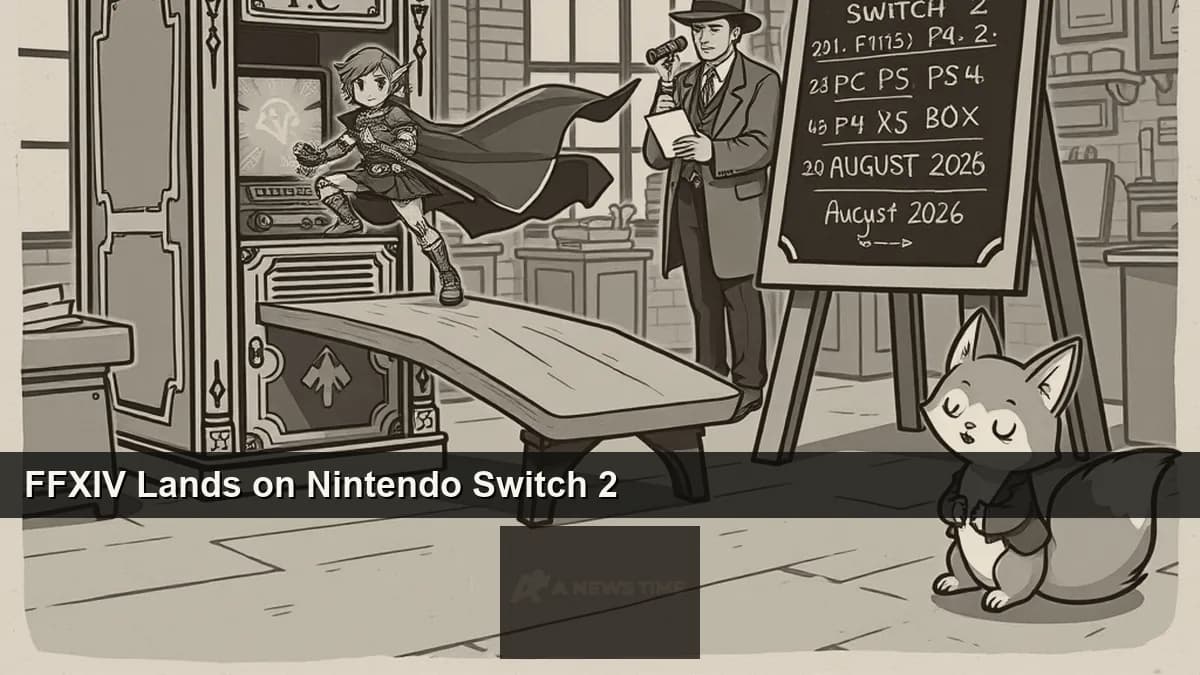
Square Enix confirmed in an investor and community update this week that Final Fantasy XIV will launch on the Nintendo Switch 2 in , ending more than a decade of Nintendo platform absence for one of the most successful subscription MMORPGs in the medium's history. The announcement, first reported by Netto's Game Room, marks the first time FFXIV has been formally committed to a Nintendo platform since the game launched in its current "A Realm Reborn" form in 2013. The version landing on Switch 2 will support cross-play with the existing PlayStation, Xbox, and PC populations, according to early developer messaging.
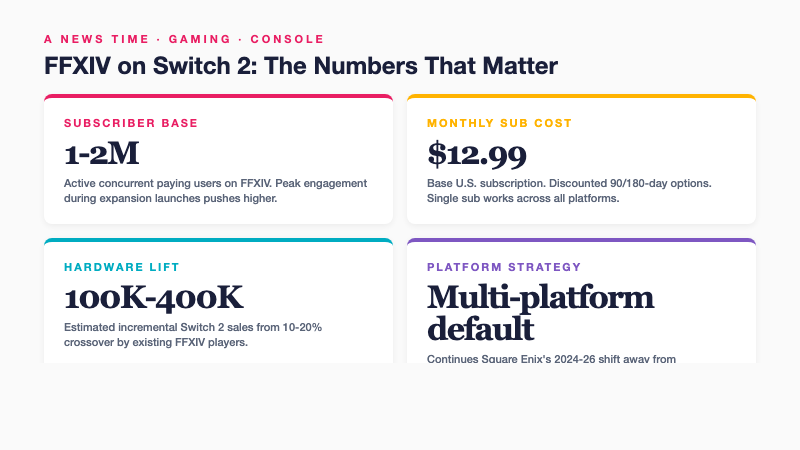
For Square Enix, the move is less surprising in 2026 than it would have been a year ago. The publisher has been visibly recalibrating its platform strategy since 2024, when chief executive Takashi Kiryu publicly committed to a multi-platform default for major releases. Final Fantasy XVI moved to PC and Xbox after a year of PlayStation exclusivity. Final Fantasy VII Rebirth shipped on PC ahead of its console exclusivity expiration window. The FFXIV Switch 2 announcement is a continuation of that strategy, applied to the studio's most consistently profitable single product.
Why Switch 2 Can Plausibly Run This
The Nintendo Switch 2 is the first Nintendo handheld with the raw graphical horsepower to plausibly run a live-service MMORPG of FFXIV's scale at acceptable performance. The custom Nvidia silicon that ships in the system, paired with DLSS upscaling and the platform's improved memory bandwidth over the original Switch, brings the device into the same general performance class as the PlayStation 4 Pro at handheld and approaching base PlayStation 5 levels in docked mode. FFXIV's baseline visual target has always been calibrated to ship across multiple console generations simultaneously, which is exactly the kind of engineering posture that makes a Switch 2 port technically feasible.
That said, three technical questions are still open. The first is whether the Switch 2 version will run at the same 60-frames-per-second target the current console releases hit, or whether it will ship at 30 frames per second to preserve battery life and thermal headroom in handheld mode. The second is how the user interface, designed primarily for mouse-and-keyboard or DualSense controller input, translates to Joy-Con controls. The third is whether the data streaming required to load high-density open-world zones holds up on the Switch 2's storage architecture under multi-player conditions.
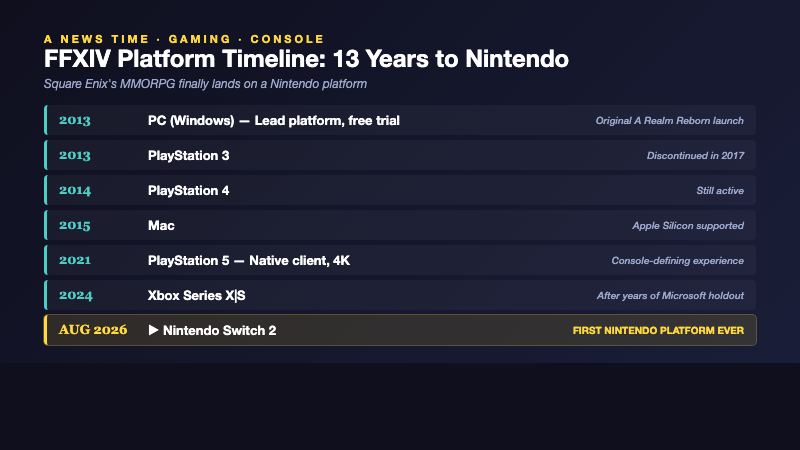
| Platform | Initial release | Notes |
|---|---|---|
| PC (Windows) | 2013 | Lead platform, free trial through level 70 |
| PlayStation 3 | 2013 | Discontinued in 2017 |
| PlayStation 4 | 2014 | Still active |
| PlayStation 5 | 2021 | Native client, 4K support |
| Xbox Series X|S | 2024 | Earlier Microsoft holdout, finally launched |
| Mac | 2015 | Active, Apple Silicon supported |
| Nintendo Switch 2 | August 2026 (announced) | First Nintendo platform release |
What This Does to Switch 2 Sales
The Switch 2 has continued to outpace Nintendo's own forecasts since launch. The platform reached strong adoption numbers in its first 12 months, with momentum that has run through the spring 2026 software calendar. Adding FFXIV to the platform brings a recurring-subscription audience that has historically not had any reason to consider a Nintendo platform purchase. The crossover potential is meaningful.
FFXIV's active subscriber base has consistently been reported in the range of 1 to 2 million concurrent paying users, with peak engagement during expansion launches pushing well past those figures. Even a 10 to 20 percent crossover into Switch 2 hardware purchases from existing FFXIV players who do not currently own a Nintendo platform represents 100,000 to 400,000 incremental Switch 2 sales over the next 12 months, plus the recurring subscription revenue Square Enix collects on every active account regardless of platform.
The deeper consequence is reputational. Nintendo has historically been a difficult fit for live-service games requiring stable online infrastructure, frequent patching, and substantial storage. The original Switch's online services and storage limitations made the platform a non-starter for most major MMOs. The Switch 2, with its improved cloud save infrastructure, faster eShop downloads, and larger built-in storage, is signaling that the live-service category is now legitimately served on Nintendo hardware. That shifts the conversation for other major MMOs and live-service games that have historically skipped Nintendo platforms.
Square Enix's Bigger Strategic Picture
The FFXIV announcement should be read against Square Enix's broader 2025-2026 platform realignment. The company has spent the last 18 months publicly distancing itself from the long-running pattern of PlayStation exclusivity for its biggest single-player Final Fantasy entries. Final Fantasy XVI has shipped on PC and is now confirmed for Xbox Series X|S. Final Fantasy VII Rebirth launched on PC earlier than the original timing window suggested. The next mainline Final Fantasy title in development, currently rumored to be in late pre-production, is expected to ship simultaneously across PC, PlayStation 5, and Xbox Series X|S without the prior exclusivity window.
That strategic shift reflects the math Kiryu and the Square Enix board have been forced to confront. A Final Fantasy mainline title costs upward of $200 million in production and marketing in 2026. Recouping that investment from a single platform's audience has become harder as PC and Xbox install bases have grown and as the comparable AAA single-player market has tightened. Day-and-date multiplatform launches expand the addressable audience by 50 to 80 percent depending on the title, which restructures the financial math behind every major Square Enix release.
Adding FFXIV to the Switch 2 is the live-service complement to that strategy. Square Enix's most consistently profitable single product, by a wide margin, will now be available on every major current-generation platform with the exception of mobile. That breadth is what subscription MMO economics have always wanted, and Square Enix is finally executing it with the platform partners willing to host live-service infrastructure at the scale FFXIV requires.
What Players Should Expect
For existing FFXIV players who have been waiting for a portable native option, the Switch 2 launch is the most consequential platform addition since the PlayStation 5 native client in 2021. Cross-play and cross-save support means a player could pick up a quest line on PlayStation 5 in the morning, continue it on a Switch 2 in handheld mode at lunch, and finish it on PC at night, with their character progression seamless across all three. That kind of seamless platform mobility has been one of the longest-standing requests on the FFXIV community wishlist, and the Switch 2 launch is what makes it operationally real.
For new players curious whether to try the game on the new platform, the Switch 2 launch will likely include the standard FFXIV free trial, which extends through the level 70 mark and includes the Heavensward expansion content at no cost. That free trial has historically been one of the most aggressive in the MMO space, and the Switch 2 launch marketing will likely lean on it heavily to convert new platform owners into FFXIV subscribers.
The Open Questions for August
Three things remain to be confirmed between now and the August launch window. The first is the specific frame rate and graphical fidelity targets for both handheld and docked Switch 2 modes. Square Enix typically shares those details closer to release, and the comparison to PlayStation 4 and Xbox Series X|S baselines will matter for performance-focused players. The second is whether the Switch 2 version will support all current expansions and seasonal content at launch, or whether some of the most graphically demanding raid encounters will be content-gated initially. The third is whether the Switch 2 launch will coincide with any other major Square Enix platform announcements, including the long-rumored FFXIV spinoff title that has been quietly in development for the past three years.
The bigger question, beyond FFXIV itself, is what other major live-service games follow it onto the Switch 2 in the next 12 to 18 months. Once the platform demonstrates it can host an MMO of FFXIV's scale, the technical case against bringing other major live-service titles to Nintendo hardware weakens considerably. Whether that next wave actually materializes is the gaming-industry story to watch as the Switch 2's second year of releases takes shape.
The Subscription Economics Worth Understanding
For readers less familiar with how MMORPG economics work in 2026, the FFXIV subscription model is one of the most stable revenue streams in gaming. The base monthly subscription runs $12.99 in the United States, with reduced rates available for limited-character entry-level subscriptions and discounted pricing for 90-day and 180-day prepaid options. The numerical scale of the FFXIV business is what gives Square Enix the operational confidence to invest in expansive expansions, regular content patches, and platform expansions like the Switch 2 launch.
Each major expansion, released roughly every two years, costs about $39.99 at launch and significantly drives subscriber reactivation. The most recent expansion cycle has continued the pattern of producing meaningful subscriber growth around expansion launch windows, with sustained engagement across the months following each release. The Switch 2 launch is timed to roughly coincide with the next major content update, which gives Square Enix a strategic moment to convert curious new platform owners into subscribers during a period of elevated game activity.
The cross-platform subscription mechanics matter for players who own multiple devices. A single FFXIV subscription works across all platforms tied to the same account, which means a player buying the Switch 2 version primarily for portable play does not need to maintain separate subscriptions for their PC or PlayStation play sessions. That seamless multi-platform subscription has been one of the most player-friendly aspects of the FFXIV business model since its current incarnation launched in 2013, and the Switch 2 addition extends it without complication.