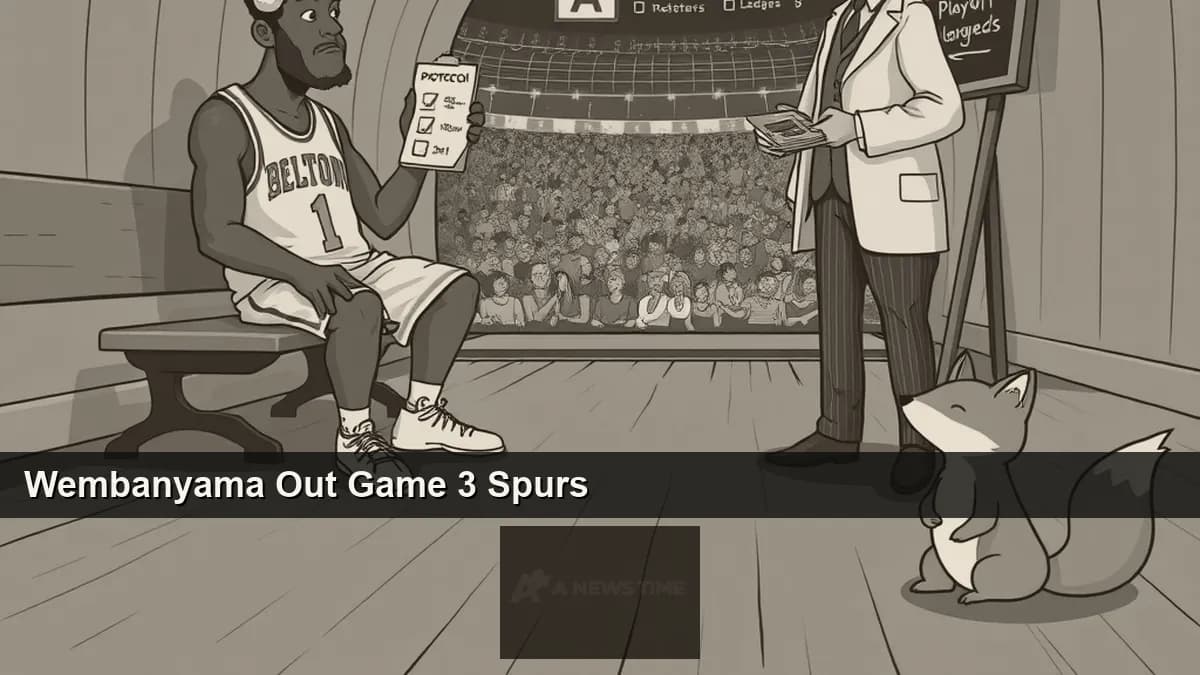
Victor Wembanyama will not suit up for the San Antonio Spurs in Game 3 of their first-round playoff series against the Portland Trail Blazers, the franchise confirmed on . The 7-foot-4 forward did not clear the NBA's mandated concussion protocol despite pushing to be available, according to The Athletic's reporting on the team's medical decision. The series moves to San Antonio with the Trail Blazers up 2-0 and the Spurs facing the kind of three-game deficit the franchise has not had to climb back from in this version of its roster.
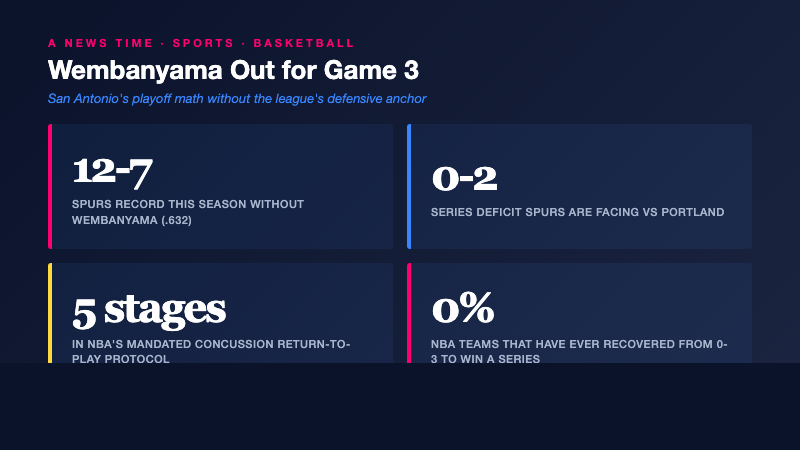
The numbers around Wembanyama's availability and the Spurs' record without him have been the most cited data point of the postseason so far. San Antonio is 12-7 this season in games Wembanyama has missed, a winning percentage of .632 that makes the team functional but not formidable on the road. In a playoff series against a Portland roster built around guard pace, three-point volume, and perimeter defense, losing the league's most disruptive interior anchor for even one game tilts the matchup decisively.
The Concussion Protocol Math
The NBA's concussion protocol, refined and tightened over the past five years in coordination with the National Basketball Players Association and an independent neurological consultant, requires a player to pass a five-stage return-to-play progression before being cleared. Stage one is symptom-limited rest. Stage two is light aerobic activity. Stage three is sport-specific exercise. Stage four is non-contact basketball. Stage five is full contact practice. Players must be symptom-free for at least 24 hours at each stage to advance. The protocol does not allow a team or a player to expedite the process based on game importance, which is by design.
Wembanyama pushed to play but has not cleared the league's mandated concussion protocol.
The Athletic's report on Wembanyama's Game 3 status, April 24, 2026
The fact that Wembanyama wanted to play is not surprising. The fact that the medical and league apparatus stopped him from playing is. The protocol's primary value to the league is its insulation from team and player pressure, and Game 3 of a playoff series is the kind of situation in which that pressure peaks. The Spurs' decision to follow the protocol rather than push for variance reflects a franchise-level investment in Wembanyama's career arc that supersedes any single-series outcome.
What the Spurs Look Like Without Him
The 12-7 record without Wembanyama tells a cleaner story than the headline number. Most of those wins came in the regular season against opponents missing key players themselves, against weaker conference rotations, or in games where the Spurs' guard play and bench depth produced enough offense to compensate for the loss of paint scoring and rim protection. Against a focused, healthy Trail Blazers team in a playoff setting, the same template is much harder to execute.
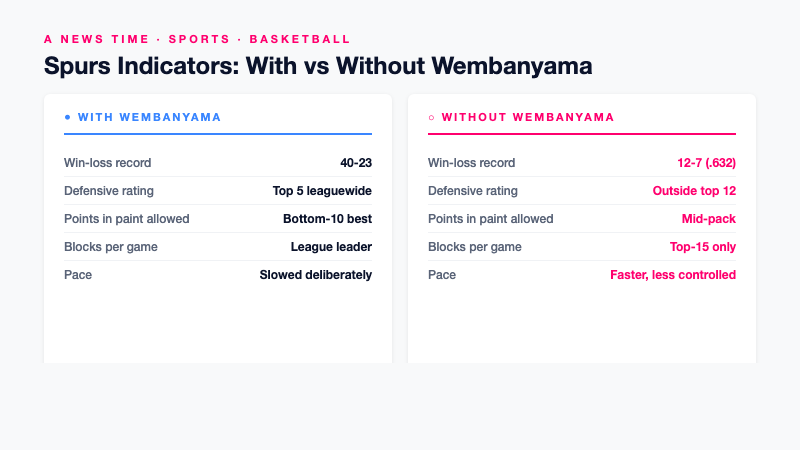
| Metric | With Wembanyama | Without Wembanyama |
|---|---|---|
| Win-loss record | 40-23 in games played | 12-7 (.632) |
| Defensive rating | Top 5 leaguewide | Drops outside top 12 |
| Points in the paint allowed | Bottom-10 (best) | Mid-pack |
| Blocks per game | League leader | Drops to top-15 |
| Pace | Slowed deliberately | Faster, less controlled |
The defensive degradation is the piece that matters most against Portland. Trail Blazers coach Chauncey Billups has built his playoff offense around dribble penetration from Scoot Henderson and pull-up threes from the wings, both of which Wembanyama's interior presence neutralizes. With Wembanyama out, the secondary rim protector role falls to Charles Bassey and rookie center Kyle Filipowski, neither of whom has the lateral range to contest the same actions. Portland's pace and three-point shot diet should jump correspondingly.
What Game 3 Actually Decides
Down 2-0 in a seven-game series, the team without home court historically wins about 7 percent of the time. Down 3-0, no NBA team has ever recovered to win a series. The math on Game 3 is therefore stark: a Spurs win keeps the series competitive at 2-1 with Game 4 in San Antonio. A Spurs loss without Wembanyama puts the franchise in a 3-0 hole no team in league history has survived. The pressure on rookie head coach Mitch Johnson, in his first playoff series in the role, is the most acute it will be all year.
The roster decisions Johnson has to make are not subtle. The starting lineup likely shifts with Bassey or Filipowski stepping in for Wembanyama. The Devin Vassell-Stephon Castle backcourt has to absorb more shot creation responsibility. Chris Paul, in what is plausibly his final extended playoff appearance, will need to control the late-game offensive sets in a way the team has not relied on for most of the regular season. Portland's matchup advantages on the perimeter mean San Antonio cannot settle for an isolation-heavy offense, which Paul's tactical instincts should help mitigate.
What Wembanyama's Concussion Means for His Career Arc
The concussion itself was sustained in the closing minutes of Game 2, when Wembanyama collided with Trail Blazers forward Toumani Camara on a contested rebound. The contact was incidental, not malicious, and Wembanyama remained in the game briefly before being removed for evaluation. The follow-up neurological assessments produced enough symptoms to keep him in the protocol's earlier stages through Thursday morning.
For a player whose injury history at the NBA level has so far been characterized by careful management rather than acute incidents, the concussion is the first major short-term unavailability of his postseason career. The longer-term implications are negligible if the protocol works as designed. The shorter-term implications for the Spurs' 2026 playoff run are immediate. The franchise has organized its entire competitive identity around Wembanyama's availability, and a postseason exit at the hands of a 2-seed Portland team without him in uniform would be the most disappointing finish to a Spurs season since the post-Tim Duncan rebuild began.
What to Watch From Here
Three things will determine how the rest of the series, and the broader Spurs season, gets remembered. The first is whether Wembanyama clears protocol in time for Game 4. A return on Sunday at home is medically possible if his Stage 4 and Stage 5 progressions go smoothly between now and then. The second is how the Spurs' guard rotation handles the additional shot creation burden in Game 3, which will set the team's offensive ceiling for the rest of the series. The third is whether the protocol experience changes how Wembanyama plays the rest of the postseason if he returns. The most physically dominant young center in the league has built his game around contact in the paint. A first encounter with the league's concussion infrastructure could change his risk calculus in subtle ways that show up over weeks, not games.
Game 3 tips off at 9:30 p.m. Eastern in San Antonio. The franchise that has spent the last three seasons designing every roster decision around Wembanyama's career timeline is about to find out how the rest of the league reads its postseason ceiling without him on the floor. The answer arrives in real time, and there is very little margin for the Spurs to absorb it.
The League-Wide Implications of the Protocol Decision
The Wembanyama situation has produced an unintended secondary effect across the league. Multiple front office sources have indicated to reporters in the past 24 hours that the manner in which the Spurs handled their star's protocol exposure, accepting the medical determination rather than appealing or seeking secondary opinions, will set a reference point for how other contending teams approach concussion protocol decisions in the coming weeks. The Knicks, Celtics, Thunder, and Nuggets all have stars who have absorbed contact in their first round series, and several of those players have been logged in the protocol's lighter symptom-monitoring stages.
The pressure points are visible in advance. Game 3 of any 2-0 series is the most acute single moment in a playoff calendar for a trailing team. The protocol decisions made in the next 10 days, by multiple teams, will define how the league's mid-2020s concussion infrastructure functions under maximum competitive pressure. The Wembanyama decision sets a baseline that other organizations will either match or visibly diverge from, and the divergences will be scrutinized by the National Basketball Players Association in real time.
For the league office, the Spurs decision is a quiet vindication. The protocol was designed precisely to remove competitive pressure from the medical determination, and a high-profile playoff Game 3 is exactly the situation where the framework gets tested. So far, the framework is holding. Whether it continues to hold across multiple comparable situations in the next two weeks will define how the protocol's credibility looks at the end of the 2026 postseason. Other star availability stories have shaped recent playoff narratives in similar ways, but the structural medical question Wembanyama's situation raises is distinct.