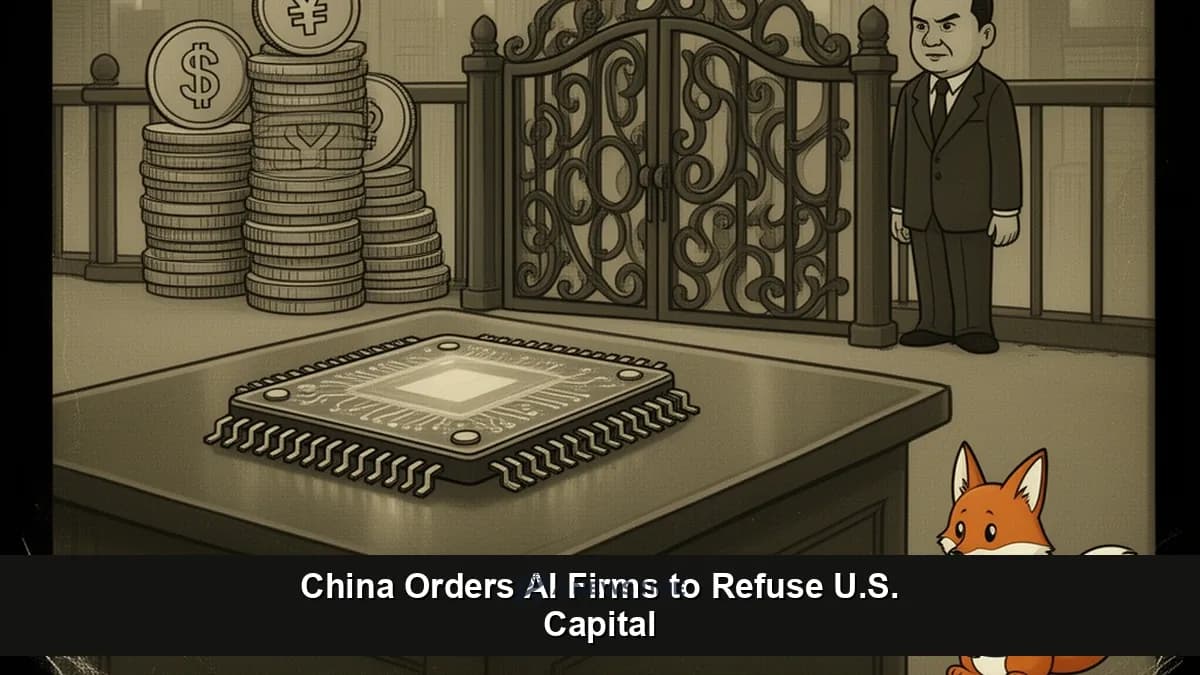
China has reportedly begun ordering its leading artificial intelligence companies to stop accepting American capital, according to reporting on by The Times of India and several Chinese-language outlets. The directive, which the reporting describes as part of a broader state framework for controlling foreign influence over domestic AI champions, follows Beijing's earlier move to block Nvidia chip purchases by Chinese firms and represents the most significant tightening of capital-side controls on the country's AI sector since the original 2017 cybersecurity law took effect.
The order is being applied to the largest Chinese AI labs and infrastructure providers, including the model developers, chip designers, and data-center operators that have raised funding from U.S. venture capital firms over the past five years. Companies that have already taken U.S. money are reportedly being told to plan for unwinding those positions on a multi-year timeline rather than immediately, but new financing rounds are no longer permitted to include U.S. limited partners or strategic investors.
The Chip Block, Then the Capital Block
The capital directive is the second leg of a coordinated tightening that began in late 2025. After the Trump administration's third round of chip-export controls and Nvidia's subsequent compliance posture made the H-series accelerators effectively unavailable to mainland Chinese customers, Beijing responded with its own restrictions on Chinese firms purchasing the small number of Nvidia chips that remained licensable. The argument inside the State Council, according to people familiar with the deliberations, was that buying restricted U.S. chips kept domestic firms locked into a hardware roadmap that Washington could shut off at any time.
The capital block applies the same logic to the financial side of the AI stack. U.S. venture investment in Chinese AI companies has historically come with the expectation of access, audit rights, and downstream board influence. Beijing's view, increasingly, is that those rights create a back door for U.S. policy to shape the development trajectory of strategic Chinese technology firms even when no chips are involved. Cutting off the capital cuts off the influence.
| Date | Action | Side |
|---|---|---|
| Q3 2025 | U.S. tightens chip export controls (3rd round) | Washington |
| Q4 2025 | China blocks domestic firms from buying remaining Nvidia chips | Beijing |
| Q1 2026 | State framework for foreign capital in AI drafted | Beijing |
| April 2026 | Directive blocking U.S. capital in AI firms takes effect | Beijing |
| April 24, 2026 | DeepSeek releases V4-Pro, V4-Flash open-source models | Industry |
Who Gets Affected
The directive's reach depends on how Beijing defines the scope of "leading AI companies," and the early reading is that it will be drawn broadly. The list almost certainly includes the major model labs (DeepSeek, Moonshot, Zhipu, Baichuan, MiniMax), the domestic chip designers (Cambricon, Biren, Moore Threads, Iluvatar, Enflame), and the largest cloud and data-center operators (Alibaba Cloud, Tencent Cloud, Huawei Cloud, ByteDance's Volcano Engine).
For the model labs, the immediate impact is limited. Most of them have not relied heavily on U.S. capital in recent rounds, in part because U.S. investors had already become cautious about Chinese AI exposure following the 2024 outbound investment rules from the Biden Treasury and the parallel CFIUS reviews on inbound deals. The chip designers are more exposed. Several of them raised early-stage funding from U.S.-based venture firms before the export-control regime tightened, and those positions will now have to be restructured.
"This is the logical extension of the chip block. Beijing concluded that as long as U.S. capital was on the cap table, the U.S. could pressure these companies through their investors. Removing the capital removes the pressure point."
Reza Khan, China technology policy researcher, in commentary cited by The Times of India
The Timing With DeepSeek's V4 Launch
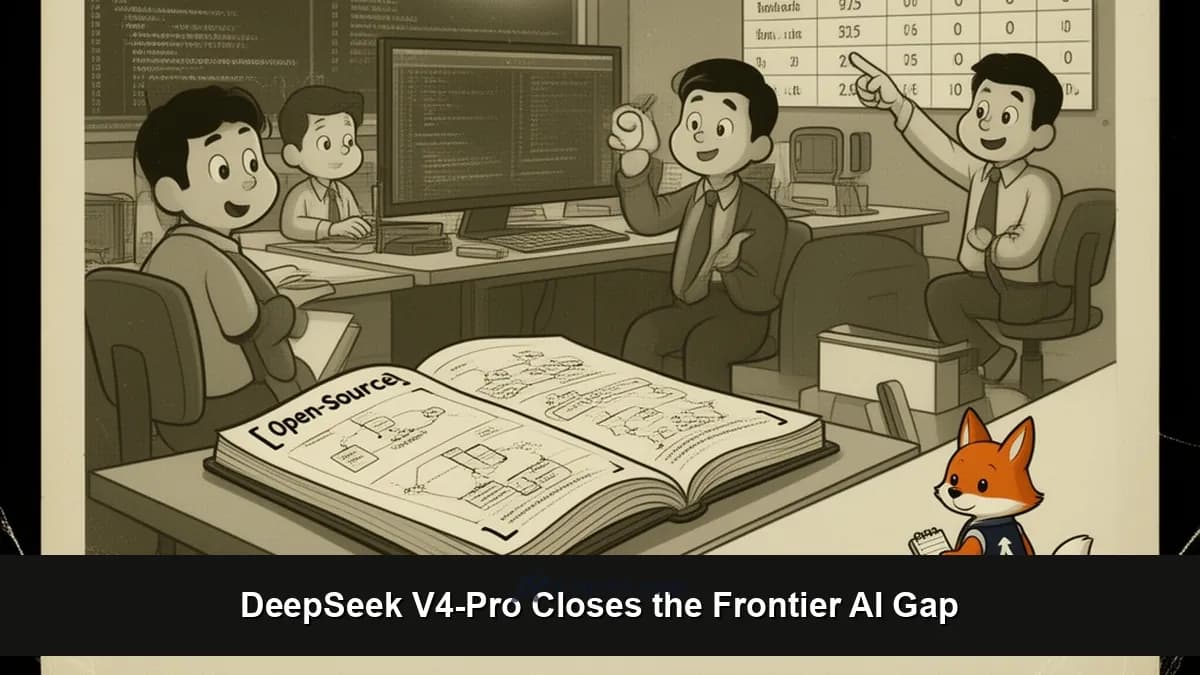
The directive is being reported on the same day DeepSeek released its V4-Pro and V4-Flash open-source models, and the timing is unlikely to be coincidental. Beijing has been signaling for months that it views the AI race as a strategic priority on par with semiconductor self-sufficiency. The capital directive is the policy equivalent of DeepSeek's product release: both are statements that Chinese AI development can proceed without U.S. inputs, whether those inputs are chips, models, or money.
The Stanford AI Index 2026 documented the same shift earlier this month. Chinese AI labs have closed the performance gap with U.S. rivals on most academic benchmarks, lead the world in publication volume and patent output, and have built out an industrial AI base larger than any other country. The capital directive is a recognition that those advantages are now substantial enough that Beijing can afford to give up the U.S. financial connection without slowing domestic progress.
The U.S. response will play out across several agencies. Treasury's outbound investment rules, originally designed to limit U.S. capital flowing into sensitive Chinese tech sectors, are now partially redundant since Beijing is enforcing the same restriction from the other side. The State Department is expected to use the directive as evidence that engagement-based China policy has reached its limit, and several China hawks in the Senate have already pointed to the move as justification for further tightening of export controls and visa policies.
What U.S. VCs Will Do
The directive removes one of the few remaining ambiguities in the China AI investment thesis for U.S. venture capital. Sequoia split its China practice in 2023, in part to insulate the parent firm from rising regulatory exposure. GGV, GSR Ventures, and several other cross-border firms have similarly restructured. The new directive accelerates the timeline for fully exiting Chinese AI positions and removes any expectation of new deals.
Several U.S. firms with existing Chinese AI portfolios are now in a forced-seller posture. The market for those positions is thin. Strategic buyers in China are limited by the same political dynamics that prompted the directive in the first place, and Chinese sovereign wealth and state-affiliated funds are unlikely to absorb the full secondary supply at par. The likely outcome is mark-downs in the next reporting cycle, with several U.S. limited partners taking realized losses on positions they had been carrying at optimistic valuations.
For Chinese founders, the practical effect is more nuanced. The talent pool, the customer pipeline, and the sovereign customer base for AI infrastructure in China are all large and growing. The capital base will need to come from domestic state-backed funds, regional government LPs, and the corporate venture arms of the large Chinese platform companies. That funding is available but comes with its own conditions, including alignment with provincial or central-government industrial policy goals.
The Bigger Picture for Decoupling
The capital directive completes a decoupling stack that now spans hardware, software, capital, and increasingly, talent. Researcher mobility between U.S. and Chinese AI labs has slowed considerably over the past 18 months, and the H-1B and student-visa frictions have made it harder for Chinese AI scientists trained in the U.S. to remain. The two AI ecosystems are moving toward a state of parallel development, where the same scientific problems are being solved in different ways with different toolchains.
That world is more expensive in the short run, since both sides have to duplicate infrastructure that previously could be shared. It is also harder to govern, since coordination on safety, evaluations, and incident response now has to happen across a much wider trust gap. The capital directive does not, on its own, change that trajectory. It is one more piece of evidence that the trajectory is set.
What to Watch From Here
Three things will determine whether the capital directive becomes a template for further tightening or an outer-bound limit. The first is enforcement: how aggressively Chinese regulators police existing U.S. positions and whether they grant exceptions for strategic partnerships. The second is the U.S. response from the Trump administration, which has been less coordinated on tech policy than its predecessor and may either escalate or use the directive as cover for a transactional deal. The third is the second-order effect on the broader Chinese venture market, where the precedent of state-directed capital exclusion may unsettle non-AI sectors that have relied on cross-border investment.
For now, the immediate consequence is that the AI funding environment in China just became fully domestic. The companies that benefit most are the ones with state-backed cap tables already in place. The companies that will struggle are the ones that built their growth model on the assumption that U.S. capital would always be available. As of this week, that assumption no longer holds.