
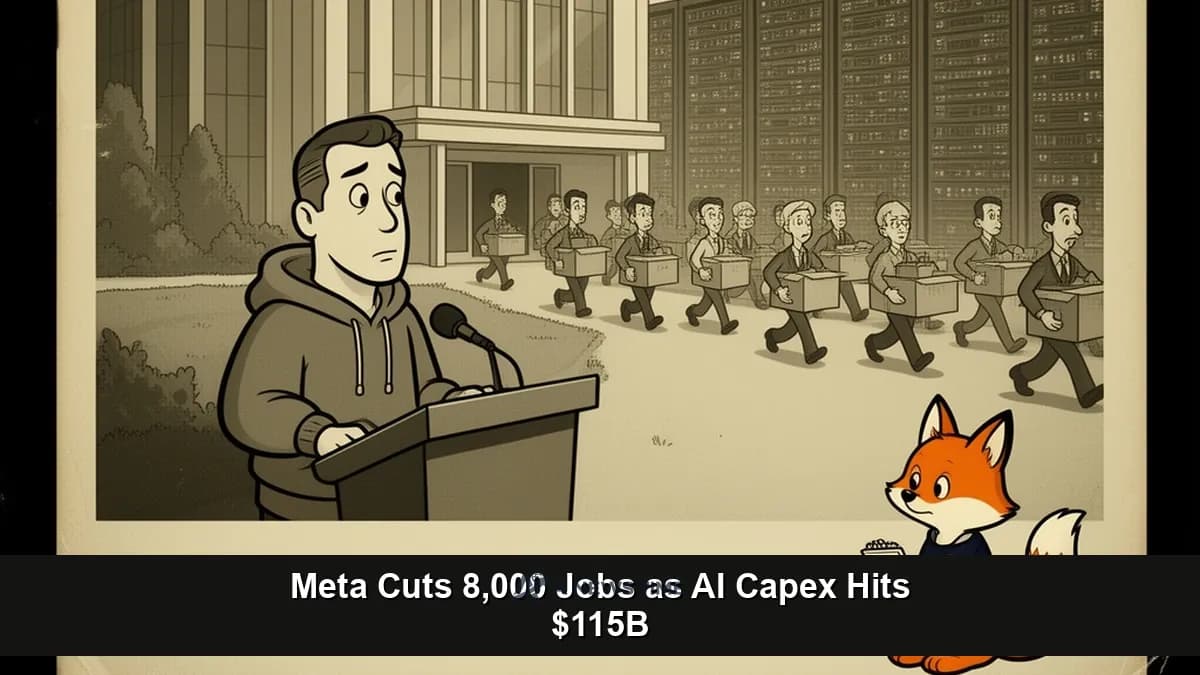
Meta Platforms told staff on that it will lay off approximately 8,000 employees, roughly 10 percent of its global workforce, and close around 6,000 open roles in what is shaping up to be the largest single round of cuts at the company since 2023. The reductions take effect . The company confirmed the figures to multiple outlets after a memo from chief people officer Janelle Gale was published by Bloomberg.
Meta shares fell more than 2 percent in afternoon trading on Thursday as investors digested the dual signal: a company aggressively cutting people while continuing to expand its AI infrastructure budget. Capital expenditure on data centers and AI training hardware ran at $72.2 billion in 2025 and Meta has guided to at least $115 billion in 2026, a 60 percent jump that has become difficult to defend to public-market investors without offsetting cost reductions elsewhere.
What Gale Actually Said
The internal memo from Gale lays out the rationale in the company's preferred phrasing. The cuts, she wrote, are part of a continued effort to run Meta more efficiently and to offset other investments the company is making. Translated from corporate, that "other investment" is the AI build-out: the GPU clusters, the megawatt-scale data centers, the hires inside the new superintelligence lab, and the buyouts of AI startups Moltbook and Manus that Meta has folded into the lab over the past two quarters.
"We're doing this as part of our continued effort to run the company more efficiently and to allow us to offset the other investments we're making."
Janelle Gale, Chief People Officer, Meta, internal memo, April 23, 2026
Affected U.S. employees will receive 16 weeks of base pay plus two weeks for every year of service, with international packages described as similar. That is broadly in line with the severance schedule Meta used during its 2022 and 2023 layoffs, which collectively eliminated tens of thousands of roles. The closing of 6,000 open requisitions is, in some ways, the more consequential number for Meta's hiring trajectory. It signals that the company expects to operate with a smaller headcount footprint not just immediately, but through the next planning cycle.
The Capex Math Driving the Decision
Meta's cost structure has been reshaped by the AI race in a way that makes the layoffs almost arithmetically necessary if the company wants to defend operating margin. Capex of $115 billion in 2026 represents money that will be depreciated against operating earnings over the useful life of the underlying servers and buildings, which Meta currently models at five to six years for its custom MTIA AI silicon and four to five years for the GPU fleet sourced from Nvidia and AMD.
That depreciation flows through the income statement as a roughly $20 billion to $25 billion drag in 2026 alone, and rises in subsequent years as more AI infrastructure is brought online. Cutting 8,000 roles, even at a fully loaded average annual cost of $400,000 per employee, returns about $3.2 billion in annualized savings. It is not enough to fully offset the depreciation, but it is a number Meta can put in front of investors as evidence that operational discipline is keeping pace with infrastructure spending.
| Metric | 2025 Actual | 2026 Guidance / Action |
|---|---|---|
| Capital expenditure | $72.2 billion | $115 billion+ |
| Workforce | ~80,000 | ~72,000 after cuts |
| Open requisitions | n/a | 6,000 frozen |
| Severance (US) | n/a | 16 weeks base + 2 weeks per year |
| Effective date | n/a | May 20, 2026 |
The acquisitions of Moltbook and Manus did not come cheap, and the talent war for senior AI researchers has pushed compensation packages at the top of the market past $10 million per year in some cases. Meta has been aggressive on both fronts, and Mark Zuckerberg has personally been involved in some of the most notable hires for the superintelligence lab Meta has built over the past 18 months.
Zuckerberg's January Warning Comes Into Focus
On Meta's January 2026 earnings call, Zuckerberg told analysts that 2026 would be "the year that AI starts to dramatically change the way that we work." He went further, saying the company was already seeing projects that previously required big teams now being completed by a single very talented person. At the time, that comment was widely read as a piece of forward-looking AI marketing. With Thursday's announcement, it now reads as a quietly delivered notice of what was coming.
"We're starting to see projects that used to require big teams now be accomplished by a single very talented person."
Mark Zuckerberg, CEO, Meta, Q4 2025 earnings call, January 2026
Internally, Meta has been restructuring engineering teams around AI-native workflows for most of the past year. Coding agents built on top of Llama and external models are running an increasing share of routine implementation work, code review, and bug triage. Several of Meta's product surfaces have moved to lean teams that ship through agent-mediated pipelines, and engineering management has been told to plan for further consolidation of supporting roles.
The Pattern Is No Longer Just Meta
The Meta cuts land in the middle of what is now an unmistakable wave. Amazon disclosed in January that it would lay off 16,000 workers, the company's second large round of cuts in three months, citing the same efficiency framing Gale used in her memo. Block, the fintech firm, announced in February that it would eliminate 40 percent of its workforce, more than 4,000 roles, and warned in unusually direct terms that more companies would follow. Microsoft is offering buyouts. Snap has trimmed. Nike has trimmed.
| Company | Cuts announced | Stated rationale |
|---|---|---|
| Amazon | 16,000 (January) | Operational efficiency |
| Block | ~4,000, 40% of staff (February) | Restructuring around AI |
| Microsoft | Buyouts offered (April) | Workforce realignment |
| Snap | Undisclosed trim (Q1) | Cost discipline |
| Meta | ~8,000, 10% of staff (April 23) | Offset AI capex |
Fast Company's April 2026 tech layoffs tracker now lists efficiency and AI spending as the through-line for almost every large company cutting jobs this month. The economic narrative being constructed in real time is that the AI build-out is paid for, in part, by the people whose work it is starting to absorb.
That framing is contested. Several economists and labor researchers have pushed back on the idea that AI is the proximate cause of these reductions, arguing that capital reallocation, post-Covid hiring overhangs, and changing interest rate expectations are doing more of the work. The honest answer is that all of these factors are present at once, and Meta's announcement gives each side evidence to point to.
What This Does to the AI Talent Market
The mechanics of the cut matter for the broader hiring environment. Eight thousand Meta engineers, product managers, designers, and operations staff entering the market in late May will not all find AI-related roles. Those who do are likely to land at second-tier AI labs, infrastructure providers, and enterprise software companies that have been struggling to compete for talent against Meta, Google, OpenAI, and Anthropic. For some startups, the layoffs will be the first real opportunity in two years to hire experienced platform engineers without paying Meta-level packages.
The reductions also clarify the new bifurcation of the AI talent market. The top of the pyramid, the few hundred researchers who can lead frontier model development, remains a seller's market with compensation continuing to climb. The middle of the pyramid, the much larger pool of strong engineers who built and maintained Meta's recommendation systems, advertising infrastructure, and consumer products, is moving in the other direction. Meta is signaling that it intends to operate that middle layer with significantly fewer people.
The impact on equity holders is more nuanced. Wall Street's first reaction was the 2 percent decline in Meta shares, but several sell-side analysts have already published notes arguing that the cuts are net positive for free cash flow over the next two years. JPMorgan and Morgan Stanley both have ongoing coverage that has been calling for more aggressive cost discipline at the megacap platforms, and Meta has now provided it.
The Story to Watch From Here
Meta will report first quarter 2026 earnings in the next two weeks, and the call will be the first opportunity for Zuckerberg and CFO Susan Li to defend the layoff math against guidance for capex, revenue, and operating margin. Investors will look for three things: a recommitment to the $115 billion capex number, a tighter range on operating expenses for the back half of 2026, and any hint about whether the cuts are a one-time event or the start of a multi-quarter restructuring.
The broader question is whether the pattern continues. Big Tech's AI spending has now reached a level where the offsetting cost reductions become structurally necessary, and the companies that have not yet announced cuts are the ones to watch closely as second quarter earnings season begins in late July. The decisions made in the next 90 days will set the template for how the largest software companies operate for the rest of the decade. Meta has just put its template on the table.