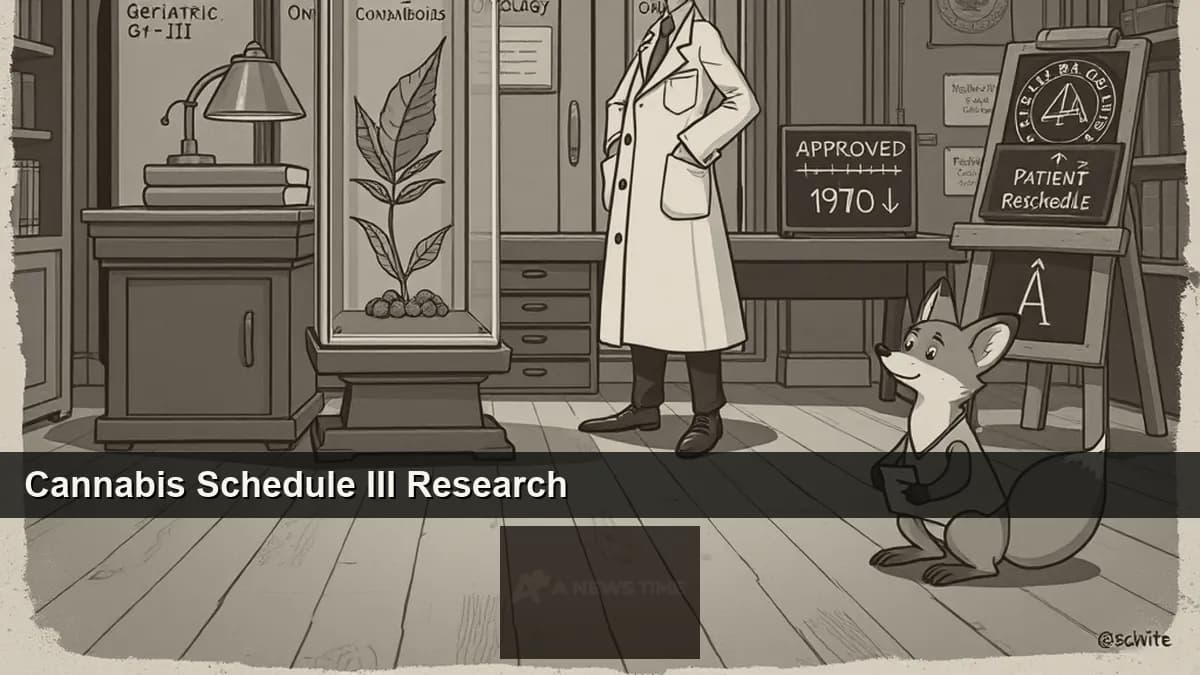
For the first time in more than five decades, cannabis used in U.S. medical research no longer has to come exclusively from a single federally licensed source. The Trump administration's acting attorney general signed an order this month moving state-licensed medical marijuana from Schedule I, the most restrictive category under the Controlled Substances Act, to Schedule III. Recreational marijuana is unaffected. The order applies only to FDA-approved medical cannabis products and to businesses operating under state medical marijuana licenses. For research scientists, that narrow scope is exactly what makes the change useful, because the bottleneck their work has lived with for decades has been the supply pipeline, not the broader legal status of the plant.
In Colorado, where legal medical marijuana has been on the books since , the policy gap between state law and federal research authority has been the single largest obstacle to producing the kind of clinical evidence that would let physicians prescribe with confidence. Shannon Donnelly, a cannabis professor at Metropolitan State University of Denver and one of the state's most active research voices on the plant, said the rescheduling closes a wait that the field has been quietly preparing for.
"We have been waiting for the federal government to catch up."
Shannon Donnelly, cannabis professor, Metropolitan State University of Denver, in a 9News interview, April 24, 2026
What Schedule III Actually Changes
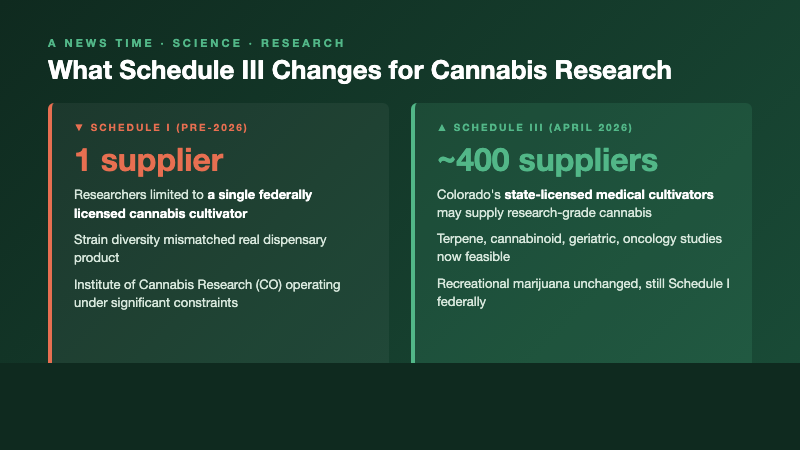
The Controlled Substances Act sorts substances into five schedules based on accepted medical use and abuse potential. Schedule I, where cannabis sat from 1970 until this month, is the category for substances with no accepted medical use and high abuse potential. It is also the category that creates the most restrictive research environment, requiring scientists to obtain cannabis exclusively from a single federally approved cultivator, historically the University of Mississippi program. The selection of strains and chemical profiles available through that pipeline never matched what state-licensed dispensaries actually sell to patients, which created a credibility problem for any study trying to model real-world use.
Schedule III places medical marijuana alongside ketamine, anabolic steroids, and codeine in combination preparations. The classification still carries restrictions, but the supply pipeline opens substantially. State-licensed medical marijuana cultivators, including those operating in Colorado under regulations the state has refined since 2001, can now potentially supply research-grade cannabis directly to scientists. That single change matters more than the symbolic reduction in scheduling severity.
| Dimension | Schedule I (pre-2026) | Schedule III (April 2026) |
|---|---|---|
| Cannabis source for studies | Single federally licensed cultivator | State-licensed medical cultivators eligible |
| Strain and chemical-profile diversity | Limited; mismatch with retail product | Research-grade aligned with what patients use |
| Scope of order | n/a | FDA-approved medical products and state-licensed medical businesses only |
| Recreational marijuana | Schedule I | Unchanged, still Schedule I federally |
| Institute of Cannabis Research scope | Significantly constrained | Expanded research pathways |
The Research Questions That Become Answerable
Donnelly described the immediate set of questions her field has been waiting to investigate at higher resolution. Two of the most actionable involve the chemistry of the plant rather than cannabis as a single substance.
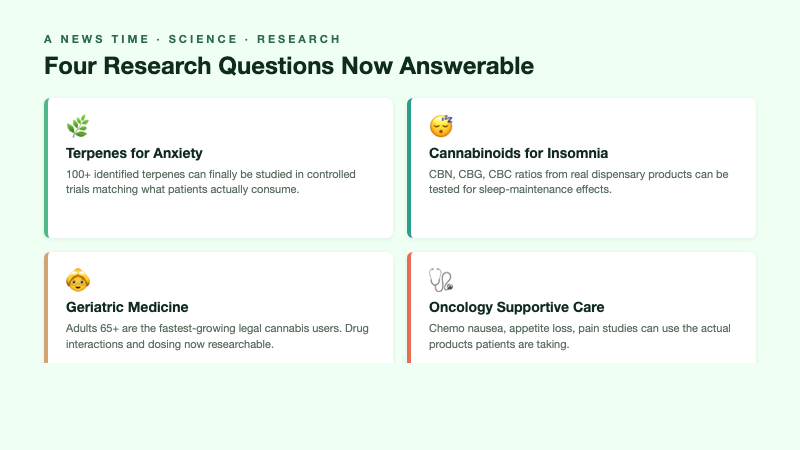
- Terpenes for anxiety: Cannabis plants contain more than 100 identified terpenes, the aromatic compounds also found in citrus, pine, and lavender. Patient-reported anxiety relief has correlated with specific terpene profiles in observational data, but controlled studies of which terpenes drive the effect have been near-impossible to design under Schedule I.
- Cannabinoids for insomnia: Beyond THC and CBD, cannabis produces cannabinoids including CBN, CBG, and CBC in varying ratios. Patient testimony around sleep maintenance has consistently pointed to specific minor cannabinoid combinations, but the supply pipeline rarely allowed researchers to obtain the exact combinations patients were actually using.
- Geriatric medicine: Adults aged 65 and older are the fastest-growing segment of legal cannabis users in the United States. Their drug-interaction profiles, dosing tolerances, and chronic-pain response patterns have been understudied because the cannabis they consume in the dispensary economy has been off-limits to most research designs.
- Oncology supportive care: Cancer patients have used cannabis for chemotherapy-related nausea, appetite loss, and pain management for decades. The new pipeline allows oncology researchers to study the same products patients are actually using rather than relying on placebo-controlled studies of a federally supplied strain that may not match anything in the dispensary case.
"It could be looking into what terpenes are better for people who deal with anxiety, what cannabinoids are going to be the best for insomnia, and where they can't stay asleep."
Shannon Donnelly, Metropolitan State University of Denver, April 24, 2026
The Institute of Cannabis Research Gets a Bigger Sandbox
Colorado's Institute of Cannabis Research, a state-funded research organization based at Colorado State University Pueblo, is one of the clearest immediate beneficiaries of the schedule change. The Institute has been functioning under federal constraints that limited the studies it could undertake even with state funding behind it. With the supply pipeline broadened and the legal classification softened for medical products, the Institute can now plan studies that would have been blocked at the design stage under prior rules.
Donnelly noted that the Institute had been operating in a permanent state of constraint and that the new pathways will substantially widen what its researchers can pursue. That will not produce overnight results. Clinical research timelines run in years, not weeks, and Institutional Review Board protocols for cannabis studies will still need to be revised to reflect the new federal posture. But the planning calendar at Colorado's research institutions has changed in a way that was not possible 30 days ago.
What the Order Does Not Do
The reclassification is narrower than President Trump's December executive order, which referenced cannabis broadly. The final rule applies exclusively to FDA-approved medical marijuana products and to state-licensed medical marijuana businesses. Recreational cannabis remains a Schedule I substance under federal law, even in the 24 states plus the District of Columbia where adult-use sales are legal at the state level. That bifurcation is unusual but coherent: it lets the federal government acknowledge medical applications without endorsing recreational use, and it limits the immediate impact on banking and tax law for retail dispensaries.
"The only things that are rescheduled are FDA-approved medical marijuana products and state-licensed medical marijuana businesses."
Shannon Donnelly, Metropolitan State University of Denver, April 24, 2026
For the recreational segment of the cannabis industry, very little has changed. The IRS Section 280E tax penalty that prevents recreational dispensaries from deducting normal business expenses still applies. Federal banking restrictions on the broader industry remain in place. State-licensed medical operations gain a clearer federal footing for research collaboration and may see incremental relief on some tax positions, but the broader legal architecture for adult-use cannabis is unchanged by this order.
What We Still Do Not Know
Several pieces of the picture have to clarify before researchers can move at full speed. The DEA has not yet issued the implementing regulations that will govern how state-licensed cultivators register to supply research-grade cannabis under Schedule III. The FDA has not specified the chemistry standards that distinguish "research-grade" cannabis from standard dispensary product, which matters because Institutional Review Boards will need a defensible answer when approving protocols. And the federal funding agencies, including NIH and the National Institute on Drug Abuse, have not yet revised their grant guidelines to reflect the broader supplier landscape.
None of those open questions block research from moving forward, but each one will shape what the first wave of post-rescheduling studies looks like. Colorado's research community is positioned to move quickly because the state's medical cannabis infrastructure is mature and its university research community has been planning for this scenario for years. Other states with established medical programs will be close behind. The federal evidence base on cannabis medicine, which has lagged decades behind the state-level treatment landscape, is finally on a track to catch up. The next 12 to 18 months will reveal how fast the field actually moves once the pipeline opens.
For readers tracking how this fits into broader health policy shifts, the schedule change arrives alongside other significant medication research developments reshaping how Americans think about prescription pharmacology. The cannabis story is part of a wider movement to align federal regulatory posture with the clinical realities patients are already navigating.
How Researchers Are Already Adapting
Even before the implementing regulations arrive, several Colorado institutions have started preparing the protocols and partnerships that will define the first wave of post-rescheduling studies. The University of Colorado Anschutz Medical Campus has had cannabis research on its planning calendar for years, contingent on exactly this kind of federal shift. Colorado State University Pueblo, which houses the Institute of Cannabis Research, is in a similar posture. Both institutions have research-active faculty who have published observational studies of cannabis use in their patient populations and who can pivot quickly to controlled studies once the supply pipeline stabilizes.
Industry partnerships are the other piece of the picture that moves quickly. Colorado has more than 400 licensed medical marijuana cultivators operating under state regulation, and several of the larger ones have research-grade facilities that meet pharmaceutical-quality standards. Those cultivators have spent years preparing the documentation and chain-of-custody infrastructure that researchers will require under Schedule III. The transition from state-licensed dispensary supplier to federal research supplier is technically nontrivial, but the gap is much smaller than starting from scratch would have been.
| Resource | Status | Role under Schedule III |
|---|---|---|
| Institute of Cannabis Research (CSU Pueblo) | State-funded, operating under prior constraints | Expanded research mandate, broader study designs possible |
| University of Colorado Anschutz Medical Campus | Active observational research | Positioned for early controlled studies |
| State-licensed medical cultivators | ~400 operating under Colorado regulation | Eligible to supply research-grade product directly |
| Metropolitan State University of Denver | Cannabis-focused academic program | Workforce training and applied research |
| Cannabis-trained physician network | Established statewide referral pathways | Patient recruitment for clinical studies |
The patient population for the first wave of studies is also already organized. Colorado's medical marijuana registry has tracked patients with qualifying conditions since 2001, producing a longitudinal data set that researchers can use both as a starting point for controlled trials and as a comparison cohort for new investigations. The state's chronic pain, cancer, and elderly patient populations have well-established connections to physicians familiar with cannabis as a treatment modality, which compresses the patient recruitment timeline that often slows clinical research at other institutions.
None of that infrastructure existed in 2001, when Colorado first legalized medical marijuana. Building it has been a 25-year project carried out under federal restrictions that often felt punitive to the researchers and clinicians involved. The Schedule III order does not undo that history, but it does mean the next 25 years of cannabis medicine will be conducted under a fundamentally different research environment than the previous quarter century. Donnelly's framing, that the field has been waiting for the federal government to catch up, is the most accurate way to describe what just happened.
Sources
- Federal reclassification of medical marijuana opens new research doors for Colorado scientists, 9News
- Institute of Cannabis Research, Colorado State University Pueblo
- Drug Scheduling, U.S. Drug Enforcement Administration
- FDA and Cannabis: Research and Drug Approval Process, U.S. Food and Drug Administration