
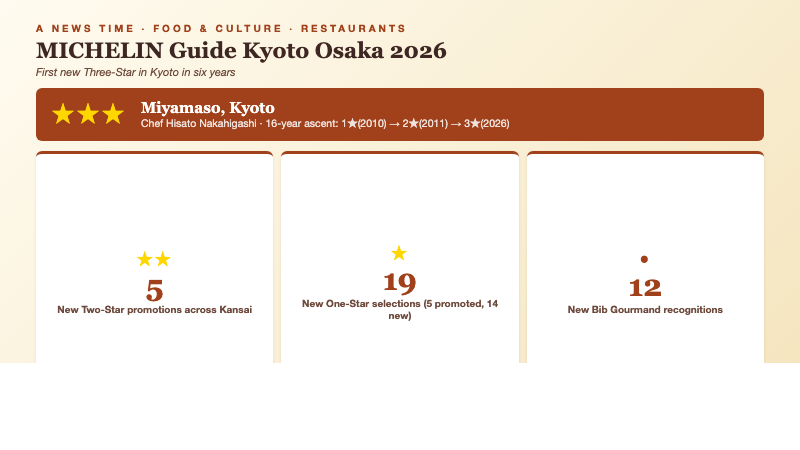
Michelin announced its 2026 Kyoto Osaka guide on , awarding the first new Three-Star rating in Kyoto in six years to Miyamaso, the satoyama-set Japanese restaurant where chef Hisato Nakahigashi cooks with seasonal ingredients foraged largely by his own hand. The promotion completes a 16-year arc that began with one star in the guide's first Kyoto edition in 2010 and continued with two stars the following year. Beyond the headline elevation, the new guide added five Two-Star promotions across the Kansai region, named 19 new One-Star restaurants, and recognized 12 new Bib Gourmand selections, the entry-level designation for restaurants offering excellent food at accessible prices.
The release lands in a year that carries unusual symbolic weight for the Michelin organization. The 2026 guides mark 100 years since the Michelin Star system was first introduced, in 1926, as a way to highlight outstanding cuisine for the early French motoring class who consulted the original Michelin red guides for road trip planning. The system's century-long evolution has taken it from a French regional reference point to the most internationally recognized restaurant rating framework in the world, and the Kansai guide is one of its most stylistically distinctive editions.
Miyamaso and the Foraged Three-Star
Miyamaso sits in a nature-rich satoyama landscape in the Hanase district of Sakyo Ward, Kyoto, an area that has been cultivated and stewarded by humans for centuries while remaining functionally rural. The restaurant occupies a building with the structural cadence of a traditional ryokan, and its menu changes with the seasons in a way that reads as instinctive rather than performative.
Chef Nakahigashi has built his cuisine around a principle that sounds simple and is operationally complex: working with nearby ingredients, foraging where possible, and staying true to the foundational techniques of Japanese cooking without retreating into formal kaiseki orthodoxy. The seasonal calendar drives every menu, with wild mountain vegetables (sansai) defining spring, river fish defining summer, mushrooms defining autumn, and gibier (game meats) defining winter. The kitchen's intimacy with its surrounding terroir, including the satoyama hillsides, the nearby Kibune River, and the forests above the restaurant, is what Michelin's anonymous inspectors cited in their evaluation.
Proprietress Sachiko Nakahigashi received Michelin's Service Award in the 2023 Kyoto Osaka edition, and the team's hospitality has been consistently recognized as part of the restaurant's appeal. The combination of the kitchen's culinary identity and the front-of-house service is what moves Miyamaso from the Two-Star tier (cooking that justifies a detour) into the Three-Star tier (cooking that justifies a journey). The 16-year ascent is one of the slower and more deliberate trajectories to Three Stars in the modern Michelin era, which makes the elevation read as confirmation of a sustained creative vision rather than a single breakout moment.
The Two-Star Class and What It Reveals
Five restaurants advanced to Two Stars in the 2026 Kyoto Osaka edition, four of them in Kyoto and one in Osaka. The Kyoto promotions all serve Japanese cuisine but each pursues a distinctively different approach within the broader category.
| Restaurant | Chef | City | Defining characteristic |
|---|---|---|---|
| Doppo | Masato Miyazawa | Kyoto | Third restaurant, integrates cuisine, tableware, and setting |
| Higashiyama Yoshihisa | Yoshihisa Suzuki | Kyoto | Counter completion, hospitality unique to the room |
| Tokuha Motonari | Shinya Matsumoto | Kyoto | Omakase pursuing classical-to-inventive range |
| Muromachi Yui | Kazuteru Maeda | Kyoto | Kappo, monthly omakase reflecting seasonal traditions |
| Teruya | Katsunori Teruya | Osaka | Kyoto-trained, harmony in dashi, depth in simplicity |
The geographic skew of the Two-Star class, four out of five in Kyoto, reflects the historical density of Kyoto's elite Japanese cuisine scene relative to Osaka's. Kyoto's restaurant culture has been refined over centuries, with kaiseki traditions tied to the city's role as the imperial capital and its temple economy. Osaka's Two-Star promotion of Teruya, a Kyoto-trained chef applying refined Japanese cuisine techniques in Osaka's more commercially driven food culture, is a quietly significant sign of how the two cities' culinary identities continue to intersect.
The One-Star and Bib Gourmand Expansion
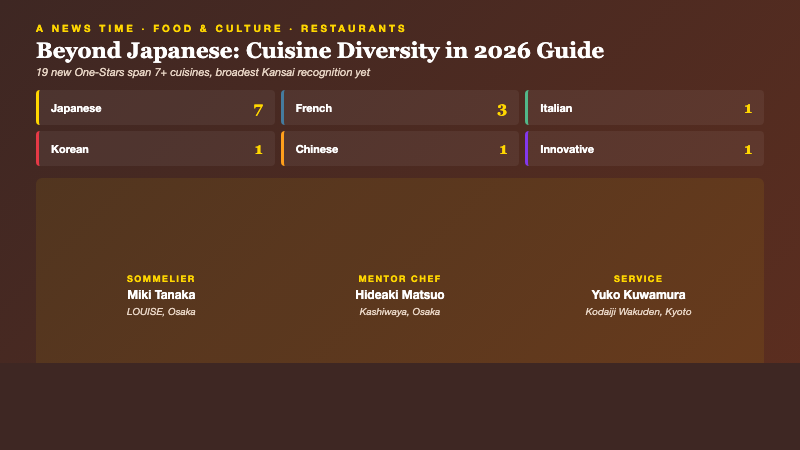
The 19 new One-Star restaurants and 12 new Bib Gourmand selections collectively reflect a guide that is broadening its reach beyond pure haute cuisine. The One-Star class includes 12 Kyoto restaurants (five promoted from previous editions, seven new entries) and seven in Osaka (three promoted, four new). Japanese cuisine remains the dominant category but is no longer the exclusive one. The 2026 guide includes new One-Star restaurants serving French (ima and KOGA in Kyoto, Empathie in Osaka), Korean (Korean Restaurant Byeoleeya in Kyoto), Italian (Germoglio in Kyoto), Chinese (atelier HANADA in Osaka), Tempura (Numata Sou in Osaka), Sushi (Sushi Shigenaga in Osaka), and Innovative cuisine (LURRA˚ in Kyoto).
That breadth matters. The Michelin Guide's traditional bias toward Japanese restaurants in its Kyoto Osaka edition has occasionally drawn criticism from chefs working in non-Japanese cuisine within the region. The 2026 expansion of recognized cuisines suggests the inspectors are explicitly engaging with the broader Kansai dining ecosystem rather than treating it as a Japanese cuisine showcase.
The 12 new Bib Gourmand selections continue Michelin's effort, accelerated globally in the past five years, to recognize accessibly priced restaurants alongside the high-end establishments that command Star ratings. The Bib Gourmand additions in the 2026 Kyoto Osaka edition include three Kyoto entries (an izakaya, a ramen shop, and a soba restaurant) and nine Osaka entries spanning Thai, Chinese, tonkatsu, French, yakitori, and ramen cuisines. The Bib Gourmand awards function as one of the most useful entry points to the guide for visiting diners, since they typically combine quality with accessibility in price brackets that haute cuisine bookings rarely reach.
The Awards and the Mentor-Service Vocabulary
Beyond the Star and Bib Gourmand recognitions, Michelin awarded three career-defining honors in the 2026 Kyoto Osaka edition. The first Sommelier Award for the region went to Miki Tanaka, owner-sommelier at Osaka's LOUISE, a French restaurant where Tanaka has worked since opening alongside chef Yannick Lahopgnou. The Mentor Chef Award went to Hideaki Matsuo of Osaka's three-star Kashiwaya Osaka Senriyama, recognizing his role in training the next generation of Japanese cuisine chefs and contributing to the development of local food culture through Osaka chef study groups and culinary school teaching. The Service Award went to Yuko Kuwamura of Kyoto's two-star Kodaiji Wakuden, a second-generation proprietress whose hospitality philosophy has helped define the Wakuden group's identity.
The new selection is further proof of Kyoto and Osaka's continued evolution. The dynamic results surprised our inspectors. Even as we mark 100 years since the Michelin Stars were first introduced to highlight outstanding cuisine, we continue to recommend restaurants through our distinctive, consistent methodology.
Gwendal Poullennec, International Director of the Michelin Guide, April 24, 2026
Poullennec's framing of the Kyoto Osaka 2026 edition as "dynamic" and "surprising" is worth taking literally. Three of the One-Star promotions are restaurants that have been on the radar of Kansai food critics for less than three years, and several of the new entries in both Kyoto and Osaka are first-generation establishments led by chefs who trained at older Michelin-rated kitchens before opening their own.
What This Means for Travelers and the Industry
For travelers planning food-driven trips to Japan in 2026 and 2027, the new Kyoto Osaka guide expands the practical options at every price point. Three-Star and Two-Star restaurants in Kansai are notoriously difficult to book, with reservations commonly requiring two to three months of advance planning even for international visitors with concierge support. The newly recognized One-Star and Bib Gourmand restaurants are typically more accessible in the booking window of two to four weeks, which makes them the more realistic targets for most international itineraries.
For the broader restaurant industry, the 2026 guide reinforces a pattern visible across Michelin's recent editions: the geographic and cultural breadth of the guide is expanding, and the typology of cuisines being recognized is becoming more diverse. Both the recent Great Lakes expansion in the United States and the Kansai 2026 edition show Michelin actively investing in the breadth of its global coverage rather than just the depth of its established markets. That expansion is reshaping the global restaurant economy in ways that ambitious chefs and investors are increasingly factoring into their location and concept decisions.
What Comes Next
The next Michelin events to watch in 2026 are the Tokyo guide release later this year and the formal Michelin Great Lakes restaurant selection in 2027, both of which will continue the 100-year-anniversary release calendar. The Kyoto Osaka 2026 awards ceremony took place this week in Osaka, with chefs and proprietors from across the region in attendance. For Miyamaso specifically, the Three-Star elevation will significantly tighten its already-difficult reservation availability. International diners hoping to experience Hisato Nakahigashi's satoyama cuisine should plan booking attempts months in advance, ideally working through hotel concierge services in Kyoto with established Michelin restaurant relationships.
The deeper signal in the Kyoto Osaka 2026 guide is that the Kansai region's culinary culture remains in a creative phase that Michelin's inspectors are actively documenting rather than simply curating. The five-year forward calendar for new restaurant openings across both cities suggests the rate of new entries to the guide will continue at or above current levels through at least 2030. Kansai's culinary momentum is one of the most reliable trends in the global restaurant economy.