The summer movie season has historically opened with a cape and a 200-million-dollar visual effects budget. This year, it opens with a runway. The Devil Wears Prada 2 hits theaters on , two decades after the original built itself into a cultural reference point that has aged better than almost any other comedy of the 2000s. Anne Hathaway returns as Andie Sachs. Meryl Streep returns as Miranda Priestly. The May 1 weekend, normally reserved for whatever superhero franchise is occupying the season's pole position, has been handed to a fashion sequel. That decision says a great deal about where Hollywood thinks the audience is in 2026.
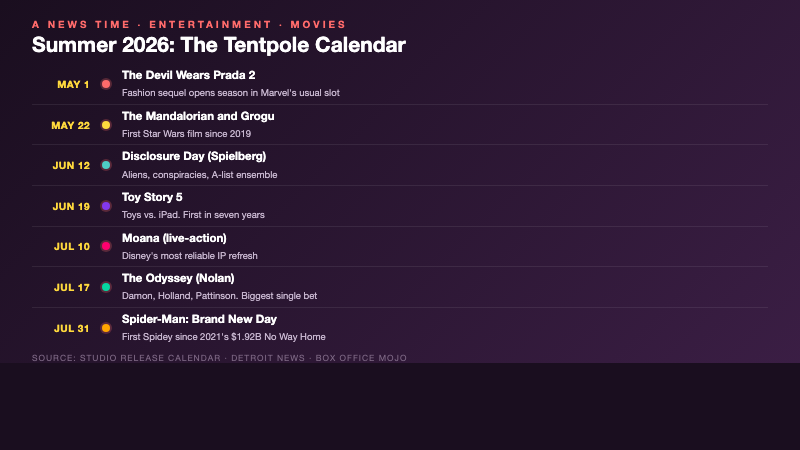
The choice is not random. Detroit News film columnist Adam Graham, in his annual A-to-Z summer movie preview published , framed the season as a return to franchise diversity after several years of capes-as-default scheduling. From the May opener through Labor Day weekend, the calendar runs heavy on big names from across the cultural pyramid: Christopher Nolan delivering his Oppenheimer follow-up, Steven Spielberg returning to alien territory, Pixar marching Toy Story back into theaters seven years after the last installment, and Star Wars putting The Mandalorian and Grogu on the big screen for the first time.
Why Devil Wears Prada 2 Is the Test Case
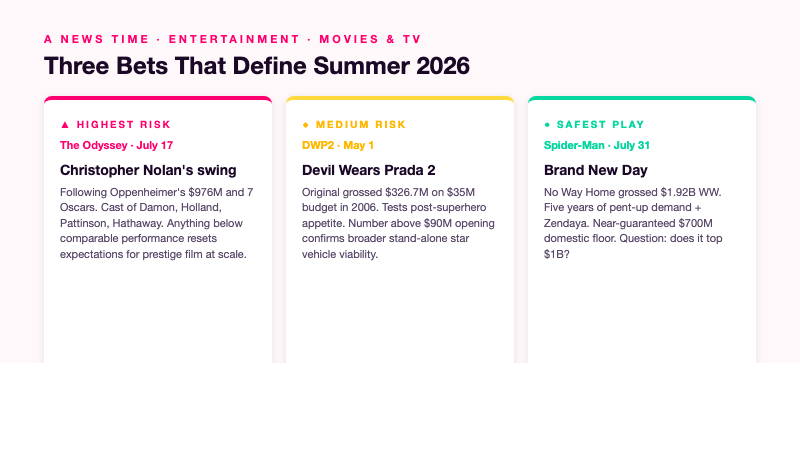
The original Devil Wears Prada, released in 2006, made $326.7 million at the worldwide box office on a budget of about $35 million, an outcome that turned a mid-budget comedy into a generational shorthand. The sequel arrives with a structural advantage few comedies have: an audience that grew up with the source material, a meme economy that has kept Miranda Priestly's "florals for spring, groundbreaking" running through Instagram captions for nearly two decades, and a streaming-era exhaustion with cinematic-universe fatigue that has made stand-alone star vehicles feel novel again.
The cast list signals the studio's confidence. Hathaway and Streep return alongside Emily Blunt, Stanley Tucci, and the original creative team led by director David Frankel and screenwriter Aline Brosh McKenna. The plot, kept under wraps until the marketing rollout earlier this month, centers on the contemporary collision between legacy fashion publishing and the influencer economy. That premise is exactly what the original film was built to satirize, only with the technology and the workforce both 20 years older.
Hathaway is having an unusually busy 2026 even by her standards. She is currently on screens as a pop singer in David Lowery's Mother Mary. She co-stars with Ewan McGregor in David Robert Mitchell's The End of Oak Street on . And she has a part in Christopher Nolan's The Odyssey, the season's biggest swing. Five major releases in seven months puts Hathaway in the position of being the through-line for the entire 2026 summer slate, an unusual centering of a single performer outside the comic-book ecosystem.
The Big Swings, Sorted by Risk Profile
Reading the calendar from a studio-economics perspective produces a clear hierarchy of bets. The lowest-risk releases are the franchise installments with built-in audiences. The medium-risk slots are sequels and reboots that need to convert nostalgia into ticket sales. The highest-risk swings are the original visions from auteur directors, which carry the largest potential upside and the most exposed downside.
| Category | Title | Date | Why it matters |
|---|---|---|---|
| Franchise sequel | The Devil Wears Prada 2 | May 1 | Opens season, tests post-superhero appetite |
| Star Wars film | The Mandalorian and Grogu | May 22 | First Star Wars movie since 2019 |
| Pixar tentpole | Toy Story 5 | June 19 | Toys vs. iPad, first since 2019 |
| Live-action remake | Moana | July 10 | Disney's most reliable IP refresh formula |
| Auteur original | The Odyssey (Nolan) | July 17 | Biggest single bet of the season |
| Marvel/Sony | Spider-Man: Brand New Day | July 31 | First Spidey since 2021's No Way Home |
| Spielberg | Disclosure Day | June 12 | Aliens, conspiracies, A-list ensemble |
Christopher Nolan's The Odyssey is the season's prestige bet and likely its most-watched data point. The cast reads like a fund-of-funds Oscar play: Matt Damon, Tom Holland, Robert Pattinson, Mia Goth, Jon Bernthal, Lupita Nyong'o, John Leguizamo, Charlize Theron, and Hathaway. Nolan is following Oppenheimer, a movie that grossed $976 million on a $100 million budget and won seven Academy Awards including Best Picture. Anything short of comparable performance for The Odyssey will reset expectations for what auteur filmmaking can do at scale, regardless of the film's actual quality. The bar is uncomfortably high, and Universal knows it.
On the other end of the bet spectrum, Spider-Man: Brand New Day is the season's safest financial play. The 2021 Spider-Man: No Way Home grossed $1.92 billion worldwide, the third-highest total in cinema history at release. Five years of pent-up Spidey demand, plus Zendaya in a co-leading role, plus a post-credit scene with multiverse implications that the marketing has already telegraphed, gives Sony and Marvel a near-guaranteed $700 million domestic floor. The interesting question is whether Brand New Day tops $1 billion or shows the first real franchise fatigue at the Marvel ticket window.
The Horror Block Is Where the Margins Are
Outside the tentpole conversation, the studios most quietly thrilled about their summer slates are the genre divisions. The horror calendar between May and August is unusually packed: Adam Scott in the haunted vacation thriller Hokum (May 1), the wish-fulfillment nightmare Obsession (May 15), the road-trip horror Passenger (May 22), the internet-folk-horror project Backrooms with Chiwetel Ejiofor and Renate Reinsve (May 29), Sébastien Vaniček's Evil Dead Burn (July 10), Eli Roth's Ice Cream Man (August 7), and a return to the Insidious world with Insidious: Out of the Further (August 27).
The horror economics are the most attractive in the business. Production budgets in the $5 million to $25 million range, a built-in audience that turns out for opening weekend, and a streaming downstream that monetizes back-catalog at a higher rate than almost any other category. A summer that produces three or four breakout horror titles is more profitable, in aggregate, than a summer that produces one $400 million tentpole. The studios know this and have been quietly reweighting their slates.
The Industry Anxiety Underneath the Calendar
Behind the brand names on the marquee, Hollywood's structural anxiety has been getting harder to hide. As David Spade observed in widely circulated comments earlier this week, productions continue to flee California for tax-incentive jurisdictions in Georgia, Vancouver, and overseas, and the broader feature economy is producing fewer mid-budget films than at any point in the last 30 years. The summer 2026 slate, with its mix of $200 million tentpoles and $20 million horror releases, has very little in the middle. The mid-budget romantic comedy, the $40 million star vehicle, the original drama with awards aspirations and box-office ambitions, all once core summer fare, are largely absent.
That bifurcation has cultural consequences. April's release calendar already showed the pattern. The summer cycle hardens it. Audiences who want anything other than franchise tentpoles or genre product are increasingly being served by streaming platforms rather than theatrical release. The studios know this, the talent agencies know this, and the exhibition chains have been reorganizing their physical footprints around the assumption that it will not reverse.
Where to Watch the Season's Real Tells
Three data points will define how the 2026 summer narrative gets written by Labor Day. The first is the Devil Wears Prada 2 opening weekend. A number above $90 million domestic confirms the broader appetite for non-superhero star vehicles and probably accelerates greenlight decisions on similar projects already in development. The second is the second-weekend hold for The Mandalorian and Grogu. Star Wars on the big screen has not been tested since 2019's The Rise of Skywalker, and the franchise needs to demonstrate it can still produce a sustained theatrical window, not just a Disney+ launch event. The third is whether The Odyssey can deliver an above-$700 million worldwide total. Nolan's previous run has rewritten what is possible for prestige originals at scale; the question is whether the audience that turned out for Oppenheimer shows up for The Odyssey in the same way.
The scheduling instinct on display this year is the most interesting summer the studios have planned in close to a decade. Whether or not the bets pay out, the choice to put a fashion sequel in the May 1 slot rather than another superhero installment is a signal worth reading. The audience that the studios are now writing the summer for looks meaningfully different from the one they were writing for in 2018. Friday's box office numbers will be the first real-time read on whether they read the audience correctly.
The streaming platforms are watching this calendar as carefully as the theatrical exhibitors. Every theatrical release that fails to convert into a meaningful opening weekend pushes more original development capital toward streaming-first projects, where the audience metrics are clearer and the financial exposure is contained inside the platform's existing subscriber economics. A weak summer for theatrical releases would accelerate the shift that has been quietly reshaping where Hollywood spends its development dollars for the past three years. A strong summer would buy theatrical exhibition another year of credibility in the green-light conversation. Either outcome reshapes what the 2027 release calendar looks like, and the studios are aware that the bet they have placed on this summer extends well past the four months it covers on paper.