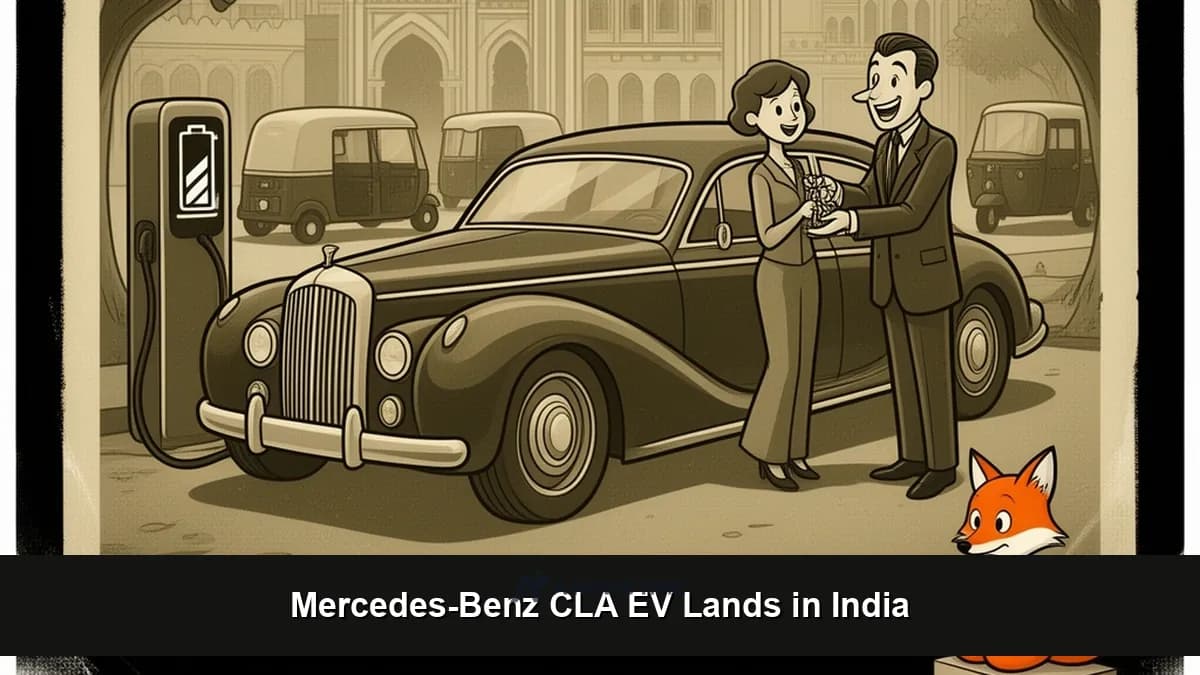
Mercedes-Benz India launched the all-electric CLA sedan in New Delhi on , marking the CLA nameplate's return to the Indian market after its ICE-powered version was discontinued in 2020. The new CLA EV, based on the company's MMA platform, is expected to be priced around Rs 55 lakh ex-showroom, consolidating the brand's entry-level sedan and two entry electric SUV nameplates into a single model. It is the first Mercedes-Benz vehicle sold in India to use the MMA platform, which the company has designed to support both pure-electric and hybrid variants across global markets.
The CLA EV competes directly with the Tesla Model Y (priced from Rs 49.89 lakh) and the Kia EV6 (Rs 60.95 lakh) in India's premium electric segment, which has seen growing competition as multiple global brands attempt to establish market position before domestic manufacturers close the technology gap. Mercedes-Benz India MD and CEO Santosh Iyer has framed the CLA EV as the brand's entry point into electric mobility for Indian buyers who have been priced out of the EQS or EQE, with the Rs 55 lakh price point representing the most accessible battery-electric Mercedes ever offered in the country.
Powertrain Specs: What the Numbers Actually Mean
Mercedes-Benz is launching the CLA EV in India in the CLA 250+ Long Range configuration, which uses an 85 kWh battery pack driving a rear-mounted electric motor producing 268 horsepower and 335 Newton-meters of torque. The company also offers a CLA 200 Standard Range globally, with a claimed range of 542 km on the WLTP cycle, but full specifications for the CLA 200 have not been disclosed at launch, and the India market initially receives the 250+ only.
The CLA 250+'s 792 km WLTP range claim is the headline figure in Mercedes-Benz's India launch materials. That number requires context. WLTP certification uses a test cycle that combines urban, suburban, and highway driving segments at moderate speeds and mild temperatures. Real-world range in India's conditions, which include stop-and-go urban traffic in Delhi and Mumbai, highway speeds of 100-120 km/h, and summer temperatures that can exceed 40 degrees Celsius, will come in materially below 792 km. Independent testing in European conditions has typically shown WLTP-rated EVs achieving 75 to 85 percent of the claimed range under mixed real-world conditions. Applied to the CLA 250+, that translates to a realistic range of roughly 595 to 673 km under normal Indian driving, which remains among the longest ranges in the segment at the price point.
The vehicle uses a two-speed automatic transmission, an uncommon configuration for an BEV. Most electric cars use single-speed reduction gearboxes; Mercedes-Benz introduced the two-speed unit to improve both low-speed efficiency and high-speed performance simultaneously. The 0-100 km/h time of 6.7 seconds is modest by electric car standards but appropriate for a luxury sedan positioned on efficiency rather than acceleration. The more telling performance figure is the claimed top speed of 210 km/h, which positions the CLA 250+ above the highway speeds where most Indian expressways are governed.
| Model | Battery | Power | Claimed Range | 0-100 km/h | Max DC Charging | India Price (ex-showroom) |
|---|---|---|---|---|---|---|
| Mercedes-Benz CLA 250+ EV | 85 kWh | 268 hp / 335 Nm | 792 km (WLTP) | 6.7 s | 240 kW | ~Rs 55 lakh |
| Tesla Model Y Long Range | 75 kWh | 456 hp (dual motor) | 681 km (WLTP) | 4.4 s | 250 kW | Rs 61.99 lakh |
| Kia EV6 GT-Line | 77.4 kWh | 229 hp | 528 km (WLTP) | 7.3 s | 233 kW | Rs 60.95 lakh |
| BMW i4 eDrive40 | 83.9 kWh | 340 hp | 590 km (WLTP) | 5.7 s | 210 kW | Rs 77.00 lakh |
Sources: Manufacturer specifications; Indian market pricing per respective brand launch data as of April 2026. WLTP figures; real-world range typically 75-85 percent of WLTP.
"The CLA Electric is not just a new product for us; it is the foundation of our new electric architecture in India. With the MMA platform, we have a long runway to bring more models to Indian customers who want the Mercedes-Benz experience at a more accessible price point."
Santosh Iyer, Managing Director and CEO, Mercedes-Benz India, at the CLA EV India launch, April 24, 2026
The MMA Platform and What It Enables
The MMA platform underpinning the CLA EV is one of two new electric architectures Mercedes-Benz is bringing to market in the 2025 to 2028 period. The other is MBEAplus, used for larger vehicles like the EQS and EQE. MMA is designed for compact-to-midsize vehicles and is built around 800-volt electrical architecture, which is what enables the CLA's 240 kW DC fast-charging ceiling. The 800V system allows thinner, lighter wiring harnesses compared to 400V systems, reducing the cable weight penalty in the charge path at high current levels.
The significance of MMA for Mercedes-Benz's India strategy is forward-looking. The platform is engineered to accept both pure-electric and mild-hybrid or plug-in-hybrid powertrains on the same production line. For a market like India, where charging infrastructure in Tier 2 and Tier 3 cities remains sparse and range anxiety is a real purchase barrier, the ability to offer hybrid variants of MMA-based vehicles expands the addressable customer base substantially beyond pure-EV buyers. Mercedes-Benz has not confirmed whether a hybrid CLA will come to India, but the architectural flexibility makes it a logical option once the brand validates customer demand with the electric-only launch.
The 800-volt architecture also positions the CLA EV for compatibility with India's evolving fast-charging network. Currently, most public DC chargers in India operate at 50 kW, with a growing number of 150 kW stations at highway corridors managed by operators like Tata Power and ChargeZone. The CLA's 240 kW ceiling will not be utilizable at these stations today; the car will charge at the station's maximum output, not its own maximum input. But as India's highway DC fast-charging network upgrades to higher-capacity units, CLA EV owners will benefit from faster stops without any change to the vehicle.
Design and Interior: The Shift Away from EQ-Series Language
The CLA EV's exterior departs from the visual language of Mercedes-Benz's standalone EQ-series models. The closed-off front grille with illuminated three-pointed star motifs replaces the EQA and EQB's shield-style fascia, and the slim LED headlamps connected by a thin light bar give the car a more contemporary silhouette without the overwrought blue-accent detailing that characterized first-generation EQ models. The rear uses a similar connected LED strip across the tail lamp cluster. Overall proportions are a coupe-sedan form with flush door handles and 18-inch aero-optimized alloy wheels, the latter chosen to reduce rolling resistance rather than maximize visual drama.
Color options in India include Clear Blue, Cosmic Black, Polar White, Alpine Grey, and Patagonia Red, a broader palette than the EQA launched in India in 2023. The India-spec vehicle is expected to launch in a single variant initially, with additional powertrain options potentially following if the 250+ finds the volume to justify additional inventory planning.
Inside, Mercedes-Benz has used its current-generation digital cockpit architecture: a 10.25-inch driver display and a 14-inch central touchscreen running the latest MBUX software. The global specification includes an additional passenger-side display, but that unit's availability in the India-market trim has not been confirmed as standard. Powered and heated front seats with memory, a fixed panoramic glass roof, automatic climate control, and touch-sensitive steering controls are part of the specification. The absence of ventilated seats is the most notable omission given India's climate; it is a specification gap that will limit the car's appeal to buyers in southern and western India who experience extended periods above 35 degrees Celsius.
Safety and ADAS: The Euro NCAP Story
The CLA EV received a five-star Euro NCAP safety rating in 2025, covering both adult occupant and child occupant protection, vulnerable road user interaction, and driver assistance systems. The rating is relevant for the Indian market primarily as a credentialing signal rather than a directly applicable test, since Euro NCAP's test conditions differ from the road environment and crash typologies most common in India. BNCAP, India's domestic testing program, has tested an expanding roster of vehicles since launching in 2023, but has not yet tested the CLA EV as of this report.
The India-spec safety suite includes six airbags, a 360-degree camera, blind-spot monitoring, tyre-pressure monitoring, and an electronic parking brake. The Level 2 ADAS package covers adaptive cruise control, lane-keep assist, and automatic emergency braking. Level 2 capability is increasingly table stakes in the Rs 50-60 lakh segment in India; the Kia EV6 and Tesla Model Y both offer comparable driver assistance systems at overlapping price points.
Mercedes-Benz has a well-documented challenge in India: the brand's installed service network, while growing, remains concentrated in Tier 1 cities. For the CLA EV, after-sale service quality matters more than for an ICE vehicle, because battery health management, software updates, and charging hardware support require technician training that independent workshops cannot provide. The brand has not disclosed how many service centers are certified for high-voltage EV work at the time of the India CLA launch, which is a detail buyers should verify before committing.
Market Context: India's Rs 50-60 Lakh EV Segment
Mercedes-Benz India has consistently positioned itself in the premium and ultra-premium segments where import duties and local assembly economics allow relatively thin volume with strong per-unit margins. The Rs 55 lakh price point for the CLA EV is, by Mercedes-Benz India standards, a deliberate attempt to open a new volume tier. The company sold fewer than 20,000 vehicles in India in 2025, largely in the Rs 70 lakh and above segment; the CLA EV is an explicit attempt to attract buyers who would otherwise consider a volume-brand premium SUV or a direct EV competitor.
The competitive set at Rs 50-60 lakh has changed substantially since 2023. Tesla entered India in 2025 with the Model Y Long Range at Rs 61.99 lakh. BYD's Atto 3 and Seal compete at lower price points but offer Chinese-market technology that is increasingly credible. Hyundai's Ioniq 5 sits at Rs 45.95 lakh. Against this backdrop, the CLA EV's 792 km WLTP range claim is its clearest differentiation: no competitor in the segment publicly claims equivalent range at a comparable price point, and Mercedes-Benz's brand equity still commands a loyalty premium among the segment's target buyers.
The EV market growth context in India: battery electric vehicle sales in India grew approximately 71 percent year-over-year in 2025 to roughly 125,000 units, still a fraction of the 4.2 million total passenger vehicle market but growing from a meaningful base. The premium EV segment, above Rs 40 lakh, accounts for less than 15 percent of total EV sales by volume, meaning the CLA EV is entering a high-value but volume-limited slice of the market. Mercedes-Benz India's goal is likely not breakout volume but category establishment: putting a long-range, fast-charging MMA-platform vehicle in front of buyers who will form brand associations that carry through the next two to three product cycles. For the broader EV demand picture in Europe and how it contrasts with the Indian dynamic, see our analysis of Germany's BEV sales surge in March 2026.
Skeptic's Corner: What the Data Does Not Say
Three important numbers are missing from the CLA EV India launch materials. First, actual India-market on-road pricing. The Rs 55 lakh figure is ex-showroom and excludes road tax, registration, insurance, and any dealer handling charges. In Maharashtra, road tax for EVs is currently zero, but registration and insurance can add Rs 2-4 lakh to the on-road figure depending on the city. Second, battery warranty terms for India. Mercedes-Benz has not published a specific battery capacity retention guarantee for the India market, and the standard global 8-year/160,000 km warranty may come with conditions that limit its practical application in India's high-temperature environment.
Third, the 792 km WLTP claim is a manufacturer figure, not an independent test result. Mercedes-Benz's own engineering teams have demonstrated the ability to optimize for WLTP scores specifically; the test cycle uses a defined speed profile that rewards large batteries and efficient drivetrains at moderate loads. An independent test by Autocar India or similar publication at representative Indian highway speeds of 100-120 km/h would likely return a substantially lower number. Given the CLA 250+'s 85 kWh battery and 268 horsepower output, a real-world range of 550 to 620 km at mixed Indian driving conditions is a more defensible expectation than 792 km.
None of this diminishes the CLA EV's positioning as a competent, well-specified entry-level luxury EV for India. The MMA platform architecture, 800V charging system, and Euro NCAP five-star rating are genuine product strengths. The caveat is that buyers should treat the 792 km range as a ceiling, not a planning figure, and factor in current DC fast-charging network limitations when evaluating the car's practical utility for long-distance Indian highway travel. For related context on how Mercedes-Benz stacks up in the broader India EV market against Hyundai's approach, see our piece on Hyundai's EV strategy in Asian markets. For fast-charging context globally, see how BYD's ultra-fast charging battery is reshaping expectations across segments.
Sources
- Mercedes-Benz CLA EV India launch on April 24: Range, features and expected price - News9 Live via MSN
- Mercedes-Benz CLA EV to launch in India on April 24: Check design, specs and more - NDTV via MSN
- Mercedes-Benz CLA EV India launch on April 24: A new entry point into luxury EVs - Times Now via MSN
- 2026 Porsche Cayenne Electric Review, Pricing, and Specs - Car and Driver (for competitive context)