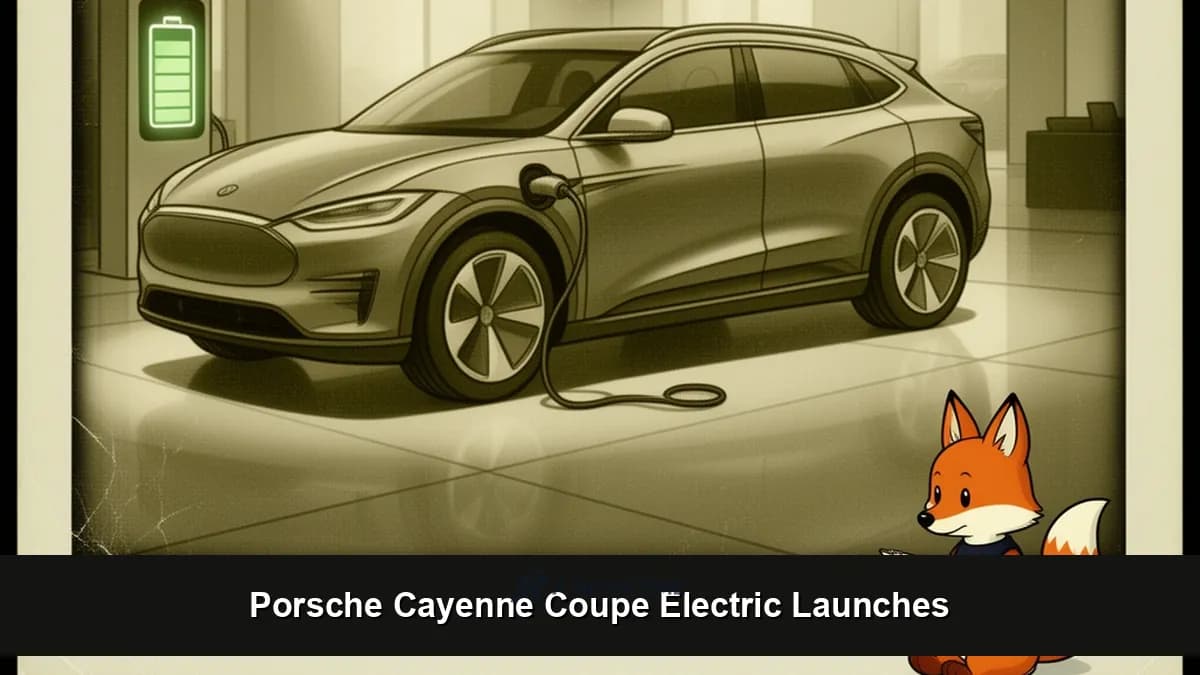
Porsche introduced the 2026 Cayenne Coupe Electric on , following the standard Cayenne Electric crossover it announced earlier this year. The Coupe shares the same 108 kWh battery pack, three trim levels, and 400-kilowatt DC fast-charging architecture as the crossover, but replaces the upright roofline with a sloping profile inspired by the 911's signature silhouette that Porsche calls the "flyline." It sits 24 millimeters lower than the standard Cayenne Electric, runs the same wheelbase and footprint, and adds a panoramic glass roof and Sport Chrono Package as standard equipment not carried over from the SUV variant. Porsche quotes deliveries in the second half of 2026, with pricing expected to carry a 5 to 10 percent coupe premium over crossover equivalents.
The announcement confirms a now-familiar VW Group playbook: launch an electric crossover, harvest early press, then add a coupe derivative that commands a higher transaction price without requiring a separate development program. Porsche says 40 percent of historical Cayenne buyers have chosen the Coupe body style over the standard SUV, which means the variant is not a niche play. At those sales ratios, the Coupe Electric stands to be one of the brand's highest-revenue per-unit EVs from the moment deliveries begin.
What the Coupe Actually Changes
A "coupe" Cayenne is less dramatic a departure from the standard model than the name implies. The Coupe Electric uses the same underpinnings, battery, motors, and charging hardware as the regular Cayenne Electric. The structural changes are concentrated from the A-pillar rearward: Porsche redesigned the windscreen angle, modified the roofline arc to produce the flyline shape, and lowered the ride height 24 mm relative to the crossover. The result is an aerodynamic profile the brand says improves Cd modestly, though Porsche has not published a specific drag coefficient comparison at this writing.
Cargo volume is slightly compromised by the sloping roofline, as expected. The Coupe Electric offers 534 to 1,347 liters of boot capacity compared to the crossover's larger flat-load floor, though Porsche retains the 90-liter frunk and quotes up to 3.5 tonnes of towing capacity on both body styles. Rear-seat headroom takes the typical coupe haircut: adults taller than six feet will find the second-row ceiling tighter than in the crossover, a physics constraint no manufacturer has yet engineered around without a substantial height increase.
What the Coupe adds relative to the standard Cayenne Electric is notable. The panoramic glass roof and Sport Chrono Package are standard across the lineup, hardware that is optional on the crossover. Rear-axle steering with up to five degrees of angle is available on all Coupe trims, and Porsche Active Ride active suspension is optionally available on the S and Turbo variants. Those additions help close the value gap created by the expected price premium.
Specs and Trim Comparison: Cayenne Electric vs Cayenne Coupe Electric vs Macan Electric
The Cayenne Electric lineup runs three trims using a single 108 kWh battery pack across all variants. Power output climbs from 435 horsepower in the base model to 1,139 horsepower in the Turbo, an extraordinary spread that reflects the difference between a single rear motor and a tri-motor performance configuration. The Cayenne Coupe Electric mirrors these powertrains exactly; the only meaningful changes are dimensional and aerodynamic.
For context, the Macan Electric, which occupies the compact luxury SUV slot one size below the Cayenne, uses a 95 kWh battery and tops out at 630 horsepower in the Turbo trim at $115,050. The Cayenne Coupe Electric base model is expected to start above $116,000 once the coupe premium is applied to the crossover's $111,350 base, making the entry-level Coupe more expensive than the top-of-line Macan Turbo.
| Model / Trim | Battery | Power (hp) | 0-60 mph | EPA Range | Max DC Charging | Base MSRP |
|---|---|---|---|---|---|---|
| Cayenne Electric Base | 108 kWh | 435 | 4.5 s | 335 mi | 400 kW | $111,350 |
| Cayenne Electric S | 108 kWh | 657 | 3.6 s | 335 mi | 400 kW | $128,650 |
| Cayenne Electric Turbo | 108 kWh | 1,139 | 2.4 s | 335 mi | 400 kW | $165,350 |
| Cayenne Coupe Electric Base | 108 kWh | 435 (408 PS) | 4.8 s (0-100 km/h) | TBD (est. 320-330 mi) | 390-400 kW | Est. $116,000+ |
| Cayenne Coupe Electric Turbo | 108 kWh | 1,139 (1,156 PS) | 2.5 s (0-100 km/h) | TBD | 390-400 kW | Est. $173,000+ |
| Macan Electric Base | 95 kWh | 335 | 5.0 s | 290 mi | 270 kW | $82,650 |
| Macan Electric Turbo | 95 kWh | 630 | 2.9 s | 308 mi | 270 kW | $115,050 |
Sources: Car and Driver (2026 Cayenne Electric, 2026 Macan Electric). Cayenne Coupe Electric MSRP estimated; official US pricing not published as of April 24, 2026. 0-100 km/h figures from Porsche/OneShift for Coupe variants.
One figure worth examining: the Cayenne Electric crossover's 335-mile EPA range does not vary across the three trim levels, which is unusual. Higher-output trims typically show reduced range due to heavier battery draw under load, but the EPA's combined cycle test smooths those differences at moderate throttle. Real-world range at sustained highway speeds or in cold climates will diverge more meaningfully. The Turbo's 1,139-horsepower output can drain the 108 kWh pack substantially faster than EPA testing captures, particularly if owners are using it as advertised.
"The design is unmistakably Porsche: dynamic proportions, slim Matrix LED headlights, a sculpted flyline and a completely reimagined interior that sets new standards in the luxury SUV class."
Porsche AG press materials on the Cayenne Coupe Electric, April 2026
The 800-Volt Architecture and Charging Reality
Both Cayenne Electric variants are built on an 800-volt architecture, which is the same electrical system found in the Macan Electric and, broadly, across the VW Group's PPE platform. The 800V system enables the 400 kW maximum DC charging rate Porsche quotes, though reaching that peak requires a compatible CCS charger capable of delivering that current. In practice, the EV public charging network in the United States has relatively few 400 kW-capable stations; most DC fast chargers operate at 150 to 350 kW.
The Cayenne Coupe Electric documents a DC charging ceiling of 390 kW under standard conditions, rising to 400 kW under "ideal" conditions, a qualification Porsche does not define in press materials. The practical distinction between 350 kW and 400 kW charging matters less than the charging curve shape: peak rates are typically available only for a short window near the bottom of the state of charge, and taper as the pack fills. Porsche quotes no end-to-end charge time from a specific state of charge, which makes the raw kW figure difficult to translate into a trip-planning number without independent testing.
For AC overnight charging, both Cayenne Electric variants support 11 kW standard, with 22 kW optional. A full charge from empty on a 22 kW L2 circuit takes approximately five hours. On a standard 11 kW circuit, that figure roughly doubles. For buyers who primarily charge at home, the overnight window is more than adequate for typical daily mileage; the 400 kW DC ceiling is relevant mainly for road trips where minimizing stop time matters.
VW Group Context: Why This Timing Makes Sense
Volkswagen Group has been under significant financial pressure since 2024, executing a restructuring that included headcount reductions and plant consolidation across its German operations. Porsche, which trades separately on the Frankfurt exchange, has maintained stronger margins than the group as a whole, and the Cayenne platform is central to those margins: the Cayenne and Cayenne Coupe together represent one of the highest-revenue nameplates in Porsche's lineup.
The decision to launch the Coupe Electric quickly after the standard Cayenne Electric tracks the brand's established cadence. The ICE-powered Cayenne Coupe launched approximately six months after the standard Cayenne in the 2019 generation cycle. By compressing that window further for the electric generation, Porsche gets a higher-transaction-price variant into showrooms before the competitive pressure from luxury EV SUVs intensifies in late 2026 and 2027. BMW's iX, Mercedes-Benz's EQS SUV, and Audi's Q8 e-tron are all priced below the Cayenne Electric's entry point, giving Porsche pricing headroom that depends partly on executing before those competitors can close the performance gap.
The coupe premium itself is worth unpacking. If the Cayenne Coupe Electric carries a 7 percent premium over the crossover, the base trim clears $119,000 and the Turbo approaches $177,000. At those numbers, Porsche is competing directly with the Lucid Gravity SUV, which starts at $94,900 and delivers 440 miles of EPA range in its longest-range configuration, nearly 100 miles more than the Cayenne Electric at less than the Cayenne's base price. The range gap, combined with the price gap, is the most direct competitive challenge Porsche will need to address with real-world performance data once the Coupe Electric is in customer hands.
The broader VW Group picture matters here. Porsche confirmed through the Cayenne Coupe Electric announcement that the brand remains committed to the all-electric premium SUV segment at scale. That commitment was not obvious in 2024 and early 2025, when VW Group publicly debated its EV pace amid weaker demand in Germany and the United States. The Cayenne Electric platform, already carrying a full gross margin given its pricing, gives Porsche the financial buffer to push forward without needing the mass-market EV volume that has stressed competitors. For more on VW Group's broader EV strategy in China, see our coverage of the group's Beijing Auto Show push.
Coupe Practicality: What Buyers Are Trading Off
The practical tradeoffs of the Coupe body style are predictable but worth quantifying for buyers trying to decide between the two variants. Cargo volume drops from the crossover's flat load floor to 534 liters minimum in the Coupe, a meaningful reduction for buyers who use the Cayenne as a family hauler. The 90-liter frunk common to both variants partially offsets this, and Porsche's flexible rear-seat arrangement allows the load floor to be extended. But the lower roofline over the rear seating area is a binary constraint: it is there, and it limits second-row headroom in ways that no option package resolves.
For buyers who primarily carry two adults and occasional gear, the Coupe's compromises are minimal. The 3.5-tonne tow rating means the Coupe can pull a trailer or boat in the same weight class as the crossover. Porsche Active Suspension Management and the optional Porsche Active Ride system are carried over, so the Coupe does not give up any chassis sophistication relative to the SUV variant. The standard Sport Chrono Package is relevant for track or spirited-driving buyers: it adds launch control, a stopwatch, and driving mode sharpening that the base Cayenne Electric crossover requires as an add-on.
For EV-market context and how Porsche compares to broader demand trends, see our analysis of how BYD overtook Tesla as the world's top EV seller in 2025 and the divergence between new and used EV market performance. The premium segment where Porsche operates has held more resilient demand than the mass-market EV tier, but it is not insulated from the same buyer caution that has pushed many EV nameplates below their initial sales forecasts.
What to Watch Before Deliveries
Porsche has set a delivery window of H2 2026 for the Cayenne Coupe Electric, which gives the brand approximately six months to finalize US pricing, complete homologation, and ramp production at the Leipzig plant. The most important number that has not yet been published is US EPA-rated range for the Coupe. The coupe body's lower drag coefficient should, in theory, improve efficiency relative to the crossover's 335-mile rating, though real-world tire sizing and weight differences can offset aerodynamic gains. If the Coupe achieves 340 to 345 miles of EPA range, it becomes a slightly more compelling long-trip vehicle than the crossover at a higher sticker price, which is the correct value proposition.
Independent testing will also determine how the 400 kW charging ceiling translates to actual charge curves. Porsche's quote of adding 325 km of range in 10 minutes at peak charging applies to the Cayenne Turbo Electric in ideal conditions; the same interval on a 150 kW DC charger, the most common fast charger type in the US public network today, would add roughly 100 km. For buyers planning road trips, the charging infrastructure question matters more than the headline peak rate.
Finally, official US pricing has not been announced. The coupe premium range of 5 to 10 percent over crossover equivalents is standard industry practice, but Porsche has some flexibility given the expanded standard equipment relative to the crossover. If the brand sets the Coupe at parity or within 3 percent of the crossover, the additional standard equipment makes the Coupe the rational choice for style-agnostic buyers. At the full 10 percent premium, buyers face a meaningful dollar gap for what is, mechanically, the same vehicle with a different roofline. For more on fast-charging technology and the competitive EV race, see our report on BYD's super-fast charging battery.
Sources
- Porsche quickly follows 2026 Cayenne Electric with pricier coupe - Automotive News, April 24, 2026
- 2026 Porsche Cayenne Electric Review, Pricing, and Specs - Car and Driver
- 2026 Porsche Macan Electric Review, Pricing, and Specs - Car and Driver
- Porsche Cayenne Coupe Electric Now Ready For Configuration In Singapore - OneShift, April 24, 2026