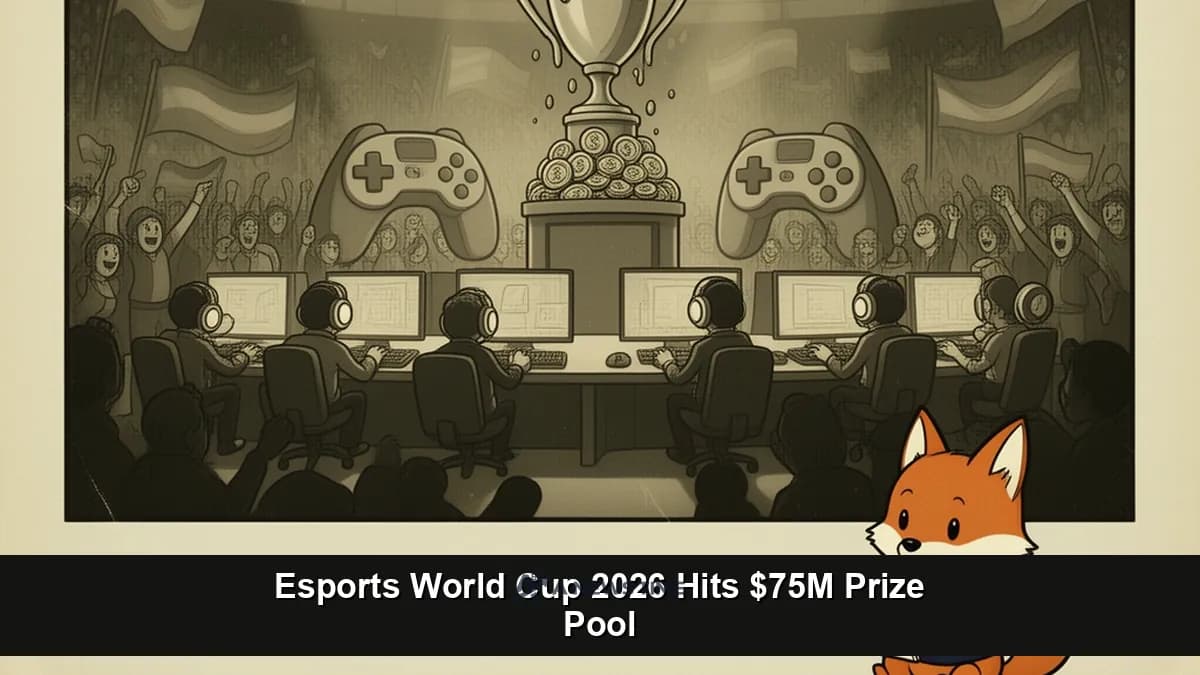
The Esports World Cup Foundation announced on that the third annual Esports World Cup will carry a $75 million prize pool when it opens in Riyadh, Saudi Arabia, on , positioning the event as the largest multi-title esports competition in history for the third consecutive year. The 2026 figure represents a $5 million increase over EWC 2025's $70 million pool and a cumulative $15 million jump from the inaugural 2024 edition, which launched with a $60 million total. More than 2,000 players and 200 clubs from over 100 countries will compete across 25 tournaments spanning 24 games over the course of the summer.
The event, organized by the EWCF with financial backing from Saudi Arabia's sovereign wealth fund, has grown into something that did not exist three years ago: a single event that serves simultaneously as the biggest financial opportunity in competitive gaming, the broadest cross-title showcase in the industry, and a deliberate soft-power statement from a nation that has committed billions to sport and entertainment as part of its Vision 2030 economic diversification strategy. Both of those realities matter when analyzing what EWC 2026 means for the competitive ecosystem at large.
The Numbers and What They Represent
The $75 million headline figure requires some unpacking to understand how money actually flows at the Esports World Cup. The event operates on a layered distribution model with three primary pools: the Club Championship, individual Game Championships, and Road to EWC qualifier rewards.
The Club Championship is the structural centerpiece of the event. Based on the 2025 model, it accounts for roughly $27 million of the total prize allocation and is distributed across the top 16 organizations based on cumulative performance points earned across all game titles. The top Club takes home $7 million, making a single organization's Club Championship victory the richest prize in esports history outside of certain traditional sports prize structures. The remaining Game Championships split the bulk of the remaining prize pool, with individual title championship purses ranging from under $1 million for newer additions to multi-million-dollar allocations for flagship titles like CS2, LoL, and Dota 2. The Road to EWC qualifier circuit, which runs through partnered publisher events leading up to July, distributes more than $5 million to the players and clubs earning their way to Riyadh.
For individual players, the financial stakes at EWC 2026 are unlike anything in competitive gaming's history. A roster member on the Club Championship-winning team earns life-changing money. Even participants on clubs that finish in the middle of the Club Championship standings collect meaningful prize shares, which is a deliberate design choice by the EWCF to improve financial stability across the organization tier of the ecosystem, where revenue volatility has historically been severe.
| Year | Total Prize Pool | YoY Change | Games / Tournaments | Club Championship Prize |
|---|---|---|---|---|
| $60 million | Inaugural | 21 games / 22 tournaments | $7 million | |
| $70 million+ | +$10 million (+17%) | 24 games / 25 tournaments | $7 million | |
| $75 million | +$5 million (+7%) | 24 games / 25 tournaments | $7 million |
The rate of growth is itself a signal worth reading carefully. The jump from 2024 to 2025 was $10 million, or roughly 17 percent. The 2025 to 2026 increase is $5 million, or about 7 percent. That deceleration does not necessarily signal concern, the pool is already so large that sustaining double-digit percentage growth indefinitely would require enormous capital commitments, but it does suggest the EWCF is calibrating prize pool growth against longer-term sustainability rather than using escalation as pure spectacle.
The 2026 Game Lineup: Fortnite and Trackmania Join the Field
The 24-title lineup for EWC 2026 retains the core of the 2025 roster while making two notable additions: Fortnite, specifically via the Reload Elite Series Championship format, and Trackmania, representing one of the more surprising inclusions given the game's niche European audience profile. Fortnite's addition is strategically significant. Epic Games' battle royale title has operated outside of the EWC umbrella until now, and its inclusion brings a title with genuine mainstream crossover appeal and a dedicated content-creator community that meaningfully expands the event's broadcast footprint.
The full 2026 game lineup, in alphabetical order: Apex Legends, Call of Duty: Black Ops 7, Call of Duty: Warzone, Chess, CS2, Crossfire, Dota 2, EA Sports FC 26, FATAL FURY: City of the Wolves, Fortnite, Free Fire, Honor of Kings, League of Legends, Mobile Legends: Bang Bang, Overwatch 2, PUBG: Battlegrounds, PUBG Mobile, Rocket League, Street Fighter 6, Teamfight Tactics, TEKKEN 8, Rainbow Six Siege, Trackmania, and VALORANT.
Several observations about this lineup deserve direct acknowledgment. The presence of Chess, now in its second EWC appearance, continues to be one of the more unusual curatorial choices and reflects the Foundation's commitment to a broad definition of competitive gaming. The inclusion of mobile-first titles including Free Fire, Honor of Kings, PUBG Mobile, and Mobile Legends: Bang Bang is a deliberate and commercially rational acknowledgment that the Southeast Asian and South Asian competitive gaming ecosystems operate on entirely different platforms and audiences than the PC-dominant Western esports scene. Any analysis of EWC's prize pool significance that ignores the mobile tier is missing approximately half of the competitive ecosystem the event is designed to serve.
"The record-breaking $70+ million prize pool, along with our commitment to the Club Partner Program and our multi-year publisher agreements, is a privilege to announce and validation of our purpose to elevate the industry, by giving players, clubs, publishers and all other stakeholders the stability needed to invest for future success. It's not just to have more money at stake, but to create opportunities for everyone at every level of the ecosystem, and strengthen the industry for generations to come."
Ralf Reichert, CEO, Esports World Cup Foundation (on EWC 2025 prize pool announcement)
The EWCF has not yet published the individual per-game prize pool breakdown for 2026, but the distribution pattern from 2025, where the combined Game Championships total exceeded $38 million across 24 titles, provides a reasonable floor for estimating individual title allocations. Flagship PC titles historically receive the largest individual Game Championship purses. EWC 2025's CS2 championship, for instance, carried a prize pool consistent with top-tier IEM events.
The Saudi Context: Vision 2030 and the Business of Esports Investment
The Esports World Cup would not exist without Saudi Arabia's Public Investment Fund, and it is worth being honest about what that means for the industry. The PIF, which is also in the process of acquiring Electronic Arts in a $55 billion transaction currently under FTC review, has committed sustained capital to building Riyadh as a global hub for gaming and esports. The EWC is the centerpiece of that effort.
The geopolitical dimension of this investment generates legitimate debate within competitive gaming communities, and that debate is not going to resolve itself. What is observable and relevant from a competitive ecosystem perspective is the structural impact: the EWC prize pool has unambiguously elevated the financial floor for elite competitive play across multiple titles, and the EWCF's Club Partner Program, which provides operational funding to partner organizations, has given top clubs a source of revenue that operates independently of tournament prize variance. For organizations like Team Liquid, Fnatic, G2 Esports, T1, and Team Falcons, the EWCF relationship has become one of the most significant funding relationships in their business models.
We covered the broader competitive gaming financial landscape in our overview of 2026 shaping up as a record year for esports prize pools, where the EWC's influence on year-round prize pool inflation across non-EWC events was already measurable. The 2026 announcement continues that trend. Event organizers and publishers that want to retain top talent for their own competitions have to compete against the financial gravity of an event that pays $75 million in a single summer.
The 2024 inaugural event attracted more than 500 million online viewers and 2.6 million in-person visitors to Riyadh's Boulevard City venue complex. EWC 2025 produced over 7,000 hours of live broadcast content, a figure second only to the Paris 2024 Olympics in global sports broadcast volume. The scale of the production operation is now genuinely comparable to what traditional sports governing bodies build for major international events, which is itself a statement about how far competitive gaming has traveled as a broadcast product in the past decade.
For further context on how mobile titles like Honor of Kings and PUBG Mobile fit into the EWC ecosystem, our coverage of the Honor of Kings World Cup 2026 details how mobile esports has developed the infrastructure needed to compete on stages like Riyadh.
Club Championship Dynamics: What the 2026 Field Looks Like
The Club Championship is what distinguishes the EWC from every other multi-title event format that has been attempted in esports. Rather than treating each game as a standalone tournament, the Club Championship aggregates performance points across all 25 competitions to rank organizations against each other holistically. The club with the highest total point score at the end of the summer wins the Club Championship and its $7 million grand prize.
At EWC 2024, Team Falcons dominated by securing 10 top-three finishes across games, finishing with 5,665 points and winning the $7 million Club Championship title. Team Liquid finished second with 2,545 points, and Team BDS placed third with 2,000 points. The gap between first and second place tells you something important about how the format currently rewards breadth of competitive excellence: Falcons were not just good at a few games, they were consistently strong across the entire portfolio.
The 2025 edition saw Team Liquid, Team Falcons, and a strong showing from newer contenders including Twisted Minds, who won the Warzone Resurgence Championship. With 40 top clubs enrolled in the EWCF Club Partner Program for 2026, including organizations like 100 Thieves, Cloud9, FaZe Clan, Karmine Corp., NAVI, Sentinels, and ZETA DIVISION, the competitive field is the deepest it has been in the event's three-year history.
The Club Championship format creates roster construction incentives that do not exist elsewhere in esports. Organizations that want to win the overall Club Championship have to field competitive rosters across multiple titles simultaneously, which drives up roster investment significantly. That dynamic concentrates player talent at the top organizations, which is not unambiguously positive for the broader competitive ecosystem, but it does make the event itself more compelling as a showcase of organizational depth.
Industry Implications: What $75M Actually Does to the Market
Prize pool records generate headlines, but the more meaningful industry question is what the EWC's scale does to the competitive market infrastructure that operates around and between the summer event. There are a few observable effects that warrant analysis.
First, the EWCF's multi-year publisher agreements, which provide financial support for external competitions that serve as Road to EWC qualifiers, are a subsidy for the annual competitive calendar of participating titles. When Riot Games, Activision, and Capcom sign EWCF partnership agreements, they are not just gaining prize pool contributions for their own events: they are building a qualification pathway that motivates players and teams to participate in their circuits year-round. For CS2, Dota 2, and League of Legends, the EWC has become integrated into their competitive structure in ways that make the event difficult to separate from the titles' annual ecosystem health.
Second, the Fortnite inclusion for 2026 is a meaningful data point about Epic Games' strategic positioning. Fortnite's competitive scene has oscillated between high investment and apparent neglect over the past several years, and Epic's decision to engage with the EWC suggests a renewed commitment to competitive play that could influence the title's tournament calendar beyond Riyadh. Epic's recent Reload Elite Series format, which the EWC will host as its Fortnite championship, is a faster-paced and more broadcast-friendly competitive structure than the earlier Chapter-era formats.
Third, the aggregate viewing and attendance figures from the first two EWC editions are creating advertising and sponsorship pricing pressure that affects the entire esports industry. When the EWC can credibly claim 500 million online viewers and 7,000 broadcast hours, it becomes a reference point for brand partners evaluating sponsorship valuations across the ecosystem. That influence extends well beyond the summer event itself.
For the competitive gaming industry as a whole, EWC 2026 represents both the ceiling and the clearest indication of where the ceiling is heading. The combination of $75 million in prizes, a genuinely global multi-title format, broadcast scale that rivals traditional sports, and the organizational stability provided by the Club Partner Program is a package that no other single entity in esports is currently positioned to replicate. Whether that concentration of resources in a single event run by a sovereign wealth fund-backed foundation is healthy for the long-term distribution of competitive gaming's economic base is a question the industry will be debating for years.
The ESL Birmingham Dota 2 event we covered in detail offers a useful counterpoint: established event organizers operating at regional and global level without PIF backing are still producing high-quality competitive products with meaningful prize stakes. See our coverage of the ESL One Birmingham 2026 Dota 2 playoffs for how those ecosystems interact with EWC's calendar.
What to Watch For Between Now and July
The EWC 2026 announcement window will extend through the spring as individual game publishers confirm their tournament formats, prize pool breakdowns, and qualification structures. Several items are worth tracking specifically.
Individual game prize pool announcements for flagship titles like CS2 and Dota 2 will determine how competitive the EWC's financial offer is relative to Valve's own The International, which runs later in the year. If EWC CS2 and Dota 2 prize pools approach or exceed TI-tier allocations, it accelerates the question of whether the EWC is becoming the de facto world championship for those titles regardless of official designation.
The Road to EWC qualifier calendar for titles like VALORANT, League of Legends, and Apex Legends will indicate how deeply publishers have integrated EWC qualification into their annual structures. More integrated structures mean higher competitive stakes across the full year, not just July. For fans watching the Spring 2026 season across any of the represented titles, understanding whether their team's results have EWC qualification implications adds a layer of meaning to results that might otherwise read as purely regular-season data points.
Finally, the Club Championship standings after the first two or three weeks of competition in Riyadh will be the most-watched narrative of EWC 2026. The organizations that entered the 2026 Club Partner Program specifically to contend for the $7 million championship, rather than simply participating in individual game events, represent a growing cohort of multi-game powerhouses. Identifying which organizations have built rosters with genuine depth across the 24-title portfolio will be one of the more analytically interesting exercises of the 2026 competitive calendar.
Sources
- The Esports World Cup 2026 Sets a Record-Breaking Prize Pool — TheXboxHub, April 24, 2026
- Esports World Cup to Feature Record-Breaking Prize Pool of More Than $70 Million for 2025 Event — EWC Official, April 10, 2025
- Esports World Cup 2025 Kicks Off in Riyadh With $70 Million Prize Pool — PR Newswire / EWCF, July 10, 2025
- Esports World Cup 2026 — Liquipedia