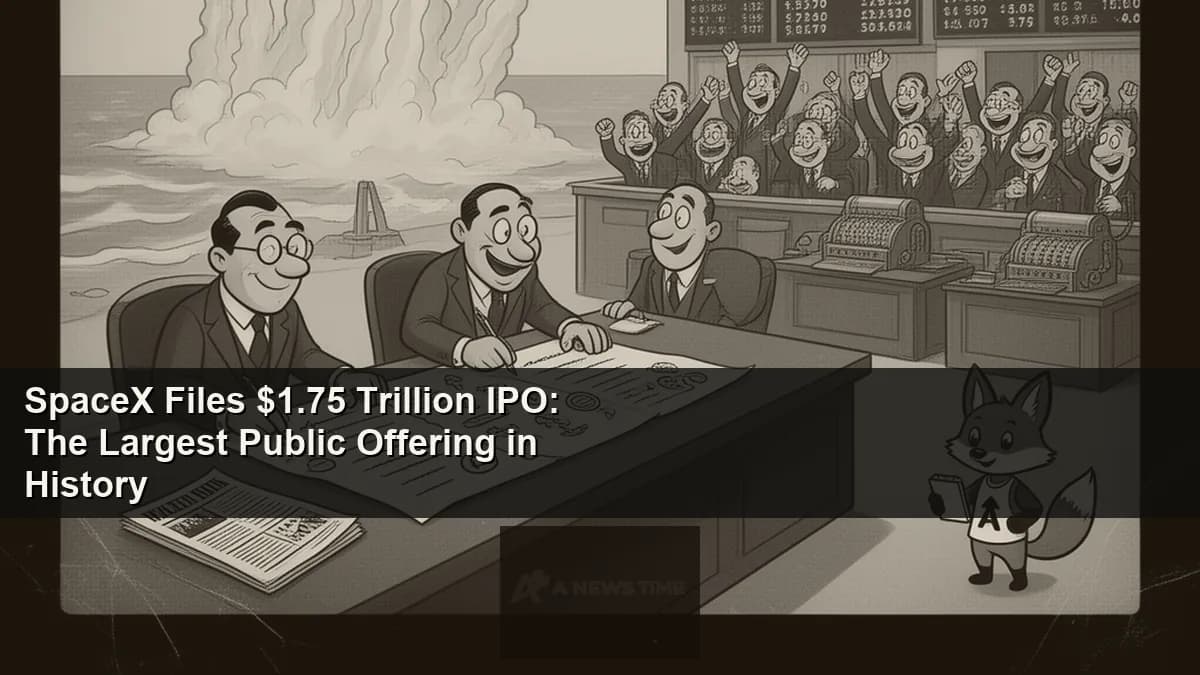
SpaceX filed confidentially with the SEC on , for an IPO that would raise approximately $75 billion and value the company at $1.75 trillion, according to reporting by Reuters. If completed at that valuation, it would surpass Saudi Aramco's 2019 offering of $29 billion as the largest public offering in history by a factor of more than two. The filing is codenamed "Project Apex" internally, and a June 2026 NASDAQ listing is expected pending SEC review. The 21-bank syndicate managing the offering includes Morgan Stanley, Goldman Sachs, JPMorgan Chase, Bank of America, and Citigroup as lead bookrunners, with sixteen additional banks in secondary roles.
The $1.75 trillion valuation would make SpaceX the most valuable public company in the world at listing, ahead of Apple ($3.1 trillion) only if the market assigns the valuation the filing seeks. More relevant as a comparison point: the valuation exceeds the combined market capitalizations of Boeing, Lockheed Martin, Northrop Grumman, and Raytheon, the four dominant legacy aerospace and defense contractors, by a factor of approximately four.
What Drives a $1.75 Trillion Valuation
The valuation arithmetic for SpaceX is more unusual than for most technology companies seeking public markets, because the company operates across multiple business lines with very different growth profiles, revenue certainties, and strategic value to the US government.
The dominant revenue driver today is Starlink, SpaceX's satellite internet constellation, which now operates more than 6,000 active satellites in low Earth orbit and serves millions of subscribers globally in both consumer and government verticals. Starlink revenue has grown at rates that private estimates put above $7 billion annually as of early 2026, driven by subscriber growth in underserved markets, expanding government contracts for military and intelligence communications, and the commercial aviation and maritime terminals market. The government contract component is particularly significant from a valuation perspective: recurring US government revenue at scale is a multiple-expander in public market comparisons to pure commercial businesses.
| Business Segment | Key Revenue Driver | Valuation Significance |
|---|---|---|
| Starlink | Subscriber revenue, government contracts | Predictable recurring revenue, highest multiple |
| Launch services (Falcon) | Commercial and government launch contracts | High margin per launch, dominant market share |
| Starship program | NASA Artemis HLS contract, future commercial | Option value on deep space commercial market |
| Defense and intelligence | NRO, DoD satellite launches and Starshield | Long-term government relationship premium |
| xAI integration | Data center access, compute partnerships | AI infrastructure narrative premium |
The xAI factor in the valuation is notable. Elon Musk's AI company xAI, which operates at a reported valuation of $1.25 trillion following its own fundraising in 2025 and 2026, has a data infrastructure relationship with SpaceX that involves satellite-based computing resources and shared orbital data center plans. Analysts covering the IPO filing have noted that the $1.75 trillion SpaceX valuation appears to partially reflect the implied value of that relationship, effectively bundling some of the xAI premium into the SpaceX offering. Whether public market investors will accept that bundled narrative or price SpaceX purely on its aerospace fundamentals will be among the most watched questions of the June listing.
Why Now: The Strategic Logic of the Timing
SpaceX has resisted public markets for most of its existence, partly because Elon Musk's previous public company experience at Tesla conditioned a preference for operational flexibility that private ownership provides, and partly because SpaceX's long-term investment horizons, including multi-decade programs like Starship, Mars colonization infrastructure, and point-to-point Earth travel, are difficult to square with quarterly earnings pressure.
Several factors converged in 2026 to change that calculation. The Artemis II lunar flyby, which the Artemis III HLS contract ties SpaceX to as the lander provider, demonstrates that SpaceX's deepest government relationship, the NASA partnership that validates Starship as a crewed transport, is producing visible results. The commercial launch market has consolidated around SpaceX to an extent that was not true three years ago. And the Starlink subscriber base has reached a scale where the revenue is large enough to anchor a valuation narrative independent of the speculative option value of Mars colonization.
The IPO also provides a liquidity mechanism for SpaceX employees and early investors who have held private shares for more than a decade. The company's private secondary markets have been active, but they are illiquid by comparison with what a public listing provides. The talent competition with Big Tech companies offering liquid equity compensation is a persistent operational challenge that a public stock solves in ways that private secondary liquidity does not fully replicate.
"The Starlink revenue base is now large enough that SpaceX can be valued on fundamentals rather than entirely on narrative. That changes the IPO math significantly compared to two years ago."
Aerospace industry analyst, per Reuters' IPO filing coverage
The Commercial Space Industry Context
SpaceX going public would be a structural event for the commercial space industry, not just a corporate finance transaction. The company controls approximately 60% of global orbital launch capacity by mass and an even larger share of low Earth orbit launch frequency. Its pricing has reset the launch market to levels that only SpaceX can match profitably, partly because of its Falcon 9 reusability and partly because of the scale advantages that come from being the dominant provider.
Public market capital at scale would accelerate the Starship development program, which is designed to be reusable at dramatically higher scales than Falcon 9 and capable of the payload capacities required for Mars missions. The $75 billion raise is large enough to fully fund Starship's development pipeline to operational status, build out a Starlink Generation 2 constellation with expanded bandwidth and coverage, and maintain the defense and intelligence launch cadence that provides baseline revenue certainty.
The secondary effect on competitors is worth noting. Rocket Lab, United Launch Alliance, Blue Origin's New Glenn, and the emerging launch vehicle startups competing for the same commercial and government contracts will find their competitive positioning relative to SpaceX more precisely valued by public markets. SpaceX's pricing power, which has already compressed margins across the industry, may attract more focused antitrust or regulatory scrutiny once the company is a publicly traded entity subject to greater disclosure requirements.
Risks the Filing Will Need to Address
A confidential S-1 filing does not become public until SpaceX makes its IPO public, but the categories of risk that prospective investors will evaluate are well understood. The concentration of authority in Elon Musk is the most frequently cited governance concern: Musk serves as CEO while also leading Tesla, running xAI, and managing other ventures. The regulatory complexity of a company that is simultaneously a defense contractor, a licensed satellite operator, a commercial launch provider, and a NASA prime contractor creates compliance and oversight obligations that are unusual in breadth for a single organization.
Starship's development schedule is a technical risk that has been visible for years. The vehicle has made significant progress in test flights but has not yet achieved the full reusability and mission success rate needed for commercial operations. The gap between where Starship is today and where it needs to be for the Artemis III lunar landing creates schedule pressure that public market investors will price into the valuation. These are not dealbreakers for the IPO, but they are the reasons the final valuation may land below the $1.75 trillion target.
The regulatory environment for commercial space is also evolving rapidly. The Federal Aviation Administration's licensing process for Starship test flights has been a recurring source of delay, and the pace of regulatory reform for commercial space operations is uncertain. As the commercial space industry matures, the regulatory framework will likely become more rather than less complex, and the compliance costs for a company operating at SpaceX's scale will grow accordingly. These are the long-range risks that connect SpaceX's IPO story to the broader science and space policy landscape we track in our reporting on the record 2025 US launch cadence.
What Comes After the Listing
A June 2026 listing would give SpaceX public market capital during the same window that Artemis III is being actively prepared. The symbolic alignment of going public while the company's most visible crewed space program is in active development is not accidental. For retail investors who have watched Artemis II's lunar flyby and understand SpaceX's role in what comes next, the IPO narrative is legible in a way that requires less technical explanation than most deep technology offerings.
The question of what the public market relationship does to SpaceX's culture and decision-making is harder to answer in advance. Companies that have successfully maintained long investment horizons as public entities, Amazon being the most cited example, typically do so through a combination of founder control mechanisms and shareholder bases that have been educated over years to accept delayed gratification. SpaceX will need to build that shareholder understanding from scratch, in an environment where the pace of AI investment competition and the quarterly expectations of institutional investors create constant pressure toward shorter-horizon decisions.
Whether the company Elon Musk built on the conviction that humanity must become a multi-planetary species can maintain that orientation as a publicly traded entity is the most interesting question the Project Apex filing raises, and it is one that will take years after the June listing to answer.