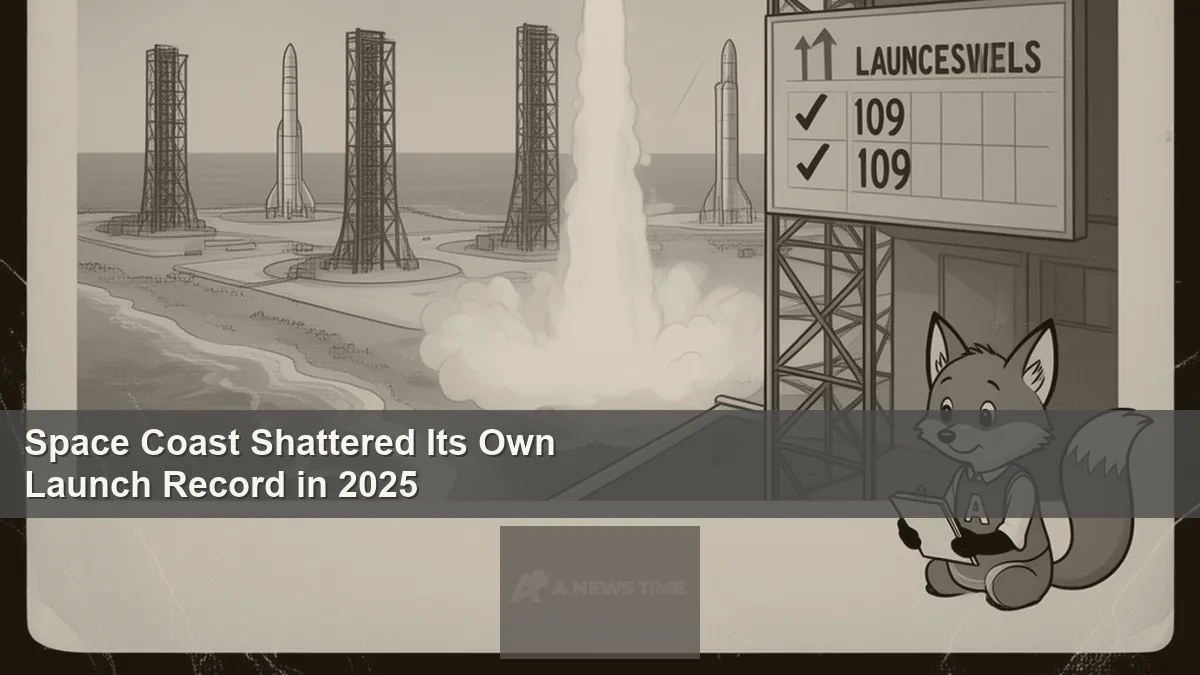
Florida's Space Coast closed with 109 orbital rocket launches, a number that would have seemed implausible five years ago and that now represents the baseline expectation for an industry that has become as operationally routine at Cape Canaveral as commercial aviation. That figure shattered the previous record of 93 launches set in 2024, itself a record at the time. As of , more than 20 Florida launches have already taken place this year, with NASA's Artemis II crewed lunar mission on the launch pad for an early April window and several additional Falcon 9 missions on the schedule for the same week.
The pace reflects a transformation in how orbital spaceflight operates. Kennedy Space Center and Cape Canaveral Space Force Station now handle launches at frequencies that would have strained the infrastructure of the entire global launch industry just a decade ago. The concentration of that activity in one geographic corridor along Florida's eastern coast is a deliberate product of investment decisions made by SpaceX, ULA, Blue Origin, and NASA, each maintaining or expanding facilities that share the same airspace and coordination infrastructure.
What Drives the Numbers
The vast majority of launches from the Space Coast are SpaceX Falcon 9 missions carrying Starlink broadband satellites into low-Earth orbit. Starlink has become the operational anchor of the Space Coast's launch cadence: a constellation that requires regular replenishment and expansion, served by a reusable rocket platform that has reduced the time between launches to a matter of days rather than months. Each Falcon 9 mission typically carries 23 to 29 Starlink satellites, and SpaceX regularly launches the same booster on its tenth, fifteenth, or twentieth flight.
| Year | Total Orbital Launches | Change vs Prior Year | Key Milestones |
|---|---|---|---|
| 2023 | ~72 | +19% | SpaceX first reuse records set |
| 2024 | 93 | +29% | Previous all-time record |
| 2025 | 109 | +17% | New all-time record; 100th launch Nov. 20 |
| 2026 (to Mar. 30) | 20+ | On pace for record | Artemis II, multiple Starlink missions |
SpaceX reached its 100th launch of 2025 from Florida on , with a Falcon 9 rising from Cape Canaveral as the region's fog cleared. That milestone came roughly 11 months into the year, and the final nine missions followed in the remaining weeks. The pace is not accidental: SpaceX has systematically expanded its launch pad infrastructure at the Space Coast, maintains its own fleet of drone ships for booster landings at sea, and operates a logistics and processing chain that treats launch vehicle reuse as an industrial rather than an engineering challenge.
What Else Is Launching
SpaceX does not hold a monopoly on the Space Coast, though it dominates the totals. United Launch Alliance operates from Cape Canaveral with its Vulcan Centaur rocket, which completed its first operational mission in 2024. Blue Origin, whose New Glenn rocket launched for the first time in January 2025 from its complex on Cape Canaveral, has additional New Glenn missions scheduled for 2026, with the next one expected in April. NASA's SLS launches from Pad 39B at Kennedy Space Center are counted separately from the commercial cadence but represent the most historically significant missions in any given year they occur.
The week of March 30 illustrates the layering of missions that has become typical of the Space Coast. SpaceX launched Starlink 10-44 on Monday, March 30, carrying 29 satellites northeast from Launch Complex 40. NASA's Artemis II is scheduled for Wednesday, April 1, launching east from Pad 39B. SpaceX's Starlink 10-58 follows Thursday, April 2, from the same complex as Monday's mission. Three orbital launches in four days, across two separate launch providers and two different launch complexes, including one that will carry human beings to the vicinity of the Moon for the first time in more than 50 years.
Florida set a new record with 109 orbital rocket launches in 2025, soaring beyond all previous annual records. As of March 30, there have already been more than 20 Florida rocket launches in 2026.
Florida Today, Space Coast launch tracking, March 30, 2026
- Monday, March 30: SpaceX Starlink 10-44, Launch Complex 40, 29 satellites
- Wednesday, April 1: NASA Artemis II crewed lunar mission, Pad 39B, 6:24 p.m. ET window
- Thursday, April 2: SpaceX Starlink 10-58, Launch Complex 40, 29 satellites
- April (later): Blue Origin New Glenn mission from Cape Canaveral
The Infrastructure Behind the Numbers
The Space Coast's capacity to sustain this tempo depends on infrastructure investments made over the past decade. SpaceX has its own processing facilities at the Cape where recovered boosters are refurbished and recertified between flights. The company operates from both Launch Complex 40 and Launch Complex 39A, allowing parallel processing of vehicles for different missions. Kennedy Space Center's Pad 39B is dedicated to NASA's SLS, maintained by a separate contractor network under NASA's management.
Coordination between SpaceX, ULA, Blue Origin, NASA, and the Space Force's 45th Space Wing (which manages airspace and range safety) is managed through a shared scheduling system. When three or more launch providers have missions close together, range safety teams work through potential interference scenarios and confirm that each mission can proceed without conflicting with others' trajectories or booster recovery zones.
The sustained pace has also created a supply chain effect. Local businesses serving the aerospace workforce in Brevard County have grown around the expectation of continuous operations. Hotel occupancy near Kennedy Space Center tracks launch schedules. The economic footprint of the Space Coast launch industry, which a report by the Space Foundation estimated at tens of billions of dollars annually for the broader US commercial space sector, is increasingly anchored by the predictability of Falcon 9 operations rather than the occasional high-profile mission.
What the Pace Means for Science
The volume of orbital launches enables science in ways that go beyond NASA missions. Commercial constellations like Starlink require the kind of frequent launch access that did not exist at this scale before SpaceX demonstrated reusability. More directly, the frequency with which Earth observation satellites, scientific instruments, and technology demonstration payloads can reach orbit has increased substantially. Missions that would have waited years for a dedicated launch slot can now book as secondary payloads on Falcon 9 rideshare missions within months.
For Artemis II, the broader context of Space Coast operational tempo matters because the infrastructure that enables rapid Starlink launches also supports the logistics of a crewed lunar mission. The same range, the same safety systems, and many of the same contractor teams that process commercial missions also support NASA's operations at Pad 39B. The nuclear SR-1 Freedom mission announced in March will similarly depend on the same launch infrastructure, using a Falcon Heavy that must complete a nuclear certification process before it can carry a fission reactor to Mars. The maturity of the Space Coast's operational ecosystem, built on years of high-frequency commercial launches, is one of the structural assets that makes missions of that ambition feasible on a timeline measured in years rather than decades. The history of human engagement with the cosmos has rarely moved as fast as it is moving in the first quarter of 2026.