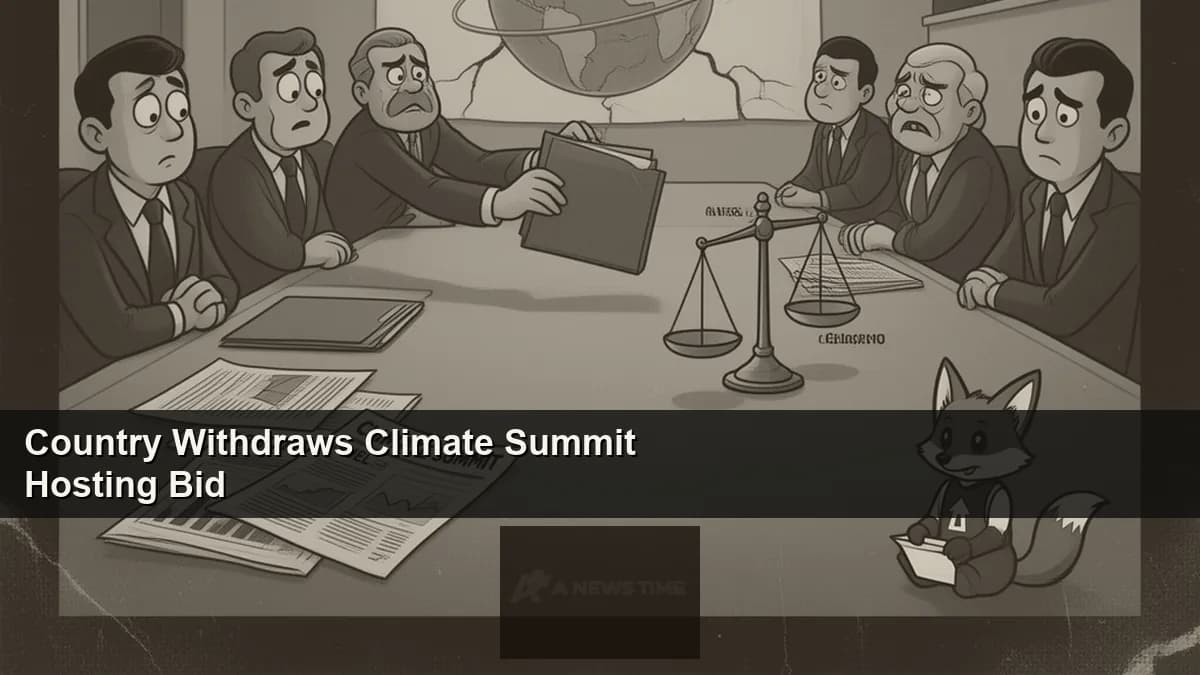
India's decision to pull out of contention for hosting COP33 arrived with little advance notice and considerable geopolitical weight. The announcement, confirmed by the Indian Ministry of Environment, Forest and Climate Change in early April, cited a combination of domestic energy security pressures and fiscal constraints that made large-scale international conference hosting impractical in the current budget cycle. The language was bureaucratic. The implications were anything but.
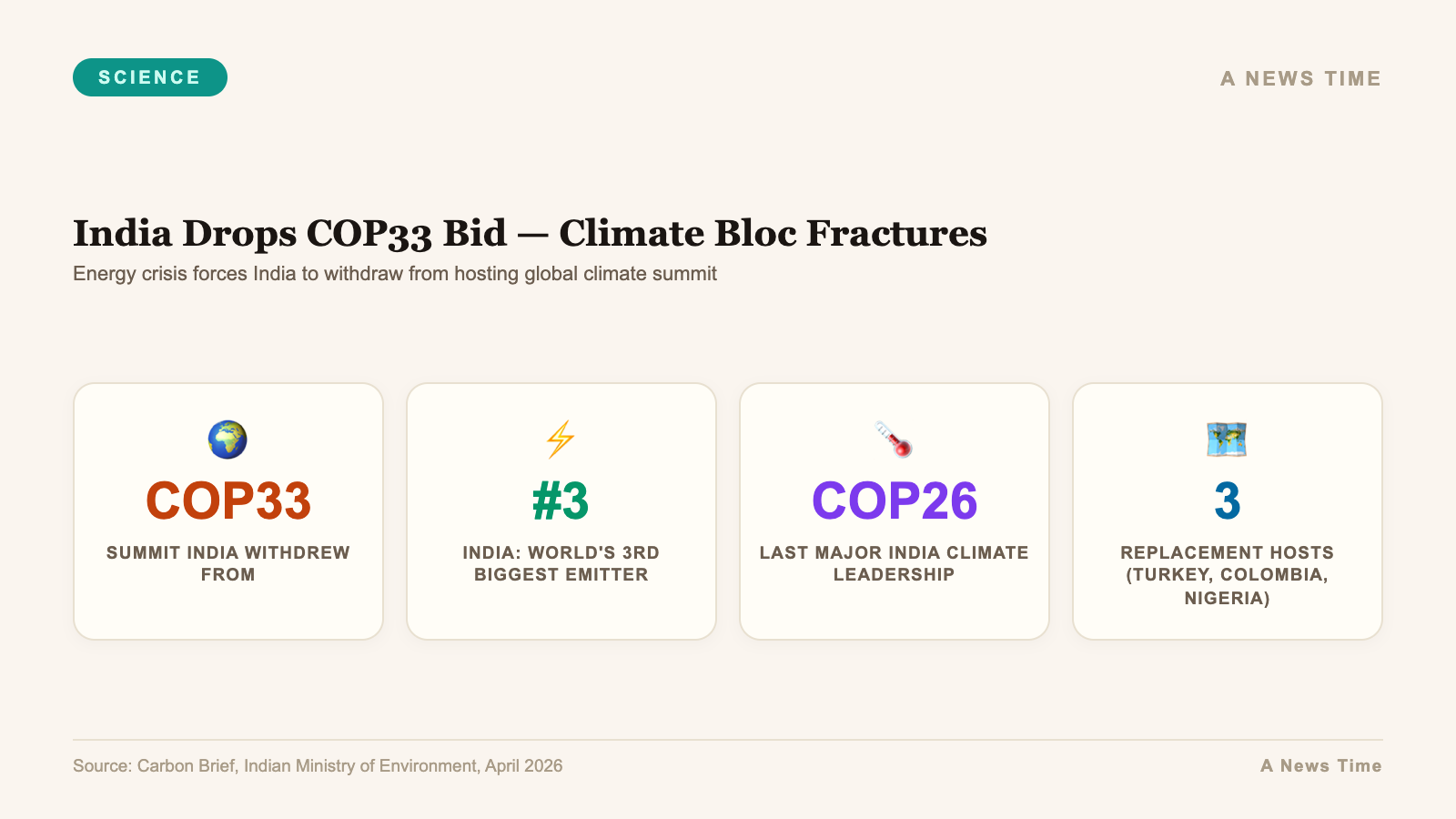
For the better part of a decade, India has positioned itself as the indispensable voice of the developing world in global climate negotiations -- a country that combines genuine climate vulnerability with the economic scale and diplomatic credibility to speak for nations that lack representation at the highest levels of the process. The withdrawal from COP33 hosting contention is the most significant retreat from that positioning in years, and it arrives at a moment when Carbon Brief's April 10 Debriefed newsletter is describing India's energy situation as potentially the worst in the country's modern history.
India's Energy Crisis in Context
The phrase "worst energy crisis ever" is not language that climate journalism typically deploys casually. Carbon Brief's characterization draws on a convergence of factors that have been building throughout late 2025 and accelerating into 2026. Power demand in India's industrial heartland states -- Maharashtra, Gujarat, Uttar Pradesh, and Rajasthan -- has been hitting record highs driven by manufacturing expansion, a hotter-than-projected dry season, and the continued electrification of transport and domestic heating. At the same time, the coal supply chain that still provides approximately 70 percent of India's electricity generation has been severely disrupted by a combination of rail logistics failures, flooding in key coal-belt regions in Jharkhand and Odisha, and pricing disputes between state utilities and private mining companies.
The result has been rolling power cuts in industrial zones, forced production stoppages at steel and cement facilities, and a return of the kind of scheduled load shedding that India had largely eliminated from its major cities over the past decade. Rural states are experiencing outages of up to 12 hours per day in some districts. The economic cost is significant -- estimates from the Confederation of Indian Industry put lost industrial output in the first quarter of 2026 at approximately $14 billion -- but the political cost may be larger.
Prime Minister Modi's government has staked substantial political capital on India's energy transition narrative, positioning the country's rapid solar and wind expansion as proof that developing economies can pursue growth and decarbonization simultaneously. A domestic energy crisis driven in part by coal supply failures undercuts that narrative in a way that is difficult to manage diplomatically, particularly in the lead-up to a major international climate conference.
The Decision to Withdraw
India's COP33 hosting bid had been regarded within climate diplomacy circles as the frontrunner. The country had strong institutional support from the BASIC coalition -- Brazil, South Africa, India, and China -- and from the broader G77 developing nation bloc. India had hosted successful international summits under the G20 presidency in 2023, demonstrating logistical capacity for large-scale diplomatic events. The UNFCCC secretariat in Bonn had reportedly received positive preliminary signals from New Delhi as recently as late 2025.
What changed was the energy crisis and its political fallout. Hosting a COP conference requires not just logistics but narrative positioning. A country leading global climate negotiations while its own population faces prolonged blackouts and its government is quietly reopening coal plant licensing approvals would face intense media scrutiny that no diplomatic framing can fully neutralize. Climate negotiators within India's Ministry of External Affairs are understood to have counseled that the political and reputational risks of hosting outweighed the diplomatic benefits.
The formal withdrawal letter, circulated to UNFCCC member states, was measured in its language. It cited fiscal constraints, competing domestic policy priorities, and a desire to ensure COP33 received the level of host government attention it deserved. It did not mention the energy crisis directly. Several climate diplomats who spoke to international news organizations described the subtext as obvious.
Who Could Host COP33
The UNFCCC's informal rotation system for COP hosting assigns responsibility to different regional groups in sequence, and India's withdrawal leaves the Asian-Pacific group's slot for COP33 without a confirmed candidate. Three countries have been named in preliminary discussions as potential replacements: Turkey, which has expressed interest in hosting a major UNFCCC event since ratifying the Paris Agreement in 2021; South Korea, which has substantial climate finance infrastructure but has been diplomatically cautious about major multilateral commitments since a change in government; and Indonesia, whose current administration has expressed moderate enthusiasm for the role.
A hosting switch outside the Asia-Pacific rotation is also possible under UNFCCC rules if no regional candidate can be identified within the required timeline. Colombia and Nigeria have both expressed interest in major future COP events and have the regional body support within their respective UN groupings to accelerate a bid process. A Latin American COP would follow a precedent set by COP25 in Madrid (replacing Santiago after Chile's political unrest) and would be broadly supported by the broader G77 coalition.
The decision needs to be reached within approximately six months to allow adequate preparation time, creating a somewhat compressed diplomatic window. Climate observers note that the hosting nation decision, while logistically important, is less consequential for negotiations outcomes than the broader geopolitical dynamics that India's withdrawal signals.
What the Withdrawal Signals About Climate Leadership
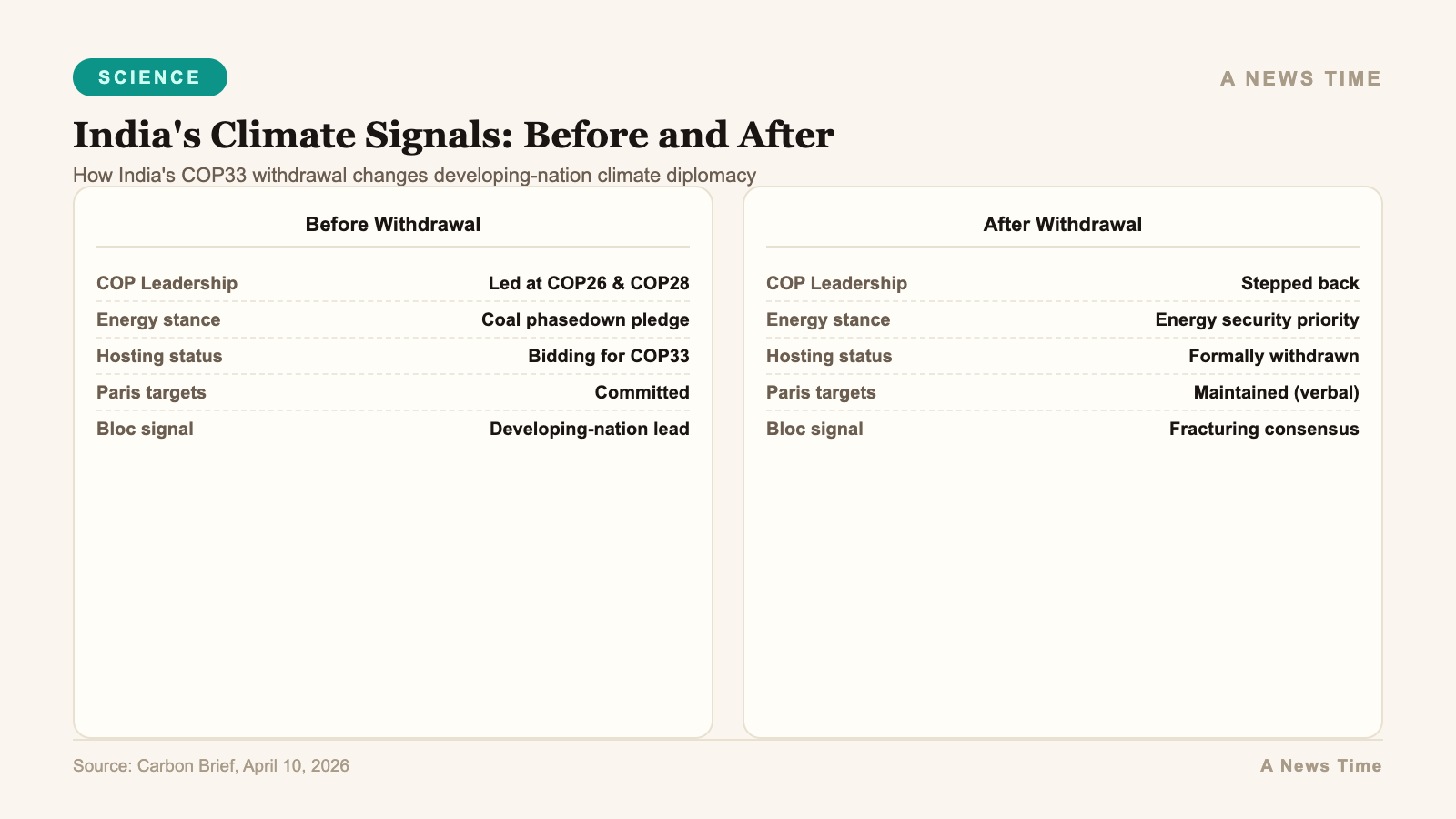
The diplomatic significance of India's retreat goes beyond the mechanics of who will host the conference. At COP26 in Glasgow and COP28 in Dubai, India played an outsized role in shaping negotiation outcomes on behalf of developing nations -- advocating for differentiated responsibility frameworks, resisting what the country characterized as premature phase-out timelines for fossil fuels, and positioning itself as the essential interlocutor between the developed world's decarbonization demands and the development imperatives of the global south.
That role required India to simultaneously acknowledge climate vulnerability and assert development rights, a difficult balance that Indian diplomats managed through a combination of commitments to renewable energy expansion and firm resistance to binding phase-out schedules. The approach earned India credibility across the developing world even as it frustrated European and North American negotiating teams.
A country navigating a domestic energy crisis, resuming coal capacity additions, and stepping back from a major hosting commitment sends a different signal. It suggests that India's political bandwidth for ambitious climate diplomacy is constrained by domestic energy politics in ways that were not visible when the COP leadership positioning was being built. That constraint is not unique to India -- China's energy security concerns, South Africa's coal dependency, and Brazil's deforestation politics all impose limits on how aggressively those countries can lead on climate -- but India's retreat is the most visible example of the pattern in the current cycle.
The Broader Fracturing of Global Climate Consensus
India's withdrawal coincides with a broader deterioration of the geopolitical architecture around climate action. The Trump administration's decision to formally withdraw the United States from the Paris Agreement for the second time has reduced American engagement in UNFCCC processes to an observer level, removing the policy pressure and financial commitments that US participation had historically brought. The EU remains the most committed major power bloc to aggressive emissions reduction timelines, but its diplomatic leverage has weakened as energy security concerns following Russia's invasion of Ukraine have made European governments more cautious about transitions that increase short-term energy costs.
The result is a negotiating environment where the traditional leaders of climate ambition -- the US, EU, and major developing nations acting through the G77 -- are all operating with reduced domestic political bandwidth for aggressive international commitments. COP30 in Belem, Brazil in late 2025 was widely characterized as a holding exercise rather than a landmark agreement; COP31 and the lead-up to COP33 need to produce something more substantive to keep the Paris Agreement's 1.5 degree pathway credible.
India's step back from hosting is not a withdrawal from the Paris Agreement or a repudiation of its own climate targets. New Delhi has been careful to ensure that message is clearly communicated. But in climate diplomacy, as in other forms of geopolitics, the willingness to assume the costs and visibility of leadership is itself a signal. India's current government is signaling, at least for now, that those costs have become too high.
Carbon Brief's Assessment and What It Means for Coverage
Carbon Brief, the UK-based specialist climate media outlet, occupies a particular position in global climate journalism. Its Debriefed newsletter, published weekly, aggregates the most significant climate news developments with a level of analytical depth that makes it the primary reference point for climate policy professionals who need to track the full sweep of the story. Its characterization of India's energy situation as potentially the worst in the country's modern history reflects both the severity of the documented facts and the significance of the context in which they are occurring.
The April 10 edition that made that characterization also connected the energy crisis directly to the COP33 withdrawal, offering an analytical frame that the Indian government's own communications had carefully avoided. That framing -- that the decision not to host is inseparable from the domestic energy crisis, and that the domestic energy crisis reflects fundamental tensions in India's climate and development policy -- is likely to be the dominant analytical lens through which climate journalists and policy researchers assess India's climate leadership posture going forward.
For further coverage of the broader climate policy picture in 2026, including US policy rollbacks and their global implications, see our report on the disappearing federal climate data and the EPA's endangerment finding repeal.
The Path Forward
Climate diplomacy does not stop because one country withdraws from a hosting bid or reduces its ambition for a conference cycle. The UNFCCC process has demonstrated remarkable institutional resilience in the face of geopolitical headwinds, and the underlying science of climate change continues to advance regardless of the diplomatic environment.
What India's withdrawal does is create an opening question for the remainder of the COP33 preparation period: who will step into the leadership vacuum on behalf of the countries most vulnerable to climate impacts? Small island states have long been the moral voice of climate negotiations, but they lack the economic and diplomatic leverage to move major emitters. The EU can provide policy ambition but has limited credibility as a voice for developing-world concerns. China's climate diplomacy is sophisticated but operates primarily in service of Chinese interests rather than as a leadership mandate for the G77.
India's decision is not permanent. The energy crisis will eventually resolve, the political dynamics will shift, and Indian climate diplomats are too professionally invested in the multilateral process to disengage permanently. But for the immediate COP33 cycle, the developing world's most credible large-economy climate voice has stepped back from the front of the room. The implications of that absence will unfold slowly and will be difficult to quantify until the next major UNFCCC milestone makes them visible.