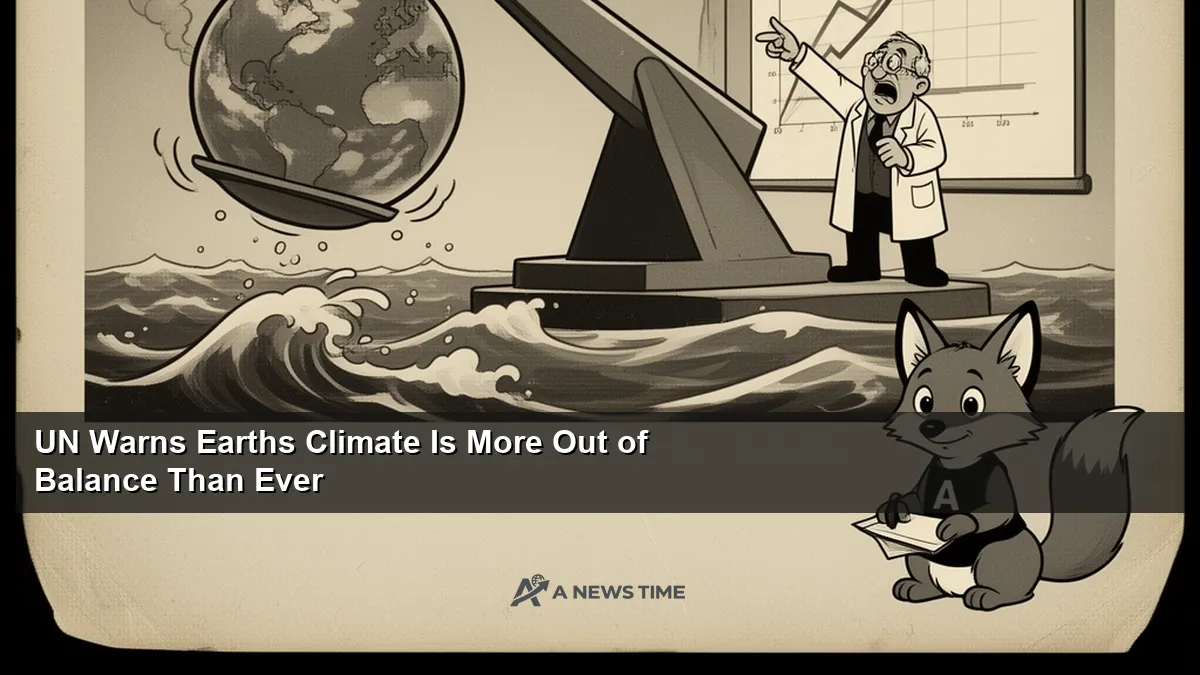
The numbers are in, and they tell a story of a planet accumulating heat faster than at any point in the instrumental record. The World Meteorological Organization's annual State of the Global Climate report, released on , confirms that every year from 2015 through 2025 now ranks among the hottest 11 years on record, that greenhouse gas concentrations have reached their highest measured levels, and that a new indicator, Earth's energy imbalance, has been added to the WMO's suite of climate markers for the first time. The message, delivered by WMO Deputy Secretary-General Ko Barrett, is blunt: the climate system is more out of balance than it has ever been during the period of modern observation.
Eleven Consecutive Record-Setting Years
The headline figure is striking in its consistency. The eleven-year span from 2015 to 2025 contains every one of the hottest years in a temperature record that stretches back to the mid-nineteenth century. This is not a matter of individual years marginally edging out competitors from the distant past. It is a sustained plateau of warmth, with each year clustering near or above the 1.5-degree Celsius threshold that the Paris Agreement identified as the preferred limit for long-term warming.
In specifically, the global mean surface temperature was 1.43 degrees Celsius above the pre-industrial baseline (defined as the 1850-1900 average). That figure is fractionally below the 1.5-degree target, but the proximity is uncomfortable. The Paris threshold was not designed as a cliff edge, a temperature at which the planet suddenly breaks. It was intended as a guardrail, a level of warming beyond which the risks of severe, irreversible climate impacts increase substantially. Spending consecutive years within a fraction of a degree of that guardrail means the margin of safety has effectively vanished.
Ko Barrett, the WMO's Deputy Secretary-General, framed the findings in terms of the cumulative trend:
"We have now experienced the hottest 11 years on record. The evidence is overwhelming and consistent across every indicator we track. The climate system is sending a clear signal."
Ko Barrett, Deputy Secretary-General, World Meteorological Organization
The phrase "every indicator" is significant. The WMO report does not rely solely on surface temperature. It tracks ocean heat content, sea level rise, glacier mass balance, sea ice extent, and greenhouse gas concentrations, among other metrics. The fact that all of these indicators are trending in the same direction, and that many are setting records simultaneously, makes the overall picture considerably harder to attribute to natural variability alone.
Greenhouse Gases: Records Across the Board
The three major greenhouse gases, carbon dioxide (CO2), methane (CH4), and nitrous oxide (N2O), all reached their highest recorded atmospheric concentrations in the WMO's monitoring period. The report notes that the year-on-year increase was also the largest ever measured, meaning not only are concentrations at a record but the rate at which they are rising has accelerated.
This acceleration is particularly concerning for methane, which has a global warming potential roughly 80 times that of CO2 over a 20-year period. While CO2 remains the dominant driver of long-term warming due to its longevity in the atmosphere (centuries to millennia), methane's potency means that even modest increases in its concentration produce outsized near-term warming effects. The sources of rising methane are multiple: fossil fuel extraction and distribution, livestock agriculture, rice paddies, landfills, and natural wetlands responding to warming temperatures. Disentangling these sources and their relative contributions remains an active area of research.
For CO2, the picture is somewhat simpler. The primary driver is fossil fuel combustion, with deforestation and land-use change contributing a smaller but significant fraction. Global CO2 emissions from fossil fuels have plateaued in recent years but have not begun the sustained decline that climate models indicate is necessary to limit warming to 1.5 or even 2 degrees Celsius. The gap between current emissions trajectories and the pathways consistent with Paris Agreement targets continues to widen.
Earth's Energy Imbalance: A New Indicator
Perhaps the most significant conceptual addition in the 2026 report is the inclusion of Earth's energy imbalance (EEI) as a formal climate indicator. This metric measures the difference between the amount of energy Earth receives from the Sun and the amount it radiates back into space. When the planet is in thermal equilibrium, these two quantities are equal. When more energy comes in than goes out, the excess accumulates as heat in the Earth system, warming the oceans, atmosphere, land surface, and ice.
John Kennedy, a WMO scientist involved in the report, described the indicator in accessible terms:
"More energy coming in than going out. That is the fundamental driver of everything else we are seeing, the warming oceans, the melting ice, the rising seas. The energy imbalance is the root cause, and for the first time, we are tracking it as a primary indicator."
John Kennedy, WMO Climate Scientist
Think of Earth's energy budget like a bathtub. The faucet represents incoming solar energy. The drain represents energy radiated back to space. If you partially block the drain (which is what greenhouse gases do, by absorbing and re-emitting outgoing infrared radiation), water accumulates in the tub even if the faucet flow stays constant. The energy imbalance measures how much the drain is blocked, and the current reading indicates it is more obstructed than at any point in the observational record.
The practical consequence of a positive energy imbalance is that even if greenhouse gas concentrations were frozen at today's levels, the planet would continue warming until a new equilibrium was reached. This "committed warming" is already baked into the system. The energy imbalance quantifies how much additional warming is in the pipeline, regardless of future emissions decisions, making it arguably the most important single number in climate science.
Oceans: Absorbing 90 Percent of the Excess
Where does all that excess energy go? The WMO report confirms what oceanographers have been tracking for years: approximately 90 percent of the accumulated excess heat is absorbed by the oceans. Ocean heat content reached a new record in 2025, continuing an unbroken upward trend that has accelerated in recent years.
The ocean's role as a heat sink has buffered the atmosphere from even more rapid warming, but this service comes at a steep cost. Warmer oceans expand (thermal expansion is the largest current contributor to sea level rise), become more stratified (reducing the mixing that brings nutrients to surface waters), and lose dissolved oxygen (creating expanding "dead zones" where marine life cannot survive). Warmer surface waters also provide more energy for tropical cyclones, contributing to the intensification of hurricanes and typhoons observed in recent decades.
The human dimension is equally stark. The report notes that more than three billion people depend directly on marine and coastal resources for their livelihoods, food security, or both. Warming and acidifying oceans threaten fisheries, coral reef ecosystems, and coastal infrastructure in ways that will disproportionately affect developing nations in tropical and subtropical regions. The cascading effects of ocean warming on marine ecosystems mirror the concerns driving European initiatives to climate-proof protected natural areas.
The connection between ocean heat and atmospheric warming also creates feedback loops that can accelerate the overall process. Warmer oceans release more water vapor into the atmosphere, and water vapor is itself a greenhouse gas. Warmer oceans also reduce the efficiency of the biological carbon pump, the process by which marine organisms absorb CO2 at the surface and transport it to deep water. If the ocean absorbs less CO2, more remains in the atmosphere, further enhancing the greenhouse effect.
Regional Impacts: Not Just Statistics
The WMO report is global in scope, but the impacts it describes are experienced locally. The 2025 data included several severe weather events that illustrate the connection between a warming planet and human suffering:
- Heat waves: Multiple regions experienced record-breaking heat waves in 2025, with temperatures exceeding historical norms by margins that would have been statistically improbable in a pre-industrial climate. The ongoing heat anomalies in the US Southwest in early 2026 extend this pattern.
- Precipitation extremes: Both record rainfall events and severe droughts were more frequent than the historical average, consistent with the theoretical expectation that a warmer atmosphere holds more moisture and releases it in more intense bursts.
- Glacier retreat: Global glacier mass loss continued to accelerate, with the rate of loss over the past decade roughly double that of the decade before. Mountain glaciers serve as freshwater reservoirs for hundreds of millions of people, and their decline threatens water security in regions from the Andes to the Himalayas.
- Sea ice: Arctic sea ice extent continued its long-term decline, with the annual minimum among the lowest on record. Antarctic sea ice, which had been relatively stable until recently, showed continued below-average extent following the dramatic losses of 2023.
These are not isolated phenomena. They are interconnected consequences of the same underlying cause: excess energy accumulating in the Earth system. The WMO report emphasizes this interconnection, presenting the climate system as a single, integrated whole rather than a collection of independent metrics.
The Gap Between Knowledge and Action
The WMO's State of the Global Climate report has been published annually since 1993. Over that period, the scientific findings have grown progressively more alarming while the language has grown progressively more direct. The 2026 edition is no exception. It states plainly that current global efforts to reduce greenhouse gas emissions are insufficient to meet the goals of the Paris Agreement and that the window for limiting warming to 1.5 degrees Celsius is rapidly closing.
This assessment is consistent with other recent analyses, including the UNEP Emissions Gap Report and the IPCC's Sixth Assessment Report. The science is not in dispute among the organizations responsible for monitoring the climate. What varies is the political and economic response to that science, which the WMO report notes has been inadequate relative to the scale of the challenge.
The addition of Earth's energy imbalance as an indicator is partly a communication strategy. By providing a single, intuitive metric that captures the fundamental thermodynamic state of the planet (more energy in than out), the WMO is attempting to cut through the complexity of climate science and deliver a message that policymakers and the public can grasp immediately. Whether that message translates into accelerated action remains to be seen. This mirrors the challenge facing scientists studying planetary-scale atmospheric changes on Mars, where understanding the mechanism is far ahead of any ability to intervene.
What the Data Does and Does Not Tell Us
It is important to understand both the strengths and the limitations of the WMO report. Its primary strength is comprehensiveness: it integrates data from weather stations, ocean buoys, satellite systems, ice cores, and atmospheric monitoring networks operated by dozens of national agencies worldwide. The temperature record, while not perfect, is robust and well-characterized, with multiple independent analyses (from NASA, NOAA, the UK Met Office, and others) producing consistent results.
The limitations are equally important to acknowledge. The report describes what has happened and what is currently happening. It does not predict the future with precision, because future warming depends on future emissions, which depend on policy decisions that have not yet been made. The 1.43-degree figure for 2025 does not mean that 1.5 degrees will be permanently exceeded in 2026 or 2027; natural variability (such as the El Nino/La Nina cycle) causes year-to-year fluctuations that can temporarily push temperatures above or below the underlying trend.
What the data does tell us, with high confidence, is the direction of that trend. Every major indicator is moving in a direction consistent with continued warming. The rate of greenhouse gas accumulation is accelerating. The ocean is storing more heat. The energy imbalance is growing. These are not projections or models. They are measurements of the current state of the Earth system, and they leave very little room for complacency.
The WMO report is, ultimately, a diagnostic document. It tells us the patient's vital signs. The vital signs, as of March 2026, indicate a planet running a fever that shows no sign of breaking, with the underlying infection (excess greenhouse gas emissions) still intensifying. The treatment is well understood. The question, as always, is whether it will be administered in time. Researchers working on solutions range from those developing next-generation energy technologies to those seeking to protect the ecosystems most vulnerable to a warming world.