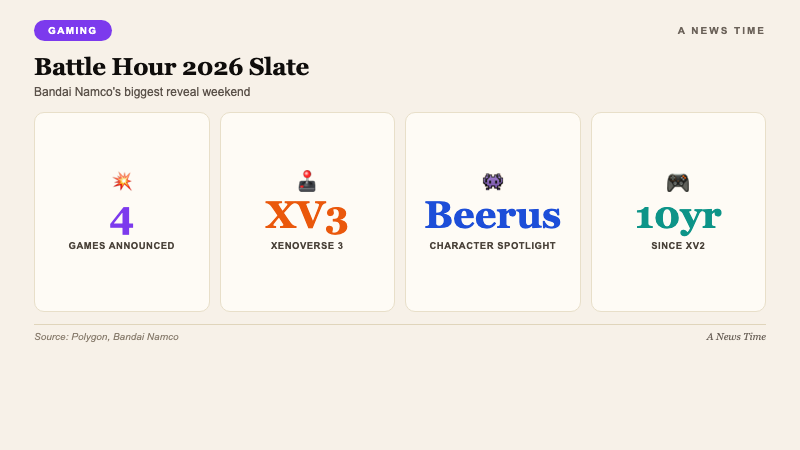
Bandai Namco and Dimps used Dragon Ball Games Battle Hour 2026 on , to stack the next two years of the Dragon Ball gaming calendar. The headline was Dragon Ball: Xenoverse 3, the first numbered mainline Xenoverse entry since Xenoverse 2 shipped in October 2016. The announcement ends nearly a decade of speculation about whether the time-patrol action-RPG subseries would ever get a full-fledged sequel or continue living exclusively through Xenoverse 2's multi-year DLC pipeline. The event also confirmed Dragon Ball Super: Beerus as a new character-focused release, new DLC for Sparking! Zero, and additional content for Xenoverse 2 itself, per Polygon's event recap.
For Dragon Ball players, the Battle Hour slate matters less as a single announcement and more as a declaration of strategy. Bandai Namco has been operating Xenoverse 2 as a live service for nearly a decade, adding character DLC and balance patches roughly on an annual cadence. Announcing Xenoverse 3 while also committing new content to Xenoverse 2 signals a deliberate parallel-release approach rather than a hard cutover. That model has become standard across gaming's long-tail franchises, but it is new for Dragon Ball.
What Xenoverse 3 Is, and What We Know About It
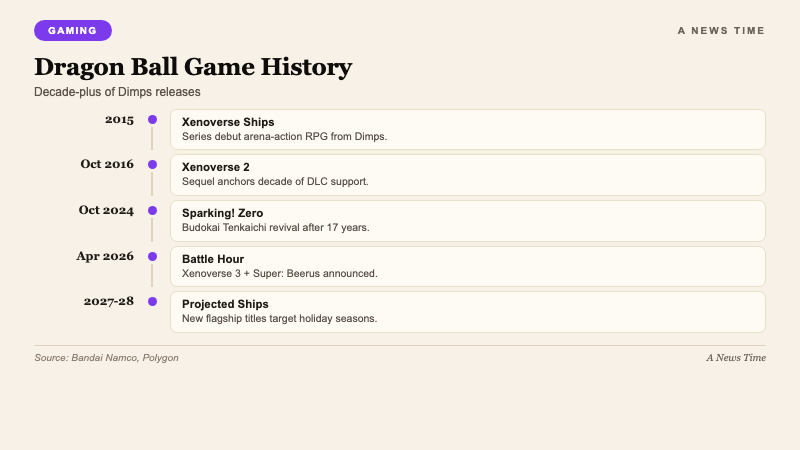
Xenoverse 2 ships as an action-RPG where the player creates a custom character who joins the Time Patrol, an organization tasked with correcting timeline corruptions that change key moments from Dragon Ball canon. The design loop combines single-player story missions, multiplayer raids, and cooperative "Parallel Quest" content, all anchored by the character-customization system. After October 2016 it received DLC expansions for a decade, adding characters from Dragon Ball Super and more recent franchise entries.
Xenoverse 3 inherits that framework, per the Battle Hour reveal trailer, but with visible graphical upgrades and what Bandai Namco described as an expanded progression system. No release date, platform list, or price was announced. Based on Bandai Namco's usual development cycle and the timing of the reveal, a late 2027 or early 2028 release would be consistent with prior franchise entries.
| Title | Status | Platform(s) |
|---|---|---|
| Xenoverse 3 | New announcement, date TBD | TBA (multi-platform expected) |
| Dragon Ball Super: Beerus | New character-focused release | TBA |
| Sparking! Zero | New DLC roadmap | PS5, Xbox Series X/S, PC |
| Xenoverse 2 | Continued DLC support | All existing platforms |
The most important creative question for Xenoverse 3 is whether Dimps keeps the Time Patrol framework or reboots it. Xenoverse 2's timeline-correction story hook has worn thin after nearly a decade of expansion DLC. A full narrative reset would let the new game introduce younger audiences to the Xenoverse concept without requiring them to work through ten years of prior context. The reveal trailer does not yet answer that question.
Dragon Ball Super: Beerus Is the Curveball
Dragon Ball Super: Beerus was the most unexpected announcement. The game is described as a character-focused release centered on the God of Destruction Beerus, who was introduced in the Dragon Ball Super anime run. No gameplay genre has been confirmed, but the reveal frames the game as an action experience. Franchise fans have been asking for dedicated character-spotlight games for roughly a decade, and Super: Beerus is the first time Bandai Namco has publicly committed to one.
"Dragon Ball Xenoverse 3 and Dragon Ball Super: Beerus headlined the franchise's latest event."
Tomas Franzese, Polygon, covering Dragon Ball Games Battle Hour 2026
The business case for a character-spotlight game is straightforward. Dragon Ball's IP recognition is global, and Beerus has been one of the franchise's most marketable characters since his 2013 film debut. A $30 to $40 mid-priced release would pick up a significant share of fans who buy character-driven entries but skip the annual Xenoverse DLC cycle. The risk is that character-focused games can feel narrow if the design does not carry enough mechanical variety to sustain a full playthrough.
Sparking! Zero and Xenoverse 2 Extensions
Sparking! Zero shipped in October 2024 as the long-awaited return of the Budokai Tenkaichi subseries, which last released a main entry in 2007. The Battle Hour DLC roadmap includes new characters and modes that address gaps fans flagged during the base game's launch, particularly in online-competitive balance and solo-player content. The DLC cadence is pitched on an annual basis, keeping Sparking! Zero active through at least 2027.
Xenoverse 2's continued DLC support is the most pragmatic announcement of the weekend. The game still has a substantial active player base, and Xenoverse 3's uncertain release window means Xenoverse 2 needs to keep receiving content to maintain engagement. The announced DLC is in line with the pattern Bandai Namco has executed since 2016: one new character pack plus balance updates per year.
What the Reveal Means for Competitive Fighting Games
The Dragon Ball fighting-game ecosystem includes three distinct lanes: the arena-action Xenoverse series, the 3D fighting-game Sparking! Zero branch, and the 2D fighter Dragon Ball FighterZ. Bandai Namco has been building out all three in parallel. Battle Hour 2026 did not include new FighterZ news, which suggests that series is either entering a content-drought phase or saving announcements for a separate event.
For the competitive scene, the most significant implication is that Sparking! Zero's DLC roadmap includes competitive-balance targeted changes. The 2024 base game shipped with a strong launch roster but flagged rough online infrastructure and uneven character balance. The Battle Hour DLC specifically addresses both, which gives the game a longer runway as a competitive fighter at events like Evo and Combo Breaker.
The Developer Side: Dimps and the Road to a Sequel
Dimps, the Japanese studio that has developed the Xenoverse series since 2015, has a long history with Dragon Ball stretching back to Dragon Ball Z: Budokai in 2002. The studio's signature approach combines arena-style 3D combat with character customization, which is exactly the loop that powered both Xenoverse entries to multi-million unit sales. What has always limited the franchise is the perception that Xenoverse 2's DLC model made a true sequel unnecessary. Battle Hour 2026's announcement ends that perception.
Development timelines for this kind of action-RPG typically run 3 to 4 years from initial concept to release. If Xenoverse 3 is targeting a 2027 or 2028 launch, Dimps has been in full production on the game since at least 2023. The engineering challenge is upgrading the game's visuals and progression systems without alienating the core player base that has spent hundreds of hours in Xenoverse 2 character builds. Carrying over specific progression or cosmetic items would address that concern, though Bandai Namco has not yet confirmed whether cross-generation progression is part of the plan.
Where Dragon Ball Games Go From Here
The Dragon Ball gaming franchise has sold tens of millions of copies across its three-decade run. The current active series generate a steady revenue stream between main-release cycles through DLC, cross-promotion with the anime and manga, and brand-extension deals. Battle Hour 2026's announcements commit the franchise to a three-to-five-year content slate, with Xenoverse 3 as the flagship in 2027 or 2028, Super: Beerus as a likely 2026 or 2027 mid-budget entry, continued Sparking! Zero DLC, and Xenoverse 2's ongoing service window.
For long-time fans, the meaningful question is whether Xenoverse 3 ships with enough structural innovation to justify a true sequel rather than a visual upgrade of Xenoverse 2. For casual fans, the Super: Beerus announcement is the one to watch, because a successful character-focused release would open the door for similar games featuring other franchise marquee characters. Both questions get answered as more footage and details surface in the coming months.
Frequently Asked Questions
What is Dragon Ball Xenoverse 3?
It is the first numbered mainline entry in the Dragon Ball Xenoverse series since Xenoverse 2 shipped in October 2016. It was announced at Dragon Ball Games Battle Hour 2026 on April 19. No release date, price, or platform list has been confirmed.
When will Dragon Ball Xenoverse 3 release?
Bandai Namco has not announced a release date. Based on the company's historical development timelines and the timing of the reveal, a late 2027 or early 2028 release would be typical for the franchise.
What is Dragon Ball Super: Beerus?
It is a new character-focused Dragon Ball game centered on the God of Destruction Beerus. It was announced alongside Xenoverse 3 at Battle Hour 2026. Genre and gameplay details have not yet been confirmed.
Is Xenoverse 2 being replaced by Xenoverse 3?
Not immediately. Bandai Namco announced continued DLC support for Xenoverse 2 alongside the Xenoverse 3 reveal, indicating a parallel-release strategy rather than a hard cutover.
What was announced for Sparking! Zero?
A new DLC roadmap including additional characters, modes, and competitive-balance changes. The DLC cadence is annual, extending Sparking! Zero's active content window through at least 2027.
What to Watch
The next Bandai Namco press conference or gaming showcase is the next major reveal window. Expect Xenoverse 3 to surface more gameplay footage by the end of 2026 if the release target is 2027. Super: Beerus will need a genre and gameplay reveal to move from announcement to pre-order marketing. And the competitive scene will watch the Sparking! Zero DLC balance changes closely as they roll out across the year. Battle Hour 2026 was the biggest single-event slate in Dragon Ball gaming's recent history. What ships from it over the next three years will determine whether the franchise has entered a new creative peak.