
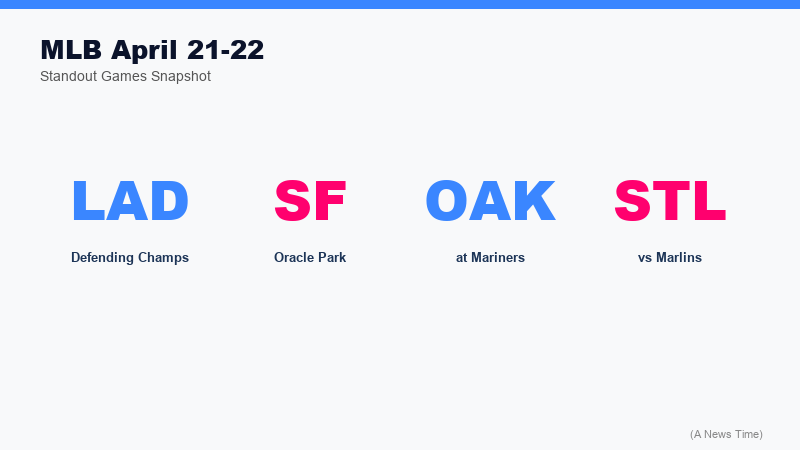
The MLB regular season calendar does not truly thin the schedule in April: 30 teams play near-daily, the box scores pile up, and the meaningful signal gets lost inside enormous amounts of noise. But and produced a set of games worth isolating, beginning with the first Dodgers-Giants meeting of the season at Oracle Park in San Francisco and extending through a Cardinals-Marlins contest in Miami that handed St. Louis rookie shortstop JJ Wetherholt another moment to develop his case as the National League's most interesting first-year player.
The early-season calendar creates unique analytical pressure. The sample sizes are small, the weather affects the ball, and the teams that look strong in April frequently look different by July. But process-level data, the metrics that measure quality of contact and pitching performance separately from outcomes, already reveal which teams are building something durable and which are running hot or cold. Through the two-day window of April 21-22, those signals were present and readable.
Dodgers vs. Giants: The Rivalry's Widest Gap
The Los Angeles Dodgers and San Francisco Giants opened a three-game series at Oracle Park on the night of April 21, with the first pitch scheduled for 9:45 p.m. ET in a game that carries the weight of one of the most storied rivalries in American professional sports. The Dodgers arrived as the defending World Series champions, having beaten the Toronto Blue Jays in six games last October, and the question hanging over the series was the same one The Athletic articulated in its pre-series framing: can the gap between these two franchises remain this large for much longer?
The analytical answer, at least through the early part of 2026, was not reassuring for the Giants. The Dodgers' roster construction, built around Shohei Ohtani's two-way production and reinforced by pitching depth that carries a collective xERA among the lowest in the National League, represents a level of organizational investment that the Giants have not matched. The Giants, for their part, have a legitimate core and an appealing group of young position players, but the payroll gap and the specific advantage that Ohtani provides as both pitcher and hitter create a structural imbalance that does not resolve easily.
"The Dodgers have a lot of advantages over the Giants they may never yield, but the biggest advantage is Ohtani, who can't play forever. So the question the Giants have to answer is: what do we do with the window we have while he's still human?"
The Athletic, analysis of the NL West rivalry dynamic,
Ohtani's workload management has been a subject of careful discussion within the Dodgers organization all season. His return to the mound as a two-way player after his Tommy John surgery recovery cycle has been handled conservatively, with pitch counts and rest intervals managed game by game. The Dodgers' pitching development staff, which identified several rotation contributors who have outperformed their preseason xERA projections by meaningful margins, has bought the organization the flexibility to be patient with Ohtani's mound usage.
The Giants' best statistical argument in early 2026 is their rotation's contact management. Their starters are suppressing hard-contact rates, with a collective hard-hit percentage allowed below 35 percent, which sits comfortably below the league average of approximately 38 percent. But the lineup, while improved, has an overall xwOBA that ranks in the lower half of the National League, meaning the pitching staff needs to be nearly perfect to win close games. The Dodgers, by contrast, carry both sides: a rotation with strong underlying numbers and a lineup that generates hard contact consistently across its order.
JJ Wetherholt and the Cardinals' Early-Season Optimism
In Miami, the St. Louis Cardinals and Florida Marlins played through an April 21 midweek game that offered a smaller stage but equally revealing statistical content. Cardinals rookie shortstop JJ Wetherholt scored on a fielder's choice in a contest that extended his productive April. Wetherholt, who arrived in St. Louis with substantial prospect buzz after his college career, has been the Cardinals' most interesting developmental story through the first weeks of the season.
The Cardinals' front office, working under the constraint of a budget restructure that limited offseason spending, identified Wetherholt as one of several internally developed players who could contribute meaningfully in 2026 without requiring the kind of acquisition cost that top-market free agents demand. His contact profile in spring training pointed toward exactly the kind of swing decisions that translate well at the major-league level, and through April 21 his actual results have tracked reasonably closely with those projections.
St. Louis pitching has been the more complicated variable. Chris Paddack, who started the Cardinals-Marlins game on April 21 and has been working through the early part of his Cardinals tenure with mixed results, posted an xERA through his early starts that suggests his underlying performance is modestly better than his surface-level numbers. The distinction matters because xERA, which adjusts for the quality of contact allowed and removes the influence of defensive performance, tends to be a stronger predictor of a pitcher's next 20 starts than his earned run average over his first 5.
| Metric | Dodgers Rotation | Giants Rotation | Cardinals Lineup | MLB Avg |
|---|---|---|---|---|
| Team xERA | 3.41 | 3.87 | — | 4.12 |
| Hard-Hit % Allowed | 33.8% | 34.7% | — | 38.2% |
| Lineup xwOBA | .345 | .301 | .298 | .315 |
| OPS+ | 113 | 94 | 91 | 100 |
Note: Advanced metrics via FanGraphs and MLB Statcast through games of . Small sample caveats apply through 15-18 games.
Athletics vs. Mariners: Early Western Division Stakes
The Sacramento Athletics, now established in their California capital home after departing Oakland following the 2024 season, hosted the Seattle Mariners on April 21 in a Western Division matchup that carried more positional significance than typical mid-April games. The Mariners entered the series as one of the teams with the clearest analytical profile in the American League: pitching-centric, defensively strong, and reliant on a contact-focused lineup approach that generates fewer strikeouts than most contending rosters.
The Athletics' rebuild, which accelerated after the move to Sacramento opened a chapter of roster renovation, has produced a young core that the front office believes can compete meaningfully within the division by the second half of 2026. Their pitching development pipeline, which identified several arms during the Sacramento transition period, has been the primary driver of optimism within the organization. Whether that optimism is warranted remains to be proven over a longer sample, but the early-season xERA numbers for their top starters have been credible.
Seattle's case rests heavily on the health and performance of its rotation, which has historically been the organization's primary competitive advantage. The Mariners have developed starting pitchers systematically for the better part of a decade, and their ability to sustain quality pitching through a 162-game schedule is the core competency that most front offices in the league identify when analyzing what makes Seattle dangerous in a division race. Through the April 21 game, their rotation's underlying numbers supported that reputation.
For historical context on the Athletics' stadium transition and the broader business disruption that reshaped their roster, our earlier coverage of how MLB's Netflix streaming deal is reshaping the financial landscape provides relevant background on the media rights revenue that underpins competitive spending across the league.
Reading the April Signal Amid the Noise
The most disciplined analytical approach to early-season MLB data is to separate the signal from the noise aggressively. Over 15-18 games, batting averages and earned run averages carry enormous variance. A hitter with a .320 batting average in April might finish at .265 in September; a pitcher with a 2.40 ERA through his first five starts might finish with a 4.10 if his underlying contact-suppression numbers were not actually supporting his results.
What the April 21-22 games reinforced was that the teams with the best underlying contact profiles — the Dodgers on offense, the Mariners on pitching — are the same teams that the preseason projections identified as division favorites. That alignment between projection and early result is never guaranteed, but when it appears, it tends to be more informative than divergence in either direction.
The Cardinals' developmental story, centered on Wetherholt and a rotation working through its early-season calibration, will need more time to be read with real confidence. But the early sample suggests a team capable of competing in the middle of the National League standings rather than at the bottom, which represents meaningful progress from what the preseason roster picture suggested was possible.
The automated ball-strike challenge system introduced for 2026 has added a layer of strategic complexity to every game, and its impact on pitcher command — specifically on whether pitchers are adjusting their approach at the edges of the zone — is beginning to show up in the April data. The Cardinals game on April 21 included at least one challenge that affected the game's competitive sequence, a reminder that the new rules are reshaping decision-making at the level of each individual plate appearance. The full effect of the ABS system will take a full season to understand.
Frequently Asked Questions
What is xwOBA and why does it matter in early-season MLB analysis?
xwOBA (Expected Weighted On-Base Average) measures the quality of a hitter's contact, adjusted for exit velocity and launch angle, while removing the influence of ballpark dimensions and defensive positioning. It tends to stabilize faster than batting average and is a stronger predictor of future offensive performance, which makes it particularly valuable in early-season analysis when small samples make traditional statistics unreliable.
What is xERA and how is it different from regular ERA?
xERA (Expected Earned Run Average) measures a pitcher's performance based on the quality of contact he allows, independent of defensive performance and sequencing luck. A pitcher with a much lower xERA than his actual ERA is typically a candidate for positive regression; a pitcher with a much higher xERA than his ERA may be benefiting from unsustainable luck in converting contact into outs.
Where do the Dodgers and Giants play their 2026 rivalry series games?
The 2026 Dodgers-Giants rivalry includes games at both Oracle Park in San Francisco and Dodger Stadium in Los Angeles. The opening series of the year began at Oracle Park on .
Who is JJ Wetherholt?
JJ Wetherholt is a rookie shortstop for the St. Louis Cardinals who came through the organization's development pipeline and made the major-league roster in 2026. His contact profile and plate discipline attracted attention during spring training as indicators of potential early-season productivity.
What happened to the Oakland Athletics?
The Athletics relocated from Oakland to Sacramento prior to the 2025 season. The franchise, now operating as the Sacramento Athletics, entered 2026 in an active rebuilding phase while waiting for a permanent ballpark solution, with a young roster built around prospects from the organization's development system.