Buffalo ended an eight-year Stanley Cup Playoff drought the way a city that has been waiting that long deserves to end one. Down 2-0 with twelve minutes left in Game 1, the Sabres scored three goals in a 4:34 span, then added an empty-netter to beat the Boston Bruins 4-3 at KeyBank Center on . Tage Thompson had two goals and an assist in his playoff debut. Alex Tuch added a goal and an assist. Mattias Samuelsson scored what turned out to be the game-winner with 3:24 left in regulation. Ukko-Pekka Luukkonen made 17 saves. The Sabres are the eighth team in NHL postseason history to win in regulation after trailing by multiple goals in the final ten minutes of the third period.
For Buffalo hockey, Game 1 was the loudest singular moment the city has experienced since the Sabres' run to the 2006 Eastern Conference Final. For the Bruins, it was a loss that head coach Marco Sturm described as something his team "has to learn again the hard way." For the broader NHL, it was the kind of Game 1 comeback that resets narrative arcs heading into Game 2 on Tuesday.
How the Comeback Actually Happened
Boston led 1-0 after Morgan Geekie's slap shot at 10:52 of the first period. Elias Lindholm's rebound goal at 1:08 of the third made it 2-0, and for the next eleven minutes of game time the scoreboard looked like the Bruins were headed toward a comfortable road win. Then the game tilted.
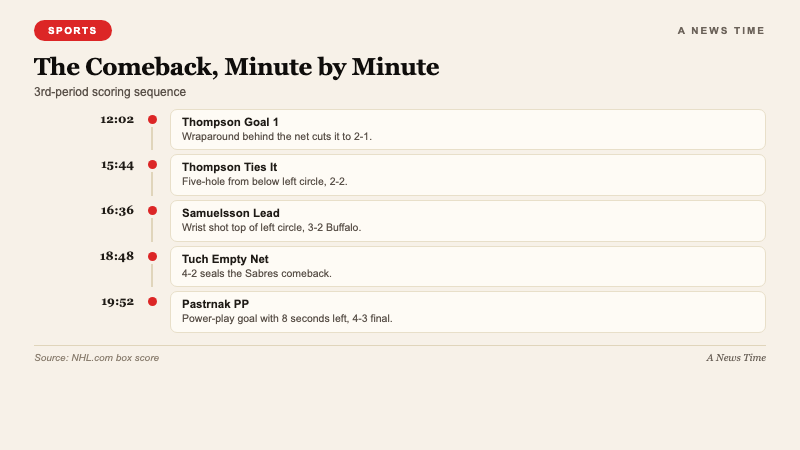
Thompson started the comeback at 12:02 of the third. He recovered a loose puck behind the net and wrapped it past Jeremy Swayman's left skate while the goaltender was looking the other way. That goal did not immediately change the tenor of the game, but it gave Buffalo a reason to press. At 15:44, Thompson tied the score 2-2 by beating Swayman five-hole from below the left circle after Tuch forced a turnover behind the net from Andrew Peeke. Fifty-two seconds later, Mattias Samuelsson took a pass from Jack Quinn and beat a screened Swayman high to the blocker side with a wrist shot from the top of the left circle. The score was 3-2 Sabres.
| Time | Event |
|---|---|
| 1:08 of 3rd | Lindholm makes it Bruins 2-0 |
| 12:02 of 3rd | Thompson (1) scores. Bruins 2-1 |
| 15:44 of 3rd | Thompson (2) ties it. 2-2 |
| 16:36 of 3rd | Samuelsson goes ahead. Sabres 3-2 |
| 18:48 of 3rd | Tuch empty-netter. Sabres 4-2 |
| 19:52 of 3rd | Pastrnak power-play makes it 4-3 |
Tuch's empty-netter at 18:48 pushed it to 4-2 and effectively ended the game. David Pastrnak's power-play goal with eight seconds remaining made the final 4-3, but Boston couldn't win the ensuing faceoff to get a final shot attempt. The Bruins were in the box when the horn sounded.
What Thompson Did
Tage Thompson finished with two goals and an assist in his first NHL playoff game. That three-point line makes him the second player in Sabres history to record three points in a playoff debut, joining Pierre Turgeon. His first goal was also the first playoff goal by a Buffalo Sabres player since Brad Boyes in Game 7 of the 2011 Eastern Conference Quarterfinals, a marker that captures the length of the franchise's absence.
"We've been in games that have prepared us for this. I think eight years of adversity is enough experience to get you ready for something like this. Any time you go eight years not making the playoffs and then it's finally here, the last thing you want is regret."
Tage Thompson, Buffalo Sabres center, postgame
Thompson's second goal is worth studying on replay. Tuch forced Peeke into a turnover behind the net. Thompson received the loose puck, skated into open ice below the left circle, and beat Swayman five-hole from an awkward angle. The shot was quick enough that Swayman did not have time to square to the puck. Goaltender positioning is often the load-bearing variable in playoff hockey, and that sequence captured it.
Why Boston Collapsed
Bruins coach Marco Sturm framed the loss as a two-mistake game that would have been a 2-0 or 2-1 win if not for specific defensive breakdowns in the late third. That is true in the mechanical sense. It is also the kind of postgame quote that a coach gives when he wants his team to hear that the win was there for the taking if execution had held.
"I thought we were in the perfect spot. We were exactly where we wanted to play, being in that position with five or six minutes left in the game. You could tell they got a little bit frustrated and, yeah, we made pretty much two mistakes to let them tie up the game. Obviously, with the crowd behind them, they got some life and the game is done."
Marco Sturm, Boston Bruins head coach, postgame
Morgan Geekie was honest in a different direction. "Everyone is going to say you can't really lose the series in Game 1, but we put ourselves behind the eight ball, and we knew they were going to come out hard," he said. "I think it is important kind of get back on the horse and just continue to build our game. It's a long series." Geekie's "eight ball" framing is correct. A Game 1 loss as the visiting team is survivable but gives the home team the series momentum that Game 2 will either confirm or reset.

The Historical Context Makes It Bigger
Buffalo's eight-year playoff drought (2011 to 2026) was the longest active gap in the NHL before Sunday. The date of the franchise's last postseason appearance, a Game 7 loss to the Philadelphia Flyers in the Eastern Conference Quarterfinals, is the specific marker Sabres fans have been tracking for years. Multiple rebuild cycles, coaching changes, and front-office restructures came and went without producing a team that could break 82 or 84 points across a full season. The 2025-26 Sabres finished atop the Atlantic Division at the No. 1 seed, reversing that pattern in a single year.
The NHL postseason record for late-game comebacks also tells the story. Per league research, the Sabres are the eighth team in postseason history to win in regulation after trailing by multiple goals in the final ten minutes of the third period. It is also the second multigoal third-period comeback in Buffalo's playoff history. The first was Game 4 of the 1993 Division Semifinals against Boston, which is a coincidence the franchise's social-media staff will not let pass without a mention.
Game 2 and What Changes
Game 2 is Tuesday at KeyBank Center at 7:30 p.m. ET. Boston has to solve two specific problems. Jeremy Swayman was beaten on sequences that were partly about defensive-zone decision-making and partly about shot selection on traffic attempts. Buffalo's forecheck created the chaos that produced two of the three third-period goals, and the Bruins need to break pucks out of their defensive zone more cleanly or change their zone-entry approach to avoid giving the Sabres the same kind of puck-recovery opportunities.
The Sabres' adjustment is smaller but real. Sustaining the pressure level from the late third period across 60 minutes is the challenge. Luukkonen was excellent in Game 1 but faced only 17 shots, which reflects Boston's scoring-chance discipline early more than Buffalo's defensive play. A Game 2 with more rubber will test the goaltending differently.
What the Win Means for the Series
Game 1 wins by the higher-seeded team in a best-of-seven series convert to series wins roughly 70% of the time across NHL history. Buffalo as the No. 1 Atlantic seed is the higher seed in this matchup. The series implications are real but not decisive. The bigger narrative shift is psychological. A Buffalo team that has been starved for playoff success now has a Game 1 result to anchor its confidence. A Boston team that has been the established Eastern Conference program for nearly two decades has to absorb a loss that was in hand with five minutes left.
Both answers become clearer Tuesday night. Either Boston restores the defensive discipline that marked its regular-season run and the series becomes a competitive seven-game war, or Buffalo takes a 2-0 lead that changes how the rest of the East handicaps the Sabres' postseason ceiling.
Frequently Asked Questions
Who won Game 1 of Sabres vs Bruins?
Buffalo won 4-3 at KeyBank Center on Sunday, April 19, 2026. The Sabres scored three goals in a 4:34 span late in the third period to erase a 2-0 Boston lead.
How many points did Tage Thompson have in his playoff debut?
Thompson finished with two goals and one assist in his first NHL playoff game. He is the second player in Buffalo Sabres history to record three points in a playoff debut, joining Pierre Turgeon.
How long had the Sabres gone without a playoff game?
Buffalo's last Stanley Cup Playoff game before Sunday was April 26, 2011, a Game 7 loss to the Philadelphia Flyers in the Eastern Conference Quarterfinals. The eight-year drought was the longest active gap in the NHL entering the 2025-26 postseason.
When is Game 2?
Tuesday, April 21, 2026, at 7:30 p.m. ET at KeyBank Center in Buffalo. The game airs on ESPN, NESN, MSG-B, TVAS2, and SN360.
How rare is a multi-goal late-third-period comeback in NHL playoffs?
Per NHL records, the Sabres are the eighth team in postseason history to win in regulation after trailing by multiple goals in the final ten minutes of the third period. It was also the second multi-goal third-period comeback in Buffalo's own playoff history.
What to Watch in Game 2
The three specific questions entering Tuesday: whether Luukkonen gets the start again for Buffalo given his solid but low-volume Game 1; whether Sturm adjusts the Bruins' third-period deployment to avoid the defensive breakdowns that produced the two Thompson goals; and whether KeyBank Center continues to provide the energy lift that visibly affected the game in the final twelve minutes. The next chapter of the eight-year Buffalo story writes itself in about 48 hours.