Walk into a design-forward home in and something immediately feels different. The spare white walls and empty surfaces that defined the last decade of interior aesthetics have given way to rooms that feel lived in, collected, and warm. Vogue's annual trend forecast, which identified 11 key directions shaping the year ahead, captured what many designers and homeowners have been feeling for some time: people want their homes to feel like places where real life actually happens. The theme threading through all 11 trends is a hunger for the natural, the organic, and the unapologetically expressive.
The cultural context matters. Years of sleek, photoshoot-ready interiors, amplified by social media, created a generation of homes that looked beautiful in a flat image but felt strangely cold in person. Research on environmental psychology has consistently shown that humans respond to warmth, texture, and visual complexity in ways that bare surfaces simply cannot replicate. A study published in the journal Building and Environment found that occupants rated rooms with natural materials and textured surfaces significantly higher on measures of psychological comfort and perceived well-being. The design world is catching up to what the data has suggested for years.
Maximalism Is Not a Dirty Word Anymore
House Beautiful summarized the dominant direction of 2026 home design with striking clarity: the top trends are all about bold color and big statements. Neutrals, the magazine reported, are on their way out. Maximalism is rising. But this is not the chaotic accumulation of stuff that the word sometimes implies. Interior designers describe a more curated form of abundance, where every object earns its place through personal meaning, craftsmanship, or visual interest.
Emily Henderson, the Los Angeles-based designer and media personality who has chronicled 11 standout decor trends hitting feeds this year, describes the shift as a rejection of impersonality. Her view is that the sterile interiors of the last decade were partly a reaction to visual overwhelm online, a kind of compensatory blankness. What is happening now, she argues, is that people have become more confident in their own taste and less worried about whether their home would look good on a mood board.
"People are tired of being afraid of their own stuff. The interiors that are resonating right now are the ones that look like someone actually lives there and has opinions. Personal clutter, in the right context, is welcome."
Emily Henderson, interior designer and design media personality
BuzzFeed's analysis of designer predictions reached a similar conclusion, framing the current moment as existing between minimalism and maximalism rather than fully abandoning either. The most compelling spaces in 2026, according to that reporting, are ones that feel warm and collected without tipping into visual chaos. The operative word from multiple sources is "layered," spaces built up over time through deliberate choices rather than assembled in a single weekend shopping trip.
Rich Aged Woods and Natural Textures Lead the Material Story
Among the most consistently cited trends across Vogue, Homes and Gardens, and the design commentary aggregated by Woodgrain is the return of aged, rich wood as a primary material in interiors. This is not the pale blonde wood that dominated Scandinavian-influenced homes for the last several years, but something darker, more characterful, and explicitly aged-looking. Think walnut, dark oak, and reclaimed woods with visible grain, knots, and history.
Woodgrain's 2026 trend analysis described the goal as "layered expressive interiors that feel warm and collected," and wood is central to achieving that feeling. The material connects to broader anxieties about synthetic environments and the growing interest in biophilic design, an approach rooted in the idea that humans have an innate need for connection to natural materials and organic forms.
Homes and Gardens flagged several specific expressions of this organic material trend in their 2026 forecast: floral sofas, built-in banquettes, multiple ottomans, and a general move toward laid-back, flexible seating arrangements that invite lingering rather than performing. The common thread is that furniture is being chosen for how it feels to use it, not just how it photographs.
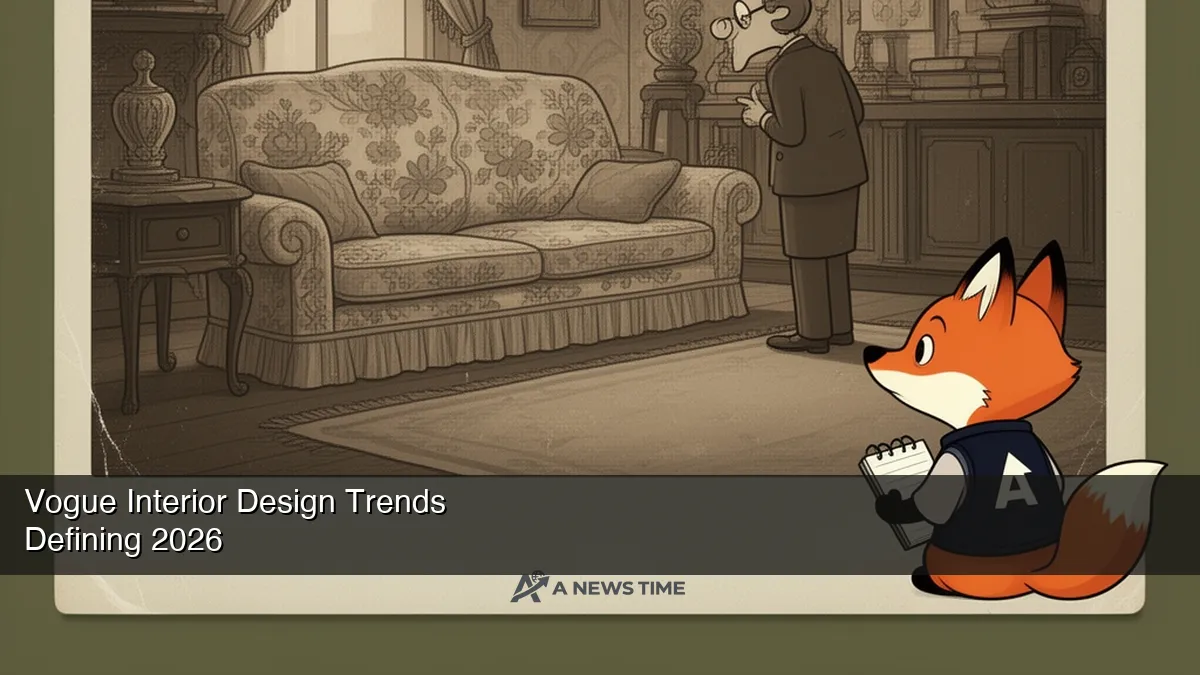
Patterned sofas deserve special attention as a trend because they represent such a clear break from the neutral upholstery that has dominated living rooms for years. A sofa is the single largest visual element in most living rooms, and choosing a boldly patterned one is a definitive statement about what kind of room you want to be in. The fact that patterned sofas are trending across multiple major publications suggests that homeowners are ready to make that statement.
Tassels, Trims, and the Return of Decorative Detail
Few trends more clearly illustrate the move away from modernist restraint than the return of tassels and trims. Vogue specifically identified these decorative details as a defining element of 2026 interiors, and their resurgence is worth examining beyond the surface-level observation that they look charming on a throw pillow.
Tassels and trims are, at their core, details that serve no functional purpose. They exist purely to be seen and touched. Their return signals a broader cultural permission to value decoration for its own sake, to embrace the idea that a beautiful object does not need to justify itself through utility. This is, in its own way, a fairly radical shift from the "form follows function" ethos that has dominated design discourse for so long.
The trend connects to a renewed interest in craft and handmade objects more broadly. As mass production has made perfectly finished, flawlessly symmetrical objects ubiquitous, the handmade imperfection of a hand-knotted tassel or a trim sewn with slight irregularities has acquired a kind of value it did not have a decade ago. Anthropologists who study material culture have noted that humans have always used decorative detail as a way of signaling care, investment, and personal identity. The current trend may be less about aesthetics and more about that deeper human need.
| Trend | Source | Key Expression |
|---|---|---|
| Rich aged woods | Vogue, Woodgrain | Walnut, dark oak, reclaimed timber with visible grain |
| Tassels and trims | Vogue | Decorative edging on cushions, curtains, upholstery |
| Patterned sofas | BuzzFeed, Homes and Gardens | Floral, geometric, and bold-print upholstery |
| Wallpaper in unexpected places | Vogue | Ceilings, inside shelving, entryways, alcoves |
| Built-in banquettes | Homes and Gardens | Integrated seating in kitchens, breakfast nooks, dining rooms |
| Bold color palettes | House Beautiful | Deep greens, terracottas, cobalt blues replacing greige and white |
Wallpaper Goes Where It Has Never Gone Before
Wallpaper has been returning for several years, but in 2026 the trend has matured into something more adventurous. Vogue's forecast specifically noted the placement of wallpaper in unexpected locations: not just on the standard feature wall, but on ceilings, inside bookshelves and cabinets, in the inside panels of doorframes, and in transitional spaces like hallways and entryways that have historically been treated as afterthoughts.
The design logic is straightforward but satisfying. When wallpaper appears only on a single "feature wall," it can feel self-conscious, a decoration that announces itself as a decoration. When it wraps an entire room or appears in a place you did not expect to see it, the effect is immersive rather than performative. Interior designers have long known that the most memorable rooms are not the ones where you immediately spot a single statement piece, but the ones where you keep discovering things.
The specific patterns trending are worth noting because they reinforce the broader organic direction: botanical and floral prints are dominant, along with abstract patterns that reference natural forms like stone, wood grain, and water movement. The palette leans warm, with ochres, terracottas, deep greens, and dusty blues appearing across multiple trend reports. This is not the cool grey-and-white wallpaper of the previous decade. It is warmer, richer, and considerably more confident.
The Psychology Behind the Turn Toward Warmth
The 2026 interior design trends are not happening in isolation from the broader cultural moment. Multiple streams of social science research point toward an increased valuation of home as a restorative space, driven partly by the lasting behavioral changes of the pandemic years and partly by rising levels of ambient stress that make the idea of a genuinely comfortable, personalized home more appealing than ever.
Research from the American Psychological Association has documented the relationship between physical environment and psychological state, finding that cluttered, cold, or characterless spaces are associated with higher cortisol levels, while environments that feel personal and warm tend to support recovery from stress. The interiors that Vogue and its peers are celebrating in are, in this light, not just aesthetically appealing. They are functionally restorative.
This intersects with the growing body of biophilic design research, which argues that human beings have an evolutionarily rooted need for connection to natural materials, organic forms, and visual complexity that mimics natural environments. The aged woods, botanical wallpapers, natural fiber textiles, and organic shapes appearing throughout 2026's trend forecasts are all expressions of this underlying need, even if the people choosing them are not consciously aware of the research behind their preferences.
The travel industry has tracked a parallel shift, with research showing that bookings for wellness retreats and nature-immersive travel have surged, as people seek the same restorative qualities in their experiences that they are now seeking in their living spaces. The home and the holiday destination are being redesigned around the same psychological needs.
What This Means for How Homes Are Actually Used
The functional implications of these trends deserve attention alongside the aesthetic ones. Built-in banquettes, multiple ottomans, and laid-back seating arrangements all point toward homes that are designed for gathering and lingering rather than for occasional, formal use. Homes and Gardens noted the popularity of multiple ottomans specifically as an expression of flexible, casual living: they can be pulled together as a coffee table, separated as additional seating, or used as footrests. Their multiplicity signals a home that is used in different configurations by different people at different times.
Built-in banquette seating follows a similar logic. A banquette in a kitchen or dining room transforms the space into somewhere people actually want to sit for extended periods, working, talking, or simply being present. The architectural commitment of a built-in also signals something important: a willingness to invest in permanence, to make design decisions that are not easily reversed because you have decided, finally, what you want your home to feel like.
This desire for permanence and rootedness may be the deepest current running beneath all 11 of Vogue's identified trends. The organic materials, the personal clutter, the handmade details, the rooms that feel inhabited rather than staged: these are all, in their different ways, expressions of a culture that has grown tired of the provisional and the reversible. The question that home design in seems to be asking is not "How will this look in a photo?" but "How will this feel to live in, day after day, for years?"
That is a more interesting question. And the answers designers are arriving at are, by most accounts, considerably more livable than the ones that preceded them. The homes being built and renovated right now, guided by the trends Vogue has catalogued and House Beautiful and Homes and Gardens have elaborated, are being built to be inhabited. That distinction, modest as it sounds, represents a genuine shift in what we are asking our homes to do for us.
Frequently Asked Questions
What are the biggest interior design trends for 2026?
Vogue identified 11 key trends for 2026, with the unifying theme being a move toward organic, warm, and personal spaces. Highlights include rich aged woods, patterned sofas, tassels and trims, wallpaper in unexpected places like ceilings and shelving interiors, built-in banquettes, and bold color palettes replacing neutral schemes.
Is maximalism replacing minimalism in interior design?
Most design commentators describe the current direction as existing between minimalism and maximalism rather than a complete rejection of either. House Beautiful reports that bold color and big statements are dominating, while BuzzFeed's designer surveys found that "personal clutter" is welcome in ways it was not before. The aesthetic is layered and collected rather than chaotic.
Why are natural materials trending in home design?
Research in environmental psychology links natural materials, organic forms, and textural complexity to psychological comfort and stress recovery. Biophilic design theory argues that humans have an evolved need for connection to natural materials. Designers are increasingly drawing on this research, consciously or not, in their material choices.
What colors are trending in interiors for 2026?
House Beautiful specifically noted that neutrals are on their way out. Deep greens, terracottas, cobalt blues, ochres, and dusty warm tones are appearing across multiple 2026 trend forecasts. The palette is warmer and more confident than the grey-and-white schemes that dominated the previous decade.
Where is wallpaper being used in 2026 interiors?
Beyond the standard feature wall, designers are applying wallpaper to ceilings, the inside panels of bookshelves and cabinets, entryways, hallways, and alcoves. Vogue specifically called out these unexpected placements as one of the 11 key trends, with botanical and floral patterns in warm palettes leading the way.