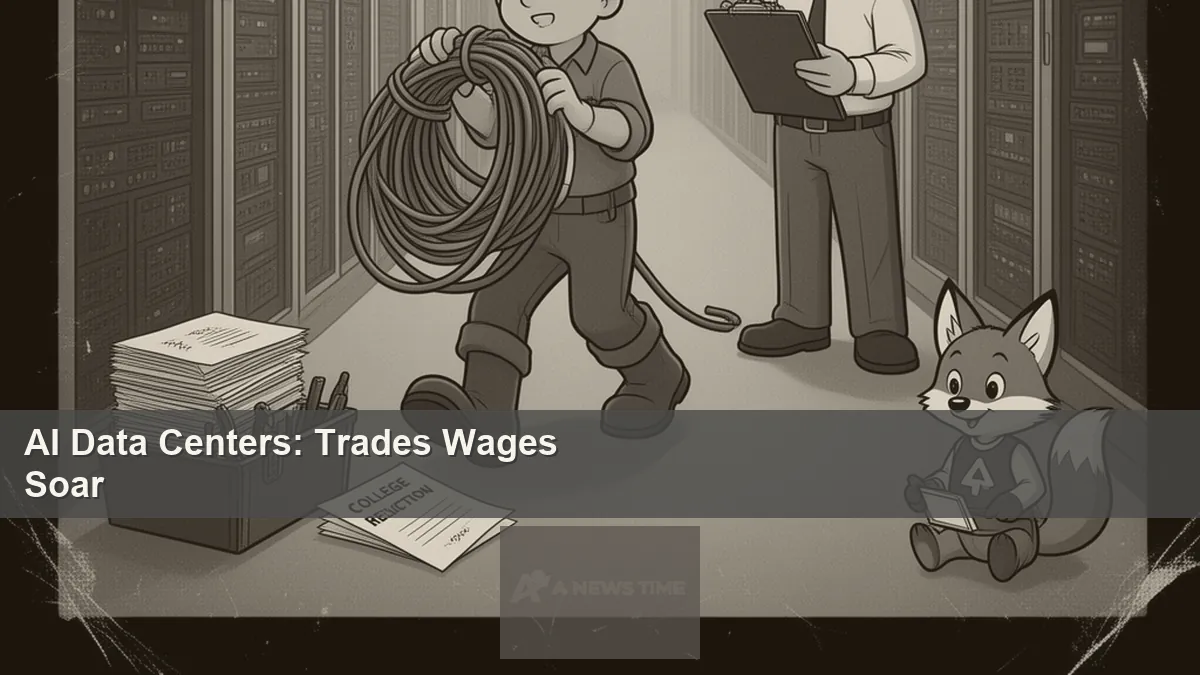
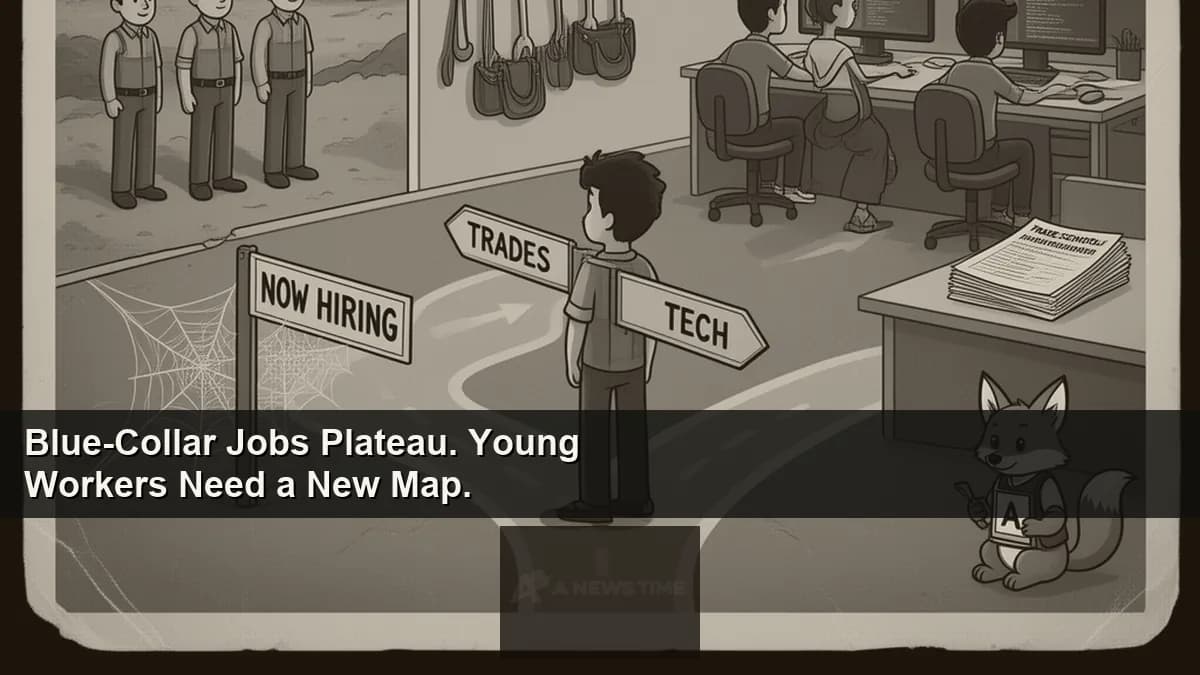
For most of the early 2020s, the story about blue-collar work was an optimistic one. Wages rose. Employers competed for electricians, plumbers, and HVAC technicians. Trade school enrollment ticked upward. Labor economists pointed to a structural shortage of workers who could operate heavy equipment or run high-voltage cable through a data center, and their projections suggested the shortage would last a decade.
That narrative has not collapsed. But it has become significantly more complicated.
As of , data from the BLS and job-posting analytics firms indicate that blue-collar employment has plateaued across several major categories. Job openings in construction, transportation, and manufacturing have declined from their 2022-2023 peaks even as wages in those sectors have stabilized. The trades remain a more reliable path to middle-income employment than many white-collar alternatives, but the window of near-guaranteed absorption that characterized 2021 and 2022 has narrowed. For young workers considering their options in 2026, the picture requires a more careful read than either the optimists or the skeptics are currently providing.
What the Plateau Actually Looks Like
The term "plateau" requires precision. Blue-collar employment has not reversed. Total employment in goods-producing industries and construction remained higher in early 2026 than in 2019. The number of unfilled skilled-trades positions is still elevated by historical standards. But the rate of job opening growth has stalled, and in some subcategories it has turned negative.
Construction job openings peaked in mid-2022 at roughly 450,000 nationally and have since declined to the low 300,000s, according to BLS Job Openings and Labor Turnover Survey data. Manufacturing openings followed a similar arc. Transportation and warehousing openings, which surged during the e-commerce boom, have retreated as JIT inventory practices have reasserted themselves and consumer spending patterns have normalized post-pandemic.
The sectors still showing genuine demand are those tied to the physical infrastructure of the digital economy: electricians for data centers, pipefitters for semiconductor fab plants, ironworkers for battery gigafactories. These roles require credentials and often union affiliation, and they tend to concentrate geographically around large capital projects. The young worker in rural Ohio or the inner suburbs of a Sun Belt city may not live within commuting distance of those projects, and relocation costs represent a barrier that aggregate national data does not capture.
What this means in practice is that the blue-collar labor market has segmented in ways that aggregate reporting tends to obscure. The very top of the skilled trades -- licensed electricians, plumbers with commercial experience, welders certified for structural work -- continue to earn six-figure incomes and face genuine employer competition. The middle of the market, which includes many construction trades workers, assembly line operators, and logistics workers, has stabilized but stopped expanding. The bottom of the market, which includes unskilled or semi-skilled roles in warehousing, light manufacturing, and fast-food adjacent delivery, faces growing automation pressure.
Oracle's $29.7 Million Hire and What It Signals
On April 6, 2026, Oracle Corporation announced the appointment of Hilary Maxson as its new Chief Financial Officer, with a compensation package reported at $29.7 million. The announcement followed Oracle's disclosure of several thousand job cuts globally as part of a broader restructuring the company described as an operational efficiency initiative.
The juxtaposition attracted comment, but the more useful lens is structural. Oracle is not unique in combining workforce reductions with high-value executive appointments. The pattern across major technology companies in the first quarter of 2026 involved cutting roles linked to operations, customer support, and mid-level administration while protecting or expanding positions in strategy, capital allocation, and AI product development.
| Company | Q1 2026 Action | Concurrent Investment |
|---|---|---|
| Oracle | Thousands of job cuts globally | $29.7M CFO hire; cloud and AI infrastructure expansion |
| Microsoft | Approx. 10,000 roles cut in 2023 cycle | Tens of billions committed to OpenAI partnership |
| Alphabet | Approx. 12,000 jobs cut in 2023 | Increased capital expenditure for AI compute |
| Amazon | 18,000+ cuts in early 2023 | Expanded AI capabilities within AWS |
According to analysis published by The Logical Indian, more than 52,050 tech jobs were cut globally in the first quarter of 2026 alone, a 40 percent increase compared to the same period in 2025. A 2025 World Economic Forum report noted that 40 percent of employers expect to reduce their workforce in areas where AI can automate tasks. Research by Erik Brynjolfsson at Stanford University indicates that entry-level roles in AI-exposed fields including software development and customer service are declining, while roles that work alongside AI are growing.
This dynamic is not confined to the technology sector. It is the leading edge of a restructuring pattern that will move through adjacent industries over the next three to five years. The Oracle story matters for young workers not because it changes what electricians earn, but because it illustrates how the corporate ladder that once ran from entry-level to senior management is being telescoped: fewer rungs in the middle, more concentrated value at the top, and AI systems increasingly handling what the middle rungs used to do.
The DC Region Creates a Transition Template
The Washington, D.C. region has been living with a version of this workforce disruption problem since early 2025, when the Trump administration's DOGE initiative produced mass layoffs among federal workers. The scale of those layoffs forced the region to build workforce transition infrastructure faster than any other metro area in the country, and the tool that emerged from that process offers a model worth examining.
Talent Capital AI, a job-matching platform built by the software company BuildWithin, was created with displaced federal workers as its primary constituency. As of early April 2026, the platform had attracted over 100,000 unique users, with 83,000 currently active and matching to more than 65,000 job listings. The platform covers Virginia (42% of users), Maryland (nearly 40%), and the District of Columbia (just over 16%).
"It wasn't lost on anyone that what we're learning about how to handle displaced workers and disruptions to the labor market will be very, very important for us all as we look to the next two or three years of AI enablement in our economy."
Paul Kihn, D.C. Deputy Secretary for Education, speaking to the Metropolitan Washington Council of Governments board of directors
According to Will Lopez, president of BuildWithin, the platform's data reveals a pattern that planners will need to understand. Healthcare leads all sectors on the platform with 15,814 open positions; engineering, primarily cybersecurity-focused roles, accounts for 6,646 listings. More telling is the behavioral shift Lopez described: users are increasingly searching not just for job listings but for training pathways. "We're seeing an uptick in conversations around training opportunities and upskilling opportunities, specifically around project management, leadership and AI foundational skills," Lopez told the COG board.
Starting in May 2026, Talent Capital will offer free virtual and asynchronous AI foundational skills training to all regional constituents. The program is built on the premise that the skills needed to survive the next phase of labor market disruption are not sector-specific but function-specific: project management, data literacy, AI tool operation, and adaptive problem-solving apply across industries. That premise aligns with what labor market data from the Talent Capital platform itself is showing.
Who Is Actually Affected Among Young Workers
The demographic most exposed to the blue-collar plateau is young workers between 18 and 25 who opted out of four-year college with the expectation that trade work would provide stable, upwardly mobile employment. That expectation was reasonable based on 2021 and 2022 labor market conditions. It requires updating in 2026.
| Sector | 2022 Job Openings (Peak) | Early 2026 Openings (Est.) | Trajectory |
|---|---|---|---|
| Construction | ~450,000 | ~310,000 | Declining from peak |
| Manufacturing | ~900,000 | ~700,000 | Declining from peak |
| Transportation / Warehousing | Elevated post-pandemic | Normalized | Declining from peak |
| Data center / infrastructure trades | Growing | Strong demand | Expanding |
| Healthcare support roles | Growing | 15,800+ openings in DC region alone | Expanding |
The workers most insulated from the plateau are those who completed formal apprenticeships in the licensed trades, particularly electrical, plumbing, and HVAC. The licensing requirements, apprenticeship timelines of four to five years, and union affiliation that many young workers found off-putting during the boom period turn out to be the features that have protected those workers from the softening in demand. Barriers to entry in a labor market function as barriers to displacement.
The workers most exposed are those who entered blue-collar work through logistics, light manufacturing, and construction labor without accumulating formal credentials. These roles provided good wages relative to fast food or retail during the labor shortage period, but they lack the credential protection of the licensed trades and face growing competition from automation in warehousing and materials handling specifically.
A distinct cohort worth tracking is young workers who entered federal employment, either directly or through contractors, and who are now being processed through workforce transition systems like Talent Capital. Their situation is different from private-sector displaced workers in that the policy disruption was sudden and concentrated, but the reskilling challenge they face is structurally similar: existing skills that were valuable in a specific institutional context, now needing translation into labor market formats that employers in other sectors can evaluate.
The Reskilling Gap and What Infrastructure Can Do
The Talent Capital model is notable not because it solves the reskilling problem but because it makes the problem legible in real time. A platform with 83,000 active users generates data on what workers are searching for, what training they are willing to undertake, and where the gap between available jobs and available credentials actually lies. That data infrastructure did not exist for previous workforce transitions. The 2008 financial crisis, for instance, was navigated without any regional platform capable of measuring the gap between displaced workers and available roles in near real time.
The limitation Lopez acknowledged -- that Talent Capital cannot track whether job matches result in hires because it does not own the job postings -- reflects a data gap that will need to close before policymakers can measure the platform's actual impact. The plan to encourage employers to post directly on Talent Capital rather than merely syndicate listings there is the right structural direction, but it depends on employer adoption that cannot be mandated.
For workers, the practical implication of the Talent Capital data is that the skills most in demand across the transition period are neither purely technical nor purely blue-collar. Project management, cybersecurity literacy, healthcare support credentialing, and AI tool operation are the categories showing the largest gap between supply and demand on the platform. These are learnable skills, but they require structured training programs with recognized credential output, not just YouTube tutorials or self-directed online learning.
The DC region's investment in free AI foundational skills training starting in May 2026 is a meaningful step. Whether it scales beyond the specific context of DOGE-displaced federal workers -- and whether other metro areas replicate it -- will determine how useful it is as a national template. The hybrid work statistics from 2026 suggest that geographic flexibility has increased for knowledge workers but not for trades workers, which limits the transferability of the DC model to regions where remote or hybrid training is less practical.
The Deeper Structural Question
Underlying all of these specific data points is a structural question about how AI will affect not just white-collar office work but the physical trades over the next decade. The conventional wisdom is that AI threatens knowledge workers first and trades workers later, if at all, because physical manipulation in complex environments remains difficult to automate. That conventional wisdom is partially correct but increasingly incomplete.
Robotic systems are already operating in warehouses, on construction sites (in survey, inspection, and materials-handling roles), and in manufacturing facilities. The current generation of construction robots cannot lay brick as efficiently as an experienced mason, but the comparison point is not the best mason -- it is the marginal construction worker who entered the industry during the labor shortage and has not accumulated deep craft skills. For that worker, automation pressure is not a decade away.
The Gen Z self-taught skills data from 2026 suggests that younger workers are already responding to this pressure by acquiring skills outside of formal training programs. Sixty-six percent of Gen Z workers reported acquiring significant job-relevant skills through self-directed learning rather than formal education or employer training. That capacity for self-directed skill acquisition is a genuine asset, but it produces credentials that employers cannot easily evaluate. The next phase of workforce infrastructure investment will need to solve the credential verification problem: how to make self-acquired skills legible to employers at scale.
The LinkedIn Skills on the Rise data for 2026 shows AI literacy, data analysis, and communication skills at the top of employer demand, categories that apply to trades workers adapting to AI-assisted tools as much as they apply to white-collar workers. An electrician who can read building management system data and troubleshoot AI-controlled HVAC systems is a different professional than an electrician who cannot, and the labor market is beginning to price that difference.
What This Means Going Forward
The blue-collar plateau is not the end of the trades as a viable career path. It is a recalibration of which trades, at which skill levels, in which geographies, will remain strong over the next decade. The segments of trades work tied to digital infrastructure -- data center construction, semiconductor fabrication facility build-out, grid modernization -- will continue expanding. The segments tied to general commercial construction and logistics will remain stable but are unlikely to return to their 2022 growth trajectory.
For workforce policy, the DC region's experiment with Talent Capital offers a data-backed model: real-time matching between displaced workers and available roles, combined with structured training pathways for the skills gaps the matching data reveals. The model works best when employers participate directly rather than just syndicating listings, and when training credentials produced are recognized by hiring managers rather than just noted on a resume.
The Oracle hire and the broader tech layoff data point toward a corporate structure that is becoming more bifurcated: high-compensation strategic roles at the top, AI-automated execution at the bottom, and a shrinking middle layer. That structure will eventually affect the trades as robotic systems mature. The question is not whether the restructuring is coming but whether the workforce transition infrastructure being built in 2026 will be capable of handling the volume when it arrives.
The workers, employers, and policymakers who take the plateau seriously now, rather than waiting for it to become a cliff, will be in a substantially better position than those who extrapolate the 2021-2022 boom indefinitely. The data from the DC region suggests that with the right platform architecture and a genuine commitment to free foundational training, the transition is manageable. Whether it is managed well will depend on decisions being made this year.
Sources
- WTOP News: From DOGE to AI: DC region's newly created jobs board seen as tool for future employment (April 10, 2026)
- The Logical Indian: Oracle's $29.7 Million CFO Hire Amid Job Cuts Signals How Companies Are Restructuring in the AI Era (April 10, 2026)
- Challenger, Gray and Christmas: March 2026 Job Cuts Report
- World Economic Forum: AI and Jobs Report, 2025