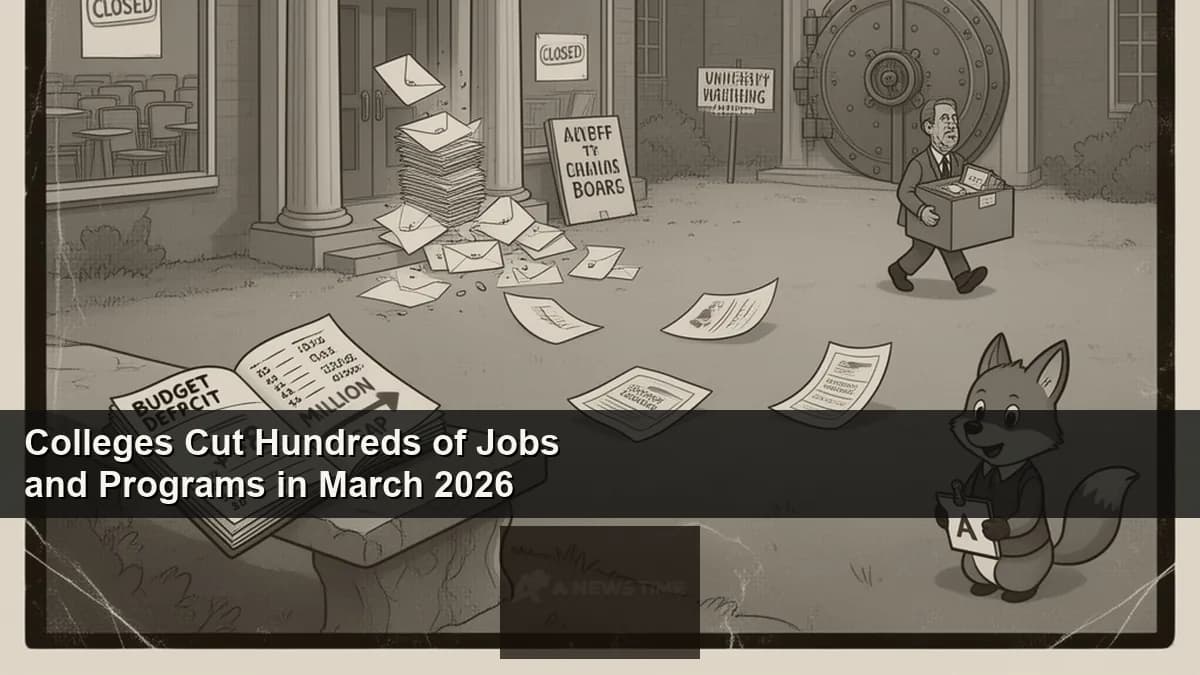
American higher education entered already under pressure, and the month produced another wave of institutional cuts that extended from struggling urban universities to wealthy private research institutions. Inside Higher Ed, reporting on , documented cuts at more than a dozen institutions spanning nearly every region of the country. The range of institutions involved, from the New School's $48 million deficit to Princeton's decision to lay off nine employees despite a $36.4 billion endowment, illustrates that the pressures reshaping higher education in 2026 do not spare institutions that were considered untouchable by conventional metrics.
The drivers behind these cuts are not uniform. State and federal funding reductions, collapsing international student enrollment, post-pandemic enrollment declines in specific disciplines, and targeted federal pressure on DEI programs are operating simultaneously at different institutions with different emphases. The result is a crisis that looks different depending on which institution is being examined but shares a common feature: programs and positions that existed three years ago are being eliminated at a rate that has not been seen since the immediate post-2008 period.
The New School: A $48 Million Hole
The New School in New York City is facing the most severe financial crisis of any institution covered in Inside Higher Ed's March reporting. A $48 million budget deficit has forced the university to announce potential cuts of up to 15% of its workforce, a figure that translates to more than 450 positions. The process began with buyout offers to academic staff: 169 full-time faculty members had been offered buyouts as of the reporting date, representing approximately 40% of the full-time faculty body. How many of those offers will be accepted, and how many additional cuts will follow, will determine the institution's shape by fall 2026.
The New School's situation reflects pressures specific to urban private universities that rely heavily on tuition revenue from a student body drawn significantly from international enrollment. International student enrollment at the New School, as at many institutions in New York and other gateway cities, has been affected by ICE enforcement anxiety, visa processing delays, and the broader chilling effect of the current federal administration's immigration posture. International students pay full tuition at most private universities and generate disproportionate revenue relative to their enrollment numbers. Their withdrawal from the pipeline is a structural revenue problem that buyouts and program cuts cannot fully address.
Portland State and the Pacific Northwest Pattern
Portland State University in Oregon is navigating a $45 million shortfall that has produced a different response than the New School's buyout-led approach. Portland State has identified up to 216 employees across 19 departments as potentially subject to layoff, a figure that the AAUP chapter at the university has made public. The university administration has disputed the AAUP's characterization of the number, arguing that the 216 figure overstates the likely final layoff count. The dispute itself is telling: it reflects the political dynamics of higher education restructuring, in which institutions and faculty unions have strong incentives to frame the same situation differently.
Portland State's deficit is driven by a combination of declining enrollment in several graduate programs, state appropriations that have not kept pace with the university's cost structure, and capital obligations from facility investments made during the previous decade. The institution is not unique in this profile. Similar patterns, tuition dependence, enrollment volatility, and deferred capital cost recognition, have produced comparable crises at regional public universities across the country, particularly those without the flagship status that concentrates state appropriations at institutions like the University of Oregon or Oregon State.
Syracuse, North Texas, and the Program Cut Wave
The most structurally significant story in March's higher education news may not be the layoff numbers but the program elimination figures. Syracuse University is cutting 84 academic programs and pausing 9 others, representing approximately 20% of the institution's total academic program portfolio. The cuts include classics and language majors, programs that have faced enrollment pressure for years but that many faculty members argue have educational value that enrollment numbers alone cannot capture.
The logic of program cuts in higher education has changed in the current environment. In earlier periods, program elimination was typically a last resort that institutions avoided because of the political costs within academic governance structures. The current environment, with enrollment declines creating genuine structural deficits at multiple institutions simultaneously, has shifted that calculation. Program cuts are now being framed as necessary rationalization rather than academic defeat, and the institutions implementing them are moving faster than the shared governance processes that previously slowed such decisions.
| Institution | Deficit / Shortfall | Actions Taken |
|---|---|---|
| The New School (NYC) | $48M deficit | Up to 15% workforce cuts, 169 faculty buyouts |
| Portland State University | $45M shortfall | Up to 216 potential layoffs across 19 depts |
| University of North Texas | $45M shortfall | Closing/consolidating 70+ academic programs |
| Syracuse University | Not disclosed | 84 programs cut, 9 paused (~20% of total) |
| University of Maine | $18M shortfall | Fewer than 10 layoffs, suspended 2 degree programs |
| Ohio University | State review | 16 underenrolled programs dropped |
| Princeton University | Not disclosed | 9 layoffs including entire Keller Center staff |
| Boise State University | Not disclosed | Two deans removed, colleges merged/shuttered |
The University of North Texas faces a $45 million shortfall and is closing or consolidating more than 70 academic programs, including women's and gender studies. The inclusion of programs with explicit social justice or DEI dimensions in the cut lists at multiple institutions is not coincidental. Federal pressure on DEI programming, combined with the enrollment declines that have reduced the student demand base for some identity-focused disciplines, has created a situation where programs that were previously politically protected by their connection to diversity commitments are now among the more vulnerable in budget conversations.
The Princeton Puzzle: Cuts Despite $36 Billion
The most counterintuitive story in March's higher education news is Princeton University's decision to lay off nine employees, including the entire staff of the Keller Center for Innovation in Engineering Education. Princeton holds a $36.4 billion endowment, the largest academic endowment in the United States by most measures. The disconnect between financial capacity and operational cuts requires explanation.
Princeton President Christopher Eisgruber described the Keller Center cuts as part of a broader effort to pursue the university's mission in a "more efficient" way. The language is notable: efficiency framing applied to a $36.4 billion institution suggests that the motivation is strategic rather than financial. Princeton is not cutting the Keller Center because it cannot afford to sustain it. It is cutting it because institutional leadership has decided that the mission it served is better accomplished through other means, or because the center no longer fits the priorities of the administration's academic vision.
"When institutions with $36 billion endowments are making staff cuts, it signals something important: the pressures reshaping higher education are not purely financial. They are also political, strategic, and structural. The institutions that can afford not to cut often still do, because they are responding to the same external environment as institutions that cannot."
Analysis, Inside Higher Ed,
The Keller Center's focus on innovation in engineering education places it at the intersection of two areas under pressure in the current environment: innovation centers whose ROI is difficult to quantify through traditional metrics, and engineering education programs whose identity sometimes overlaps with the DEI-connected institutional missions that federal pressure is targeting. Whether either of those factors played a role in Princeton's decision is not confirmed, but the context is relevant to understanding why a $36.4 billion institution is making cuts that look optional rather than necessary.
Rutgers, Maine, Ohio University, and the Long Tail of Cuts
Rutgers University's contribution to March's higher education news is less visible than the larger institutional crises but potentially more insidious in its long-term effects. The university did not reappoint 38 adjunct faculty members, a group collectively responsible for teaching approximately 100 courses. Adjunct non-reappointment is the most common form of higher education workforce reduction, and it is systematically undercounted in coverage that focuses on full-time faculty and administrative positions.
Adjunct faculty represent the majority of undergraduate teaching at many American universities, including flagship research institutions. Their non-reappointment is often structured to avoid triggering the formal layoff processes that require WARN Act notification and generate public attention. The practical effect on students, who lose access to courses they expected to take, and on the adjunct faculty themselves, who lose employment without formal layoff status, can be significant despite the administrative quietness of the process.
The University of Maine, facing an $18 million shortfall, has taken a more targeted approach: fewer than ten layoffs alongside the elimination of the master's program in teaching Spanish and the suspension of the undergraduate medical laboratory sciences program. The Spanish teaching program cut reflects enrollment realities in language programs at regional public universities, where declining language requirement mandates and shifting student interest have eroded the enrollment bases that sustained programs for decades.
Ohio University dropped 16 underenrolled programs following a state review that flagged 36 programs for potential consolidation. The state-driven review process that Ohio University is navigating is becoming more common across public university systems, as state legislatures and coordinating boards impose enrollment thresholds as a condition for program continuation. This mechanism, state-mandated rationalization of underenrolled programs, is a structural change to higher education governance that is occurring alongside but somewhat separately from the financial crises at individual institutions.
Students and Faculty Respond
At the College of Saint Scholastica in Minnesota, students held a sit-in to protest faculty cuts affecting up to a dozen positions. The protest reflects a pattern that has been visible at several institutions this spring: student body recognition that faculty cuts are not abstract budget decisions but concrete changes to the educational experience they are paying for.
The student debt calculation that underlies higher education's business model is directly affected by program and faculty cuts. A student who chose an institution because of a specific program, faculty member, or research opportunity and then finds that program or faculty member eliminated has a legitimate grievance about the product they are financing. The legal vulnerability that higher education institutions face from this dynamic is increasing as students become more sophisticated about consumer protection frameworks and as plaintiff-side legal advocacy targeting higher education has grown.
Faculty governance responses have varied. At Portland State, the AAUP chapter's public disclosure of the 216-employee figure reflects a strategy of maximum transparency as a pressure tactic against administrative decision-making. At other institutions, faculty senates have been more measured, negotiating over the terms of cuts rather than opposing them categorically. The difference in approach often reflects both the institutional culture and the strength of faculty union organization at specific campuses.
The higher education funding landscape has been evolving rapidly alongside these specific institutional crises. Our earlier coverage of the Trump administration's multi-front higher education crackdown, including the Harvard grant freeze and student visa revocations, provides essential context for understanding the federal policy environment in which these institutional decisions are being made. Many of the program and workforce cuts happening in spring 2026 are directly attributable to federal funding uncertainty that began with the administration's January executive orders.
The Five Drivers: Why This Is Structural, Not Cyclical
Understanding March 2026's higher education news requires recognizing that the cuts are not the product of a temporary downturn that will reverse when economic conditions improve. They reflect five structural changes that are operating simultaneously and that will not self-correct on their own:
- State and federal funding reduction: Appropriations at the federal level have been cut or frozen across multiple program categories, and several state legislatures have reduced higher education appropriations in real terms. These reductions compound over time because universities cannot immediately adjust cost structures to match reduced revenue.
- Declining enrollment in specific disciplines: Enrollment declines are not uniform. Some disciplines, nursing, computer science, engineering, have waiting lists. Humanities, many social sciences, and language programs have lost enrollment over the past decade in ways that are now creating genuine structural deficits in departments that were sized for larger student bodies.
- Collapsing international student enrollment: The federal administration's visa policy and immigration enforcement posture has deterred international students in ways that affect both tuition revenue and the research ecosystem that international graduate students support. This effect is concentrated at research universities and urban private institutions that historically drew large international enrollments.
- Federal DEI pressure: Executive orders and Department of Education guidance targeting DEI programs have put funding for programs and positions connected to diversity initiatives at risk. The legal uncertainty around federal funding compliance has led some institutions to make preemptive cuts rather than risk losing broader federal funding.
- Post-pandemic financial pressure compounding: Many universities deferred financial restructuring during the pandemic by drawing on reserves and benefiting from temporary federal relief funding. Those measures have been exhausted at many institutions, and the underlying structural imbalances that existed before 2020 are now presenting in sharper form.
These five factors interact in ways that make the current crisis more severe than any single one would produce independently. An institution managing declining enrollment might absorb the pressure if federal funding were stable. Federal funding uncertainty is more manageable if enrollment is strong. The combination of multiple simultaneous pressures is what makes spring 2026's higher education news qualitatively different from periodic adjustment periods in previous decades.
For further context on how students are responding to the uncertainty around educational value and career outcomes, our earlier coverage of AI-proof degrees and the negative ROI crisis addresses the growing concern about whether specific academic credentials are maintaining their economic value in a rapidly changing labor market.
What Comes Next
The institutions that survive the current restructuring period in the strongest position will be those that made the hardest decisions earliest, maintained sufficient reserves to fund the transition costs of workforce and program reduction, and preserved their core academic identity through a process that requires eliminating significant parts of their periphery.
The institutions at greatest risk are mid-tier private universities and regional public universities that lack both the endowment cushion of elite institutions and the mission clarity and enrollment stability of specialized professional schools. Many of these institutions have been operating on deficit margins for several years, funding operations through debt and deferred maintenance rather than structural reform. Spring 2026 is the moment when many of those deferred decisions are arriving simultaneously.
Accreditation bodies, which have been monitoring financial stress at multiple institutions, will be critical in determining which institutions can continue operating and which face closure or merger. Several higher education observers have identified a wave of institutional closures and mergers as likely in the 2027-2029 period if current trends continue. The March 2026 cuts are not the end of this story. They are the opening phase of a restructuring of American higher education whose final shape is not yet clear.