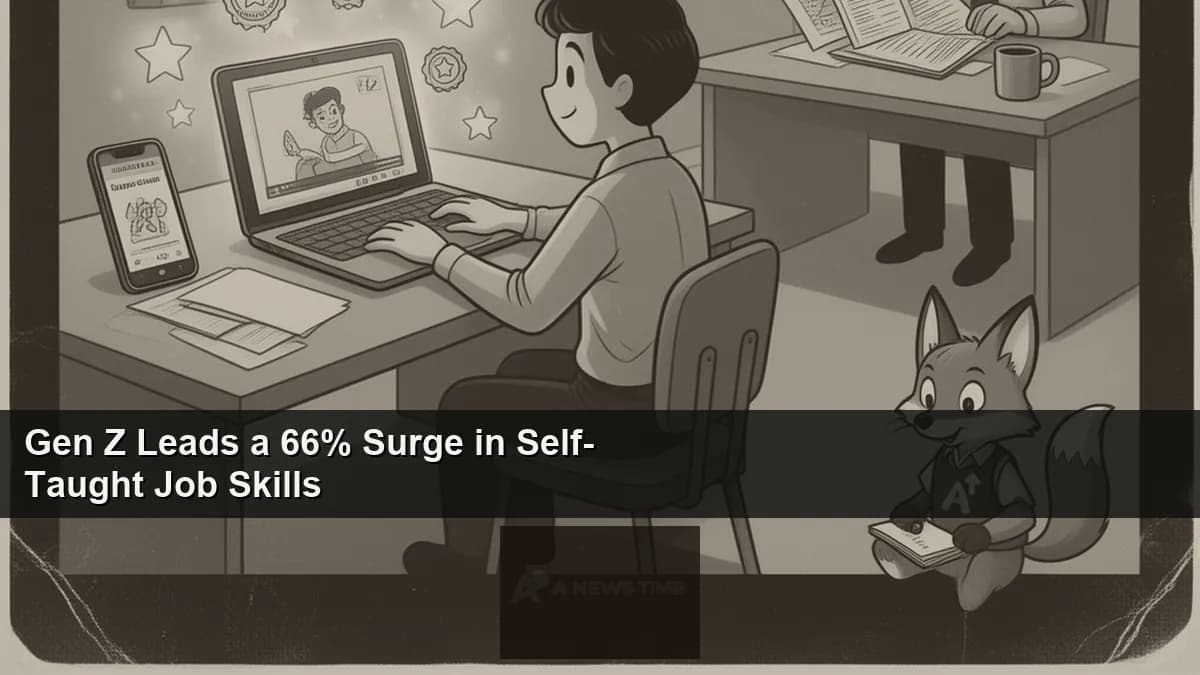
The numbers from the latest workforce survey are striking in their generational spread. Sixty-six percent of Gen Z workers say they have taught themselves job skills online. Fifty percent of millennials say the same. The figure drops to 35 percent for Gen X and reaches only 20 percent among boomers and seniors. The Express Employment Professionals-Harris Poll survey, conducted in late 2025 and released in February 2026, documents what educators and workforce researchers have been observing qualitatively for years: the act of acquiring professional skills through informal channels is not evenly distributed across generations, and Gen Z's relationship to self-directed digital learning is categorically different from the one that defined how their parents and grandparents prepared for work.
The survey involved 1,002 U.S. hiring decision-makers and 1,003 adult job seekers, providing a data foundation large enough to draw meaningful conclusions about the gap between how self-taught skills are being acquired and how they are being evaluated. That gap is the story: self-taught learning is exploding while the hiring infrastructure designed to evaluate it is still catching up.
The Numbers: What the Survey Actually Found
The headline statistic is the generational comparison, but the survey contains several other findings that add nuance to the picture. Among job seekers, 47 percent now include self-taught skills on their resumes, a figure that represents a substantial portion of the workforce actively claiming credentials that did not come from formal education systems. Men (53 percent) are more likely than women (40 percent) to list self-taught skills, a gender gap that has not been widely examined in workforce coverage but may reflect differences in which fields are being self-taught and how those fields are gendered.
| Generation | Self-Taught Skills Online (%) | Include on Resume (%) |
|---|---|---|
| Gen Z (born 1997-2012) | 66% | Higher than average |
| Millennials (born 1981-1996) | 50% | Higher than average |
| Gen X (born 1965-1980) | 35% | Average |
| Boomers / Seniors (born before 1965) | 20% | Below average |
| All job seekers | 47% include on resume | 47% |
On the employer side, the picture is complicated. Seventy-one percent of hiring managers say skills learned through informal online platforms are credible, a statement of openness to self-taught credentials that seems to contradict the finding that 53 percent still prefer formal education when evaluating candidates. The apparent contradiction resolves when you read the fine print: believing that self-taught skills can be credible and preferring formal education as a screening criterion are not mutually exclusive positions. Hiring managers who recognize informal learning as valid may still default to degree credentials as a filtering mechanism because degrees provide verification that self-reported YouTube learning does not.
Twenty-nine percent of hiring managers value formal and self-taught skills equally, and 18 percent now actively favor self-taught learning. The 18 percent figure is the leading edge of a shift that will likely grow as the workforce evolves, but it remains a minority position among decision-makers who control most hiring outcomes.
The Verification Problem: How Skills Get Proven
The most operationally significant finding in the survey is not about credibility beliefs but about verification. Ninety-two percent of hiring managers say that demonstrating how skills were used or how they would be applied is more effective than reviewing a resume. This is a striking statement of preference for demonstrated competence over credential signaling, and it has direct implications for how job seekers should be presenting self-taught skills.
The survey breaks down what specifically builds employer confidence:
- Demonstrated industry knowledge cited by 47% of hiring managers
- Clear explanation of how skills were used cited by 46%
- Work sample or assessment completion cited by 45%
- References cited by 37%
- Employee referrals cited by 29%
- Team impressions cited by 22%
The pattern suggests that the premium is on behavioral evidence rather than credential evidence. A portfolio of work, a skills assessment, or a detailed explanation of how a self-taught skill was applied in a real context outweighs the credential itself. For job seekers building skills through online platforms, the implication is that the platform completion certificate is less important than what was built with the skills afterward. This is a fundamentally different incentive structure than formal education, where the degree is the primary signaling vehicle and the projects completed during study are secondary.
The AI Factor: Why Self-Teaching Is Accelerating
The survey's findings on AI provide context for why the self-taught skills trend is accelerating rather than plateauing. Seventy-five percent of job seekers say AI advancements make them more likely to pursue additional training. Seventy-six percent believe it is appropriate to use AI tools to learn professional skills, including 27 percent who say it is completely appropriate. Men are more likely than women to pursue AI-driven additional training (79 percent versus 71 percent) and to endorse AI-based learning (82 percent versus 69 percent).
The structural logic is straightforward. AI is reshaping job requirements at a pace that formal education institutions cannot match: the typical university curriculum update cycle is measured in years, while the skills that AI is making valuable or obsolete are changing on timescales measured in months. Workers who recognize this gap are responding by learning outside formal systems where they can update their skills in response to actual market signals rather than curriculum committee decisions.
LinkedIn's 2026 Skills on the Rise report, published separately from the Harris Poll survey, identifies the fastest-growing skills across 12 global markets and finds a pattern consistent with the self-teaching trend: the highest-growth skills are largely technical and AI-adjacent, in categories where online learning infrastructure is well-developed and where practical application can be demonstrated through portfolio work without institutional validation.
How Hiring Is Changing in Response
Fifty percent of hiring managers report that their company has already updated hiring processes to recognize and verify self-taught skills, with 35 percent saying more updates are planned. The changes concentrate in larger employers, who encounter self-taught candidates at higher volume and have more organizational capacity to design structured verification processes. Smaller employers who rely on simpler screening mechanisms are less likely to have implemented specific accommodations for self-taught credentials.
The practical adaptations taking several forms across the hiring landscape. Skills assessments conducted at the interview stage or before have become more common, allowing candidates to demonstrate competence directly rather than relying on resume claims. Portfolio review processes, where candidates submit work samples for evaluation alongside or instead of credentials, are expanding beyond the design and software development fields where they were already standard. Trial projects or paid assessment periods are being used in some contexts as alternatives to credential screening.
"Self-learning is opening doors for workers everywhere, but it also raises the bar," said Bob Funk Jr., CEO, President, and Chairman of Express Employment International. "Job seekers must be ready to demonstrate their abilities right away, and employers should update their hiring practices to evaluate the skills people gain on their own." The framing positions self-taught learning as a mutual obligation: learners must be able to demonstrate, and employers must create mechanisms to evaluate what is demonstrated.
What This Means for Students and Early-Career Workers
The survey findings carry specific practical implications for the Gen Z cohort at the center of the trend. Being in the majority of your generation who teaches themselves skills online is not sufficient: the 92 percent figure on demonstrated competence suggests that the self-teaching itself needs to be followed by deliberate portfolio construction, skills documentation, and preparation to explain how acquired skills translate to employer value.
The skills that employers report valuing most in self-taught candidates align with the kinds of technical and applied competencies where online learning infrastructure is most developed: coding and software development, data analysis, digital marketing, and the AI-adjacent skills that LinkedIn's research identifies as fastest growing. Liberal arts and humanities fields where self-taught credentials are harder to demonstrate through portfolio work present a different challenge, one the survey does not directly address but that is implicit in the heavy concentration of self-teaching in technical domains.
The tension between the 53 percent of hiring managers who still prefer formal education and the 18 percent who actively favor self-taught learning represents a genuine fork in credential strategy. For entry-level roles in large organizations with established degree requirements, a self-taught credential as a standalone qualification still faces structural resistance. For roles where demonstrated competence is the primary screening criterion, the self-taught path may produce better outcomes than a credential that doesn't come with a portfolio of applied work.
The Larger Education System Implications
The survey's findings arrive in a broader context where the return on investment for formal education credentials has become a more contested question than it has been at any point in the past several decades. Research published in early 2026 on negative ROI for certain graduate programs and the Gallup-Lumina Foundation data showing 42 percent of college students reconsidering their major choices due to AI provide the quantitative backdrop against which the self-taught skills surge is occurring.
The logical endpoint of the trend, if it continues, is a hiring market where demonstrated skills increasingly substitute for formal credentials across a wider range of roles. That shift has profound implications for higher education institutions that have structured their value proposition around the credential as the primary outcome, and for policy frameworks built on the assumption that formal education is the primary pathway to workforce entry.
What is not yet clear is whether the current moment represents a genuine structural shift or a cyclical response to rapid technological change that will stabilize as the AI-driven skills disruption settles into new patterns. The 66 percent of Gen Z workers who have already turned to self-directed digital learning to prepare for work are not waiting for that question to resolve. They are making practical decisions based on available signals, and the signals right now favor learning over credentialing as the primary investment of their time and attention.