
There is a skill the labor market wants more than almost any other right now, and most schools are not teaching it. Not because educators do not care, but because it has never been placed on the curriculum map the way reading, math, or even computer literacy has. That skill is decision-making, and a growing body of workforce data suggests its absence is becoming one of the most consequential gaps in American career readiness.
The research was published on by the Alliance for Decision Education, in a report titled Decision Skills in the Workforce, produced in collaboration with the Burning Glass Institute. The Burning Glass Institute analyzed millions of US job postings. What emerged was not a picture of soft-skill nostalgia. It was a hard data case for why human judgment is one of the few capabilities the AI economy is actively bidding up.
What the job postings data actually shows
The numbers from the Burning Glass analysis are specific enough to matter. 41 percent of US job postings explicitly reference decision-making skills. In technical occupations including computer and mathematical roles, that share rises to 68 percent. These are not vague mentions of "critical thinking" buried in boilerplate. They are job requirements using specific language about evaluating options, weighing trade-offs, and determining what to do next.
The wage premium attached to those postings is even more clarifying. Jobs that require demonstrable decision-making skills carry wage premiums of up to 23 percent compared to equivalent roles that do not list those requirements. The labor market is not just saying it values decision-making. It is paying for it.
The reason connects directly to what AI systems currently do and do not do well. Generative AI is genuinely capable of summarizing documents, generating first-draft content, running surface-level analysis, and automating pattern-based tasks. It is not capable of setting goals, establishing values, or determining what a given situation actually calls for. It also frequently produces inaccurate information and tends to reinforce the framing assumptions of whoever is asking it. That means the human on the other end of every AI workflow needs something AI lacks: the judgment to know what to do with what the machine produces.
As the Burning Glass report framed it, while technology can generate information and automate tasks, people still need to evaluate options, weigh trade-offs, and determine what to do next. In that sense, AI is not reducing the value of human decision-making. It is raising the stakes for it.
What decision education actually teaches
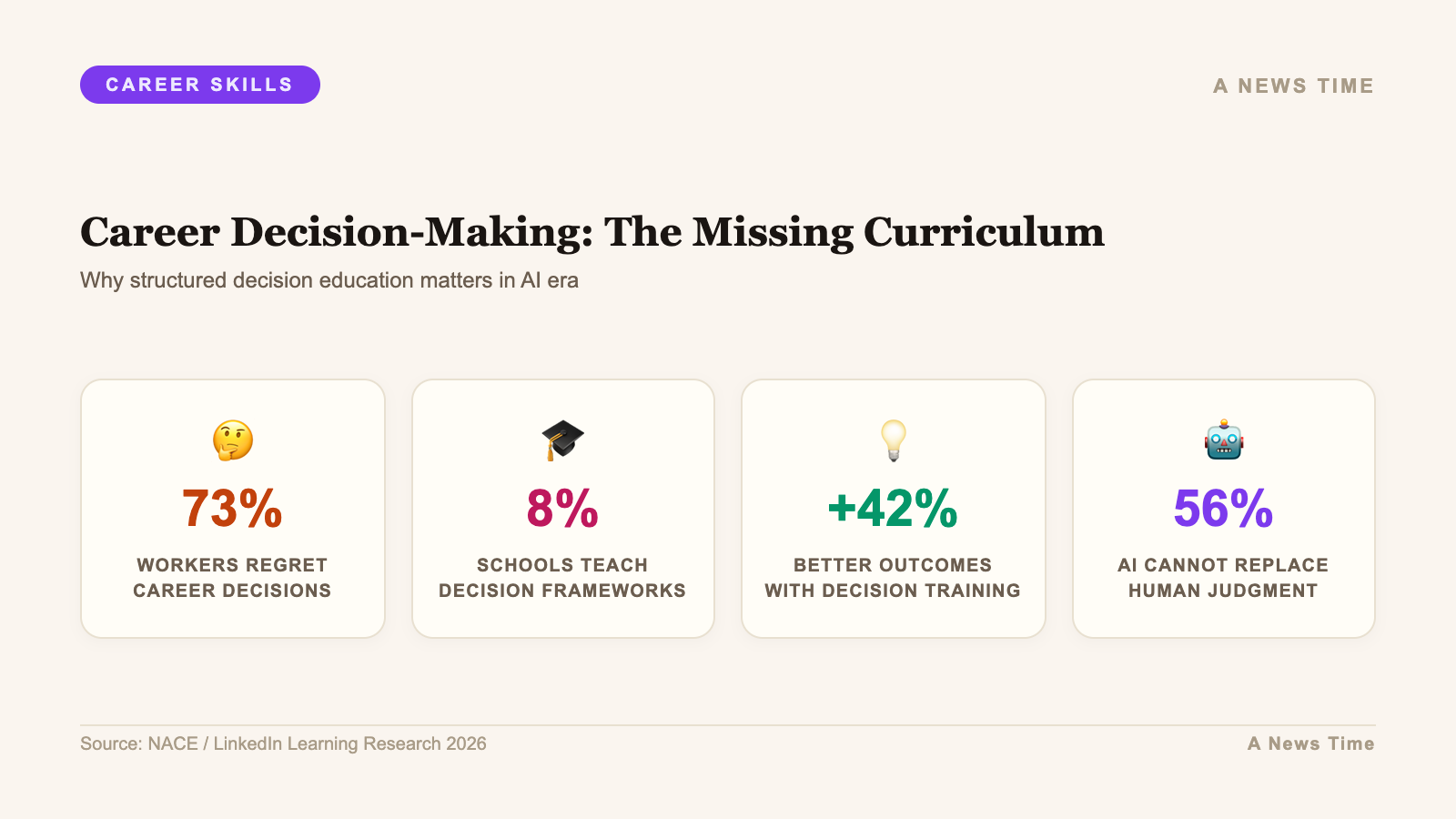
The term Decision Education refers to a specific pedagogical framework developed and promoted primarily by the Alliance for Decision Education, a nonprofit organization that has been working with K-12 schools to embed decision-making instruction into existing curricula. It draws from psychology, behavioral economics, and decision science to teach students a structured process for making better choices under uncertainty.
The framework covers five core areas. Probabilistic thinking: the ability to reason about uncertain outcomes without defaulting to false certainty. Cognitive bias recognition: the ability to identify common mental shortcuts that distort judgment, including confirmation bias, availability bias, and sunk cost thinking. Metacognition: the practice of thinking about one's own thinking, stepping back from an in-progress decision to evaluate the process being used. Active open-mindedness: the deliberate practice of seeking out information that challenges existing beliefs rather than confirming them. And decision structuring: the ability to map a problem, identify the relevant alternatives, and think systematically about their likely consequences before committing to a path.
The practical classroom application is more intuitive than the framework terminology suggests. A middle school class practicing decision education might be given a real-world trade-off question: should a city invest in a new public park or expand its public transportation network? Students work in groups, evaluate available data, consider second- and third-order consequences, and structure their reasoning before committing to a recommendation. The goal is not to arrive at the right answer. It is to practice the process of arriving at a defensible answer through deliberate reasoning rather than instinct.
Decision-making skills are at the heart of every career journey. When education and workforce programs integrate these skills into local delivery, students and job seekers gain the practical tools they need to make informed choices, seize opportunities, and build lasting economic mobility.Dr. Mardy Leathers, Executive Vice President, Adaptive Construction Solutions
Why the skill is undertaught despite its value
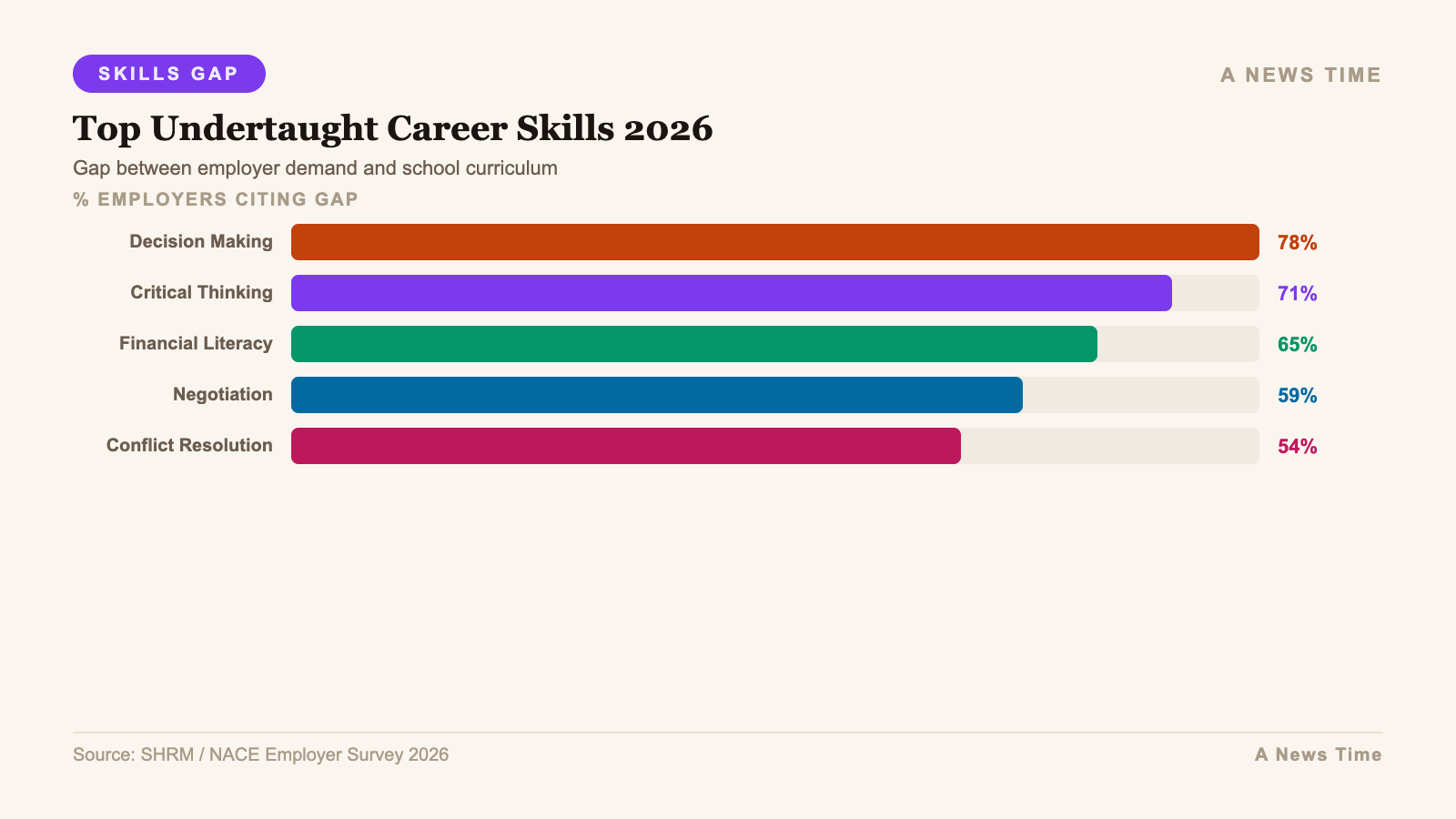
Decision-making occupies an awkward space in education. It is widely acknowledged as important, routinely listed in school mission statements as a graduate outcome, and essentially absent from formal curriculum in most districts. The absence is not ideological. It is structural.
Career readiness frameworks, both state-level standards and the private-sector workforce development programs that have expanded to fill gaps in public education, have historically prioritized technical training and industry credentials. That emphasis is not wrong. Coding bootcamps, industry certifications, and trade apprenticeships deliver real employment returns. But they represent only part of what graduates need. The missing piece is the durable, transferable foundation that applies across professions and throughout a career that will likely involve multiple industry transitions.
The average American worker today changes jobs roughly a dozen times over a career and changes industries several times as well. The credentials that get someone a first job in a specific industry become less portable over time. The judgment about how to evaluate a new situation, navigate ambiguity, and choose a course of action under uncertainty becomes more valuable over time. Decision education addresses precisely that long arc.
The Alliance for Decision Education has been building infrastructure to change this through its Decision Education Incubator, a program that works with teachers to embed decision-making lessons into existing courses across subjects. The approach is deliberately non-additive: rather than asking schools to carve out a new class period for decision education, it asks teachers to identify moments within existing curricula where the framework applies and embed the practice there. A history class discussing the decision to drop the atomic bomb. A biology class designing an experiment under resource constraints. A math class building probability models for real-world scenarios.
The AI factor shifts the timeline from optional to urgent
What has changed in the past 18 months is not the underlying importance of decision-making. That has been documented in workforce research for years. What has changed is the timeline on which its absence becomes professionally consequential.
When AI tools were limited in capability, the gap between students who could reason well under uncertainty and students who could not was relatively forgiving. Both groups could find entry-level roles that did not demand much of either. As AI handles more of the mechanical cognitive work, that forgiveness disappears. The roles that remain and grow are the ones where human judgment is not a nice-to-have but a core deliverable.
This shift is visible in the occupational categories showing the strongest decision-making demand. Computer and mathematical occupations, where 68 percent of postings reference the skill, are among the fastest-growing sectors in the economy. Healthcare, where clinical judgment under uncertainty is the central competency, is another. Construction management and infrastructure, which our coverage of Larry Fink's workforce warning identified as an area of growing demand driven by AI infrastructure buildout, requires constant field-level decision-making that AI systems cannot replicate. The common thread is not industry but the nature of the work: adaptive, context-dependent, and requiring judgment that cannot be preprogrammed.
The students entering the workforce in 2026 and beyond are the first generation to face a labor market where AI handles entry-level cognitive tasks at scale. The research now shows that the graduates most likely to succeed in that market are not simply the most technically trained, but the ones who have developed the judgment to work alongside AI systems rather than be replaced by them.
What schools are actually doing about it
Adoption of decision education frameworks in US schools remains early-stage and concentrated in districts with deliberate innovation cultures. The Alliance for Decision Education has trained teachers across the country through its Incubator program, and some state-level career readiness standards are beginning to incorporate language about judgment and reasoning alongside technical competencies. But the gap between policy language and classroom practice remains wide.
The most promising signal is that decision education is not asking schools to do something fundamentally alien to their existing work. Every teacher who runs a Socratic discussion is practicing a version of it. Every project-based learning assignment that asks students to make trade-offs is practicing a version of it. The framework gives structure to what good teachers are already doing intuitively and makes it transferable and systematic.
The urgency from the labor market is also beginning to reach school districts through the employers and workforce development organizations they partner with. The quote from Dr. Mardy Leathers of Adaptive Construction Solutions, a company that works directly with workforce training programs, reflects the kind of employer voice that school administrators pay attention to. When employers articulate what they are missing in graduates in specific terms, that language eventually finds its way into curriculum conversations.
The practical case for students right now
For current students in high school and college, the practical implication is straightforward: seek out experiences that require you to make consequential decisions with incomplete information, and reflect on how you made them. That can happen in student government, in entrepreneurship programs, in case competitions, in research where the methodology has to be designed from scratch, or in any context where the right answer is not pre-determined by a rubric.
The wage premium research is useful precisely because it makes the argument in terms the labor market already understands. A 23 percent premium on decision-making jobs is not an abstraction. At median earnings, that translates to a meaningful income difference over a five-year early career. The skills that employers are willing to pay more for are the ones worth developing deliberately, and decision-making, rare among in-demand skills, can be developed without expensive equipment, proprietary software, or credentialing fees.
The most important thing that research documents about decision education is also the most accessible. The skill can be taught. It can be improved through practice. It does not require native intelligence or fortunate circumstances. It requires deliberate engagement with a process that schools, families, and students themselves can build into existing routines. The labor market will reward that investment for the rest of a career. The question is whether the education system moves fast enough to make it standard rather than exceptional.
What to watch through the year
Two things to follow. The first is whether any state-level career and technical education standards revisions in 2026 incorporate explicit decision-making competencies as measurable outcomes, rather than aspirational language. Several states are in active curriculum revision cycles this year. The second is whether the wage premium data from the Burning Glass study generates a policy response from the Department of Education or major workforce development funders. The data is clear enough to act on. The question is whether institutional response time matches the pace at which the labor market is already sorting graduates by this capability.
Sources
- Career readiness starts with a critical, undertaught skill: Decision Education -- eSchool News
- Decision Skills in the Workforce report -- Alliance for Decision Education and Burning Glass Institute
- Decision Education Incubator program -- Alliance for Decision Education
- Report explores how AI is reshaping foundational workforce skills -- THE Journal