Stand at the base of Mount Fuji at sunrise and the light does something specific to the snowpack near the summit: it turns the surface a pale amber before the mountain goes white again in full morning. Forty years ago, the number of Americans who had witnessed that particular shade was vanishingly small. In , 5.27 million travelers moved between Japan and the United States, the second-highest bilateral travel figure ever recorded between the two countries. The newest campaign from the JTA is designed to push that number higher still.
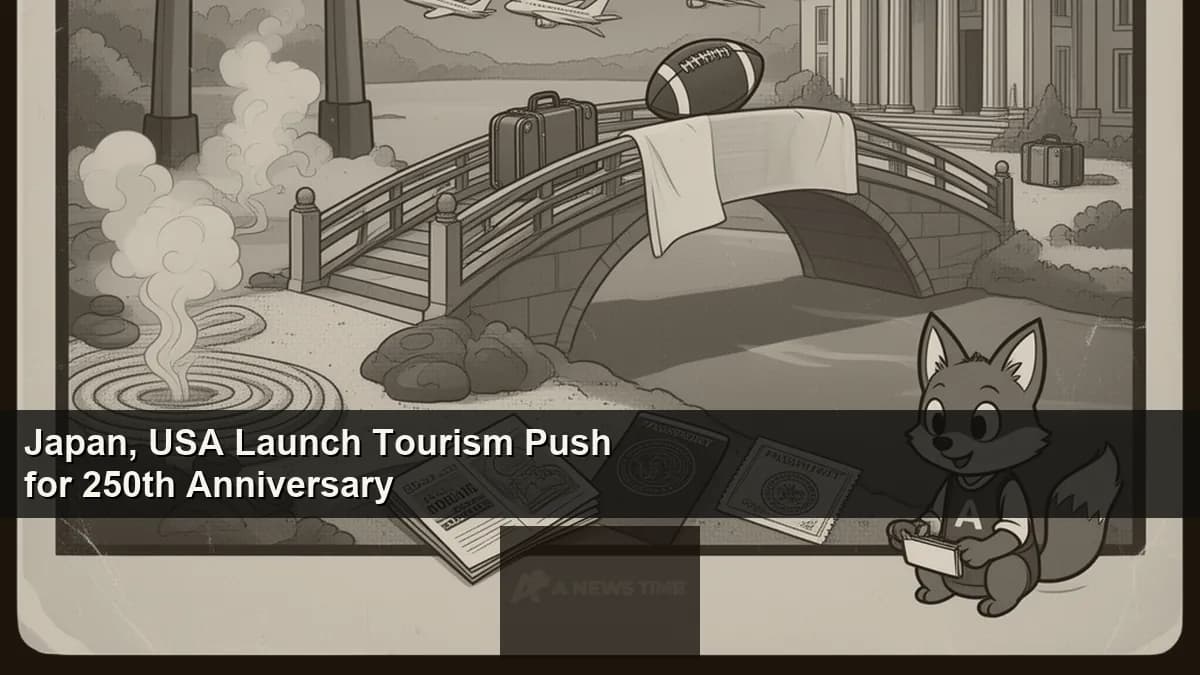
The Japan-USA tourism campaign, announced in , is one of the more strategically layered bilateral tourism partnerships in recent memory. It does not simply place ads in airports. It anchors its launch to two of the largest events in its target audience's calendar: the 250th anniversary of American independence, and the 2026 FIFA World Cup, co-hosted by the United States, Mexico, and Canada. The timing is deliberate. The JTA identified both events as demand catalysts that create windows of elevated interest in international travel among precisely the demographic that both tourism economies most want to attract.
What the Campaign Actually Involves
The campaign operates on two axes. The first is American inbound travel to Japan: drawing more US visitors to Japanese destinations through coordinated marketing that goes beyond the standard temples-and-cherry-blossoms imagery. The second is Japanese outbound travel to the United States: positioning American cities and cultural events as compelling destinations for Japanese travelers who have historically underutilized their proximity to North America relative to their travel to other Asian and European markets.
On the American inbound side, the campaign's marketing centers on four experience categories. Wellness tourism, particularly onsen bathing and Zen meditation retreats, leads the pitch to American consumers, driven by data showing that Gen Z and millennial American travelers prioritize health-focused experiences at significantly higher rates than previous generations. Celebrity-adjacent events, the kind of cultural programming that generates social media documentation and peer validation, form the second category. Geographic diversity, encouraging exploration beyond the Tokyo-Osaka-Kyoto triangle that most first-time American visitors follow, is the third. Sports tourism, particularly around the FIFA World Cup, anchors the fourth.
On the Japanese outbound side, the campaign emphasizes educational travel, cultural immersion in American cities, and sports tourism tied directly to the World Cup. Japanese outbound travelers have long shown a preference for structured, knowledge-enriching travel experiences over purely recreational tourism. The campaign's American offer, built around cultural institutions, university connections, and sporting events with strong narrative context, aligns well with those existing preferences.
"The relationship between Japan and the United States is one of the most important bilateral partnerships in the world. Tourism is one of the most direct expressions of that relationship at the human level. We want more people on both sides of the Pacific to experience the other country with depth, not just as a checklist of famous sites."
Japan Tourism Agency spokesperson, campaign announcement statement, via Travel and Tour World
A unified campaign logo, which the JTA and its US partner agencies developed through a joint design process, will anchor the marketing across digital, outdoor, and broadcast channels in both countries. Unified branding across a bilateral tourism campaign of this scale is unusual. Most bilateral tourism partnerships operate through separate national tourism boards with loosely coordinated messaging. The decision to build a shared visual identity signals an intent to position the Japan-USA travel corridor as a category in its own right rather than simply two competing destinations marketing to each other's populations.
The 2025 Numbers and What They Mean
The 5.27 million bilateral traveler figure from 2025 deserves close reading. That number encompasses both American travelers to Japan and Japanese travelers to the United States, counted in aggregate. The second-highest-on-record designation places it behind only the pre-pandemic peak year, when travel volume between the two countries briefly exceeded its historical averages before the disruptions of 2020 through 2022 reset the baseline.
The recovery trajectory since 2023 has been steep. Japan's post-pandemic reopening in October 2022 released significant pent-up demand from American travelers who had already placed Japan near the top of their travel intention surveys during the closure period. The yen's sustained weakness against the dollar through 2023 and 2024 added a practical incentive on top of the cultural pull: Japan became, in purchasing-power terms, one of the most affordable premium travel destinations in Asia for American visitors carrying dollars.
The Gen Z dimension of the recovery is worth isolating. Multiple consumer travel surveys conducted in 2024 and 2025 identify Japan as the top international destination among American Gen Z travelers, with a preference profile weighted toward cultural authenticity, culinary exploration, and wellness experiences. This cohort is not traveling to Japan for the reasons their parents' generation did (historical sites, efficient infrastructure, cherry blossoms). They are traveling for specific food experiences, for the kind of neighborhood-level immersion that short-term rental accommodations enable, and for the wellness infrastructure, particularly onsen culture, that Japan offers at a quality level that few other countries can match. The broader 2026 destination landscape shows Japan consistently at the top of Gen Z travel intention surveys across multiple markets.
The FIFA World Cup Connection
The FIFA 2026 World Cup, hosted across the United States, Mexico, and Canada beginning in June 2026, is the largest single sporting event in North American history by attendance capacity. The tournament will be played in 16 cities, with the final at MetLife Stadium in East Rutherford, New Jersey. Total attendance across 104 matches is expected to exceed 5 million, with an additional global television audience measured in the billions.
Japan qualified for the 2026 World Cup and will participate in the tournament. Japanese national team supporters, who have historically traveled in significant numbers to World Cup venues, now have a tournament that is logistically far more accessible than previous editions held in Russia, Qatar, or Brazil. The time zone alignment between Japan and the US East Coast creates a viewing and travel window that supports sports tourism flows that previous World Cups held in distant time zones could not.
The JTA's integration of the World Cup into the campaign is strategic rather than incidental. Japanese supporters traveling to the United States for World Cup matches are a defined, bookable audience with high per-trip spend. The campaign offers to extend their stays through partnerships with cultural institutions, wellness providers, and regional tourism bureaus in the World Cup host cities. A Japanese supporter traveling to New York for a group stage match, in this framework, is also a potential visitor to Kyoto's sister city programs, a wellness retreat package, or an educational cultural program in a non-World Cup city.
| Travel Direction | Primary Segments | Key Draws | 2026 Catalyst |
|---|---|---|---|
| USA to Japan | Gen Z, wellness travelers, cultural tourists | Onsen, cuisine, Mount Fuji, Tokyo, Kyoto, Osaka | US 250th anniversary cultural awareness |
| Japan to USA | Educational groups, sports tourists, cultural travelers | World Cup matches, universities, cultural institutions | FIFA World Cup 2026 in US/Mexico/Canada |
| Bilateral business | Corporate, academic exchange | Conference programming, partnership events | Anniversary diplomatic programming |
Travelers planning trips around the World Cup should note that accommodation in host cities is booking rapidly for the June-July 2026 window. The FIFA 2026 official site lists match schedules, host city information, and official ticket and accommodation channels. Planning 60-90 days in advance is advisable for any trip that combines World Cup attendance with the extended cultural programming the JTA campaign is promoting.
The 250th Anniversary Dimension
America's 250th anniversary in creates a specific marketing window that the JTA recognized before most other national tourism organizations. The anniversary will generate a sustained period of American historical and cultural introspection, with programming scheduled across hundreds of cities from the spring through the fall. International tourists interested in American history, culture, and democratic heritage have a defined reason to visit in 2026 that goes beyond seasonal tourism patterns.
For Japanese travelers, the 250th anniversary is particularly resonant. Japan and the United States share one of the world's most significant bilateral histories, beginning with Commodore Matthew Perry's arrival in 1853 and developing through the Meiji Restoration's deliberate engagement with American institutions, the complex events of the mid-twentieth century, and the post-war alliance that has defined both countries' foreign policy for 80 years. Japanese educational travel has always placed significant weight on engagement with American history and institutions. The 250th anniversary provides a structured entry point into that engagement that general tourism marketing cannot manufacture.
The campaign's American-side programming includes partnerships with Independence Hall in Philadelphia, the National Archives in Washington, D.C., and several university programs offering short-term cultural immersion curricula for Japanese students and professionals. These partnerships are not purely symbolic. They represent bookable inventory that the JTA can incorporate into its product offerings for the Japanese outbound market, converting anniversary marketing into actual travel packages with defined itineraries and partner accommodations.
"The 250th anniversary gives us something specific and time-limited to organize a campaign around. Japanese travelers who have been curious about American history, American democracy, and American culture now have a year with a clear narrative significance to make that trip. We are here to make it easy for them to do exactly that."
Japan National Tourism Organization communications team, via Japan National Tourism Organization
Passport Fees, Practical Access, and Industry Impact
One concrete policy change accompanying the campaign is a reduction in Japanese passport fees, which the Japanese government approved in early 2026. The reduction lowers the cost of obtaining a 10-year Japanese passport from approximately 16,000 yen to a reduced rate, a change designed to remove a financial friction point for first-time or infrequent Japanese outbound travelers. The impact of passport fee changes on travel behavior is modest but measurable: research from European markets that have implemented similar reductions shows increases of 2-5 percent in first-time passport holder rates among younger demographics in the 12 months following a fee reduction.
The campaign is also expected to generate direct economic activity in the tourism, hospitality, and transportation sectors on both sides of the Pacific. Airlines operating Japan-US routes are positioned to benefit from increased passenger demand. The US-Japan transpacific aviation market, dominated by United, ANA, Japan Airlines, and Delta, saw load factors exceed 85 percent on peak-season routes in 2025. Any sustained demand increase above current levels will likely require additional capacity, which the major carriers have been adding cautiously given broader aviation industry capacity constraints.
For American travelers planning Japan visits, the practical landscape has improved significantly since 2023. Japan's upcoming JESTA electronic travel authorization system, currently in development, will eventually streamline entry further, though American visitors do not currently require a visa for stays up to 90 days. The existing entry process remains straightforward. The primary planning friction points are accommodation booking, particularly in Kyoto during peak seasons, and the advance reservation requirements for some of Japan's most sought-after dining experiences.
- Best booking window: 90-120 days for Kyoto accommodation in spring and fall; 60 days for Tokyo
- Currency: The yen remains favorable for dollar-holders; carry some cash for smaller establishments and vending machine culture
- Transport: The Japan Rail Pass remains the most efficient option for multi-city itineraries; purchase before departure
- Wellness bookings: Premium onsen ryokan (traditional inns) in Hakone, Kyushu, and Tohoku require 90-day advance booking minimum during campaign promotion periods
- World Cup crossover: Travelers combining a Japan visit with World Cup attendance should book the US segment first, then build the Japan component around fixed match dates
Families considering Japan as part of a broader 2026 travel year should consult our guide to the best family travel destinations for 2026, which ranks Japan among the top five globally for family-friendly infrastructure, safety, and the density of engaging experiences across age groups. The country's transit reliability and food culture accessibility make it particularly well-suited to multigenerational travel in ways that other high-demand destinations are not.
Gen Z and the New Shape of Japan-USA Travel
The Gen Z travel profile driving the 5.27 million 2025 figure is worth examining beyond the headline number. Research from multiple travel industry sources identifies three characteristics that define Gen Z's approach to the Japan-USA corridor specifically.
The first is the preference for neighborhood-level immersion over landmark-driven itineraries. Gen Z travelers are significantly more likely than previous generations to spend extended time in a single neighborhood, build familiarity with local food establishments, and prioritize interactions that require some language engagement, even limited Japanese, over purely English-language tourist infrastructure. This preference is driving growth in accommodation types (neighborhood guesthouses, local ryokan outside major tourist centers) and experience categories (cooking classes, craft workshops, neighborhood food tours) that the JTA's campaign is well-positioned to market.
The second is the role of social platforms in both discovery and validation. Japan has been one of the most-documented destinations on visual social platforms for the past four years. The specific aesthetic of Japanese daily life, the convenience stores, the train station food culture, the neighborhood temple incidental to someone's commute, has generated a visual library that functions as ongoing organic marketing for the country at a scale that any paid campaign would struggle to replicate. The JTA's challenge is converting documented interest into actual travel bookings among users who have been engaging with Japan content for years without necessarily making the trip.
The third characteristic is the wellness orientation. Japan offers wellness infrastructure, particularly the onsen culture that spans from Hakone day trips to multi-day ryokan stays in remote Tohoku mountains, that has no direct equivalent in other major travel destinations. The campaign's decision to lead with wellness on the American inbound side is strategically sound: it speaks to a demonstrated preference among the target demographic and offers an experience category that Japan does better than virtually any other country in the world.
The safe destinations picture is equally favorable. Our analysis of the safest travel destinations in 2026 consistently positions Japan near the top of global safety rankings on the metrics that matter most to US travelers: personal safety, healthcare access, political stability, and natural disaster preparedness. For first-time international travelers in the Gen Z cohort, safety perception is a significant decision variable. Japan's standing on these metrics removes a barrier that higher-risk destinations cannot overcome regardless of their cultural appeal.
Frequently Asked Questions
Do Americans need a visa to visit Japan in 2026?
No. American citizens do not require a visa for stays up to 90 days in Japan under the existing bilateral agreement. Entry requires a valid US passport and a completed immigration card, typically distributed on the arriving flight. Japan's upcoming JESTA electronic travel authorization system is in development but is not yet required as of 2026.
What is the best time of year for Americans to visit Japan?
Spring (late March through early May) and autumn (mid-October through mid-November) offer the most favorable combination of weather, foliage or cherry blossom conditions, and festival programming. Summer is hot and humid, particularly in Tokyo and Osaka, but offers matsuri (traditional festival) culture that has its own distinct appeal. Winter is cold but beautiful in mountainous regions, and offers the best onsen experiences when contrast between outdoor temperatures and hot spring temperatures is most pronounced.
How does the Japan-USA tourism campaign connect to the FIFA World Cup?
The campaign actively positions Japan as a complementary destination for Japanese supporters traveling to the US for World Cup matches. Japan has qualified for the 2026 World Cup and its supporters traditionally travel in significant numbers to tournament venues. The JTA is offering extended cultural itineraries that allow supporters to combine match attendance with longer US stays, and reciprocally, is marketing World Cup programming to American travelers who may combine a Japan visit with a US return for the tournament's later rounds.
What wellness experiences is the campaign promoting for American visitors to Japan?
The campaign focuses on onsen bathing (particularly in Hakone, Beppu, and Tohoku regions), Zen meditation retreat programs available through temple accommodation networks, and forest bathing (shinrin-yoku) experiences in rural and mountainous areas. Several partners have developed packaged wellness itineraries combining multiple elements into 5-10 day programs that can be booked through the JTA's official partner channels.
What economic impact does the campaign expect to generate?
The JTA has not published specific projections tied to the 2026 campaign, but comparable bilateral tourism campaigns in other markets typically target 10-15 percent increases in traveler volumes over a 2-3 year horizon. The direct economic impact is expected to include job creation in tourism, hospitality, and transportation sectors on both sides of the Pacific, with the FIFA World Cup window creating a short-term spike that the broader campaign is designed to convert into sustained demand beyond the tournament period.