The Tidal Basin has been beautiful for exactly this many days per year for the better part of a century: somewhere between five and fourteen, depending on the precise peak of the Yoshino cherry blossoms and whatever the Potomac Valley's weather system decides to do about it. The National Park Service has been tracking peak bloom since 1921. The mathematics of that window, predictable to within a week but not an hour, is what makes the National Cherry Blossom Festival one of the most precisely calibrated seasonal surges in American tourism.
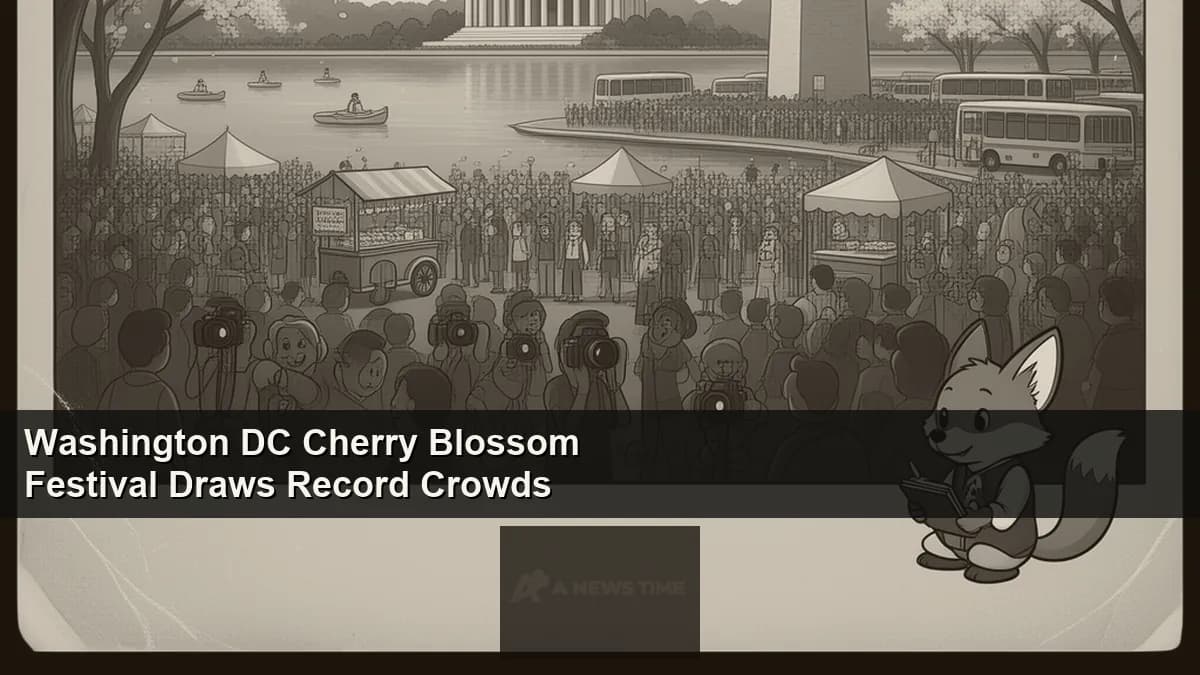
In 2026, that calibration met a demand level that the capital's tourism infrastructure was not designed to absorb. Over 1 million visitors arrived in Washington DC during the festival's peak week in early April, making it what the National Travel and Tourism Office described as one of the largest single-event seasonal surges in American tourism history. The result was not the cherry-blossomed pastoral of the festival's promotional materials. It was a demonstration of what happens when a mid-sized government city that happens to have extraordinary public spaces is asked to function simultaneously as one of the world's busiest tourism events.
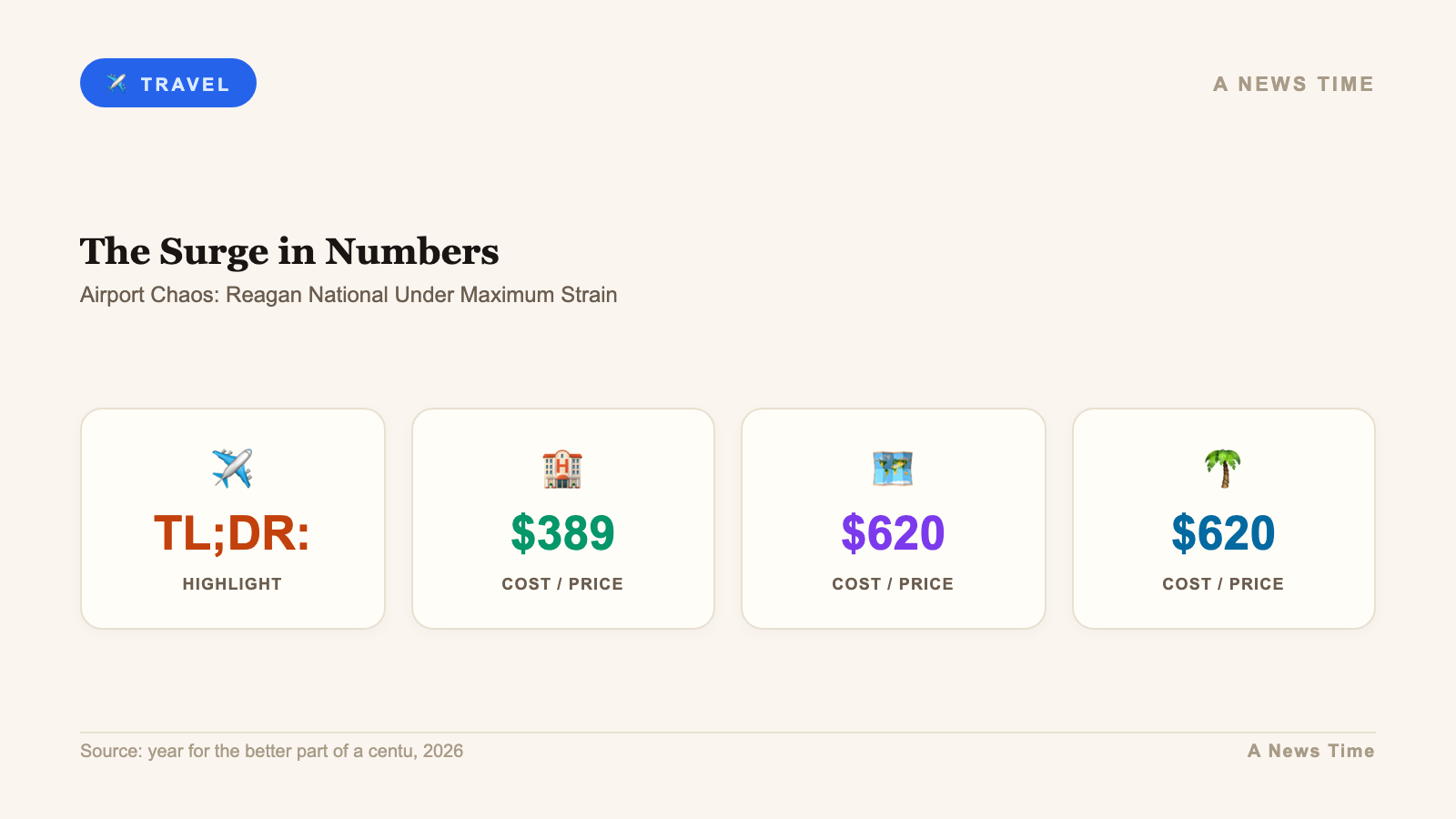
The Surge in Numbers
The National Cherry Blossom Festival draws between 700,000 and 1 million visitors in a normal peak year. The 2026 edition exceeded the upper bound. The contributing factors were several.
The 2026 peak bloom timing was near-ideal: the Yoshino cherries along the Tidal Basin and in East Potomac Park reached full bloom on approximately April 2nd, with the peak window holding through April 9th, a longer-than-average flowering owing to a mild late March that slowed petal development without freezing it. The extended window distributed the surge across more days but also gave more travelers the confidence that their specific travel dates would overlap with actual flowers.
International arrivals contributed disproportionately to the 2026 numbers. Visitors from Japan, South Korea, the United Kingdom, Germany, France, Canada, Brazil, and Mexico were all represented in higher volumes than the previous year. The festival's cultural resonance is particularly strong for Japanese travelers, for whom cherry blossom viewing (hanami) carries a cultural weight that makes Washington's Tidal Basin one of the more meaningful international destinations in the spring travel calendar. Cherry blossom season in Washington coincided in 2026 with strong spring-break travel demand from European and Latin American markets, compressing the international arrival volume into a concentrated window that airport capacity was not designed to accommodate at that scale.
| Metric | 2026 Figure | Change vs 2025 |
|---|---|---|
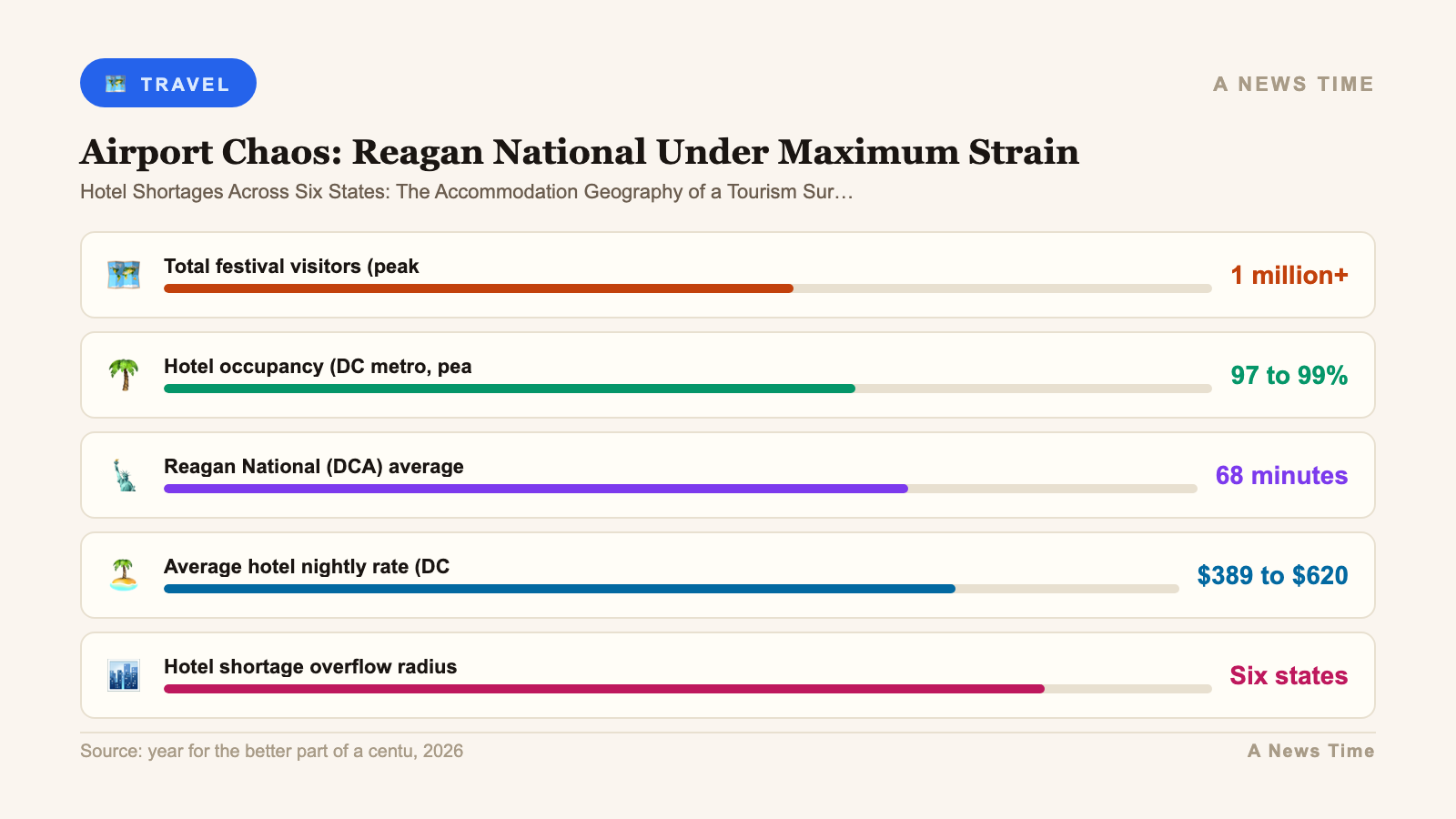
| Total festival visitors (peak week) | 1 million+ | +18 to 22% |
| Hotel occupancy (DC metro, peak weekend) | 97 to 99% | +6 percentage points |
| Reagan National (DCA) average wait time, security | 68 minutes | +24 minutes |
| Average hotel nightly rate (DC, April 4 to 6) | $389 to $620 | +41% |
| Hotel shortage overflow radius | Six states | Expanded from four in 2025 |
Airport Chaos: Reagan National Under Maximum Strain
Reagan National Airport (DCA) was not built for a tourism event of this scale. Its single active runway configuration, its proximity to restricted airspace over central Washington, and its relatively constrained terminal footprint make it one of the most operationally tight major airports in the country under normal conditions. During festival peak week, normal conditions did not apply.
TSA checkpoint wait times at Reagan National during the April 4 to 6 peak weekend averaged 68 minutes, up from a baseline of approximately 22 to 28 minutes on comparable non-event weekdays. The southwest concourse, which handles the bulk of short-haul domestic arrivals and departures for carriers including Southwest Airlines, American, and United, reported sustained wait times of 75 to 90 minutes at peak periods on April 5th. Passengers with tight connections who arrived at Reagan National on domestic flights intending to connect internationally were particularly exposed to the bottleneck.
The airport implemented extended security lane hours and deployed additional TSA personnel from the Baltimore-Washington International reserve pool, but the physical constraint of the checkpoint footprint limited how much additional throughput could be achieved even with additional staffing. The fundamental problem is that Reagan National's 1997-era terminal infrastructure was designed for approximately 20 million annual passengers. In 2025, the airport processed 27 million. Adding a million-visitor festival week on top of normal spring travel demand pushes the system beyond its design parameters regardless of staffing levels.
Dulles International Airport (IAD) in Virginia performed somewhat better, partly because its larger footprint and lower baseline density gave it more buffer capacity. But international arrivals at Dulles were also significantly elevated during the festival period, and the customs and border protection hall, which handles all international arrivals, experienced processing delays of 90 to 120 minutes for some international flights. Travelers who arrived on transoceanic flights after long journeys and then faced two-hour CBP queues before even reaching ground transportation reported it as the least impressive element of an otherwise memorable trip.
Baltimore-Washington International Airport (BWI), the third airport serving the DC metro area, was materially less congested during the festival peak and is worth considering as an alternative arrival point for 2027 visitors who have schedule flexibility. The MARC train connects BWI to Washington's Union Station in approximately 45 minutes and runs on a frequent schedule during morning and evening peak periods.
Hotel Shortages Across Six States: The Accommodation Geography of a Tourism Surge
The immediate Washington DC hotel market saturated within days of the 2026 peak bloom forecast being issued in mid-March. Properties on the National Mall, in Georgetown, in Dupont Circle, and near Capitol Hill were already at 100% occupancy by early March for the peak weekend of April 4 to 6. Rates for those dates reflected the demand: a standard room at a four-star DC downtown hotel averaged $389 to $620 per night during peak weekend, up 41% from the same weekend in 2025.
As DC inventory exhausted, the hotel-search overflow extended outward in a pattern that traced the radius of practical commutability to the Tidal Basin. Northern Virginia cities Alexandria and Arlington sold out next, followed by Bethesda and Silver Spring in Maryland. By late March, the hotel search geography extended to Baltimore, a 45-minute drive north, and then, startlingly, outward to Richmond, Virginia; Annapolis, Maryland; and further. By the time the peak weekend arrived, travelers who booked late were being quoted the last available rooms in Delaware, Pennsylvania, and West Virginia.
This geographic spread of the accommodation shortage is a structural feature of Washington's tourism infrastructure, not an anomaly. The district itself has relatively limited hotel room inventory compared to cities of comparable tourism importance. New hotel construction in DC faces both high land costs and a regulatory environment that constrains development density in the height-restricted, historically protected city center. The result is that the city's accommodation capacity grows slowly while its tourism appeal, for an event like the cherry blossom festival, grows faster.
For practical purposes, the accommodation geography during festival peak breaks down as follows. Same-day or late-booking arrivals should search Baltimore first and Richmond second for the best combination of availability and reasonable drive-in distance. Amtrak's Northeast Regional service connects Baltimore to Union Station in 40 minutes; Richmond to Washington in 2 hours and 15 minutes. Travelers who are flexible about commuting in daily can find acceptable hotel rates in both cities at a fraction of the DC premium during festival week.
National Mall and Tidal Basin: What Actually Happened on the Ground
The Tidal Basin has never been designed for crowds at the scale the 2026 festival produced. The 1.875-mile walking path that circles the basin accommodates comfortable two-way pedestrian flow up to roughly 3,000 to 4,000 people simultaneously under normal parkland conditions. On April 5th, the National Park Service estimated that the path and adjacent grounds held approximately 40,000 people during the four-hour morning peak between 8 a.m. and noon.
The practical consequences were predictable to anyone who has attempted to walk a narrow path against a bidirectional current of 40,000 people photographing flowers. Movement slowed to a shuffling pace in several sections. The pedestrian underpasses at the Memorial Bridge approach and the bridge connecting Hains Point to the main Tidal Basin path became bottlenecks where wait times of 15 to 20 minutes accumulated during the mid-morning peak. Several National Park Service rangers stationed at path intersections attempted to manage flow direction informally but had no enforcement mechanism to implement formal crowd management.
The Jefferson Memorial, located on the south shore of the Tidal Basin and surrounded by some of the densest cherry plantings on the path, was inaccessible for significant periods during peak hours without a timed entry pass. The National Park Service had implemented a reservation system for Jefferson Memorial interior visits in 2025 and extended it for 2026, but the path and grounds surrounding the memorial had no reservation requirement and reached pedestrian densities that made the experience unpleasant for many visitors who had traveled significant distances specifically for it.
The broader National Mall, stretching from the Lincoln Memorial to the Capitol, managed the festival crowds more successfully simply because of scale. The Mall's open expanse absorbs visitor volume differently than the narrow Tidal Basin path. The Smithsonian museums along the Mall reported record single-day visitor counts for several days during festival week, with the National Museum of Natural History and the National Air and Space Museum implementing de facto timed-entry systems at their doors by managing queue lengths and entry rates manually.
The Infrastructure Math: A City Temporarily Out of Its Depth
Washington DC is a city built for approximately 700,000 permanent residents, serving roughly 3.5 million people in its broader metropolitan area, and functioning as the capital of a federal government that employs another 350,000 workers within the district. Its Metro system was designed around those use cases. Its road network carries that load. Its utility infrastructure is calibrated for that population.
Adding 1 million visitors during a single week stresses all of those systems simultaneously. The Metro's Red Line, which serves Union Station, Dupont Circle, and Cleveland Park with the highest festival visitor relevance, experienced service gaps and platform overcrowding at Gallery Place-Chinatown and L'Enfant Plaza during peak festival periods. The Orange, Blue, and Silver Lines serving Arlington and the airport corridors were similarly stressed. Several stations implemented temporary crowd management procedures, asking passengers to exit via specific turnstiles and limiting platform access during peak periods.
The District's water and sanitation infrastructure faces a different kind of pressure. The Tidal Basin area and the National Mall have a limited number of public restroom facilities relative to 40,000 hourly visitors. The queue for the portable facilities deployed by the National Park Service during festival peak days reached documented wait times of 25 to 35 minutes. This is an unpleasant detail but a practically significant one for travelers with children or medical needs.
Rideshare surge pricing during the festival peak weekend reached levels that surprised even habitual users of DC's densely networked rideshare system. The combination of elevated demand from festival visitors and the geographic concentration of pickups and drop-offs near the Tidal Basin produced surge multipliers of 3x to 4x base rate during morning peak hours. A ride from Georgetown to the Jefferson Memorial that would normally cost $12 to $15 was running $45 to $55 at peak surge. The Metro, despite its capacity pressure, offered the more predictable and cost-effective transport option during the peak window.
The Economics: Who Benefits and How Much
The economic impact of the 2026 festival's visitor volume was substantial. Tourism economists estimate the direct visitor spending associated with the festival's peak week at approximately $700 million to $900 million across accommodation, food and beverage, retail, transportation, and attractions. The secondary economic effect, representing the circulation of tourism spending through local supply chains, extends the total economic impact toward $1.5 billion when the full festival period from late March through mid-April is counted.
The beneficiaries of this spending are somewhat uneven in their distribution. Hotels and short-term rental hosts captured the largest share, with the dramatic ADR increases during peak weekend generating significant revenue concentration among accommodation providers with DC-center inventory. Restaurant revenue was meaningfully elevated across the district, with the Georgetown and Penn Quarter dining districts reporting the highest restaurant covers since the post-pandemic 2022 surge.
Retail captured a smaller share than the visitor volume might suggest. The festival's primary attraction is outdoors, free, and requires no specialized equipment. Visitors come to look at trees, walk, and eat. The retail spending profile skews toward food, souvenirs, and pharmacy needs rather than the apparel and electronics categories that generate higher retail revenue per visitor.
The tax revenue picture is positive for both the District government and the federal National Park Service. Hotel occupancy taxes at 14.5% of room revenue, meal taxes at 10%, and sales taxes on retail activity collectively generate District government revenue during the festival week that is equivalent to several weeks of ordinary collections. The Park Service's fee collections, while limited at the Tidal Basin itself, are elevated across the paid monuments and museums that benefit from the visit surge.
Planning the 2027 Visit: What the 2026 Experience Teaches
The National Cherry Blossom Festival will produce similar infrastructure stress in 2027 unless something fundamental changes about the city's capacity or the festival's management structure. Neither appears likely in a single year. What changes is your information level going in.
Book accommodation by October. This is not a recommendation to be early; it is the operational reality of the DC hotel market during festival peak. Properties within a 45-minute Metro ride of the Tidal Basin are functionally sold out for the likely peak window by mid-November of the preceding year. If you want an affordable, walkable option for 2027, the time to reserve is approximately now. If you are reading this in spring 2026 with a 2027 festival trip in mind, mark your calendar for October 2026 to begin accommodation research.
Plan around the crowds, not in spite of them. The Tidal Basin at 7 a.m. on a weekday during peak bloom is a genuinely different experience from the same location at 10 a.m. on a Saturday. Early arrivals at the path encounter near-empty grounds, golden morning light, and the peculiar stillness of blossoms before the crowds arrive. The Metro runs from approximately 5 a.m. on weekdays. Bring coffee from the hotel, arrive before 7:30, and leave by 10 before the peak surge arrives.
Consider the less famous cherry collections. The Tidal Basin is the headliner, but Washington's cherry trees are distributed across the city. East Potomac Park's long straight avenue of cherry trees is less photographed, equally beautiful, and a fraction of the Tidal Basin's crowd density. The National Arboretum in northeast DC, reachable by car or rideshare, has extensive cherry plantings and almost no festival crowds on most days. Kenwood, a neighborhood in Bethesda just outside the district, has private-property cherry trees lining its streets that produce a bloom arguably rivaling the Tidal Basin and attract a fraction of the visitor volume.
Connect the festival to a longer DC visit. One of the 2026 festival's unintended consequences was an experience that felt rushed and crowd-managed for many visitors who had flown significant distances for a single bloom event. Building two to three days around the festival visit allows the cherry blossom experience to sit within a richer Washington itinerary: the Smithsonian museums, the Library of Congress, the National Cathedral, the neighborhood architecture of Capitol Hill and Columbia Heights. The festival is a reason to come to Washington. It should not be the only thing you do there.