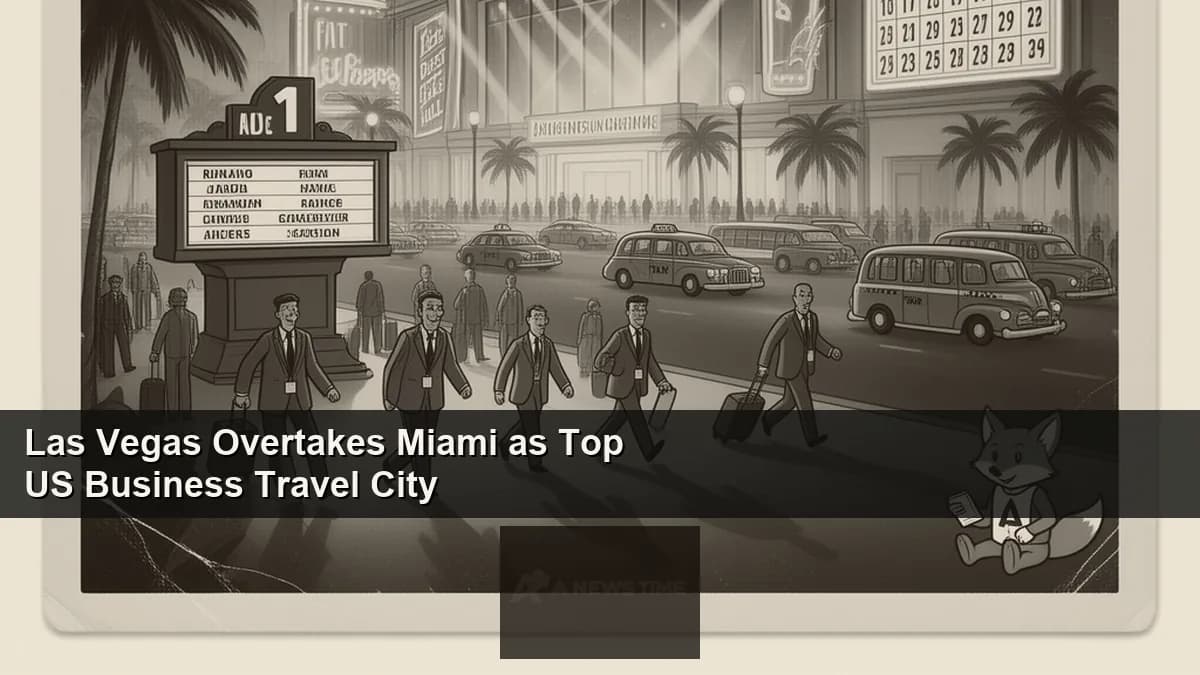
Las Vegas has officially overtaken Miami, Dallas, Atlanta, Chicago, and Orlando to become the United States' top business travel destination, a shift now confirmed by Travel And Tour World's just-released ranking of the world's top 100 convention centers for 2026. The Las Vegas Convention Center sits at number two globally on the new list, the highest American venue and the only US site in the top three, while convention spaces in Atlanta, Miami Beach, Orlando, Seattle, Chicago, Dallas, and New York all sit further down the table. The ranking landed on , alongside reporting from Travel And Tour World on what the reshuffle means for corporate event planners and the broader American MICE economy.
The numbers framing the shift are striking. International arrivals to the United States are forecast to reach roughly 85 million in 2026, a 10.2 percent jump that finally pushes the country above its 2019 baseline. Global business travel spend is expected to top $1.62 trillion this year, an 8.1 percent year-over-year increase. The US meetings, incentives, conferences, and exhibitions market is on track to grow from $146.14 billion in 2025 to $205.63 billion by 2032, a compound annual growth rate of about 5 percent. And the broader US events market is projected to expand at a 13 percent CAGR through the end of the decade.
Why Las Vegas keeps winning the convention math
The case for Las Vegas as the top business travel destination is structural rather than glamorous. The Las Vegas Convention Center now offers the kind of exhibition scale that nothing else in North America can match, anchored by the West Hall expansion that opened ahead of CES and built around an integrated hospitality ecosystem of more than 150,000 hotel rooms within walking or short shuttle distance. That scale is what corporate planners actually price when they pick a venue. They are not buying weather. They are buying the math of putting 30,000 attendees within 10 minutes of the show floor.
The city's calendar is the second piece. Las Vegas has spent the past decade carefully sequencing flagship events, from CES in January to ConExpo in March, from the Restaurant Show in May to NAB in April, in a way that keeps midweek hotel occupancy high without cannibalizing tourism revenue. Most American cities still struggle to fill convention centers Monday through Wednesday. Las Vegas does it as a matter of routine.
Anup Kumar Keshan, the founder and editor-in-chief of Travel And Tour World, framed the broader shift in the report as part of a global retooling of MICE infrastructure, with nearly 70 percent of the top 100 venues now holding advanced green certifications and more than 65 percent targeting net-zero operations. Smart venue investments have surged 40 percent year over year, driven by 5G-enabled hybrid platforms and AI analytics. The venues are projected to contribute over $500 billion in international trade.
How the rest of the American top 10 stacks up
The Travel And Tour World ranking is useful precisely because it lets corporate planners see where their alternatives sit. The picture is not flattering for several traditional convention markets.
| Global rank | Venue | City |
|---|---|---|
| 2 | Las Vegas Convention Center | Las Vegas, NV |
| 5 | Georgia International Convention Center | Atlanta, GA |
| 15 | Miami Beach Convention Center | Miami Beach, FL |
| 22 | Orange County Convention Center | Orlando, FL |
| 25 | Seattle Convention Center | Seattle, WA |
| 29 | McCormick Place | Chicago, IL |
| 35 | Gaylord Texan Resort & Convention Center | Dallas, TX |
| 40 | Moscone Center | San Francisco, CA |
| 48 | Los Angeles Convention Center | Los Angeles, CA |
| 70 | Javits Center | New York, NY |
The interesting story inside the table is the gap between Atlanta at five and Miami Beach at 15. Atlanta has been building convention infrastructure aggressively for the past decade, capitalizing on the world's busiest airport and a corporate base that has tilted toward technology, healthcare, and logistics. Miami, by contrast, has leaned into its luxury and Latin America gateway positioning, which produces high-value events but struggles to match the volume that Vegas and Atlanta can put through their facilities every month.
Orlando at 22 is the surprise. The Orange County Convention Center remains one of the largest in the country by raw square footage, but the report suggests its booking velocity has slowed as corporate planners gravitate toward the bleisure-friendly markets where attendees can extend trips. Chicago, Dallas, and New York all sit further down the list than their economic weight would suggest, a function of older infrastructure and, in New York's case, the cost premium that the Javits Center carries against suburban alternatives.
The corporate spending picture behind the rankings
The Travel And Tour World report puts the rankings in macro context, and the macro is more nuanced than the headline numbers suggest. Global business travel spend is up, but US meeting planner sentiment has actually declined sharply, with the share of planners expecting an improved outlook dropping from 46 percent to 24 percent in the most recent survey. The disconnect is what makes 2026 such an unusual year for the industry. Spend is rising. Confidence is falling.
The meetings industry, particularly exhibition and convention centers, is evolving into a strategic driver of economic growth and global collaboration. Leading destinations across the United States, Brazil, Mexico, Canada, Europe, Asia, and Africa are leveraging cutting-edge infrastructure, digital ecosystems, and scale to stay at the forefront of international trade and business tourism.Anup Kumar Keshan, Founder and Editor-in-Chief, Travel And Tour World
The reasons planners give for the caution are familiar. Tariff uncertainty after the recent Supreme Court ruling on Trump-era levies. Lingering inflation pressure from the Iran war energy shock. Currency volatility making international group bookings harder to lock in. And the unsettled political environment around inbound visas, particularly for delegates traveling from regions where the US has tightened entry rules.
Las Vegas is partly insulated from those headwinds because most of its convention business is domestic. Companies do not need to clear visa hurdles or navigate currency hedges to fly their sales force from San Jose to Henderson for a four-day product launch. That same domestic anchor is part of why Atlanta and Orlando have held up better than Miami or San Francisco in the current cycle.
What the bleisure trend is doing to bookings
One of the more durable post-pandemic shifts in business travel is bleisure, the practice of extending corporate trips into leisure stays. The pattern shows up most clearly in cities that pair convention infrastructure with weekend attractions. Orlando has built its entire MICE strategy around it. Las Vegas does the same thing more efficiently, because the leisure infrastructure is woven into the convention infrastructure rather than separated by a 30-minute drive.
The implication for corporate planners is that the cities best positioned for the next five years are the ones that can deliver both. Chicago has the convention scale at McCormick Place but the leisure case weakens in winter. New York has the leisure pull but the cost structure of the Javits Center makes mid-size events unaffordable. San Francisco has both, but post-pandemic safety perceptions have hurt bookings. Las Vegas, Atlanta, and Orlando all clear both bars.
What planners are pricing for 2026 and beyond
Three structural themes are reshaping how event organizers spec their venue and city selections. Hybrid format remains the default for any event with significant international attendance. Sustainability is now a hard requirement for procurement teams at most large enterprises, which is part of why the green certification rate at top-100 venues has jumped above 70 percent. And regional portfolio strategies are becoming more common, with companies splitting their annual conference rotation across multiple cities to reduce dependence on any single venue.
For travelers tracking the bigger picture, our reporting on the recent 560 percent surge in Asia-to-Europe flight rerouting and the $212 million Hong Kong tourism revival blueprint covers the global side of the same shift. The American convention story is part of a broader rebalancing, not a standalone phenomenon.
What to watch through the year
Two things to track. The first is whether the Las Vegas Convention Center holds its number-two global position when the next ranking lands in 2027. The list above it is short and includes some Asian and European venues that have been investing aggressively in expansion. The second is whether American secondary cities like Indianapolis, Columbus, and Nashville keep climbing the rankings as cost-conscious planners hunt for value alternatives to the major hubs.
For now, the headline is straightforward. American business travel has a new center of gravity, and it is in Nevada. The corporate calendars that get set in 2026 will shape which cities benefit through the rest of the decade.