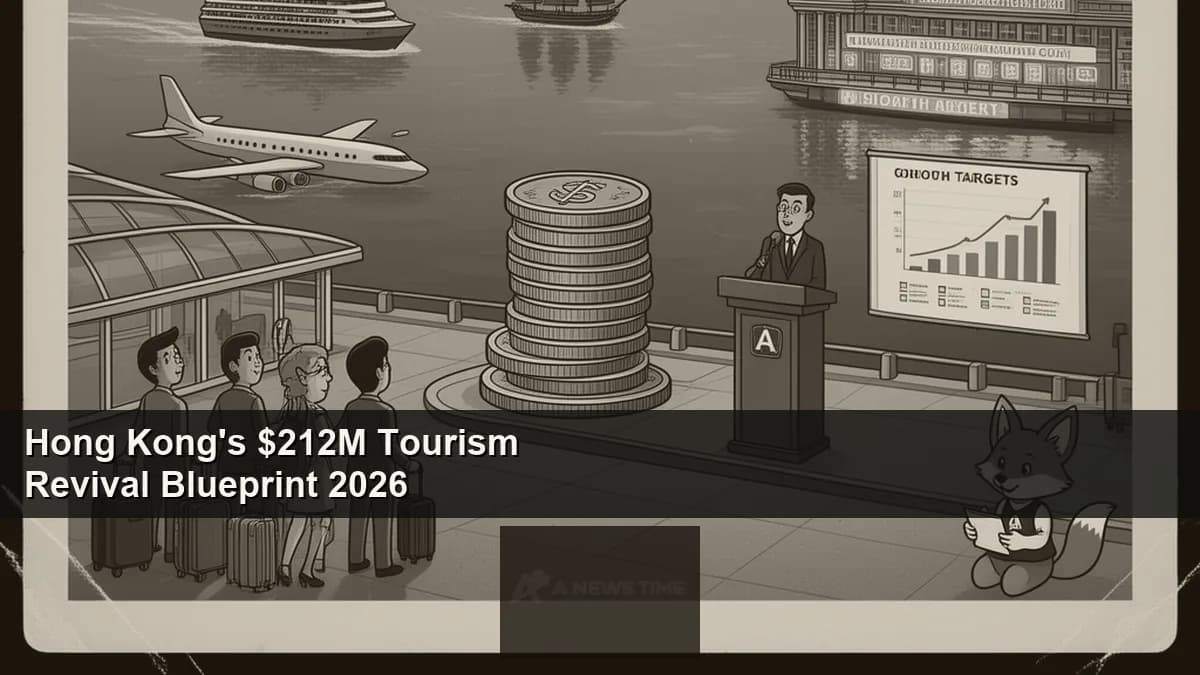
Victoria Harbour at night still stops people in their tracks. The light off the water, the skyline stacked like a circuit board, the sheer density of it all. But for the better part of four years, Hong Kong's tourism machine has been running well below that electricity. Now, with HK$1.66 billion (US$212 million) committed in a sweeping new strategy, city planners are betting they can convert that latent appeal into arrivals, revenue, and relevance on the global stage.
The HKTB published its "Tourism Revival Blueprint 2026" on , outlining the most ambitious tourism recovery plan the territory has attempted. The blueprint goes beyond headline arrival counts. Its core logic: chase fewer visitors who spend more, anchor them with world-class events, and rebuild Hong Kong's reputation as the natural home for Asia's most significant business gatherings. In industry terms, that means premium leisure and MICE travel as the twin engines of recovery.
"The goal is to move beyond recovery into repositioning Hong Kong as Asia's most vibrant, connected gateway for culture and commerce."
Pang Yiu-kai, Chairman, Hong Kong Tourism Board
That sentence, from HKTB chair Pang Yiu-kai, is worth parsing carefully. "Beyond recovery" signals that the city is not simply trying to restore 2018 numbers. It is trying to restructure the composition of its visitor base entirely, and the $212 million price tag is the financial commitment behind that ambition.
Quality Over Quantity: The Strategic Shift
Hong Kong's pivot to quality-over-quantity tourism is not novel in Asia. Japan's US bilateral tourism campaign has similarly repositioned the country as a premium cultural destination rather than a volume-driven market. Singapore and Dubai have spent years refining the same playbook. What makes Hong Kong's move significant is the scale and urgency of the commitment, and the specific mechanisms it is deploying to get there.
The blueprint targets three visitor segments that historically outspend mass-market package tourists by a considerable margin: business travelers from mainland China making short premium weekend stays, long-haul visitors from western markets with higher per-trip budgets, and international corporate groups attending conventions, conferences, and incentive events.
To capture and retain those visitors, the HKTB is expanding its "Hong Kong Goodies" digital pass, a bundle that currently combines Airport Express train tickets with dining credits. The updated pass adds more merchant categories and deeper discounts, designed to increase visitor spending across hospitality, retail, and cultural attractions from the moment someone clears customs. It is a frictionless-spend strategy: reduce the decision-making overhead for travelers and watch average receipts rise.
The numerical targets are specific. The HKTB wants tourist arrivals at 80 percent of 2018 levels by year's end. More importantly, it wants average spend per visitor to climb by 15 percent over the same period. Those two metrics, if achieved together, would represent a meaningful revenue recovery even if the raw headcount never fully rebounds to pre-disruption peaks.
MICE at the Center: Convention Subsidies and Corporate Grants
No segment of the travel market carries higher per-visitor economic impact than MICE. A delegate attending a three-day international medical conference spends more on hotels, meals, transport, and incidental purchases than most leisure visitors manage in a week. Hong Kong, with its convention infrastructure at AsiaWorld-Expo and the Hong Kong Convention and Exhibition Centre, has long competed for this business, and the blueprint makes restoring that pipeline a primary objective.
The headline incentive for event organizers is a venue subsidy covering up to 50 percent of rental costs for qualifying international conventions. That is a significant concession, particularly for smaller professional associations that have historically been priced out of Tier 1 Asian venues. Alongside the subsidy, corporate travel buyers whose events bring a minimum of 500 overseas delegates become eligible for grants that refund up to HK$100,000 in group-ticket surcharges.
| MICE Incentive | Details | Qualifying Threshold |
|---|---|---|
| Venue rental subsidy | Up to 50% of international convention venue costs | International events; HKTB pre-approval required |
| Group-ticket surcharge grant | Refund up to HK$100,000 in surcharges | Minimum 500 overseas delegates |
| Hong Kong Goodies pass | Airport Express + dining and merchant credits | Available to all inbound visitors |
| Long-haul marketing push | Targeted campaigns in Middle East, India, secondary US cities | Tied to Cathay Pacific A350 and Greater Bay Airlines 787 capacity |
For hoteliers, the MICE focus carries an obvious knock-on benefit. Convention delegates fill rooms at full rate during the week, generating higher yield than leisure visitors who typically book on weekends and through promotional channels. The blueprint's emphasis on "premium short-stays" is expected to lift revenue per available room if visitor nights trend back toward pre-disruption averages, according to market observers tracking the territory's hospitality sector.
An Events Calendar Built Around International Draw
Conventions and incentive groups need a year-round reason to choose Hong Kong over Singapore, Seoul, or Tokyo. The HKTB's answer is an amplified events calendar anchored by three properties with genuine global reach: Art Basel Hong Kong, the Hong Kong Rugby Sevens, and a relaunched Wine and Dine Festival. Each event draws a specific premium traveler profile. Art Basel brings collectors, gallerists, and high-net-worth cultural tourists from over 70 countries. The Rugby Sevens delivers an international sports crowd with strong representation from Australia, New Zealand, the UK, and the United States. Wine and Dine, historically one of Asia's most visited culinary events, targets affluent short-stay visitors from mainland China and Southeast Asia.
The blueprint does not stop at those three anchors. Niche programming in culinary tourism, luxury retail, and cultural heritage will fill the calendar between major events. The logic is straightforward: a visitor who arrives for Art Basel and discovers the wine festival is running two weeks later has a reason to extend the trip or plan a return. Event density converts one-time visitors into repeat visitors, and repeat visitors represent the most efficient segment for cost-per-acquisition in tourism marketing.
For travelers already tracking the region's aviation disruptions, context matters here. The global jet fuel crisis driven by the US-Israel conflict with Iran has pushed barrel prices to $195 and forced route cancellations across Asia. Hong Kong's blueprint explicitly accounts for this by channeling marketing dollars toward airline partners expanding capacity on long-haul corridors: Cathay Pacific's incoming Airbus A350 deliveries and Greater Bay Airlines' Boeing 787 order. Both carriers are adding seats on routes from the Middle East, South Asia, and secondary US markets, which are the same origin points the HKTB is targeting for outreach.
New Markets: Middle East, India, and Secondary US Cities
The geographic diversification element of the blueprint is arguably its most structurally important feature. For years, Hong Kong's inbound tourism was dominated by mainland Chinese visitors, with secondary contributions from established Western markets. That dependence created fragility. The "Tourism Revival Blueprint 2026" explicitly channels marketing investment toward origin markets that have been underutilized relative to their spending potential.
The Middle East, where outbound travel is growing faster than almost any other region, represents a natural target. Gulf Cooperation Council nationals travel frequently to Asia for business, shopping, and cultural experiences, and per-trip spend figures from that segment are among the highest in global tourism data. India, whose outbound leisure market is expanding rapidly as the country's urban middle class grows, is another primary focus. And secondary US cities (beyond the established New York-Los Angeles-San Francisco feeder markets) represent untapped capacity on routes where Cathay Pacific's new aircraft can now operate economically.
The Canadian market is worth noting as context here. While Canadian travelers have pivoted away from US destinations in significant numbers, Asia-Pacific has picked up a share of that redirected demand. Transatlantic demand from Canada has surged to the point where more than 1,200 weekly transatlantic departures are operating during peak summer 2026 schedules. The broader point is that long-haul demand is robust globally, even as specific corridors face geopolitical headwinds, and Hong Kong is positioning itself to compete for that reallocated wallet.
| Target Market | Rationale | Airline Partner |
|---|---|---|
| Middle East (GCC) | High per-trip spend, fast-growing outbound market | Cathay Pacific A350 |
| India | Expanding urban middle class, strong business travel ties | Cathay Pacific A350, Greater Bay Airlines 787 |
| Secondary US cities | Untapped premium leisure demand beyond gateway cities | Cathay Pacific A350 new routes |
| Mainland China (weekenders) | Short-haul premium stays, weekend spending power | Multiple carriers, high-speed rail |
The Labor Problem No Blueprint Can Paper Over
Not everyone reviewing the blueprint is convinced that ambition alone will translate into execution. Fitch Ratings analysts have flagged a structural constraint that marketing dollars cannot easily fix: the hospitality sector in Hong Kong is running into significant staffing shortages in frontline service roles.
Manpower shortages in hospitality may temper growth unless labour-import quotas for frontline service roles are relaxed.
Fitch Ratings, published analysis on Hong Kong tourism outlook, April 2026
The concern is real and not unique to Hong Kong. Post-pandemic labor dynamics have left hospitality sectors across Asia, Europe, and North America understaffed at precisely the moment that demand is returning. For a city explicitly positioning itself around premium service standards, a guest experience undermined by exhausted or undertrained staff is a reputational risk that subsidy programs alone cannot offset.
The HKTB blueprint does not directly address the labor quota question, which falls under immigration policy rather than tourism board authority. Industry observers note that unless the Hong Kong government adjusts work-permit structures to allow faster recruitment from source markets in Southeast Asia and South Asia, the service standards required to justify premium pricing may be difficult to sustain at scale as arrivals ramp up.
For travelers already considering the region, this plays into broader planning questions. Japan, which has faced similar labor pressures while managing record visitor numbers, has developed its own policy framework for managing demand. The Japan JESTA electronic travel authorization system launching in 2028 represents one piece of that puzzle, giving Japanese authorities better tools to manage visitor flows. Hong Kong's challenge is less about managing too many visitors right now, and more about ensuring the infrastructure is ready when the blueprint's demand projections materialize.
Hong Kong Versus Singapore and Dubai: The Premium Positioning Race
The "quality over quantity" philosophy in the HKTB blueprint is not an isolated decision. It mirrors a strategic shift that Singapore and Dubai have both executed over the past several years, and it reflects a competitive reality: mass-market package tourism is low-margin, highly seasonal, and puts enormous pressure on urban infrastructure. Premium travelers, by contrast, spend more, stay longer, use high-end services, and generate better returns for both government and private tourism operators.
Singapore has leaned heavily into MICE leadership and luxury positioning through Marina Bay Sands, the Formula 1 Singapore Grand Prix, and targeted investment in financial and technology conferences. Dubai has used Expo legacy infrastructure, luxury retail, and cultural programming to convert short-haul Gulf visitors into long-stay international tourists. Both cities have seen their strategies pay off in revenue per visitor metrics even during periods when absolute arrival counts fluctuated.
Hong Kong's comparative advantages in this race are real: the density of cultural, culinary, and commercial experiences packed into a small geographic area; direct connections to mainland China that no competitor can replicate; and a financial services cluster that generates a natural MICE pipeline of its own. The blueprint is essentially a bet that those advantages, properly activated, can restore Hong Kong to a position of genuine premium leadership in Asia rather than simply recovering to a pre-disruption status quo.
Whether it works depends on execution across multiple variables that no single agency controls. The airline capacity needs to materialize. The labor situation needs a policy solution. The event calendar needs to land without incident. And the city needs to deliver on the service standards that justify premium price points for visitors who have no shortage of alternatives in the region.
What the Blueprint Means for Travelers and Event Planners
For travelers, the most immediately tangible piece of the blueprint is the expanded "Hong Kong Goodies" digital pass. The pass bundles airport rail access with credits usable across dining and merchant partners, reducing the friction cost of arrival and incentivizing spend in sectors that benefit the broader visitor economy. Anyone arriving at Hong Kong International Airport who picks up the pass before or on arrival gains a streamlined entry into the city's hospitality network without the typical first-day logistics overhead.
Art Basel Hong Kong, the Rugby Sevens, and the Wine and Dine Festival each represent anchor events worth booking around. These are not manufactured tourism exercises; they are established properties with genuine international audiences and a track record of drawing visitors who stay multiple nights and engage deeply with the city's restaurant and cultural scenes.
For corporate event planners, the 50 percent venue subsidy and the group-ticket surcharge grant represent a meaningful cost reduction on events that bring 500 or more overseas delegates. Combined with the infrastructure at AsiaWorld-Expo and the Convention Centre, Hong Kong is making a strong financial case for events that might otherwise default to Singapore or Bangkok on cost grounds alone.
The blueprint also signals that Japan and South Korea have scrapped pandemic-era flight caps on Hong Kong routes, opening additional seat capacity for the routes the HKTB's marketing push depends on. Connectivity constraints have been one of the quieter obstacles to Hong Kong's recovery, and the loosening of those caps is a structural improvement that the blueprint's success partly rests on.
What Comes Next
The Tourism Revival Blueprint 2026 lands at a moment when global travel demand is genuinely strong. Transatlantic corridors are running near-capacity. Asian intra-regional travel is rebounding. The MICE pipeline, disrupted for three years by health restrictions and hybrid-event habits, is consolidating back toward in-person formats as organizations rediscover the relationship capital that video calls cannot replicate.
Hong Kong has the infrastructure, the cultural density, and now the financial commitment to compete seriously in the premium and MICE segments. The city's immediate challenge is converting that commitment into measurable changes that visitors and event planners experience on the ground: faster airport processing, more available hotel staff, event programming that delivers on its marketing, and a digital pass ecosystem that actually reduces friction rather than adding another app to the itinerary.
The HKTB's 80 percent arrivals target by year-end is achievable if the airline capacity additions from Cathay Pacific and Greater Bay Airlines come online on schedule and the new origin market campaigns generate bookings in time for the peak autumn and winter convention season. The 15 percent spend-per-visitor improvement is the harder number, because it requires not just more visitors but visitors who are prepared to pay more for a premium experience. That second number is the real test of whether the blueprint's philosophy holds under commercial pressure.
For Asia's travel industry, Hong Kong's move carries significance beyond the territory's borders. If a city that has spent years managing recovery can successfully reposition around quality rather than volume, it strengthens the case for that model across the region. Singapore, Tokyo, Seoul, and Bangkok are all watching to see whether the blueprint delivers results by year-end. The answer will likely shape how cities across the Asia-Pacific approach their own next-cycle tourism investment decisions.
Sources
- Hong Kong unveils HK$1.66 billion tourism revival plan focused on premium and MICE travel - VisaHQ
- Hong Kong Unveils a Groundbreaking HK$1.66 Billion Plan to Boost Premium and Business Tourism - Travel and Tour World
- Canada to Europe Travel Boom as Transatlantic Demand Surges - Travel and Tour World
- Hong Kong Goodies Digital Pass - Hong Kong Tourism Board