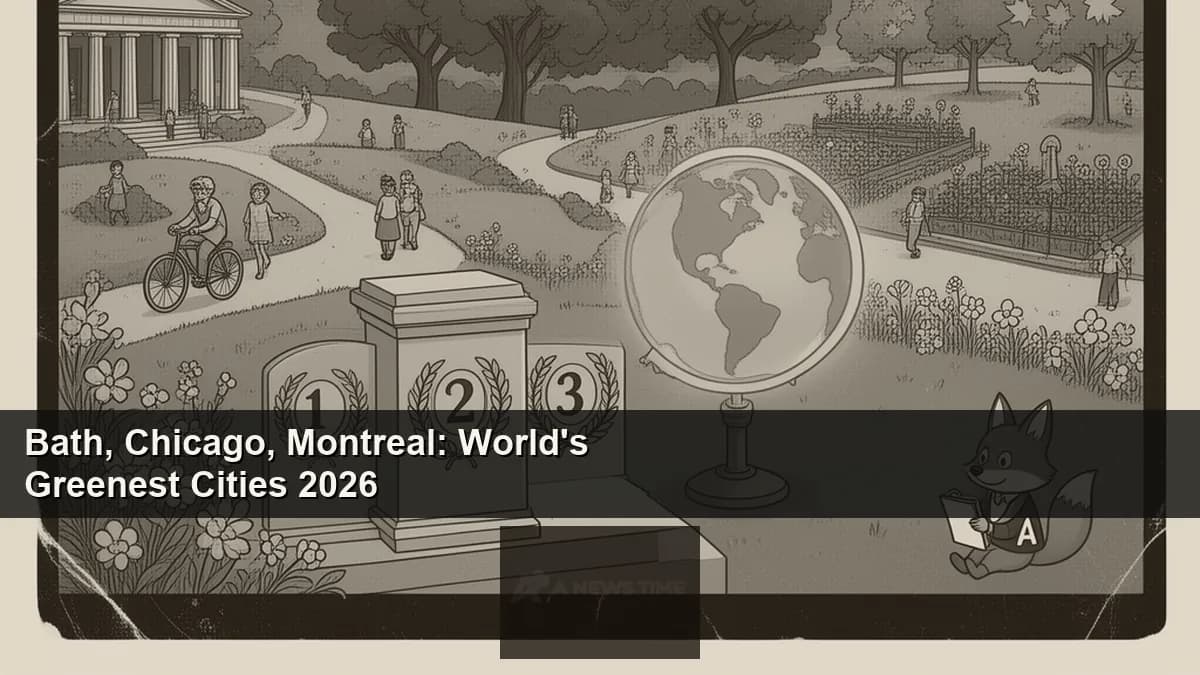
Time Out published its 2026 ranking of the world's greenest cities on , drawing on a survey of 24,000 city-dwellers across 150 urban hubs conducted by travel writer Liv Kelly. The methodology centered on resident scores for green space access and quality, combined with objective data on parkland coverage, tree canopy, and active environmental programs. The results are occasionally surprising: the city at the top of the list is a Roman-era spa town in the English West Country, not a Scandinavian capital or a Singapore-style urban planning showcase. Bath, United Kingdom scored 94% on the green space metric, nine points clear of second-place Chicago.
The ranking matters beyond tourism. Green space access has become one of the most consistently validated predictors of urban livability in the research literature, correlating with better physical and mental health outcomes, lower urban heat island effects, higher property values, and stronger resident satisfaction scores. The cities at the top of this list are not simply the most pleasant to visit. They are, in multiple measurable ways, the most functional places to live.
Bath Leads, and the Reasons Are Worth Understanding
Bath's 94% green space score from Time Out's panel reflects a combination of geographic luck and deliberate policy. The city sits within the county of Somerset, surrounded by the Gloucestershire countryside on multiple sides. The UNESCO World Heritage Site designation that protects Bath's Georgian architecture also functions as a de facto constraint on sprawling development, preserving the city's relationship with its surrounding green landscape.
Within the city limits, Prior Park Landscape Garden, managed by the National Trust, is the kind of 18th-century designed landscape that Bath's visitors come specifically to experience. Layered on top of the historic green infrastructure is Bath's contemporary Greener Places Plan, a 10-year strategy running from 2025 to 2035 that commits the city to expanding tree canopy coverage, improving park facilities, and greening the pedestrian routes that connect Bath's residential neighborhoods to its center.
What Bath demonstrates is that small cities can outcompete large ones on green space when they have both the legacy landscape and the civic commitment to maintain and extend it. Bath's population is under 100,000, which makes it easier to sustain the ratio of green space to urban density that its 94% score reflects. The more instructive comparison is with larger cities that have managed to build genuinely green identities despite the density pressures that come with population over a million.
The Full Top Ten: Five Continents, One Theme
The Time Out ranking's top ten spans five continents and illustrates that green urbanism is not a regional or cultural peculiarity. Cities from North America to Southeast Asia to South America to Northern Europe and Sub-Saharan Africa are building or preserving green space as a core civic value.
| Rank | City | Country | Score | Signature Feature |
|---|---|---|---|---|
| 1 | Bath | UK | 94% | Prior Park, Gloucestershire countryside |
| 2 | Chicago | USA | 89% | 600+ parks, Wild Mile floating eco-park |
| 3 | Montreal | Canada | 88% | Mount Royal Park, 180+ bird species |
| 4 | Riga | Latvia | 87% | 47% green land, 39% tree coverage |
| 5 | Melbourne | Australia | 87% | 70,000 trees with email addresses |
| 6 | Cape Town | South Africa | 86% | Cape Floral Region, UNESCO heritage |
| 7 | Singapore | Singapore | 86% | 50% land is green, "Garden City" since 1967 |
| 8 | Medellín | Colombia | 86% | Green corridors lowered city temp by 2°C |
| 9 | Stockholm | Sweden | 86% | First European Green Capital (2010) |
| 10 | Hamburg | Germany | 85% | GrünesNetzHamburg, century-old green network |
Chicago: A City in a Garden
Chicago's second-place finish at 89% is the most surprising result in the top tier for observers who associate the city with its industrial and financial identity rather than its landscape. But Chicago's green infrastructure is genuinely exceptional by American urban standards. The city maintains more than 600 parks spread across 8,800 acres, a park system that has been central to Chicago's civic identity since the city rebuilt itself after the 1871 fire.
The Wild Mile, the world's first floating eco-park installed on the Chicago River's North Branch, has become one of the more discussed urban nature experiments in North America since it opened in its current form. The floating wetland infrastructure supports native plant species, provides wildlife habitat in the middle of a dense urban river corridor, and has been accompanied by water quality improvements that make sections of the river accessible for recreation for the first time in generations.
Chicago's park system is also notably equitable in its geographic distribution relative to most American cities, where park access correlates strongly with neighborhood income. Chicago still has equity gaps in park quality across its neighborhoods, as do virtually all large American cities, but the raw metric of parkland per resident is among the strongest in the United States for a city of its size and density.
Montreal's French-Canadian Green Identity
Montreal's name derives from Mont Royal, the mountain that rises from the center of the island city. Mount Royal Park, designed by Frederick Law Olmsted (who also designed Central Park in New York), covers 190 hectares and supports more than 180 recorded bird species, making it one of the most ecologically productive urban parks in North America.
The Montreal Botanical Garden, the second-largest botanical garden in the world by collection size, adds a formal dimension to the city's green identity that complements Mont Royal's naturalistic landscape. The combination gives Montreal a claim to urban green space that is unusual in North American cities of comparable density and economic complexity.
Montreal's 88% score from Time Out's panel reflects what local residents know: the city's relationship with green space is unusually integrated into everyday life. The park system connects residential neighborhoods to the mountain in ways that make access a practical convenience rather than a weekend outing. The cycling infrastructure, one of the most developed in North America, makes it possible to reach significant green space from most Montreal neighborhoods without a car.
The Outliers: Medellín and Cape Town
Two entries in the top ten deserve particular attention because they represent cities that have built or maintained green space identity under conditions that make it more difficult: high-density informal urbanization in Medellín's case, and ecological rarity and political complexity in Cape Town's.
Medellín's green corridors program, launched after the city's dramatic 21st-century urban transformation, reduced the average city temperature by 2°C in the corridors themselves by replacing paved surfaces and vehicle lanes with plantings and pedestrian infrastructure. The temperature reduction is not a trivial outcome. In a city at Medellín's altitude and latitude, 2°C can be the difference between comfortable street life and heat-driven residential retreat. The corridors have also become community spaces that replaced vehicle infrastructure in ways that made Medellín's notoriously divided neighborhoods physically more connected.
Cape Town's green credentials are grounded in something rarer than urban planning: the Cape Floral Region, a UNESCO World Heritage Site that surrounds the city, is one of the most species-rich plant communities on Earth. Approximately 70% of its plant species are found nowhere else in the world. The Table Mountain National Park, which bisects Cape Town, puts one of the world's great wilderness areas within walking distance of city neighborhoods in ways that most cities simply cannot replicate because the ecological asset does not exist.
For context on how climate dynamics are affecting the environments that give cities like Cape Town and Medellín their green character, our earlier coverage of the UN's warning on Earth's record climate imbalance is directly relevant to understanding the pressures these ecosystems face.
Singapore's Deliberate Construction of Greenness
Singapore belongs in a separate analytical category from the rest of the top ten. Every other city on the list has green space that is at least partly the product of historical accident, geography, or policy inheritance. Singapore's greenness has been deliberately engineered across six decades of urban planning that began with Lee Kuan Yew's "Garden City" vision in 1967.
The data is remarkable. 50% of Singapore's land area is green space in a city-state with a population density of more than 8,000 people per square kilometer. The combination is essentially impossible by conventional urban planning expectations, and Singapore achieved it through an approach that treats greenery as infrastructure rather than amenity. Trees are planted on building facades and rooftops. Expressways are lined with engineered green corridors. Parks are connected by green bridges over major roads. The entire city is a continuous green system rather than a collection of discrete parks.
Singapore's goal is to be the world's greenest city by 2030, an ambition it is pursuing through new programs including the Singapore Green Plan and expanded urban farming initiatives. At 86% in the Time Out survey, Singapore is already making a strong case for the title based on current performance.
North American and European Cities Not in the Top Ten
The ranking extends beyond the top ten. Beijing placed 11th at 84%, a surprising result for a megacity more often associated with air quality problems than green space, though Beijing's massive park system and recent urban greening investments are less internationally recognized than its other characteristics. Vienna placed 12th at 83%, Helsinki 13th at 83%, and Krakow 14th at 82%. Oslo and Seoul rounded out the top 20 at 81% and 80% respectively.
The absence of London, Paris, and New York from the upper tiers of the ranking is notable. All three cities have significant park systems, but their density and the uneven distribution of green space across their neighborhoods affect the survey scores from residents who may have limited access to quality green space depending on where they live. The resident survey methodology, rather than a top-down assessment of total parkland, captures the experience of living in these cities across their full geographic range rather than the experience of living in their most park-adjacent neighborhoods.
Toronto, which has been investing heavily in green infrastructure along its waterfront and through the Ravine Strategy, and Vancouver, consistently cited as one of North America's most livable cities in its own right, both appeared in the broader rankings but below the top 20. The North American cities that performed best, Chicago and Montreal, both have unusually equitable park distributions relative to their size, which affects how broadly resident satisfaction with green space is distributed across the survey sample.
Why This Ranking Matters for Travel
For travelers, the Time Out green space ranking is a genuinely useful lens for choosing destinations, particularly for trips oriented around quality of urban experience rather than specific attractions. The cities at the top of this list are, by a consistent set of measurements, the most pleasant places to simply be in. Walking, cycling, and spending time outdoors are easier, more enjoyable, and more naturally integrated into daily life in Bath, Chicago, and Montreal than in cities where green space exists but is difficult to access or unevenly distributed.
Spring and early summer are the optimal seasons for experiencing green urban spaces in the Northern Hemisphere cities on this list, and the ranking was published at precisely the moment when visitors planning May or June trips have their maximum flexibility. Bath's Prior Park and surrounding countryside are at their most accessible in spring before summer crowds arrive. Chicago's lakefront parks are transformative in late spring when water temperatures moderate enough for outdoor activity. Montreal's Mount Royal is extraordinary in June, when the city's famous festival season begins and the park becomes a social destination as well as a natural one.
For travelers considering how green space quality factors into destination selection alongside food and culture, our recent coverage of group travel and outdoor experiences in Sedona touches on a related question: how outdoor environments drive travel decisions and what kinds of experiences are drawing travelers to specific destinations in 2026.
The Broader Pattern: Nature Is Urban Now
The Time Out ranking, taken as a whole, reflects a documented shift in what urban residents and travelers value in cities. Survey after survey in the post-pandemic period has found that access to nature and green space has risen in priority relative to cultural amenities and commercial density. The experience of urban lockdowns, which forced many city residents to discover or rediscover local parks and green corridors as their primary outdoor outlets, permanently raised the weighting that people apply to green space in evaluating where they live and where they travel.
Urban planners have noticed. The cities investing most aggressively in green infrastructure right now, Singapore with its greening mandate, Medellín with its corridors, Hamburg with its GrünesNetzHamburg expansion program, are responding to both citizen demand and evidence that green space produces measurable returns in public health, energy costs, and property values that justify the investment on conventional economic terms as well as quality-of-life grounds.
The 2026 Time Out ranking captures a moment in urban development where the "city as nature" vision, long a minority position in planning conversations dominated by density and connectivity optimization, is moving from aspiration to standard. Bath, Chicago, and Montreal are not anomalies. They are early examples of what the most livable cities will look like.