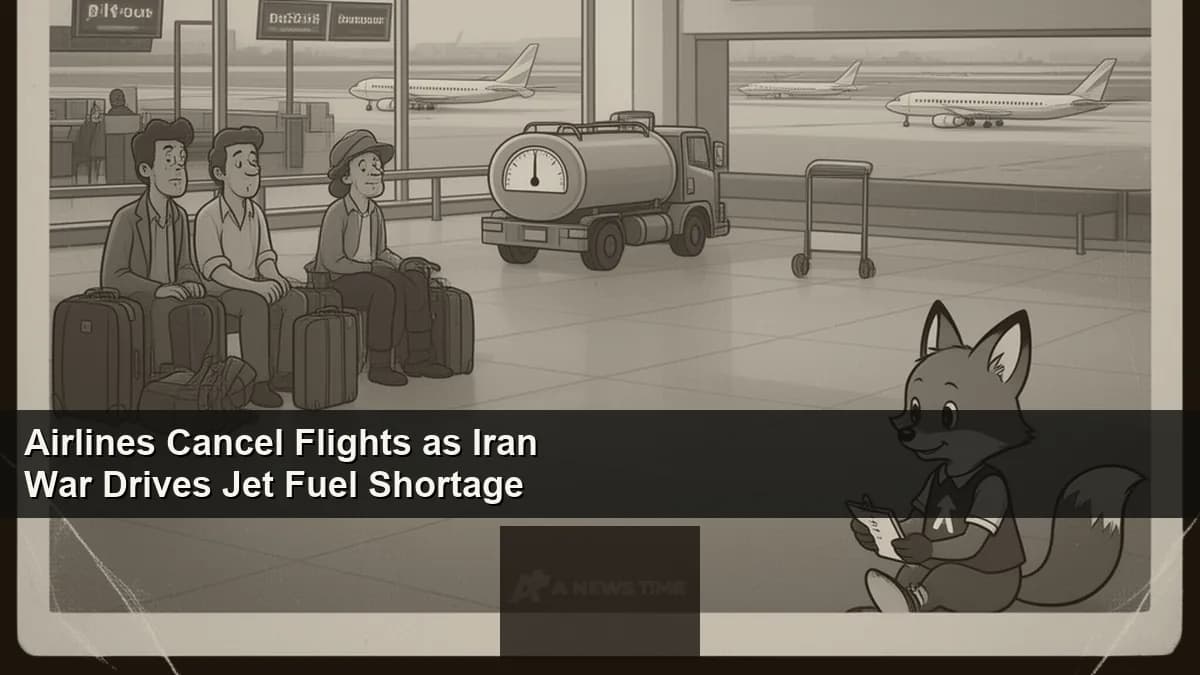
The fuel gauges were already tightening when arrived and the full cost of the US-Israel war on Iran hit the global aviation industry in one number: $195 per barrel for jet fuel. Six weeks earlier, that same barrel cost roughly $95. For airlines that run on margins measured in fractions of a cent per seat-mile, the doubling of their single largest operating cost is not a budget problem. It is an existential arithmetic problem, and the industry's response has been swift, cascading, and still accelerating.
Across four continents, carriers are cancelling flights by the hundreds, grounding aircraft, and hiking fares to levels not seen since the post-COVID travel surge of 2022. The passengers caught in the middle are discovering that the crisis is no longer confined to Middle East routes. A Swede flying Gothenburg to New York, a Malaysian family connecting through Kuala Lumpur to London, a business traveler booking Sydney to Los Angeles: all of them are now pricing in a conflict 7,000 miles from their departure gate.
How a War in Iran Emptied the Fuel Tanks
The mechanism linking the Iran conflict to a gate agent in Copenhagen or Melbourne runs through a remarkably short supply chain. The Persian Gulf region accounts for roughly a third of global crude oil trade by volume. When active military operations and airspace restrictions began trapping Middle Eastern oil in regional storage, the downstream consequences moved through the refining chain in weeks rather than months.
Crude oil crossed $100 per barrel in the first weeks of the conflict, a threshold that had not been breached in sustained fashion since 2014. But crude is only the feedstock. Jet fuel, or aviation kerosene, requires additional refining steps and trades at a premium to crude that typically ranges from $15 to $30 per barrel. Under normal market conditions. When refining capacity serving European and Asian carriers cannot access typical Middle Eastern crude supplies, and when global shipping routes for refined products are simultaneously disrupted, the jet fuel premium inflates beyond anything in the historical range.
"April losses will be twice what we saw in March. The scarcity we are seeing in the Middle East will spread to Europe by April and May unless supply routes reopen."
Fatih Birol, Executive Director, IEA
Birol's warning to the international energy community was issued in and it reframes what some airline executives had been characterizing as a short-term shock. If the IEA's modeling is correct, European carriers face a second wave of cost pressure starting in May even if the conflict shows no further escalation. The UK is particularly exposed: British refiners rely more heavily on Middle Eastern crude imports than their continental counterparts, and London-based analysts flagged the UK as the most vulnerable European fuel market in a briefing distributed to airlines in the third week of March.
For a more detailed look at how the oil price surge is translating into broader economic damage, see our Goldman Sachs recession odds analysis and the Federal Reserve's impossible position between inflation and job losses.
Airline by Airline: Who Is Cutting What
The response has not been uniform. Airlines with different fuel hedging positions, different network structures, and different access to refining infrastructure are facing different versions of the same problem. The table below summarizes the major carriers' publicly announced responses as of early April 2026.
| Airline | Action Taken | Scale | Fuel Cost Position |
|---|---|---|---|
| United Airlines | Flight cuts across two quarters | $11 billion additional annual fuel expense projected | Partially hedged; absorbing large unhedged exposure |
| Air New Zealand | Route suspensions and frequency reductions | ~1,100 flights cut | Exposed; limited refining alternatives at Pacific prices |
| SAS | Network-wide frequency reductions | ~1,000 flights cut | Exposed; European supply chain tightening |
| Lufthansa | Considering grounding aircraft | Up to 40 aircraft potentially grounded | Partially hedged through Q2; Q3 unprotected |
| Ryanair | Reviewing route network, reductions under consideration | Unspecified; worst-case scenarios being modeled | Historically thin margins leave little buffer |
| AirAsia | 10% flight capacity cut; fares raised | 30 to 40% fare increases announced | Fully exposed: $90 to $200/barrel cost increase |
| Vietnam Airlines | Route suspensions | 7 international routes suspended | Southeast Asian refiners facing supply shortfalls |
| Delta Air Lines | Limited cuts; operating most schedule | Minimal announced reductions | Owns Monroe, PA refinery providing partial buffer |
The contrast between Delta and virtually every other major carrier illustrates the value of vertical integration that was mocked when Delta acquired the Monroe, Pennsylvania refinery from ConocoPhillips in 2012 for $150 million. At the time, analysts questioned whether an airline had any business running a petroleum refinery. Today, that refinery's output provides Delta with a partial buffer against spot market prices, a structural advantage that no other major US carrier possesses. Delta still faces higher fuel costs, but not the same cliff-edge exposure as United, American, and Southwest.
The AirAsia situation deserves particular attention because it frames the problem starkly. AirAsia CEO Tony Fernandes described the current environment to analysts as "the most serious challenge" the airline has faced since the COVID-19 pandemic. When a low-cost carrier that built its entire model on cheap fuel for short-haul routes across Southeast Asia sees its fuel cost more than double in six weeks, the business model itself comes under pressure. The 30 to 40% fare increases AirAsia has announced signal that the era of ultra-cheap intra-Asian air travel, at least for the duration of the conflict, is over.
Airspace Closures Add a Separate Layer of Disruption
Fuel cost is the structural story, but airspace closures are creating a separate, more immediate disruption for passengers. More than 29 flights have been grounded on any given day due to specific airspace restriction enforcement, a number that understates the total impact because it counts only direct grounding orders rather than airlines' own preemptive cancellations in restricted zones.
The airspace problem interacts with the fuel problem in a compounding way. When airlines reroute flights around Iranian and Iraqi airspace to comply with FAA and EASA directives, those longer routes consume more fuel. A Europe-to-South Asia flight adding two hours of routing burns approximately 12 to 15 additional tonnes of jet fuel per sector. At $195 per barrel, that adds roughly $3,500 to $4,500 in fuel cost to a single round-trip sector. Multiply that across hundreds of flights per day and the arithmetic becomes brutal quickly.
Denmark has become the most prominent European nation to formally declare a travel disruption emergency, joining a growing list of countries where aviation regulators have issued guidance to passengers about expected delays and cancellations on affected routes. The UK, per the IEA analysis and independent fuel market research, faces the sharpest deterioration in jet fuel availability of any major European aviation market. British carriers including British Airways parent IAG have acknowledged the challenge without specifying exactly which routes will face further reductions.
For travelers already navigating the broader disruption picture in the region, our earlier reporting on Middle East flight disruptions and passenger rights covers the regulatory framework around rebooking and refund entitlements in detail.
What the Fare Data Tells Us
Airline revenue management systems are, in one sense, extremely good real-time sensors for what is happening in the market. The fare data emerging in early April 2026 tells a clear story: carriers that have not yet announced formal flight cuts are quietly repricing upward in a way that amounts to demand rationing through price.
Transatlantic routes have seen economy fares on peak summer dates rise an average of 22% compared to the same booking window a year ago, according to data from multiple fare tracking platforms. Intra-European routes, where Ryanair and easyJet have historically competed on price to an extent that kept fares structurally low, are showing increases of 15 to 35% depending on the route and date. The budget carrier model depends on marginal cost per seat being low enough that even aggressively discounted base fares generate positive contribution margins. When fuel represents 35% of that cost structure and doubles, the model breaks.
Long-haul routes in the Asia-Pacific region are showing the most dramatic fare movements. Singapore Airlines, one of the few major carriers that has maintained most of its schedule by rerouting extensively through Central Asian corridors, has acknowledged that the additional fuel burn from rerouting is being partially passed through to customers on affected routes. Cathay Pacific has reduced frequencies on several European destinations and raised fares on the routes that remain. Air New Zealand's decision to cut approximately 1,100 flights reflects both fuel economics and the specific challenge of ultra-long-haul operations: Auckland to London on the new direct route pioneered in recent years is among the most fuel-intensive commercial flights in operation, and at $195 per barrel, the economics of that route become genuinely difficult to justify at current load factors.
The summer airfare spike analysis we published in late March projected 18% above-year-ago fares for summer 2026 bookings. That projection was made before the most recent escalation in fuel prices, and the current trajectory suggests the actual figure will be higher.
The Delta Exception: Why One Airline Is Holding Up
Delta's relative resilience in this environment is worth examining as a case study in aviation risk management, because the Monroe refinery story is more nuanced than it first appears. The refinery does not supply all of Delta's jet fuel needs. It produces a mixture of refined petroleum products, of which jet fuel is one, and Delta has a complex arrangement through which refinery output is traded and optimized through supply agreements with other major oil companies.
What the refinery actually provides is partial price insulation, not price immunity. Delta is still exposed to the spot market for a significant portion of its fuel needs. But its weighted average fuel cost is structurally lower than carriers buying entirely at spot prices, and in a market where spot prices have doubled, that structural advantage translates directly into a competitive edge: Delta can maintain routes that United, American, and Southwest are cancelling because Delta's marginal economics on those routes still close.
The broader lesson for the industry is not that every airline should buy a refinery. The lesson is that fuel risk management, whether through refinery ownership, sophisticated hedging programs, or conservative fleet fuel-efficiency standards, makes a measurable difference when the fuel market dislocates. The carriers that invested in fuel-efficient narrowbody and widebody fleets over the past decade are in meaningfully better positions than those that deferred those capital decisions.
What Travelers Face Practically
For travelers with bookings in the coming weeks and months, the practical implications sort into several categories depending on route and carrier.
Flights to and through the Middle East: The disruption here is most severe and most direct. Flights to Tel Aviv, Beirut, and conflict-adjacent destinations remain suspended by most Western carriers. Connections through Dubai, Doha, and Abu Dhabi are operating but at reduced frequency, which means rebooking options when flights are disrupted are more limited than normal. Travelers connecting through Gulf hubs to onward destinations in Asia, Africa, or the Indian Subcontinent face longer wait times for alternative routing.
Transatlantic routes: Fewer direct cancellations but significant fare increases. Travelers with existing bookings at pre-crisis prices are in a better position than those booking now. Flexibility provisions and change fees vary by carrier: United has reinstated change fees on some fare classes after temporarily waiving them in the first weeks of the conflict.
Asia-Pacific routes: The combination of airspace rerouting, higher fuel costs, and frequency reductions is creating longer journey times and less scheduling flexibility. Passengers on itineraries that connect through Middle Eastern hubs should verify their connections are still operating before departure.
Budget carriers in Europe and Southeast Asia: The fare increases at Ryanair, easyJet, and AirAsia are most acute here. The ultra-low fares that characterize these carriers' normal pricing have largely disappeared on routes where fuel exposure is highest. Travelers comparing current fares to historical benchmarks will find the gap significant.
- Check airline websites directly for cancellation and rebooking policies before contacting customer service
- Travel insurance policies purchased after conflict outbreak began typically exclude conflict-related disruptions as claims
- Credit card travel protections (trip interruption, trip cancellation) may provide coverage where travel insurance does not
- EU Regulation 261/2004 requires rebooking or full refund on cancellations but exempts compensation payments for extraordinary circumstances
- Passengers booked through travel agents or online travel agencies should contact those intermediaries first for rebooking assistance
For travelers watching the broader economic picture, the impact extends beyond flight prices. The OECD's revised global growth outlook reflects the cascading effects of the fuel shock across the wider economy, with travel and tourism among the sectors facing the sharpest near-term pressure.
The Longer Horizon: When Does This Stabilize?
The IEA's Birol warned explicitly in early April that the pattern is not stabilizing. His projection that April losses will be twice March losses and that scarcity will reach European markets by April and May is not a worst-case scenario framing: it reflects the IEA's base case modeling given current supply disruption trajectories.
For aviation specifically, the stabilization question has two parts: when does the conflict deescalate enough to reopen Middle Eastern airspace and supply routes, and when do fuel hedges and alternative supply arrangements allow airlines to reduce their spot market exposure? The first question is political and outside the industry's control. The second question is one the industry is actively working, but hedging programs take time to execute at scale, and alternative crude supply routes from West Africa, North Sea producers, and the Americas have capacity constraints that limit how quickly they can offset Middle Eastern losses.
The carriers best positioned for an extended disruption are those with diversified fuel sourcing, efficient fleets, and strong balance sheets that allow them to absorb near-term losses without cutting their networks to the bone. The carriers most at risk are the budget operators in high-fuel-cost regions, which are already signaling through fare increases and route cuts that their margins have hit a floor.
What the coming weeks will reveal is whether governments in Europe and North America move to release strategic petroleum reserves specifically to address jet fuel tightness, as several European energy ministers have called for. Strategic reserve releases helped moderate gasoline and diesel prices during the 2022 Ukraine conflict's fuel shock. Whether a similar mechanism can meaningfully address jet fuel supply in the current environment is an open question, and the answer will determine how much further the flight cancellations and fare increases have left to run.
Frequently Asked Questions
Why is jet fuel so much more expensive because of the Iran conflict?
The Persian Gulf region supplies roughly a third of global crude oil by volume. Active military operations and airspace restrictions have trapped significant quantities of Middle Eastern oil in regional storage, reducing the crude supply available to global refiners. When crude prices rise above $100 per barrel and refinery access to typical feedstocks is restricted, the downstream refined products including jet fuel see amplified price increases. Jet fuel was trading at approximately $95 per barrel in February 2026 and reached $195 per barrel by late March.
Which airlines have cut the most flights so far?
Air New Zealand has announced cuts of approximately 1,100 flights. SAS has cut around 1,000 flights. AirAsia has reduced capacity by 10% across its network. United Airlines is cutting flights across two quarters. Vietnam Airlines has suspended 7 international routes. Lufthansa is considering grounding up to 40 aircraft. Ryanair is reviewing its network for further reductions.
Will airfares continue rising through summer 2026?
The IEA projects fuel supply tightening will spread to European markets by April and May 2026, which suggests additional upward fare pressure through at least the early summer travel season. Airlines that have already raised fares are unlikely to reverse those increases until fuel costs stabilize. Summer 2026 economy fares on transatlantic routes are currently tracking approximately 22% above the same booking window in 2025.
Are any airlines protected from the fuel price spike?
Delta Air Lines has partial insulation through its ownership of the Monroe, Pennsylvania refinery, which provides a portion of its fuel at below-spot-market prices. Airlines with robust fuel hedging programs in place before the conflict began have varying degrees of protection through their hedge books, typically extending one to three quarters forward. However, no major carrier is fully protected from a sustained fuel price at current levels.
What should travelers do if their flight gets cancelled due to fuel-related cuts?
Travelers flying routes departing the EU or arriving in the EU on EU-based carriers are entitled to rebooking or a full refund under EU Regulation 261/2004, though compensation payments are likely exempt under the extraordinary circumstances clause. For US domestic and transborder routes, airline customer service policies vary. Credit card travel protections and existing travel insurance purchased before the conflict began may provide additional coverage. Travelers should check their carrier's specific rebooking waiver policy before paying change fees.
Sources
- Airlines Cancel Flights as Iran War Drives Jet Fuel Shortage - Business Insider
- Global Airline Chaos as Iran Conflict Sends Jet Fuel Past $195 Per Barrel - Travel and Tour World
- IEA Emergency Response and Energy Security - International Energy Agency
- Oil Prices Surge on Iran Conflict Supply Disruption - Reuters