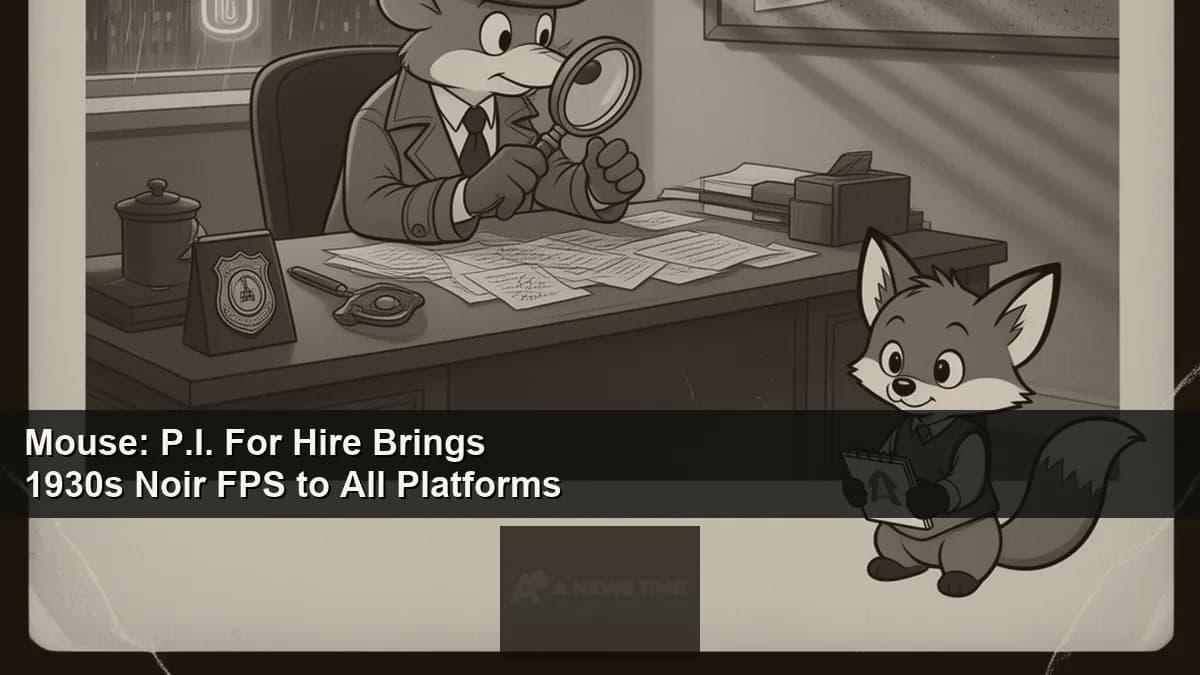
There is a category of game that gets underestimated on first look: the ones where the art direction is so distinctive that coverage instinctively frames them as art projects with guns rather than actual shooters. Mouse: P.I. For Hire, from developer Fumi Games and publisher PlaySide Publishing, is squarely in that category. It releases on across PC via Steam, PS5, Xbox Series X/S, and Nintendo Switch 2 at a price of around $32 USD (30 EUR), and it looks, at first glance, like a Cuphead homage with FPS mechanics grafted on.
The first-glance read is incomplete. Preview coverage from IGN, following a hands-on session ahead of the review embargo lifting on , described the game as "far more robust" than its appearance suggests. What sits underneath the rubber hose animation and black-and-white palette is a movement shooter with wall-running, grapple-hooking, and double-jumping, a detective noir storyline following a former war hero named Jack Pepper through the city of Mouseburg, and a suite of experimental firearms that reviewers have called creative rather than functional-but-boring. That is a different game than the aesthetic sells on its own.
The timing of the release is worth noting. April 2026 is a crowded month for gaming releases. Xbox Game Pass is headlining Oblivion Remastered, and Starfield has just arrived on PS5 with the Free Lanes update in tow. Mouse: P.I. For Hire is going up against heavy competition for player attention and wallet share, which makes its multi-platform day-one strategy, including Switch 2, a notable commitment from a smaller developer and publisher.
The World of Mouseburg: Setting, Story, and Visual Design
The game takes place in Mouseburg, an anthropomorphic city rendered entirely in hand-drawn 1930s cartoon animation using the rubber hose style that characterized early Disney and Fleischer Studios productions. Rubber hose animation is named for the way characters' limbs are drawn as smooth, flexible tubes without joints or rigid anatomy, which gives the characters a fluid, almost boneless movement quality that reads as simultaneously charming and slightly uncanny. In motion, especially in a first-person game where the player is inhabiting this world rather than watching it, the aesthetic is reportedly disorienting in an interesting way: the environments feel simultaneously alive and artificial.
Mouseburg is not a single-biome city. The game moves through film studios, opera houses, swamps, and sewer systems, which is a broader environmental range than most FPS games in this budget tier offer. Each environment is drawn and animated consistently with the 1930s style, which means the art team has had to solve the problem of making a sewer feel like a Fleischer Studios cartoon without losing the sense of place or threat. Early screenshots suggest they have managed it, though the proof will be in how well the environments hold up over the full game length.
Jack Pepper, the protagonist, is a mouse, a former war hero who has set up as a private investigator in Mouseburg. The noir detective frame is a genre choice that fits the 1930s aesthetic naturally. Raymond Chandler's first Philip Marlowe novel, The Big Sleep, was published in 1939. The genre conventions of hard-boiled detective fiction, moral ambiguity, corrupt power structures, atmospheric urban environments, a protagonist who operates in the cracks between legitimate society and its criminal underworld, all of them are baked into the period the game is drawing from. Fumi Games is not innovating on genre here, and they don't need to. They are using a coherent aesthetic and narrative framework as a container for a shooter, which is a structurally sound approach.
The game is organized around multiple cases for Jack Pepper to solve. This is not a single linear campaign with a clean three-act structure. It is a collection of discrete investigations, each presumably with its own narrative thread, that players work through in Mouseburg. The collectibles mentioned in preview coverage suggest there is meta-content threading through the cases, rewarding thorough exploration alongside the main objectives. The boss battles are described as manic, which in context suggests they lean into the cartoon logic of the world rather than trying to import realistic combat design into an unrealistic setting.
Movement and Combat: More Than Aesthetic
The mechanical question for any FPS built around a distinctive art direction is whether the design team has built a game or built a visual showcase. The preview coverage points toward a game. The movement system in Mouse: P.I. For Hire includes wall-running, grapple-hook traversal, and double-jumping. These are three mechanics that, when combined in a shooter, produce a specific kind of moment-to-moment play: vertical space matters, momentum matters, and the player has genuine control over how they approach each combat encounter rather than being funneled through flat geometry.
Wall-running requires level design that supports it. Corridors need to have walls at the right height and distance, vertical compositions need to give players targets to run toward, and the grapple system needs anchor points that are abundant enough to make traversal feel fluid rather than tokenistic. The fact that preview coverage does not flag this as a problem is a modest positive signal. Grapple-hook mechanics in particular are easy to implement poorly and immediately obvious when they are. A grapple that has awkward attach detection or momentum that doesn't carry over into subsequent movement ruins the feel of an otherwise competent shooter.
The firearms are described as creative and experimental. In a game grounded in 1930s cartoon logic, this is probably the most interesting design space available. The 1930s cartoon universe does not have to honor physics, material properties, or even consistent object permanence. Guns in Fleischer Studios cartoons do things that guns do not do. Fumi Games appears to have used this as a license to build weapons that operate on cartoon logic rather than military authenticity, which is the right call for this setting. What exactly those weapons do has not been fully disclosed ahead of the review embargo, which is a reasonable decision from a publisher perspective: the weapons are probably one of the game's strongest selling points and worth keeping for first-look coverage.
| Platform | Release Date | Price (USD) | Notes |
|---|---|---|---|
| PC (Steam) | ~$32 | Day one release; full feature parity | |
| PlayStation 5 | ~$32 | Day one release | |
| Xbox Series X/S | ~$32 | Day one release; Game Pass inclusion unconfirmed | |
| Nintendo Switch 2 | ~$32 (30 EUR) | Day one release; Switch 2 performance unspecified |
The boss battles deserve specific attention because they represent the highest-risk design element in a game like this. Manic boss encounters in a cartoon shooter need to be legible despite the chaos. If the art direction makes it difficult to read boss attack patterns, or if the screen is too visually busy during high-stakes moments for players to track both the environment and the threat, the game stops being fun precisely when it is trying to be most exciting. Preview coverage describes the bosses as manic but does not flag readability as a problem, which is again a modest positive signal. Full reviews on April 14 will give a clearer picture.
Fumi Games and PlaySide: Developer and Publisher Context
Fumi Games is a smaller studio, and Mouse: P.I. For Hire appears to be their most ambitious release to date in terms of scope and platform reach. PlaySide Publishing, the Australian games publisher backing the release, has been building a portfolio of independent releases across this budget tier, a segment of the market that is growing even as larger publishers face legal and reputational headwinds. The partnership makes structural sense: Fumi handles development, PlaySide handles the commercial infrastructure for a simultaneous four-platform release with marketing and distribution overhead that a small developer would struggle to manage alone.
The $32 price point is calibrated carefully. It sits comfortably below the $40-50 range that independent games with significant production values have been testing in recent years, which reduces the perceived risk for a player who is uncertain about an unfamiliar developer. It is also above the $20-25 range that signals a shorter or lighter experience. At $32, Fumi Games and PlaySide are implying something in the range of 6-12 hours of content, possibly more with collectibles and multiple cases, which positions the game as an evening-and-a-weekend commitment rather than a quick play session.
"Mouse: P.I. For Hire is far more robust than it might appear at first glance. The movement system is tight, the firearms are creative, and the cartoon world holds up across different environments. This is a real shooter wearing a very distinctive costume."
IGN preview coverage, IGN
The Switch 2 release is particularly interesting from a business perspective. Nintendo's second-generation handheld has attracted meaningful support from independent publishers since launch, and the platform's audience has historically been receptive to distinctive art-direction games. Mouse: P.I. For Hire's visual style is immediately readable as a Switch game in a way that many technically impressive releases are not. The question for Switch 2 is performance: the movement mechanics, particularly wall-running and grapple-hook traversal, require consistent frame pacing to feel correct, and the game has not specified target frame rates or resolution modes for the platform ahead of launch.
Genre Position: Where This Fits in the Cartoon FPS Space
The comparison that will be applied to Mouse: P.I. For Hire most frequently is Cuphead, and it is worth being specific about where that comparison applies and where it does not. Both games draw from 1930s animation, both use the rubber hose style, and both are built around characters who navigate a world where cartoon logic applies. The differences matter more than the similarities for assessing what Mouse: P.I. For Hire is trying to be.
Cuphead is a run-and-gun platformer with a heavy emphasis on boss rush difficulty. It is a game about pattern recognition, repetition, and precise execution under pressure. The difficulty is central to the design philosophy. Mouse: P.I. For Hire is an FPS with a detective narrative and a movement system built for traversal, not precision platforming. The cases structure implies something closer to a mission-based campaign than a boss-rush experience. These are different games that share an aesthetic ancestor.
- Shared with Cuphead: 1930s rubber hose animation, black-and-white palette, anthropomorphic cartoon characters, boss encounters.
- Different from Cuphead: First-person perspective, movement mechanics (wall-run, grapple, double-jump), detective narrative, mission/case structure, multi-platform simultaneous release at a lower price point.
- Closer comparisons in FPS terms: Ultrakill (stylized movement shooter with strong aesthetic identity), Amid Evil (retro-influenced FPS with distinctive tone), Dusk (momentum-based FPS emphasizing traversal).
The movement-shooter comparisons are more structurally useful. Games like Ultrakill have demonstrated that there is a dedicated audience for FPS games that prioritize movement fluency and creative combat over realism or cover-based mechanics. Mouse: P.I. For Hire is not as mechanically radical as Ultrakill, but it is working in a similar direction: a game where the way you move through space is itself a core pleasure, not just a means of getting between firefights.
"The 1930s aesthetic is doing a lot of work here, but it is not doing all the work. The movement feels good independently of the art. That matters."
Bleeding Cool preview, Bleeding Cool
Industry Implications: The Case for Stylized Mid-Budget FPS
Mouse: P.I. For Hire exists in a market segment that has had a complicated few years. The mid-budget FPS, games that cost $25-40 and are built by teams of 10-30 people rather than 300-plus, has been squeezed from multiple directions. On the low end, free-to-play competitive shooters absorb a disproportionate share of player time. On the high end, annual franchises like Call of Duty and major releases like Battlefield consume the blockbuster-FPS appetite. In the middle, developers have to find a reason to exist.
The successful mid-budget FPS releases of the past several years have almost universally found that reason in differentiation. Prodeus, Turbo Overkill, Selaco, and similar releases have each carved out space by being very specific about what they are and who they are for. Mouse: P.I. For Hire has one of the most immediately distinctive aesthetic identities in this cohort, which solves the discoverability problem that kills mid-budget games that look like worse versions of bigger releases. A player scrolling through Steam will recognize Mouse: P.I. For Hire as something specific within seconds, which is a commercial advantage that money cannot easily buy.
The multi-platform simultaneous launch, including Switch 2, is a meaningful commitment for a game at this scale. It signals that PlaySide and Fumi believe the concept travels across different player demographics, not just the PC-native indie game audience. If the game performs on Switch 2, it opens a template for similar mid-budget stylized shooters to target that platform more aggressively, which would be a meaningful shift from the pattern of PC-first, console-later releases that has dominated the mid-budget FPS space.
Community Reaction and What to Watch
Pre-release community interest in Mouse: P.I. For Hire has been consistently positive in the gaming spaces where it has been discussed. The launch trailer generated strong engagement on gaming forums and social media, with most of the reaction focused on the aesthetic first and the movement mechanics second once preview footage became available. The Steam wishlist numbers have not been publicly disclosed, but community signal has been warm enough that PlaySide has maintained an active pre-release campaign.
The review embargo lifting on , two days before release, is a neutral-to-positive sign. Publishers who lack confidence in their game's critical reception tend to hold embargoes until launch or later. A two-day window gives buyers time to read reviews before making a purchase decision, which indicates PlaySide expects those reviews to be helpful rather than harmful to sales. This does not guarantee strong scores, but it suggests the publisher is not expecting a critical disaster.
Things to watch on and after release. First, the Switch 2 performance: if the movement mechanics run cleanly on Nintendo's hardware, it validates the platform as a meaningful target for movement-shooter developers. If there are frame-rate issues, it will affect reception specifically on that platform. Second, the cases structure: whether the individual investigations feel substantive or thin will determine whether the game has legs beyond the launch weekend. Third, the weapon variety: the creative firearms are one of the most-discussed elements in preview coverage, and if they hold up across the full game rather than front-loading the creativity in the opening hours, that will drive positive word-of-mouth significantly.
The deeper question Mouse: P.I. For Hire poses for the FPS genre is whether aesthetic identity alone is sufficient to build a lasting audience, or whether the movement mechanics and narrative need to carry equal weight once the novelty of the art direction wears off. Every game with a strong aesthetic faces this question around the five-hour mark, when the player has acclimated to the visual world and is evaluating what is left underneath it. Fumi Games has built something that looks, from the outside, like it has answers. April 14 is when the reviewers find out if those answers hold.
Frequently Asked Questions
What is Mouse: P.I. For Hire?
Mouse: P.I. For Hire is a first-person shooter developed by Fumi Games and published by PlaySide Publishing. It is set in a 1930s hand-drawn cartoon world called Mouseburg, where players take on the role of Jack Pepper, a former war hero turned mouse detective. The game features wall-running, grapple-hook traversal, double-jumping, creative firearms, and a noir detective storyline organized around multiple cases.
When does Mouse: P.I. For Hire release and on which platforms?
The game releases on April 16, 2026, simultaneously on PC via Steam, PlayStation 5, Xbox Series X/S, and Nintendo Switch 2. All versions release on the same day at the same price of approximately $32 USD (30 EUR).
Is Mouse: P.I. For Hire similar to Cuphead?
Both games draw from 1930s rubber hose animation, but they are structurally different. Cuphead is a run-and-gun platformer focused on boss-rush difficulty and precise pattern recognition. Mouse: P.I. For Hire is a first-person shooter with movement mechanics, a detective narrative, and a mission/case structure. They share an aesthetic ancestor but are different types of games with different design philosophies.
When does the review embargo lift?
The review embargo for Mouse: P.I. For Hire lifts on April 14, 2026, two days before the game's April 16 release date. Full reviews will be available from that date, giving buyers a short window to read critical coverage before deciding whether to purchase.
Is Mouse: P.I. For Hire coming to Xbox Game Pass or PlayStation Plus?
No Game Pass or PlayStation Plus inclusion has been announced for the April 16 launch. The game is a standard purchase title at approximately $32 USD across all platforms. Any future subscription service additions would likely be announced separately after the initial launch period.