

Minneapolis has been cold-shouldered by the Michelin Guide for so long that local chefs and food writers developed a running dark joke about it: the city was either too Midwestern to be interesting, or too interesting to be safely Midwestern, and Michelin could not figure out which. Neither turned out to be the reason. The reason was simpler and more frustrating. The guide had not gotten around to it yet.
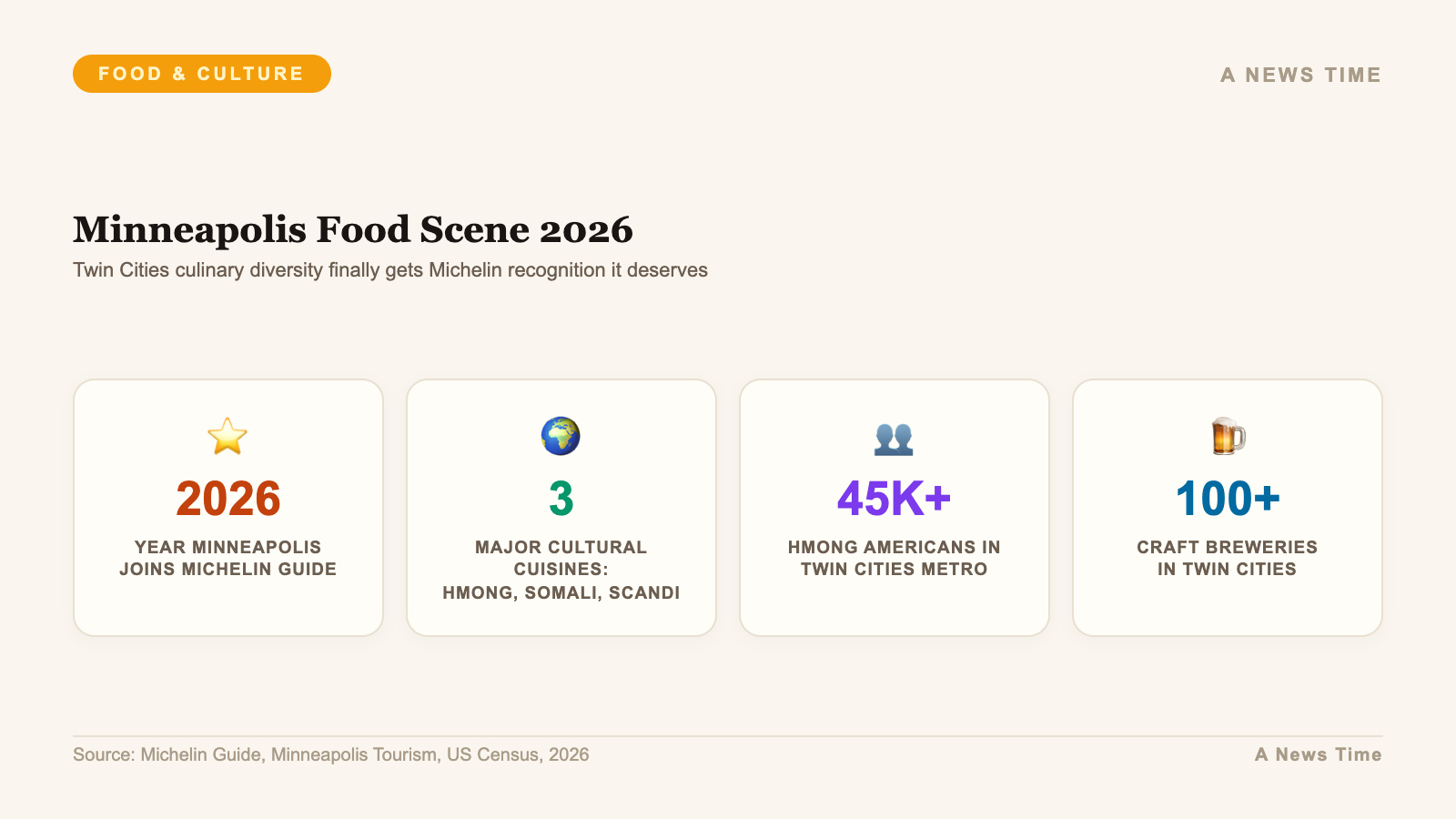
On April 9, 2026, Michelin announced that Minneapolis will be included in the American Great Lakes edition for the first time. The city, which has built one of the most quietly exceptional dining scenes in the country over the past fifteen years, joins Chicago, Detroit, Milwaukee, and Cleveland in a regional guide that now covers the entire corridor from the Chicago lakefront to the western end of the Great Lakes basin. For the chefs who spent years cooking extraordinary food in a city that the national food media treated as a footnote, it is an overdue acknowledgment.
Why Minneapolis Was Overlooked and Why That Changes Now
Michelin's American expansion has always moved in patterns that reflect the guide's commercial logic as much as its culinary judgment. New York received the guide's first American edition in 2006. Los Angeles and San Francisco followed. Chicago was added in 2010. The Great Lakes edition, covering cities beyond Chicago, launched in 2021. Minneapolis's absence from that initial Great Lakes launch frustrated the local food community, which pointed to a restaurant scene that had been producing nationally recognized cooking for years.
The case for Minneapolis was not subtle. The city had given the country some of its most discussed restaurants of the past decade. The Bachelor Farmer, which opened in 2011 and closed in 2020, spent nearly a decade redefining what Nordic-influenced American cooking could look like outside of Scandinavia. Travail Kitchen and Amusements, the collaborative, theatrical restaurant in Robbinsdale that operates as a chef collective, has been on James Beard Award shortlists since 2014. Owamni, the Indigenous foods restaurant opened by Sean Sherman in 2021, won the James Beard Award for Best New Restaurant in 2022 and became arguably the most discussed new restaurant in the country that year.
The guide's delay was attributed internally, according to sources familiar with the process, to the logistical complexity of covering additional cities and the limited pool of inspectors available for extended Midwestern market coverage. Michelin inspectors are required to dine anonymously, multiple times per restaurant, across multiple visits and meal periods. Adding a new city requires committing inspector time for an extended period before any announcement. The pandemic delayed several planned expansions, and Minneapolis was one of the markets that fell off the schedule in 2020 and 2021 without being formally rescheduled.
The Expected Stars: Four Restaurants to Watch
Michelin does not preview its star decisions before the official announcement, which is scheduled for May 14 at a ceremony in Minneapolis. But the food community's speculation about likely recipients has converged around a small number of restaurants whose cooking aligns most clearly with what the guide has historically recognized.
Owamni by the Sioux Chef is the most discussed candidate for a two-star designation. Sean Sherman's restaurant, located on the west bank of the Mississippi River at the base of St. Anthony Falls, draws exclusively from pre-colonial Indigenous ingredients and cooking traditions. There are no dairy products on the menu, no wheat flour, no processed sugar. What there is, instead, is an extraordinary range of Native American ingredients: tepary beans, hand-harvested wild rice from Minnesota lakes, bison prepared in six different ways across a tasting menu, cedar-smoked fish from Lake Superior, and preparations of corn that span fermented masa to wood-roasted whole kernels with rendered bear fat.
The cooking is technically precise and philosophically original, which makes it exactly the kind of restaurant Michelin has learned to seek out: a kitchen that cannot be easily compared to anything else. The two-star case is built on that irreducibility.
| Restaurant | Chef | Cuisine Focus | Expected Recognition |
|---|---|---|---|
| Owamni | Sean Sherman | Indigenous / Pre-colonial American | Two Stars (projected) |
| Mara | JD Fratzke | Modern Midwestern | One Star (projected) |
| Young Joni | Ann Kim | Wood-fired / Korean-American | One Star (projected) |
| Martina | Daniel del Prado | Modern Italian-Latin fusion | One Star (projected) |
| Travail | Chef Collective | Avant-garde Midwestern | Bib Gourmand (projected) |
Young Joni, the wood-fired restaurant by Ann Kim in Northeast Minneapolis, is the other strong one-star candidate. Kim, who also operates Pizzeria Lola and Hello Pizza, built Young Joni around a wood-burning hearth and a flavor vocabulary that blends Korean culinary traditions with the seasonal Midwestern ingredients she grew up eating. The scallion pancakes, which arrive at the table looking deceptively casual and deliver a level of crunch and depth that requires a practiced ear to produce, have been described by Bon Appetit as among the top ten dishes in the country.
Minneapolis as a Food City: How It Actually Got Here
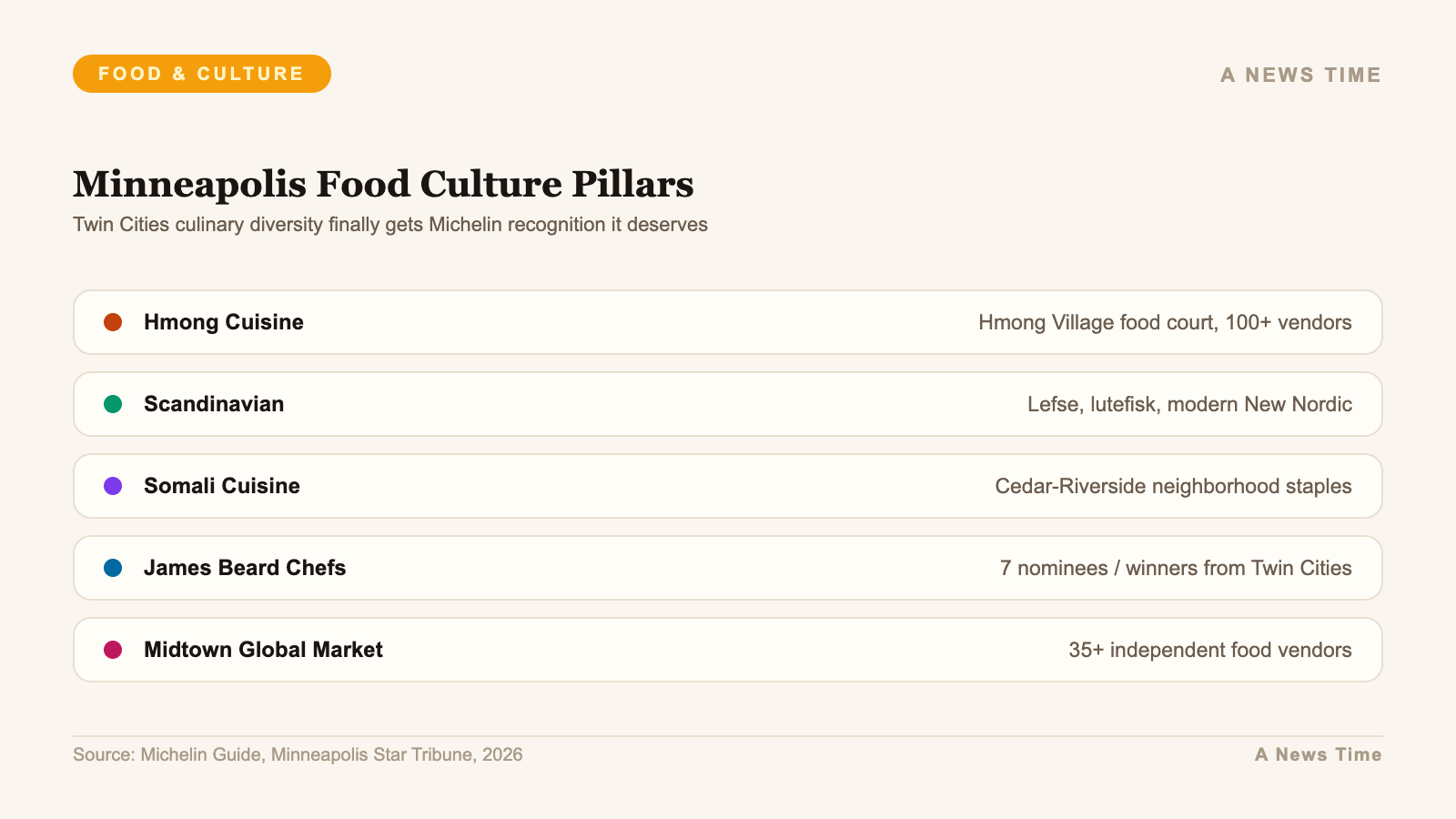
The Twin Cities food scene is a product of several overlapping forces that do not exist in the same combination anywhere else in the country. The first is immigration. Minneapolis has one of the largest Somali diaspora communities in the United States, a substantial Hmong population concentrated in the Frogtown neighborhood of St. Paul, a Vietnamese community that has operated restaurants along Nicollet Avenue for three decades, and an East African community that stretches from food trucks to sit-down restaurants with tablecloths and hand-written menus.
The second force is agriculture. Minnesota sits at the center of one of the world's most productive food growing regions, and the relationships between Minneapolis chefs and Minnesota farmers are some of the most developed in American cooking. Several restaurants in the city operate their own farms or maintain exclusive supply agreements with specific producers. The wild rice that appears on menus across the city is hand-harvested by Ojibwe communities who have managed the lakes of northern Minnesota for centuries. The produce at the Minneapolis Farmers Market, which runs from May through November along Lyndale Avenue North, is the foundation of the seasonal menus at half the serious restaurants in town.
The third force is the relative affordability of the market. In New York or San Francisco, a restaurant operating at the level of Owamni or Young Joni would need to charge $250 per person for a tasting menu to cover its rent and labor. In Minneapolis, the same restaurant can charge $135 and remain economically viable. That affordability allows restaurants to take creative risks that would be financially untenable in higher-cost markets. Travail, which operates as a chef collective with shared equity among eight cooks, would not survive in its current form in a major coastal city. In Robbinsdale, it has been the city's most adventurous kitchen for over a decade.
What Michelin Recognition Does to a City
The evidence from other Michelin entries is clear and consistent: the guide generates measurable tourism and reservation volume in markets that receive significant recognition. Detroit's inclusion in the Great Lakes guide in 2021 was followed by a 22 percent increase in restaurant bookings in the city's downtown dining corridor within the first year, according to data from the Detroit Metro Convention and Visitors Bureau. Cleveland, which received three one-star restaurants in its inaugural Michelin listing, saw hotel occupancy in the downtown core increase by 11 percent in the six months following the announcement.
Minneapolis operates in a tourism context where the food scene is already a significant driver. Explore Minnesota, the state's tourism agency, estimates that culinary tourism generates approximately $1.2 billion in annual spending in the Twin Cities market. The Michelin designation is expected to reach international audiences that current marketing efforts have not penetrated, particularly visitors from Japan, South Korea, France, and Germany, markets where Michelin carries enormous cultural weight and where food tourism is a primary travel motivation.
The reservation platforms are already reflecting anticipatory demand. Resy and OpenTable both report unusual booking activity at Owamni and Young Joni in the weeks following the Michelin announcement, with waitlist lengths at both restaurants tripling compared to the same period last year. Restaurants that have not yet received their designations are experiencing the Michelin announcement as a pre-emptive demand surge.
The St. Paul Effect and What Comes Next
Minneapolis and St. Paul, the Twin Cities that function as a single metropolitan area of 3.6 million people, are distinct food cultures as well as distinct political geographies. The Michelin designation is technically for Minneapolis, but several of the most compelling restaurants in the broader market are in St. Paul, and the guide's inspector coverage has included the full metro area.
Hmongtown Marketplace in St. Paul, a massive indoor market where Hmong vendors sell fresh produce, prepared foods, and pantry items from a community that has been in Minnesota since the late 1970s, has been discussed as a potential Bib Gourmand designation. The Bib Gourmand category, which honors restaurants offering exceptional quality at modest prices, was designed precisely for environments like Hmongtown: dense, culturally specific, and operating at a price point that makes Michelin stars irrelevant but quality inspection entirely appropriate.
Several St. Paul restaurants focused on East African cuisine, particularly the Somali community's concentration of cafes and restaurants around Cedar-Riverside, are also on observer radar. These are not restaurants built for external recognition. They are restaurants built to feed a community. Whether the Michelin framework can accommodate them without distorting what makes them meaningful is one of the guide's own ongoing tensions.
The Local Response: Pride, Anxiety, and Gentle Skepticism
Not everyone in Minneapolis's food community responded to the Michelin announcement with unqualified enthusiasm. Several chefs expressed concern, privately and occasionally publicly, about the consequences of the attention that follows a guide designation. Reservations at starred restaurants become harder for local regulars to secure. Menu prices trend upward. The pressure to maintain a star creates a conservatism that can suppress the experimentation that built the scene in the first place.
These concerns are not abstract. They are drawn from the experience of cities like Nashville and New Orleans, whose star designations in recent years were followed by a rapid increase in out-of-town reservation blocks and a concurrent complaint from longtime local diners that the restaurants they built relationships with had become destinations for people passing through rather than community institutions.
The chefs who built Minneapolis's dining scene over the past fifteen years are largely people who chose the city deliberately, for its affordability, its community density, its agricultural richness, and its willingness to support unusual ideas. They built restaurants in a city that, until this week, most food tourists were not booking flights to visit. Whether Michelin recognition changes the character of what they built, or simply amplifies it to a wider audience without distorting it, is a question that will take two or three years to answer.
For now, the announcement is a moment of recognition, and recognition, even when complicated by what follows it, matters. Sean Sherman's kitchen, built on Indigenous ingredients that most Americans have never tasted, deserves to be known by more people. Ann Kim's wood-roasted scallion pancakes deserve to be traveled for. Minneapolis's food scene, which has been doing extraordinary work in a quiet room, is about to have a much larger audience.