The kitchen that changed the way the world thinks about fine dining is now selling $150 bottles of aged balsamic vinegar on a quiet street in Los Angeles. The man who built it, Rene Redzepi, is no longer standing at the pass. He is, for the first time in his adult life, stepping back from the restaurant that made his name synonymous with a specific kind of culinary ambition, and the shape of what he is building in its place says something important about where the cooking world goes after the age of the great chef-patron.
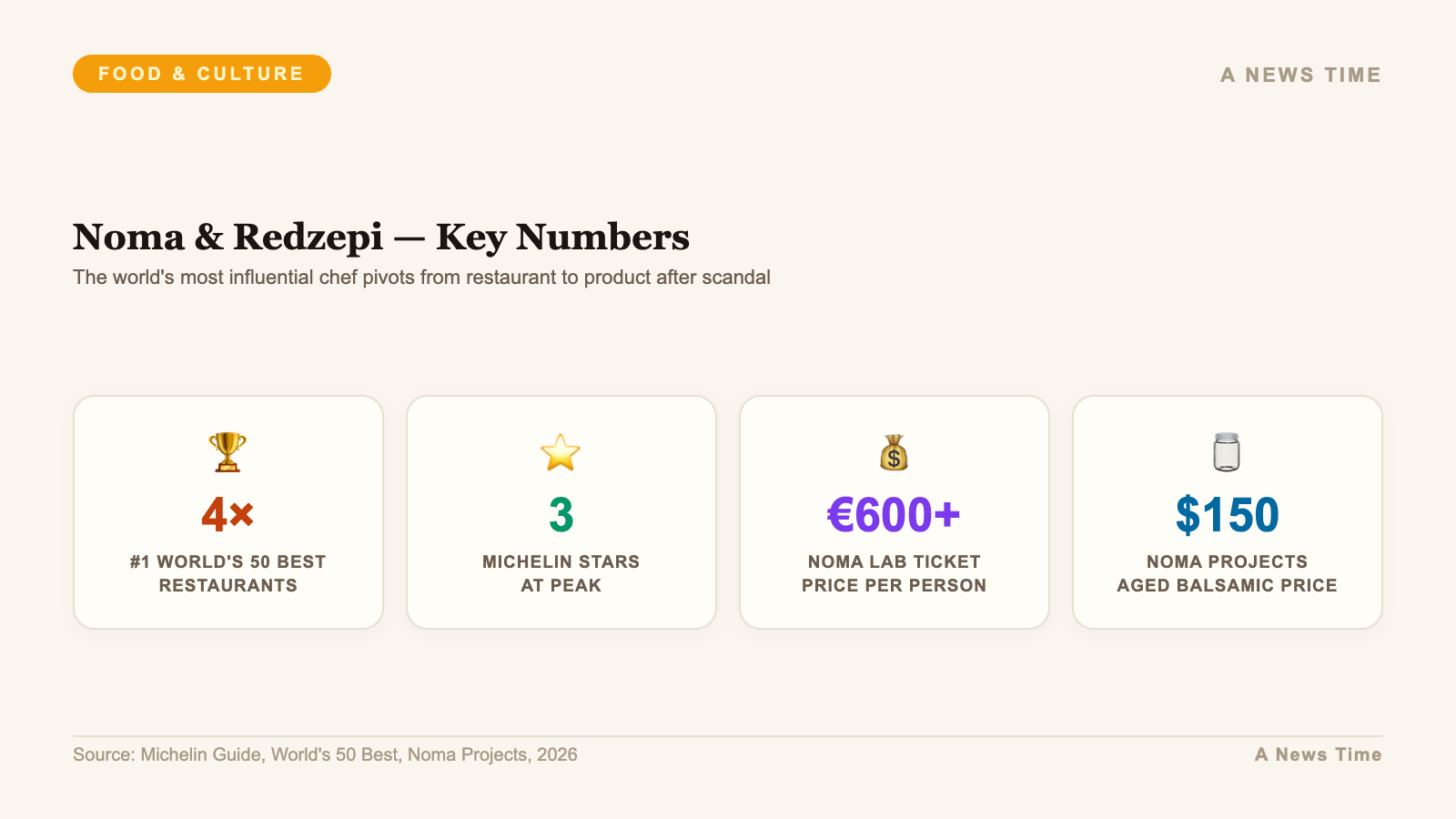
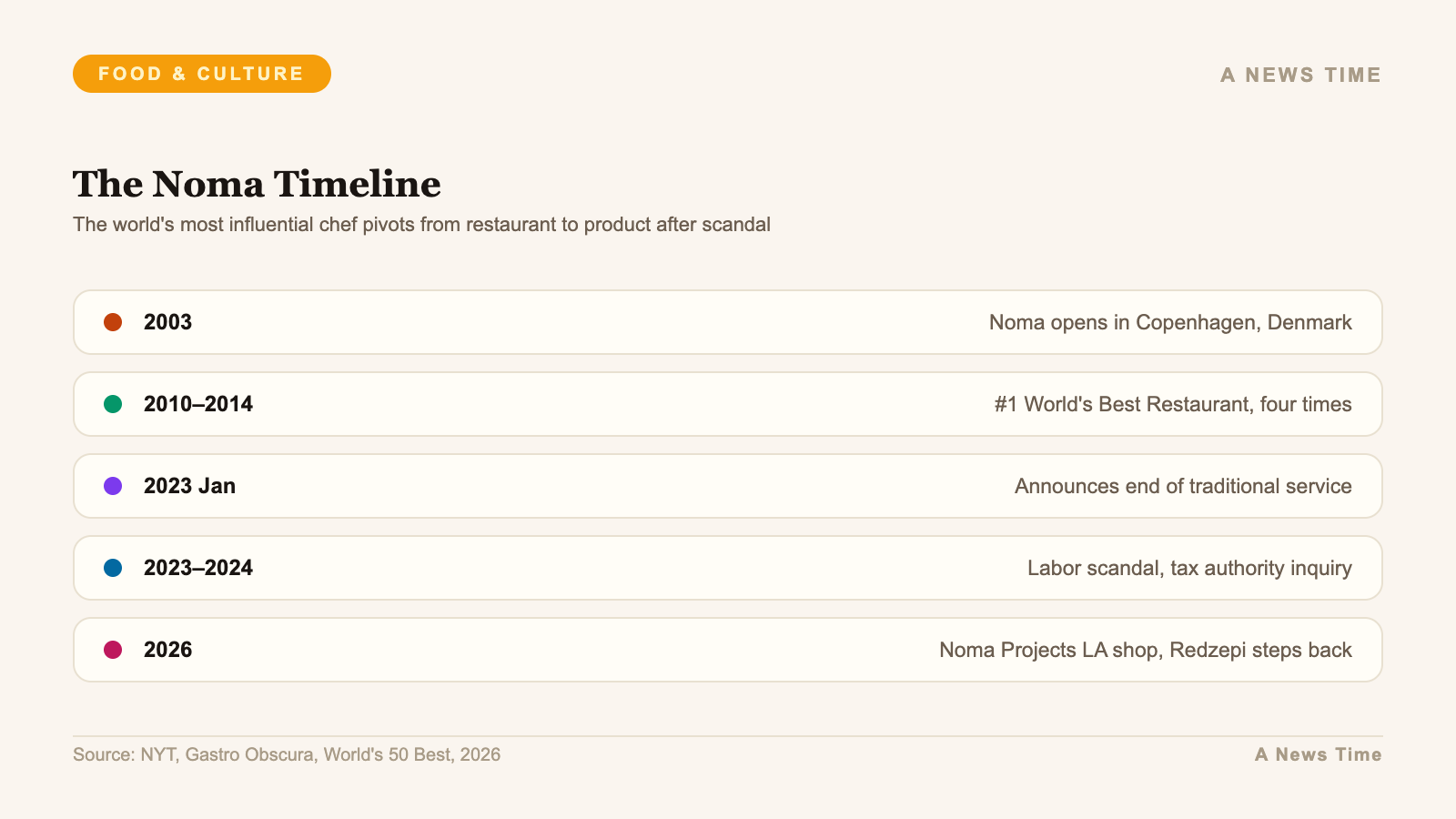
Noma, the Copenhagen restaurant that held the No. 1 spot on the World's 50 Best Restaurants list four times and received three Michelin stars, announced in January 2023 that it would permanently close its traditional restaurant format by the end of 2024. What followed that announcement was a period of institutional reckoning that reshaped the conversation around Noma from one about food to one about labor, power, and the cost of perfection.
The Year the Conversation Changed
The complaints did not arrive in a single wave. They accumulated, over months, from former stagiaires and employees who described a culture of extreme pressure, unpaid labor, and a hierarchy that treated junior kitchen workers as expendable resources in the service of an artistic vision that belonged to someone else. The New York Times investigation into Noma's intern culture, published in 2023, became the publication's most-read food story in five years. It described young cooks working 60-hour weeks without pay as part of internship programs that Redzepi himself publicly characterized as formative.
Redzepi's response, at first, was defensive. He argued that the intern program was educational and that the experience of working in a kitchen like Noma was compensation in itself. That argument found little traction in a moment when the broader hospitality industry was already grappling with the mismatch between the idealism it sold to young workers and the conditions it actually offered them. By mid-2023, the tone of his public statements had shifted toward acknowledgment. He said the culture had been wrong. He said he took responsibility.
The labor complaints were not the only pressure. Denmark's tax authority opened an inquiry into Noma's employment practices for foreign interns, who in many cases had not been classified as workers under Danish employment law. The restaurant settled the inquiry in late 2024 without disclosing the terms. Several former staff members received compensation packages whose amounts were also not disclosed.
Through all of this, the food itself never stopped being extraordinary. The final traditional service season at Noma, running through the summer of 2024, was reviewed by critics as the best cooking of Redzepi's career. The dish descriptions from the last menus, fermented chicken skin served with a cream made from the rendered fat of aged Wagyu, a savory ice made from the mineral-dense water of a specific Norwegian fjord, represented a kind of controlled mastery that comes only from years of obsessive focus. The restaurant was at its best artistically precisely as the institution around it was fracturing.
What Noma Became After the Restaurant Closed
The format that replaced traditional restaurant service was called Noma Lab. Operating in the original Copenhagen space with a reduced team, it hosts periodic pop-up experiences for small groups at ticket prices starting at 600 euros per person. These are not dinner services in the conventional sense. They are more like food performances, structured around a single theme, fermentation in one session, the concept of "ugly" produce in another, and attended by an audience of food professionals, journalists, and wealthy enthusiasts who have been on waiting lists for more than a year.
Noma Lab is financially viable, apparently. The reduced headcount, the premium ticket pricing, and the absence of a full restaurant operation have together produced a business model that does not require the 100-cover machine that the original Noma ran at full speed. Whether it is creatively sustainable is a different question. Several of the senior staff members who built Noma's technical foundations have departed: Rene's former head of fermentation research, Lars Williams, is running his own Copenhagen project; the pastry director who defined Noma's dessert language for six years has joined a hotel group in Lisbon.
The people who remain are largely younger, less experienced, and more malleable. That is either an opportunity or a limitation, depending on what Noma's next creative chapter requires.
Noma Projects and the Quiet LA Shop
The Los Angeles venture is called Noma Projects. It has a minimal web presence, a two-paragraph Instagram bio, and no press releases. Word of it reached the food media through a combination of social media sightings and a single mention in a Danish business publication in March. Redzepi has not publicly announced it. The approach is either a soft launch or a deliberate cultivation of scarcity.
The product line is small. A 25-year aged balsamic from a small producer in Modena that Noma has been working with for a decade, available in 100ml bottles for $150 each. A rose hip vinegar, fermented in the Noma facilities and shipped in ceramic bottles, priced at $85. A dried seaweed blend sourced from a family fishery in the Faroe Islands, $45 for 50 grams. A preserved lemon paste that Noma's fermentation team developed during the restaurant's Mexican seasons, $38 for a 200g jar. There are plans to add a live cultured butter and a fresh cheese later in the year.
The Los Angeles location, a 400 square foot retail space in Silver Lake, was chosen for reasons that Noma's team has not explained publicly. The neighborhood's combination of food-culture sophistication, affluent creative professionals, and openness to imported artisan goods makes it a reasonable bet. The city also has no existing Noma-adjacent retail presence; in New York or London, the space would compete against a dozen similar high-concept food shops. In Silver Lake, it is unusual.
Whether the shop constitutes a genuine retail business or a brand maintenance exercise is unclear. The price points, $150 for 100ml of vinegar works out to $45 per ounce, suggest that the volume economics are not the point. The Noma name still commands attention in the food world, even amid the reputational difficulty of the past two years, and the products allow it to maintain a presence without the operational burden of a restaurant.
The Divided Reaction in the Industry
Food professionals have responded to Redzepi's pivot with a range of views that map roughly onto how they positioned themselves during the labor controversy. Critics who wrote the most sharply critical pieces about Noma's intern culture tend to see the LA shop as an attempt to rehabilitate an image without substantively addressing the conditions that generated the criticism. If the labor complaints were about the exploitation of young, idealistic cooks in service of a luxury product, then launching a luxury product in Los Angeles is not exactly a departure from the underlying logic.
Supporters of Redzepi's work, and they remain numerous in the culinary world despite the controversy, tend to frame the pivot differently. They point out that the restaurant format itself was the source of most of the structural problems: the pressure to produce extraordinary food nightly at scale, the need to employ hundreds of workers in a facility running at 70 percent occupancy, the impossible economics of multi-hour Nordic tasting menus. If Noma is moving toward smaller, slower, more product-driven work, that might actually improve the conditions for the people who work there.
The reality is probably somewhere between these poles. Redzepi has not issued a reform manifesto. He has not announced new labor standards for Noma Projects employees. He has opened a small shop in Silver Lake and listed some products on a minimal website. The ideological interpretation is, for now, projection.
What the $150 Balsamic Vinegar Actually Tastes Like
A small number of food writers who received early access to the Noma Projects product line have written tasting notes. The balsamic, a 25-year aged Aceto Balsamico Tradizionale from a single-estate producer in Modena's Castelvetro hills, is described consistently as one of the finest examples of the style available in retail anywhere in the world. The producer, a family that has been making traditional balsamic since the 1880s, limits annual production to around 200 bottles.
Tasting notes describe the color as nearly black, the consistency as somewhere between honey and motor oil, and the flavor as extraordinarily complex: initial sweetness giving way to a deep acidity that lingers, threaded through with notes of fig, dried cherry, dark chocolate, and a mineral finish that food writer Laura Sherwood described as "tasting like the inside of an old stone cellar on a cool day." At $150 for 100ml, it is an indulgence without practical justification. It is also, apparently, exceptional.
The rose hip vinegar is made from foraged Scandinavian rose hips and lactic acid fermentation developed in Noma's research kitchen. It is bright and complex in the way that Noma's fermentation work has always been, with a floral top note that settles into an earthy sourness. The preserved lemon paste is intensely aromatic, made from Meyer lemons that were fermented for 18 months before being puréed with salt and fresh citrus zest.
What Comes Next for the Man and the Brand
Redzepi has said, in the few interviews he has given over the past year, that he wants to spend more time with his family and less time in kitchen service. He has three children with his wife Nadine, who was a co-owner of Noma and played a central role in its business management. He has spoken about wanting to cook at home, to travel without the obligation of it being research, and to read about food history rather than produce it at industrial volume every day.
Whether this quieter mode is a genuine life change or a strategic pause is impossible to know from the outside. Chefs who achieve what Redzepi achieved at Noma very rarely step away entirely. Thomas Keller has not cooked a full service at The French Laundry in years but remains the operative intelligence behind a hospitality empire. Ferran Adria closed El Bulli and spent a decade on ElBulli Foundation before returning to open Enigma in a new form. The pattern in the industry suggests that the energy either finds a new vessel or goes dormant for a period and then resurfaces.
The Noma Projects shop in Silver Lake is, in that context, a vessel. It is small and quiet and sells products that require no performance. But it keeps the name alive in the minds of the people who care about where food at this level is going. And in the food world, that kind of presence is worth more than any number of press releases.