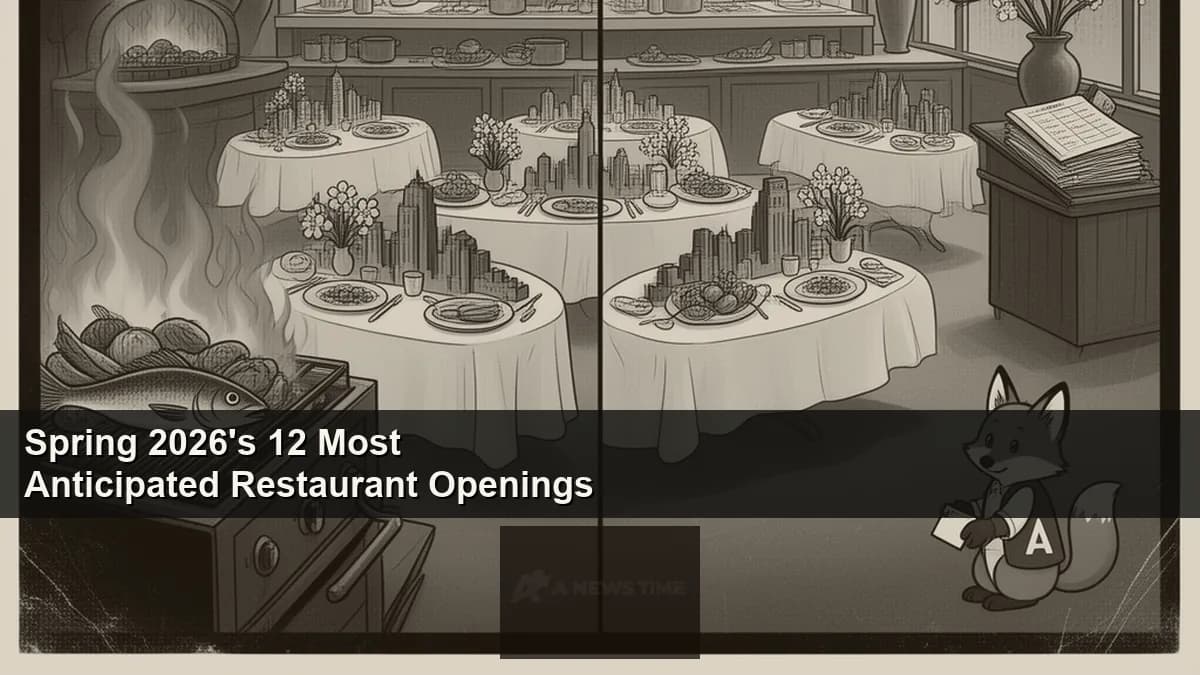
Food & Wine published its definitive guide to spring 2026 restaurant openings on , and the lineup covers 12 restaurants from writers Amelia Schwartz and the magazine's dining editors. What makes this particular cohort remarkable is its source: every chef on the list is a former Food & Wine Best New Chef, a designation that has historically been one of the more accurate early indicators of sustained culinary excellence in American dining. The spring slate ranges from a wood-fired modern French brasserie in Hudson Yards to a seasonal seafood destination on the Maine coast. The common thread, across wildly different cuisines and price points, is the caliber of the kitchen leadership.
Spring 2026 is a notably active moment for restaurant openings after a period of contraction in 2024-2025 when rising labor costs, equipment supply chain issues, and continued post-pandemic financial pressure slowed the pace of new restaurant launches significantly. The openings arriving this season reflect projects that survived that contraction, which has served as a filter: the restaurants reaching their debut in spring 2026 are generally the ones with stronger capital structures and more experienced operational teams than some of the more speculative projects that folded before opening.
The Northeast: New York and Boston Lead the Brasserie Wave
New York City is contributing three openings to the spring roster, each representing a meaningfully different proposition for diners.
Saverne (Hudson Yards) opened on from Gabriel Kreuther, the 2003 Food & Wine Best New Chef whose Michelin-starred namesake restaurant has been one of midtown's most respected fine dining destinations for years. Saverne is explicitly positioned as a casual counterpoint to that formal work: a wood-fired modern French brasserie with the kind of all-day menu and relaxed service standard that Kreuther has not previously offered under his name. For diners who love what he does but find his flagship intimidating or financially inaccessible on a regular basis, Saverne represents a meaningful new option.
Bar Rocco (Rockefeller Center) opened from Rocco DiSpirito, the 1999 Best New Chef whose career arc from fine dining to celebrity-driven comfort food and back has been one of the more unusual in American gastronomy. Bar Rocco's Italian American brasserie concept centers on the "Double Nonna Hero" sandwich, which has already generated social media attention, and takes advantage of the Rockefeller Center location's ability to capture tourist and office worker traffic in addition to destination diners. The menu is deliberately accessible in ways that DiSpirito's earlier fine dining work was not.
Dean's (TBC location), from Jess Shadbolt (2018 Best New Chef) and targeting opening, promises a British-inspired pub format at a moment when British pub cooking has been experiencing a critical reassessment in American dining. Shadbolt's menu, which leans into hot buttered crumpets, Stargazy pie, and English wines, is betting that American diners who have been primed for serious British food by the wave of English chef immigration of the past decade are ready to embrace pub food done rigorously rather than ironically.
Boston contributes two openings with distinctly different orientations. Willie's in Beacon Hill opened from Jamie Bissonnette (2011 People's Best New Chef), offering pizza, pasta, and Spanish accent dishes in a neighborhood setting that feels designed for regulars rather than destination traffic. La Tavernetta on the East Boston waterfront from Douglass Williams (2020 Best New Chef) arrives this spring with a "coastal tavern with an Italian kiss" concept that positions it as the most ambitious waterfront dining proposition the neighborhood has seen.
The West Coast: San Francisco, Portland, and the Wine Country
Joujou opened in San Francisco on from David Barzelay (2016 Best New Chef), and it has already generated the kind of sustained critical attention that suggests it will be one of the definitive restaurants of the year on the West Coast. The concept is seafood-focused French cooking with New Orleans and French West Indies accents, housed in what F&W describes as a "glamorous glass-enclosed patio" setting that uses the San Francisco climate to create an indoor-outdoor dining experience. The cultural mashup in Joujou's food is genuinely unusual in San Francisco's current dining landscape, and Barzelay's technical background makes the combination feel earned rather than eclectic.
Ladyfish arrives on the Maine coast near Portland from Jordan Rubin (2025 Best New Chef), targeting a opening with a seasonal format that will run May through October. The seasonal structure is unusual for a project of this ambition level: Rubin's menu combines lobster rolls with Cantonese-style dishes in a way that reflects his background cooking at Kimika and Chino Grande. Christine Lau, who previously worked at both those restaurants, is running the kitchen alongside Rubin. The Maine coastal setting and the seafood-forward menu position Ladyfish as the kind of destination opening that drives summer travel decisions in the way that a handful of restaurant openings do each year.
Edna in San Luis Obispo's Edna Valley wine country from Jeremy Fox (2008 Best New Chef) is the most extended project on the list, opening first as a market and tasting room before adding a distillery and farm-to-table restaurant in later phases. Fox's previous work at Rustic Canyon in Los Angeles established him as one of the more creative vegetable-forward cooks in American fine dining, and the Edna Valley setting, with its wine country agricultural infrastructure, gives him a sourcing environment that complements that approach naturally.
Cleveland's Rosy and the Midwest Renaissance
Rosy, which opened in Cleveland on , is the earliest opening on the spring list and has already established itself as the most discussed restaurant debut of the quarter. Chef Vinnie Cimino (2025 F&W Best New Chef) describes the concept as "ancestral European," built around a live-fire grill and ingredients sourced from within 200 miles of the restaurant. That geographic constraint, combined with Cimino's technical background and the culinary ambition the concept signals, makes Rosy a restaurant that would generate national attention in any market. In Cleveland, it is functioning as a demonstration of what the city's dining scene is capable of.
| Restaurant | City | Chef (Award Year) | Opening | Concept |
|---|---|---|---|---|
| Rosy | Cleveland | Vinnie Cimino (2025) | Feb 26 | Ancestral European, live-fire |
| Saverne | NYC, Hudson Yards | Gabriel Kreuther (2003) | Mar 2 | Modern French brasserie, wood-fired |
| Joujou | San Francisco | David Barzelay (2016) | Mar 6 | Seafood-focused French, New Orleans accents |
| Bar Rocco | NYC, Rockefeller | Rocco DiSpirito (1999) | Mar 11 | Italian American brasserie |
| Willie's | Boston, Beacon Hill | Jamie Bissonnette (2011) | Mar 16 | Pizza, pasta, Spanish accents |
| Dean's | NYC | Jess Shadbolt (2018) | Mar 31 target | British-inspired pub |
| 1111 | Houston | Emmanuel Chavez (2023) | Mid-April target | Mexican fine dining |
| Sally's Stay Awhile | Nashville | Josh Habiger (2012) | Late April target | Classic American all-day |
| Ladyfish | Portland, Maine | Jordan Rubin (2025) | May 1 target | Seafood, lobster rolls, Cantonese |
| Edna | San Luis Obispo | Jeremy Fox (2008) | Spring target | Wine country farm-to-table |
| Brasserie Boulud | NYC | Daniel Boulud (1988) | Spring target | All-day French brasserie, 10,000 sq ft |
| La Tavernetta | Boston, East Boston | Douglass Williams (2020) | Spring target | Coastal Italian, waterfront |
Cleveland's dining scene has been building national credibility for several years through a combination of lower commercial real estate costs that attract ambitious chefs who cannot afford New York or San Francisco buildouts, and a food culture that is genuinely supportive of ambitious independent restaurants. Rosy's early reception has validated that combination in the most public way possible. Reservations for April and May dates filled within hours of the review coverage appearing in national outlets.
Houston and Nashville: The South's Spring Contribution
1111 in Houston from Emmanuel Chavez (2023 Best New Chef) of Tatemó targets mid-April for its opening and represents a significant development in Houston's already strong Mexican fine dining scene. Chavez's work at Tatemó established him as one of the most technically sophisticated cooks working in regional Mexican cuisine in the United States. The 1111 menu, centered on herb guacamole and pescado a la talla, suggests a continuation of that technical approach in a new setting rather than a departure from it.
Houston's dining scene has become one of the most diverse and technically accomplished in the United States, driven by the city's demographics and by a food culture that genuinely rewards ambition across a wide range of cuisines. A Mexican fine dining destination from a chef of Chavez's caliber would be significant in any American city. In Houston, it arrives as part of an ongoing conversation about what contemporary Mexican fine dining can be when executed without the compromises that non-Mexican markets sometimes force.
Sally's Stay Awhile in Nashville from Josh Habiger (2012 Best New Chef) targets late April for its opening. The all-day format, covering breakfast, lunch, and dinner with classic American dishes, positions Sally's as a neighborhood institution rather than a destination restaurant in the conventional sense. Habiger's track record suggests the execution will be precise enough to convert that neighborhood positioning into destination status anyway. Nashville's restaurant scene has grown significantly in the past five years as the city's population has expanded and its dining culture has matured beyond its barbecue and honky-tonk reputation.
The Boulud Consolidation: A New Kind of New York Opening
The most logistically significant opening on the list is not a new restaurant in the conventional sense. Brasserie Boulud, Daniel Boulud's spring project in New York, replaces three existing Boulud operations, Bar Boulud, Boulud Sud, and Épicerie Boulud, with a single 10,000-square-foot all-day brasserie spread across two floors. The consolidation reflects the economic reality of operating multiple distinct restaurant concepts within proximity of each other in New York City's post-pandemic commercial environment.
The 1988 Best New Chef award means Boulud's recognition predates the formal category structure that the award now operates within, and his career arc, from the four-star heights of Restaurant Daniel to the ambitious but accessible proposition of Brasserie Boulud, illustrates how the dining landscape has changed around him. The brasserie format, a central theme of spring 2026's opening calendar alongside live-fire cooking and coastal seafood, is where fine dining ambition and democratic access find a productive middle ground. Boulud building a large-format brasserie at this moment in his career is both commercially sensible and philosophically coherent.
For context on how New York's dining scene is positioned more broadly this spring, our earlier coverage of the hottest new Los Angeles restaurants of April 2026 and London's spring restaurant openings provides useful comparison for understanding where New York's spring roster sits in a global dining context. The Michelin Guide's increasing geographic range is also relevant backdrop: our earlier report on the Michelin Guide's Great Lakes expansion illustrates how national dining geography is shifting in ways that benefit cities outside the traditional coastal markets.
The Broader Context: What Spring 2026 Means for American Dining
The concentration of Best New Chef alumni opening restaurants simultaneously is not coincidental. The designation, which Food & Wine has awarded annually since 1988, creates a cohort identity that connects chefs across career stages. Older award recipients who open new projects do so with awareness of who else is opening alongside them, and the shared credential functions as a loosely organized professional network. The spring 2026 cohort's geographic range, from Cleveland to Houston to San Luis Obispo, suggests the network's appetite for expansion beyond gateway cities has reached a new level of confidence.
The live-fire cooking trend visible in multiple spring openings (Rosy, Saverne's wood-fired element, 1111's grilling approach) reflects where fine dining's technical vocabulary is pointing. After years of sous vide precision and molecular gastronomy influence, there has been a consistent movement back toward flame and smoke as primary cooking media. The techniques are not simpler than what they replaced. They are differently complex, requiring different skills and creating different results. But they carry a connotation of directness and craft that resonates with diners who became skeptical of heavily manipulated fine dining plates during the experimental period.
The brasserie format's prominence, Saverne, Brasserie Boulud, and La Tavernetta each fitting the category in different ways, suggests that the dining culture is also in a phase of valuing conviviality and flexibility over formal occasion. Brasseries work because they accommodate multiple dining contexts simultaneously: the power lunch, the anniversary dinner, the Tuesday after-work meal. They are not compromise positions between fine dining and casual. They are a distinct category with its own logic, and the chefs building brasseries in spring 2026 are treating them that way.
How to Actually Get In
Reservations for the highest-demand openings on this list, Rosy in Cleveland, Joujou in San Francisco, and Saverne in New York, have been difficult to obtain since the first major reviews appeared. All three are using Resy as their primary reservation platform, and release patterns for new slots have been unpredictable enough that checking the platforms directly during morning hours, when new slots are most often added, is more reliable than working through concierge services.
Ladyfish, Edna, and the still-to-open spring targets have not yet experienced the same reservation pressure, and booking within the first week of their announced opening dates should be manageable for most diners. The late-April Nashville opening of Sally's Stay Awhile, oriented as an all-day neighborhood restaurant, should be the most accessible of the high-profile debuts from a pure reservation standpoint.
The wave of spring openings will slow through the summer as kitchen teams settle into their rhythms and the initial review coverage fades. The fall 2026 opening calendar is already beginning to take shape, with several significant projects targeting October and November launches. If spring 2026 is the live-fire and brasserie season, fall may become the urban Asian fine dining moment, based on the project rumors that have been circulating in industry channels since late 2025.