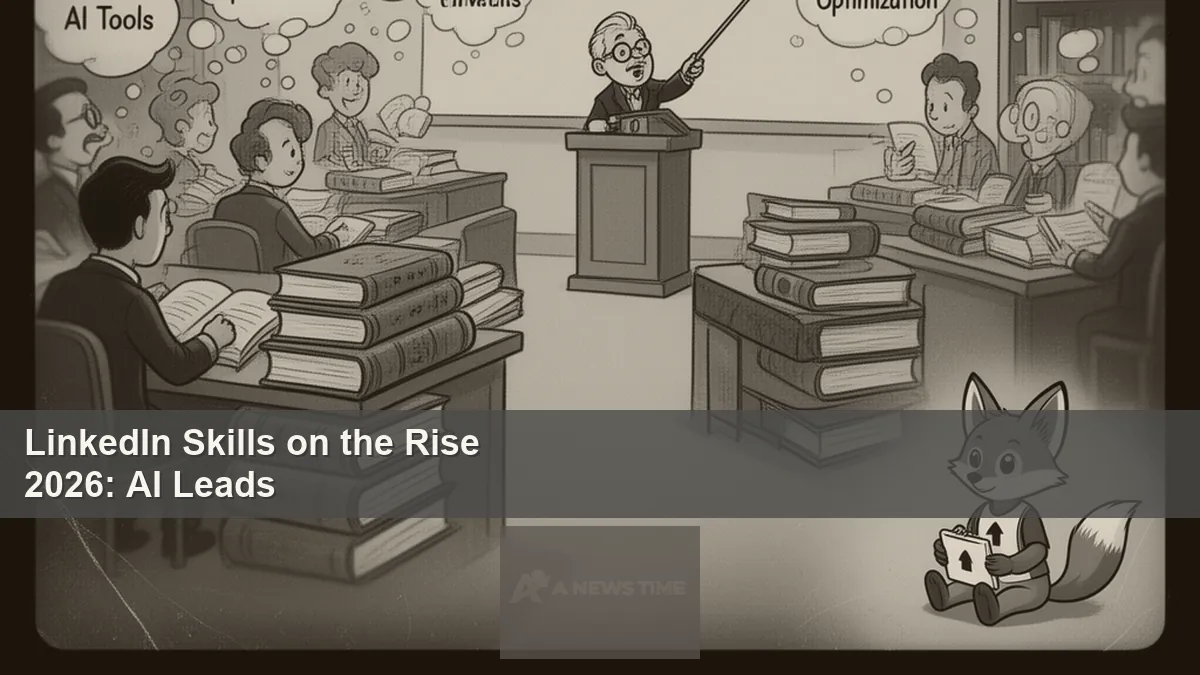
LinkedIn published its Skills on the Rise 2026 report on , and the data behind it represents something more methodologically serious than the typical annual skills rankings that circulate across HR and workforce circles. The LinkedIn methodology, explained in detail in the report's technical appendix, measures two distinct signals simultaneously: year-over-year growth in how quickly LinkedIn members are acquiring specific skills as shown in their profiles, and the degree to which those same skills are contributing to hiring success, defined as members with those skills being hired into new roles at elevated rates compared to members without them. Skills that score high on only one dimension are excluded from the top rankings. Skills that are growing in acquisition without improving hiring outcomes are not yet validated by the labor market. Skills that improve hiring outcomes without growing in acquisition are underutilized opportunities for workers who have not yet found them. The skills that appear in LinkedIn's top clusters are those that pass both tests simultaneously, making the list a more reliable guide to where the market is actually moving than surveys of employer intent or self-reported skill importance.
The 2026 findings, covering growth from through compared against the prior-year period, identified eight distinct skill clusters at the top of the growth curve. The first and most dominant of those clusters is AI development tools, which encompasses a specific constellation of technical capabilities that, taken together, describe the emerging role of the AI practitioner: someone who can build, configure, and deploy AI-powered systems in real working environments rather than just use them as end tools.
AI Development Tools: The Fastest-Growing Cluster
The AI development tools cluster includes six specific skill areas that LinkedIn tracked as its fastest-growing professional competencies: prompt engineering, LangChain, RAG, OpenAI API integration, vector databases, and XGBoost. The technical coherence of this cluster is not accidental. These six skills constitute the practical toolkit of someone who builds AI-powered applications: the ability to communicate effectively with large language models through prompt design, the ability to connect those models to external data sources and workflows through frameworks like LangChain, the ability to make AI systems retrieve and reason over specific knowledge bases through RAG architectures, the ability to call AI capabilities programmatically through the OpenAI API, the ability to store and search the vector representations that AI systems use to work with unstructured data, and the ability to build and optimize gradient-boosted machine learning models for structured prediction tasks.
The fact that prompt engineering leads this cluster reflects something specific about the 2026 labor market that is frequently misunderstood in popular coverage of AI skills. Prompt engineering is not a beginner skill that non-technical workers can learn in an afternoon to put on a resume. It is an emerging discipline that, at a professional level, requires understanding how large language models generate outputs, how context and instruction structure affect those outputs, how to design prompts that produce reliable results across a distribution of inputs rather than just impressive results on a single example, and how to evaluate and improve prompts systematically. The practitioners who are commanding hiring premiums for prompt engineering are doing something technically substantive, and the LinkedIn data reflects that the gap between practitioners at that level and workers who have done a YouTube tutorial remains wide and consequential.
"What we are seeing in the data is that AI skills are splitting into two distinct labor market categories. There are AI-adjacent skills, the ability to use AI tools effectively in a domain-specific context, and there are AI-foundational skills, the ability to build, configure, and extend AI systems. Both are growing. But the foundational category is growing faster and commanding higher premiums, because the supply of people who can actually build things with AI is much smaller than the demand."
Yao Huang, Senior Economic Research Analyst, LinkedIn, February 2026
XGBoost's presence in the top cluster alongside large language model skills is a useful reminder that the AI skills economy is not exclusively an LLM economy. Gradient boosting methods, including XGBoost and its variants, remain among the most effective approaches for structured tabular data prediction problems, the kind of data that most businesses actually work with most of the time. The practical machine learning practitioner who can apply the right tool to the right problem, LLMs for language tasks, gradient boosting for structured prediction, computer vision for image tasks, and so on, is more valuable than the practitioner who has specialized in only one approach, and the LinkedIn data reflects that breadth matters in this market.
The Process Layer: Operations and AI Governance Rising Together
The second and third fastest-growing clusters in the LinkedIn data reveal a pattern that is less intuitive but arguably more significant for understanding where the 2026 labor market is actually heading. Operations and process optimization ranked second, and AI strategy and governance ranked third. These clusters are rising together, and the connection between them is direct: organizations that are deploying AI at scale are discovering that the technical capability to build AI systems is less scarce than the organizational capability to deploy them effectively, which requires both sophisticated process design and a working understanding of the governance requirements around responsible AI use.
The AI strategy and governance cluster includes two specific skills that LinkedIn tracked: AI for business and responsible AI. These are not the same as AI technical skills. AI for business covers the ability to identify where AI creates genuine value in a specific organizational context, how to evaluate AI tool options, how to build business cases for AI investments, and how to measure outcomes from AI deployment. Responsible AI covers the ability to assess AI systems for bias, fairness, transparency, and accountability, and to design deployment frameworks that manage the risks that AI systems introduce.
The Gartner and HBR data published on provides a useful complement to the LinkedIn skills data on this point. Gartner estimated that only 1 in 50 enterprise AI investments was delivering transformational value, and its analysis pointed to a common failure mode: organizations deploying AI technology without redesigning the business processes around it. Business units that had redesigned their workflows to incorporate AI effectively were twice as likely to exceed their revenue goals as comparable units that had deployed AI tools without process redesign. The LinkedIn data on operations and process optimization is reflecting this pattern in the hiring market: organizations that understand what it actually takes to get value from AI are hiring for the combination of technical and process skills, not for technical skills in isolation.
The responsible AI cluster's rise is also being driven by regulatory pressure that is moving faster than most technology company communications departments would like to acknowledge. The European AI Act's implementation timeline has created genuine compliance requirements for organizations operating in the EU market, and the ripple effects of those requirements are being felt in job descriptions and hiring criteria globally as multinationals build governance capabilities that can operate across regulatory environments.
The Human Skills That AI Is Making More Valuable
Four of the eight clusters in LinkedIn's 2026 Skills on the Rise list have nothing to do with AI at a technical level: stakeholder engagement and communication ranked fourth, leadership and people management ranked sixth, business development and go-to-market skills ranked seventh, and financial operations and reporting ranked fifth. The prominence of these clusters in a year dominated by AI skills coverage is significant, and the LinkedIn methodology helps explain why.
Stakeholder engagement and communication is rising fastest because AI is changing the nature of communication work in a specific direction. The routine production tasks of professional communication, drafting standard emails, generating first-pass documents, summarizing meeting notes, are becoming AI-assisted or AI-automated. What remains distinctively human in the communication domain is the higher-order work: building trust relationships with difficult stakeholders, managing complex negotiations where emotional intelligence matters, navigating organizational conflict, and communicating in ways that motivate rather than merely inform. The workers who are building hiring advantages through communication skills are not the ones improving at document production. They are the ones developing the relational and strategic communication capabilities that AI cannot substitute for.
The rise of leadership and people management in the LinkedIn data reflects a related dynamic. Managing people who are working with AI, which increasingly means most people in professional roles, requires understanding how to evaluate AI-augmented performance, how to set appropriate autonomy levels for human-AI collaboration, how to develop employees whose work is changing rapidly, and how to maintain team cohesion and accountability in environments where the division between human and AI contribution is often unclear. These are not skills that the previous generation of management training was designed to develop, and the gap between management training and management reality in 2026 is producing demand for leaders who have figured out the new terrain through experience.
The Gartner data cited earlier contained a finding that deserves specific attention in this context. Gartner estimated that fewer than 1 percent of actual layoffs at major employers could be directly attributed to AI productivity gains, significantly undercutting the most alarmist accounts of AI's immediate labor market impact. But the same research found an emerging phenomenon it labeled "workslop," instances of poor-quality AI-generated work that required human review and correction, averaging approximately two hours of additional work per instance to identify and remediate. The organizations experiencing the most workslop were those where workers were using AI extensively without adequate oversight or quality frameworks. Managing the workslop problem is turning out to be a management challenge as much as a technology challenge, which is part of why leadership and people management skills are rising in parallel with AI skills.
Risk, Compliance, and the Credential Economy
The eighth cluster in LinkedIn's top list, risk and compliance, is growing for reasons that span the AI governance story and a broader regulatory tightening across multiple industries simultaneously. Financial services compliance, healthcare data privacy, cybersecurity risk management, and AI governance are all driving demand for professionals who can work at the intersection of technical systems and regulatory frameworks. The ability to read a regulation, understand its operational implications, and design processes that achieve compliance without destroying operational efficiency is a skill set that has historically been scattered across legal, IT, and operations functions. The current environment is producing demand for generalists who can hold all three domains simultaneously.
For workers looking at this cluster as a career opportunity, the LinkedIn hiring success data is useful context. Compliance and risk skills are not just growing in terms of how many professionals are acquiring them. They are producing hiring success at elevated rates, meaning that building these skills is translating into actual job offers and career advancement. The practical entry point for many workers is through domain-specific certifications: the CISSP for cybersecurity risk, relevant regulatory compliance certifications in healthcare or financial services, or the emerging AI governance credentials from bodies like the AI Governance Institute. These certifications are not sufficient on their own, but they function as credible signal of foundational knowledge that opens conversations with hiring managers.
The future Gartner flagged in its February 2026 analysis adds context that shapes how workers should think about skills investment over a multi-year horizon. By 2028, Gartner estimated that 25 percent of job candidates may be entirely synthetic, AI-generated profiles designed to game hiring systems. The pressure that prediction creates on hiring processes will likely accelerate the shift toward verified, proctored demonstration of skills, making the distinction between credentials that certify real demonstrated capability and credentials that merely attest to course completion increasingly consequential. The LinkedIn skills data already reflects this trend at the front end of hiring: skills that can be tested and verified are commanding premiums precisely because they are harder to fake.
Reading the Data as a Worker
The LinkedIn Skills on the Rise report is a retrospective instrument: it reflects what happened in hiring markets from late 2024 through late 2025. The skills at the top of the 2026 list are not necessarily the skills that will be at the top of the 2027 or 2028 list, because the labor market is moving faster than any annual report can fully capture. But the report provides something valuable beyond its specific rankings: a framework for evaluating skill investments in real time.
The dual-signal methodology, acquisition growth plus hiring success, is a framework any worker can apply informally to their own career planning. Skills that are growing in acquisition but not yet reflecting in hiring outcomes are speculative investments, bets on the direction the market is heading before employers have fully validated the importance of those skills. Skills that are showing hiring success without broad acquisition growth are windows of opportunity: the labor market is already rewarding them, but they are not yet crowded with candidates who have built them. The intersection of both signals, as LinkedIn's top clusters represent, is where the evidence for skills investment is strongest.
The harder question, which the LinkedIn data cannot answer directly, is which specific combination of skills is most valuable for a given worker in a given role. The report shows what is working at the aggregate level. Individual career strategy still requires judgment about fit with existing experience, proximity to the skills a specific employer values, and the time and resource investment required to build meaningful capability rather than superficial familiarity. The workers who will navigate the 2026 and 2027 labor markets most effectively are those who combine the market-level information in reports like LinkedIn's with honest self-assessment about where their current skills sit and what the realistic path to genuine proficiency looks like.