
Larry Fink has been building BlackRock into the world's largest asset manager for four decades. He has watched financial crises, dot-com collapses, and pandemic-era labor dislocations from one of the most consequential vantage points in global finance. When he issues a warning about the labor market, people tend to listen. On , he issued one aimed squarely at the generation about to walk across commencement stages this spring.
"I'm worried that when this year's college graduates enter the workforce, we could see the highest unemployment rate among them in years, even without a recession," Fink said at BlackRock's 2026 Infrastructure Summit. The statement landed because of what drove it. Not a financial shock. Not a pandemic. Not a policy failure. Artificial intelligence.
"The speed at which AI is changing, we're not adapting our society fast enough," the 73-year-old added. "Really post World War II, the pathway to a white-collar job was a college education, and AI is going to disrupt many of those types of jobs."
The data behind the warning
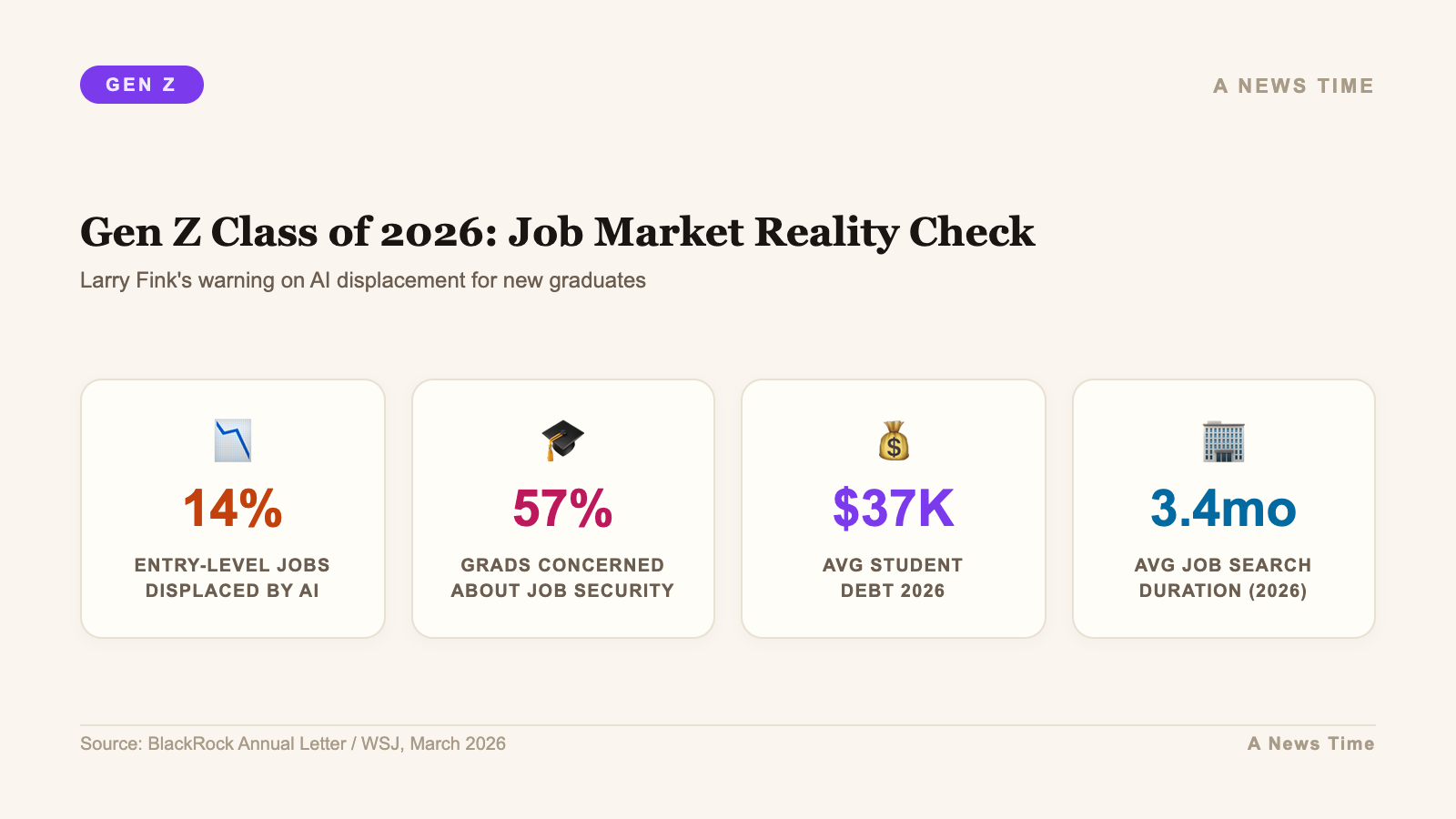
Fink's concern is not speculative. The unemployment rate among recent college graduates ages 22 to 27 currently sits at 5.6 percent, according to the Federal Reserve Bank of New York, levels not seen since 2013 outside of the pandemic. That number has been climbing even as the broader labor market remains resilient, which makes it structurally significant rather than cyclically explained.
Demand data confirms the squeeze. Job postings on Handshake, the recruiting platform used by most major universities, fell more than 16 percent between August 2024 and August 2025. At the same time, the average number of applications per role jumped 26 percent. More graduates chasing fewer openings while AI tools handle the entry-level analytical tasks those openings once required.
The pattern has a structural logic. Entry-level white-collar work, the first rung of the career ladder for generations of college graduates, has always been defined by volume tasks: summarizing documents, building spreadsheets, drafting first-pass reports, fielding routine client emails. Those are exactly the tasks that generative AI handles best. When employers can use an AI tool to do the work of a junior analyst, the incentive to hire one diminishes.
This is not a distant prediction. It is already showing up in hiring data, in the experience of the class of 2025, and now in the explicit concern of one of the most prominent CEOs in global finance.
Why Fink is not dismissing college altogether
The nuance in Fink's remarks matters. He did not say a four-year degree is worthless. He said it is no longer a universal pathway. The distinction is important, particularly given that Fink's own career was built on exactly the kind of credentialing he is now qualifying.
After graduating from UCLA in 1974 with a political science degree, Fink felt unprepared for the workforce. He went on to earn an MBA with a real estate focus, then launched a career at First Boston before spending four decades building BlackRock. His trajectory, degree to graduate credential to industry to institutional empire, is precisely the kind of pathway that worked for a specific generation. He is saying it no longer works for all graduates the same way.
"The key for life for everyone is to find their purpose," Fink said. "For some people, their purpose will remain to get a four-year or advanced degree, and they could take that forward, but that's not going to be the pathway for everybody."
The framing is notable. Fink is not echoing the anti-college populism that has become common in certain corners of American politics. He is making a more precise argument: the credential's relationship to employment is changing, and not because the credential is less valuable in an abstract sense, but because the jobs it was meant to prepare graduates for are themselves changing faster than the curriculum teaching them.
Where the jobs are actually growing
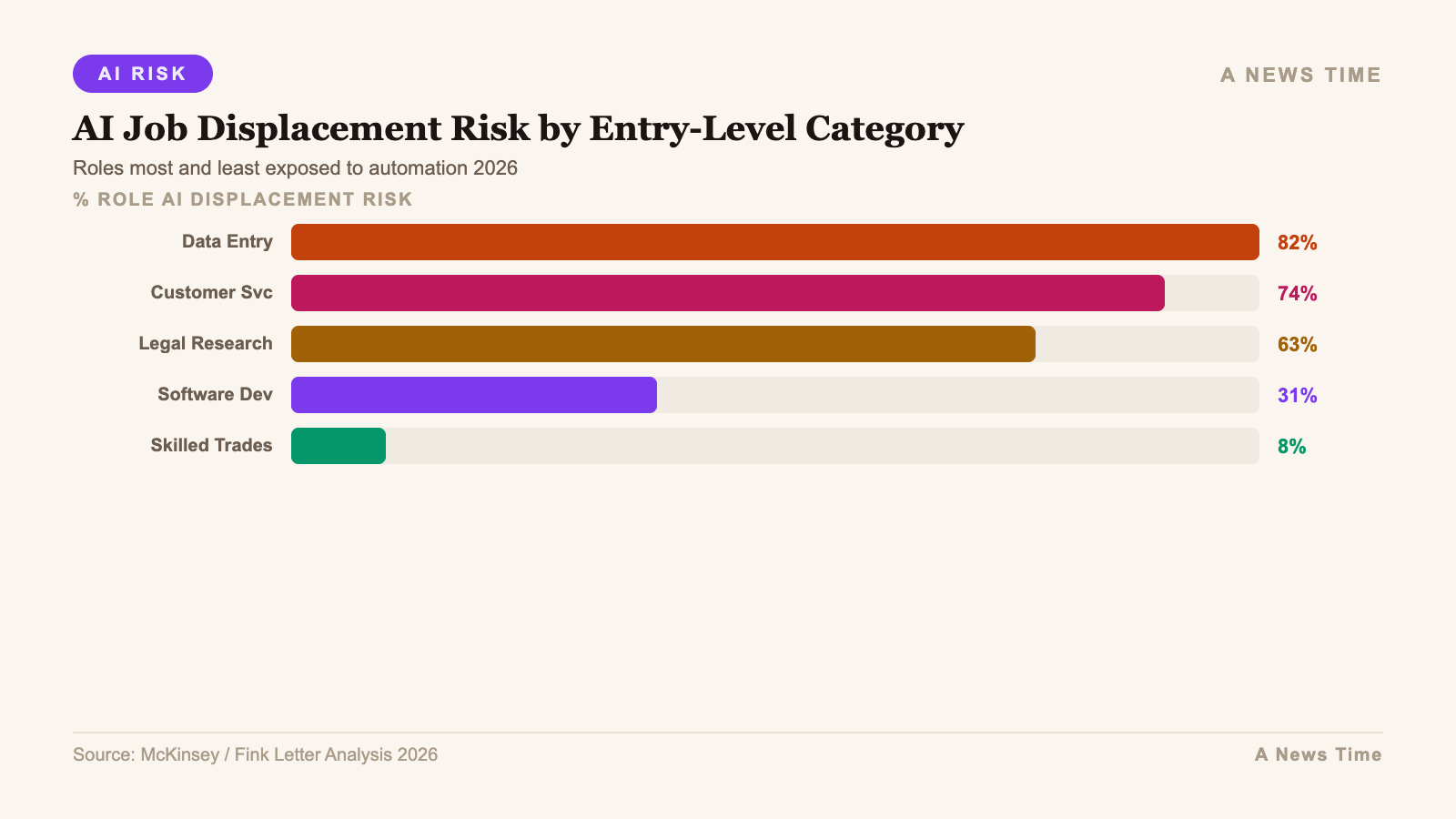
The place Fink pointed to as under-supplied is the skilled trades, and his reasoning is tied directly to the AI infrastructure buildout he has been financing. Data centers require electricians. Power grid expansion requires HVAC technicians and ironworkers. Physical infrastructure cannot be automated away in the same way analytical tasks can. The irony is that the technology driving down demand for entry-level white-collar workers is simultaneously creating demand for the workers who wire, cool, and maintain the physical systems running that technology.
"AI is going to create many jobs and we're not prepared as a society to fulfill those jobs," Fink said. "And to me, this is a crisis."
The week before his remarks, BlackRock committed $100 million to skilled-trade training programs, targeting 50,000 workers over five years in partnership with nonprofit and workforce development organizations. The targeted roles include electricians, HVAC technicians, plumbers, and ironworkers. The announcement followed BlackRock's 2025 participation in a $40 billion acquisition of Aligned Data Centers alongside Microsoft and Nvidia. That investment created direct demand for the trades the $100 million program is designed to supply.
The circular logic is not lost on Fink. He is financing the AI infrastructure that is displacing white-collar entry-level work, and simultaneously funding the training pipelines for the physical-world jobs that AI infrastructure requires. Whether that represents genuine workforce responsibility or strategic positioning, the capital commitment is real.
More than half of employers see the market as poor or fair
Fink is not alone in his concern. A survey from the National Association of Colleges and Employers found that more than half of employers view the job market for the class of 2026 as poor or fair. That is the most pessimistic reading from NACE since the start of the pandemic. The confluence of post-pandemic hiring corrections, tighter corporate budgets, and AI-enabled productivity gains has narrowed the aperture for entry-level hiring across industries from consulting to financial services to media.
Other major CEOs are threading a careful needle. AMD CEO Lisa Su, named as MIT's 2026 commencement speaker, framed the moment as one of opportunity. "The Class of 2026 will be graduating at an exciting time, as AI transforms our world and expands what is possible," she said. Bank of America CEO Brian Moynihan acknowledged graduate anxiety directly, telling CBS News: "If you ask them if they're scared, they say they are. And I understand that. But I say, harness it. It'll be your world ahead of you."
The tone from CEOs like Su and Moynihan is more optimistic than Fink's, but the substantive concern is the same. The question is not whether AI changes entry-level work, but how quickly graduates can adapt. Our earlier coverage of blue-collar employment plateauing for young workers showed a similar structural shift from the trades side: neither traditional white-collar nor traditional trade routes are as simple as they were a generation ago.
What this means for current students and recent graduates
The graduates most exposed to this disruption are those pursuing degrees with the highest overlap between their intended career path and current AI capabilities. That includes many business, communications, finance, and marketing graduates whose first jobs involve tasks that generative AI now handles with growing fluency.
The graduates least exposed are those in fields that require physical presence, licensed practice, or clinical judgment: nurses, engineers with field responsibilities, construction managers, attorneys, and teachers. The credentialing systems for those roles remain intact because the underlying work cannot be fully automated, at least not yet.
What this moment calls for is not a mass abandonment of four-year degrees, but a more honest assessment of what any given degree is actually preparing graduates to do in the first year out of school. The degrees that deliver the most direct employment return in an AI-disrupted market are the ones that pair credential with skill sets that are either too physical, too relational, or too contextually complex for current AI to replace.
Our coverage of decision education as the most sought-after undertaught skill points to one direction: the human judgment capabilities that AI cannot replicate are precisely what the labor market is now pricing at a premium. The 23 percent wage premium cited in workforce research for jobs requiring strong decision-making skills reflects exactly this dynamic.
The broader structural argument
Fink's warning is not primarily about the class of 2026. It is about the lag between how fast AI is changing the economy and how fast social institutions, particularly education, are responding. The post-World War II pathway he described, high school to college to white-collar job, was a product of a specific historical arrangement. That arrangement is not being abolished, but it is being renegotiated in real time.
What Fink is gesturing toward is a more pluralistic credentialing future: one in which the trades carry genuine economic dignity, in which alternative credentials like bootcamps and certifications carry real employer weight, and in which the four-year degree is one path rather than the dominant path. Whether higher education institutions can make that transition without a painful intervening period of graduate unemployment is the question the next several years will answer.
For the class of 2026, the answer will be personal, determined by field, institution, network, and timing in ways that no single statistic can capture. What Fink's warning offers is not a reason to panic, but a reason to look honestly at the rung they are trying to reach and whether it still holds the same weight it did for the generation before them.
What to watch through the year
Two markers worth tracking. The first is whether the Federal Reserve Bank of New York's June update on the recent graduate unemployment rate shows acceleration or stabilization. A rate continuing to climb through graduation season would confirm Fink's thesis with the most direct possible evidence. The second is whether BlackRock's $100 million skills commitment begins to generate verifiable placement data within 18 months. Workforce development pledges from large corporations have a poor record of translating into measurable outcomes. This one comes from a CEO who has publicly staked a reputational claim on the crisis it is meant to address.
The class of 2026 begins their job search in a market where the most prominent voice in global asset management has just called their timing a crisis. That is an uncomfortable truth to carry through commencement. It is also, if taken seriously, a reason to approach the first five years of a career with a level of strategic honesty that earlier generations were not required to bring.