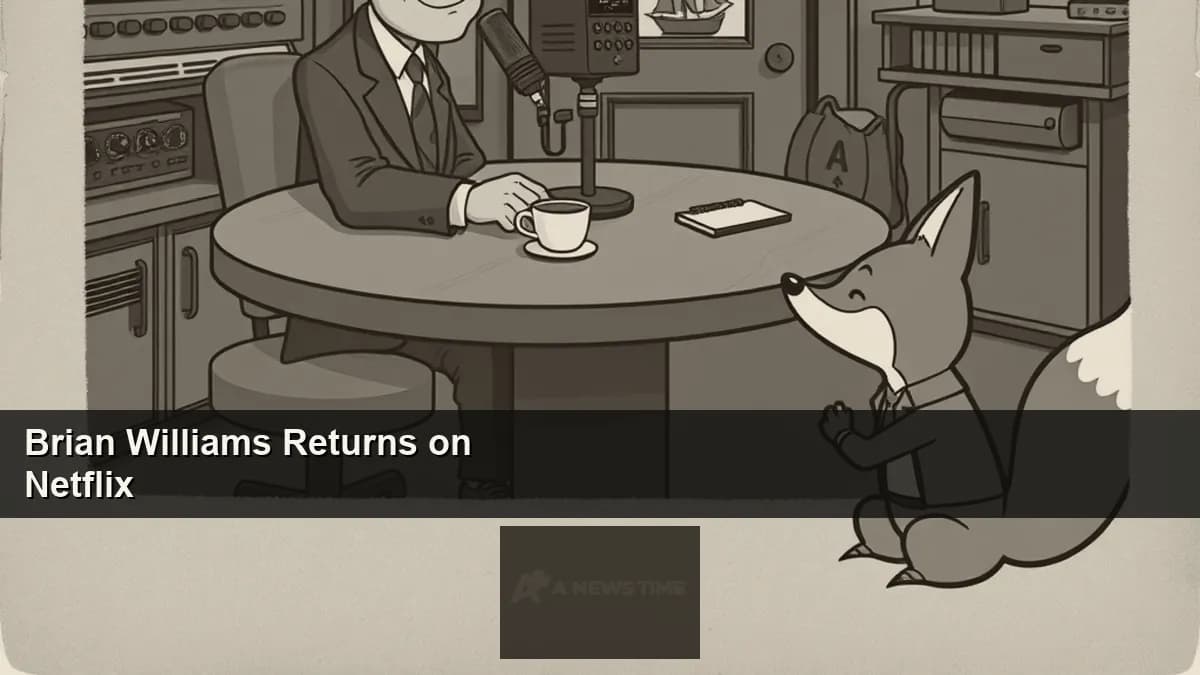
Brian Williams is returning to screens. Netflix announced that the former NBC Nightly News and MSNBC anchor will host a new original podcast titled We're Back! With Brian Williams, his first regular television work since leaving NBC in December 2021 after a 28-year run. The Netflix press materials describe the format as unscripted and long-form, with Williams in conversation with actors, writers, musicians, athletes, journalists, and what the streamer called "unexpected newsmakers."
The project is a significant get for Netflix's podcast push and a significant reset for Williams, who has been publicly quiet since his final MSNBC broadcast. Four-time Emmy winner Jonathan Wald, who worked with Williams at NBC News and oversaw Election Night Live with Brian Williams, will executive produce. Production partner At Will Media brings in founders Will Malnati and Ashley Taylor as additional executive producers. A premiere date has not been set.
Williams's Framing of the Return
Williams's statement to Netflix leaned on a specific gripe that cable news veterans share. The modern news format, in his telling, compresses interesting conversations into slivers. Long-form podcasts do the opposite, and Williams wants that space.
"With scientists predicting that every American will have a podcast by 2030, I thought it was time to get in the game. After 40 years in the news business, where an in-depth interview gets 4 minutes of airtime at best, I just want to have interesting conversations with creative, funny, smart, talented, and consequential people, like the shows we all grew up watching and listening to. Netflix is the perfect home."Brian Williams, Netflix press statement, April 17, 2026
The self-deprecating joke in the opening line is calculated. Williams has been aware since 2015 that any public statement he makes attaches back to the helicopter story and the suspension, and his comeback voice has been tested on late-night appearances before this formal return. The "every American will have a podcast by 2030" line is a tell about the tone he plans to bring: a veteran acknowledging the medium's saturation while claiming a seat at the table.
What Netflix Gets From the Deal
Netflix has been building a podcast strategy that sits somewhere between Spotify's original-heavy model and Apple's distribution-focused approach. The platform's prior podcast signings have included strong adjacencies to its scripted and unscripted content, with the goal of building audio properties that cross-promote the streaming library and vice versa.
Williams brings specific audience attributes that matter to that strategy. He carries name recognition across a demographic that skews older than Netflix's core, which is a demographic the streamer has been working to retain as subscription growth slows in maturing markets. He also brings booking power. A veteran of 28 years at NBC News has the relationships to land guests who would not show up for a younger podcaster.
The commercial logic is straightforward. A show like this does not need to be the platform's top-tier audio property to justify the investment. It needs to be a credible piece of the audio slate that gives Netflix a pitch on the streaming-plus-audio proposition for subscribers who want more than scripted programming.
| Item | Detail |
|---|---|
| Title | We're Back! With Brian Williams |
| Host | Brian Williams, 66, former NBC / MSNBC anchor |
| Platform | Netflix |
| Format | Unscripted long-form interviews |
| Guest mix | Actors, writers, musicians, athletes, journalists, newsmakers |
| Executive producers | Jonathan Wald, Will Malnati, Ashley Taylor |
| Production partner | At Will Media |
| Release date | Not yet announced |
The Path Back: A 2015 Suspension and a 2021 Exit
Williams's history with NBC is the reason the return is news at all. In 2015, NBC conducted a six-month internal investigation that found he had made several false and embellished statements about his reporting experiences. The most prominent distortion was his claim, made in various public appearances and late-night TV over the years, that a helicopter he was in during the 2003 Iraq War had been hit by a rocket-propelled grenade.
The helicopter in question was not hit. Stars and Stripes first reported the contradiction in 2015, triggering the NBC review. The network found additional embellishments across unrelated stories Williams had told over the years, and Williams was suspended before being reassigned to MSNBC as a breaking news anchor. He apologized publicly to Matt Lauer, describing the moment and saying he would be "held to a different standard" going forward.
"I am sorry. I am sorry for what happened. I am different as a result, and I expect to be held to a different standard."Brian Williams, interview with Matt Lauer, 2015
The MSNBC chapter ran until December 9, 2021, when Williams signed off The 11th Hour for the final time. He announced his departure in a memo to NBC staff, calling the network "a part of me" and leaving the door open to return to broadcasting at some future point. That return is now, and it is not at an NBC property.
How the Return Lands
The broader media story around Williams's return is the continuing migration of legacy news talent into streaming and podcast formats. The pattern is not new, but it is accelerating. The economic case for a senior anchor's skill set in 2026 is clearer on a subscription platform with one long-form show than on a cable network with seven hours of programming per week.
Netflix has been specifically aggressive about signing talent with TV news pedigree, and the Williams deal sits alongside other recent signings that have positioned the platform as a destination for long-form nonfiction conversation. The distinction from podcast-native competitors is that Netflix's audio shows benefit from the video infrastructure already in place. A Netflix podcast is not just audio, it is typically filmed, allowing the show to appear as a video format in the main Netflix app and as audio across podcast distribution points.
The Reception Question
Whether the podcast succeeds depends less on Williams's interviewing ability, which was established over decades at NBC, and more on whether he can book the guests the format requires. The press materials' emphasis on actors, writers, musicians, athletes, journalists, and newsmakers is effectively a promise of booking range. Delivering on that promise requires the kind of relationships Williams has, but also a willingness from potential guests to sit with an anchor who is remembered for the 2015 suspension as much as for the anchor chair.
Williams's late-night TV guest appearances over the last two years have shown he can navigate the former issue with self-deprecation, and the "every American will have a podcast" line in the Netflix announcement is pitched in exactly that register. Whether that tone carries through an hour-long interview format is what the first episodes will determine.
Our coverage of Netflix's overall April 2026 slate tracks the broader content ecosystem the Williams podcast will land inside. Netflix's recent pricing increases and the industry's shift toward ad-supported tiers together explain why the platform is motivated to broaden its programming beyond scripted and into conversation-first formats like the Williams show.
What to Watch
The three things that will determine this podcast's trajectory are the premiere date, the first guest list, and the review reception of episode one. Netflix's release pattern for new podcasts has historically favored a batch drop of several episodes rather than weekly release, and the model tends to lean into the first weekend's discovery numbers to set expectations for the season.
If the opening guest list includes names from across the categories Williams flagged, the podcast enters the crowded audio market with the kind of booking signal that establishes credibility quickly. If the premiere stays inside Williams's comfort zone of political and media figures, the show positions as a narrower offering. Netflix has not previewed either approach.
Williams's own arc remains an open question. Five years is a long time to be out of the daily news cycle, and audiences have shifted significantly in that window. The podcast is the first real test of whether Williams's career has a next chapter, and of whether the specific kind of comeback that long-form streaming now makes possible is the one he can sustain.