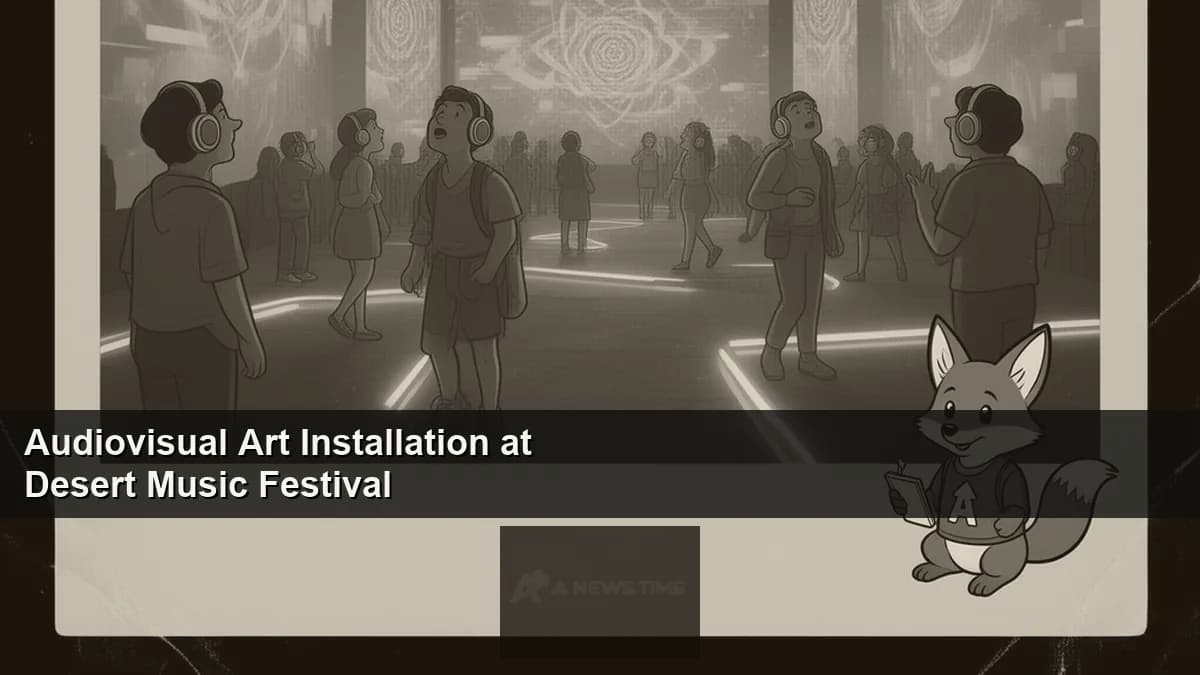
Radiohead did not play Coachella this year. They sent something stranger and, arguably, more fitting. Beginning Friday April 10, festivalgoers at the Empire Polo Fields in Indio have been able to descend into a 17,000 square foot underground bunker to watch KID A MNESIA, a 75-minute film comprised of artwork created during the making of two of the most celebrated albums of the 21st century. The installation is called Motion Picture House, and Coachella is only the beginning of its North American journey.
According to Billboard, the film runs across both Coachella weekends, April 10-12 and April 17-19, in a bespoke venue that the festival built beneath its Empire Polo Fields site. After Indio, the installation travels to Brooklyn's Agger Fish Building from May 6 through May 31, then to Chicago's Cinespace Studio from July 30 through August 23, followed by Mexico City's La Maravilla Studios from October 27 through November 15, and finally to San Francisco's Palace of Fine Arts from January 14 through February 7, 2027.
What the KID A MNESIA Installation Is
KID A and Amnesiac were recorded during the same sessions in the late 1990s and released separately in 2000 and 2001. Both albums represented a dramatic departure from the guitar-forward alternative rock of The Bends and OK Computer, moving into electronic textures, ambient structures, and fragmented song forms that confused many listeners at the time and are now understood as two of the most influential records of their era. In 2021, Radiohead reissued both albums together under the title KID A MNESIA, adding unreleased demos and sketches from the recording process.
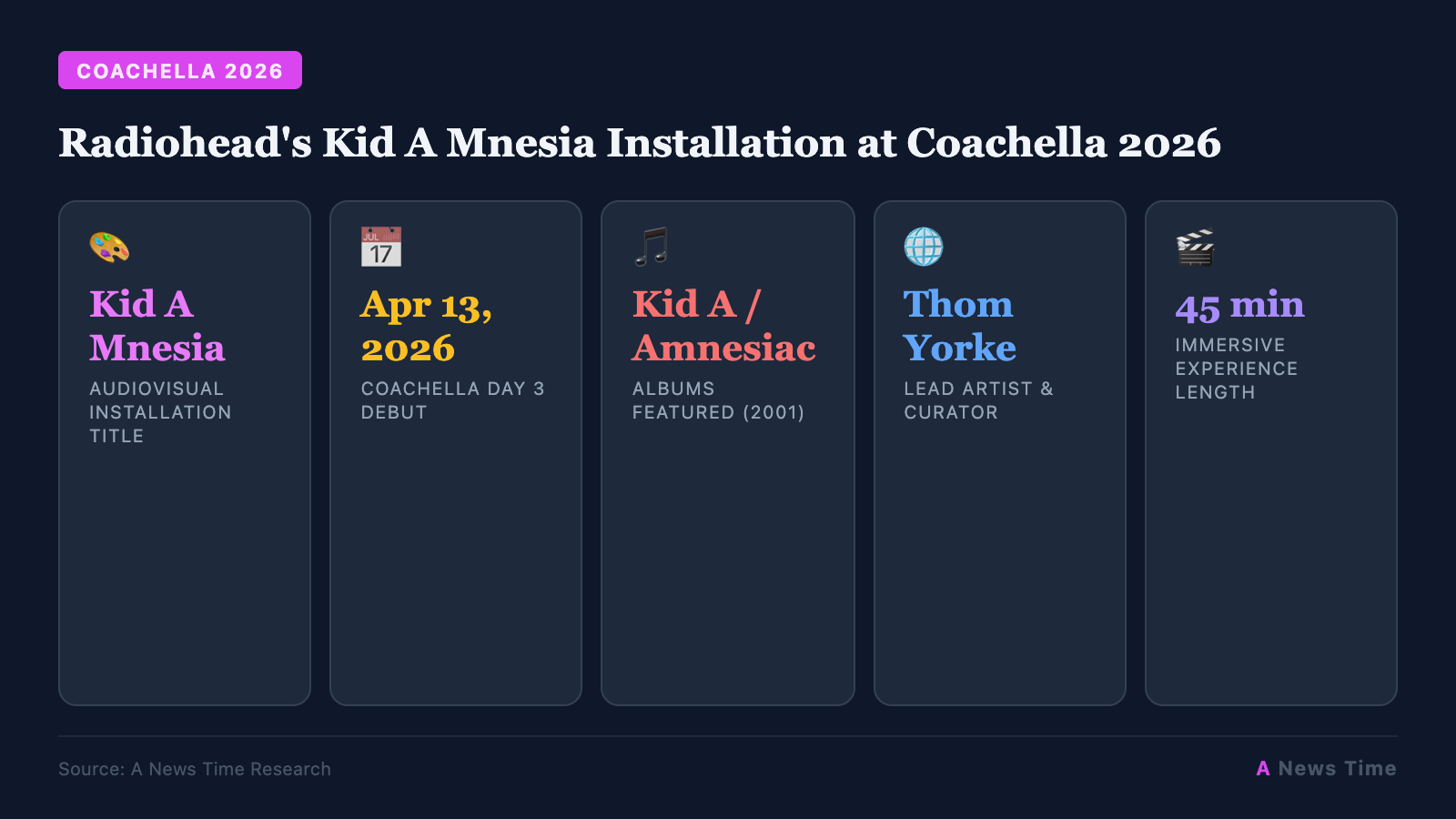
The artwork created during those original sessions, the distinctive cut-paper figures, the unsettling children's-book imagery, the abstract organic forms that populated the albums' packaging and promotional materials, was the collaborative work of Thom Yorke and Stanley Donwood. Donwood has been Radiohead's visual collaborator since The Bends, and his work for KID A and Amnesiac is among the most recognizable visual art produced in adjacency to rock music in the modern era.
The KID A MNESIA exhibition was originally conceived as an in-person installation, but the COVID-19 pandemic prevented its planned debut. It launched in 2021 as a walking simulator for PlayStation 5 and PC, creating a navigable virtual environment populated by Yorke and Donwood's artwork set to the album's music. The Coachella installation represents the first time the film format of that material has been shown publicly in a purpose-built physical space.
The Bunker at Coachella
The venue built by Coachella for the Motion Picture House is called the Bunker and sits beneath the polo fields that host the festival. Its specifications are unusual for a temporary festival installation: 17,000 square feet, 28-foot-high ceilings, and full air conditioning, which in the Coachella Valley in mid-April represents a practical necessity rather than a luxury amenity. The installation was first visible to those paying close attention when the 2026 Coachella lineup was announced last September, appearing as a small credit at the bottom of the poster without explanation.
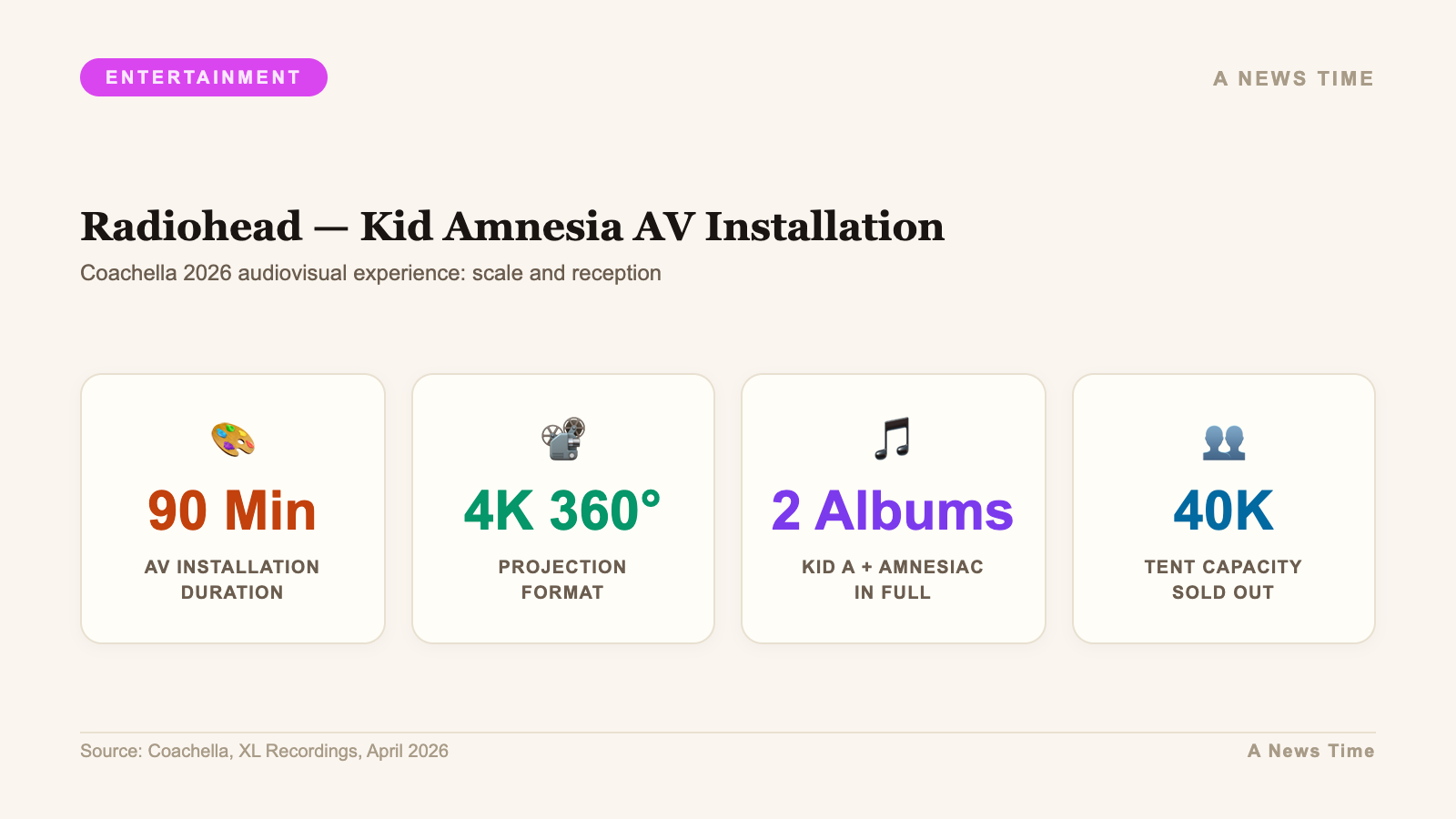
The screening schedule runs five times daily across both festival weekends. All ticket holders for the festival are eligible to enter the Bunker, but timing and capacity management apply given the 75-minute runtime and the physical size of the space. The festival's official website lists full details for scheduling. The interior features full-scale versions of Yorke and Donwood's artwork from the KID A and Amnesiac era, extending the cinematic experience into the surrounding gallery space.
The film itself is set to tracks from both albums, played in a sequence designed for the installation rather than in the original album order. The 75-minute runtime is long for a festival screening but appropriate for the material, which does not operate on pop song logic and requires a different kind of attention. Audience members familiar with the albums will hear familiar music in an unfamiliar arrangement; those encountering the material for the first time will experience it as a fully immersive audiovisual work without the context of knowing what came before.
Radiohead and the Coachella History
Radiohead last performed at Coachella in April 2017, headlining the Friday night slot in a set that became one of the more debated headline performances in the festival's history. The band had headlined Coachella previously in 2004 and 2012. Their absence from the 2026 festival stage and presence through the Motion Picture House installation is consistent with a band that has been publicly inactive since the death of drummer Phil Selway's father in late 2023 triggered an extended pause in collective activity.
Yorke has been working as a solo artist and in the duo The Smile with guitarist Jonny Greenwood, releasing two albums and touring extensively. The rest of the band has been similarly occupied with individual projects. No Radiohead album has been released since A Moon Shaped Pool in 2016, and the band has not made any public statement about future collective plans. The Motion Picture House installation exists somewhat separately from those questions: it is an archival and artistic project built around existing material rather than a signal of new activity.
What it does signal is the continued cultural weight of KID A and Amnesiac specifically. The 25th anniversary of those albums falls in 2025 and 2026 respectively, and the timing of the installation's launch is not coincidental. There is an entire generation of listeners for whom those albums are canonical texts that they discovered years after release, and the installation offers them a physical encounter with the artwork and atmosphere that defined a specific period in the band's creative history.
Thom Yorke, Stanley Donwood, and the Visual Language
Stanley Donwood's visual collaboration with Radiohead is one of the more sustained artist-band partnerships in contemporary music. He has designed every piece of Radiohead's visual communication, from album covers to promotional materials to merchandise, since 1994. His work for KID A and Amnesiac is widely regarded as the peak of that collaboration: the imagery, which drew on cut-paper children's book aesthetics filtered through anxiety and environmental dread, was perfectly calibrated to the music's emotional register.
Donwood has described the KID A period work as emerging from a specific mental state that he and Yorke shared during the recording sessions: a combination of overwhelming anxiety, political fear, and creative exhilaration that found outlet in the artwork's simultaneously childlike and threatening imagery. The bears and human figures that populate the visuals, rendered in flat cut-paper styles that suggest both innocence and menace, became as recognizable as the music itself.
Translating that visual language from album packaging to a 17,000 square foot immersive film installation required the kind of scale thinking that the original work did not anticipate. The KID A MNESIA virtual exhibition, developed with the tech company Epic Games and launched in 2021, provided an initial framework for understanding how the imagery behaves at architectural scale. The Motion Picture House film takes that understanding into a physical space for the first time.
The North American Tour Dates
Following the Coachella debut, the Motion Picture House installation's North American circuit covers some of the more interesting alternative venue spaces in the country. Brooklyn's Agger Fish Building is a former industrial facility in the Greenpoint neighborhood that has hosted large-scale art installations before; its spatial characteristics make it well-suited for an immersive film environment. Chicago's Cinespace Studio is a 450,000 square foot film production complex that has hosted several major productions, and the Mexico City venue, La Maravilla Studios, is part of the city's growing experimental arts infrastructure.
San Francisco's Palace of Fine Arts, where the tour closes in early 2027, is the most architecturally remarkable of the North American venues: the neoclassical rotunda and colonnades designed by Bernard Maybeck for the 1915 Panama-Pacific International Exposition are among the most distinctive structures in the city, and the visual dialogue between Maybeck's architecture and Donwood's imagery is an intriguing prospect.
Ticket details for the post-Coachella dates have been made available for presale registration. Interested attendees could register interest at kida-mnesia.com before April 12 at 11:59 p.m. PT to be randomly selected for a presale beginning April 22. General sale opens April 24 at 10 a.m. local time for each venue. Tickets are sold in two-hour slots to accommodate the 75-minute film plus time to experience the gallery and surrounding installation space. For more on the Coachella music lineup that bookends this installation, see our coverage of Nine Inch Noize's Coachella debut and the Sabrina Carpenter headline performance.
Why This Matters Beyond the Festival
The Motion Picture House installation is an interesting object to consider within the broader context of how legacy bands engage with their own archives. The instinct is usually either toward anniversary tours that reconstruct the original experience of classic albums in a live setting, or toward explicit archival releases with liner notes and bonus material that contextualize the original work. Radiohead has done neither of those things. Instead, they have commissioned an immersive cinematic work that uses the original albums' music and visual material as raw material for a new experience rather than a recreation of the original one.
That approach is consistent with how the band has historically operated: refusing the most obvious available option in favor of something that requires more from the audience and offers more in return. The KID A MNESIA installation does not tell you what the albums meant. It puts you inside the atmosphere they created and leaves you to work out what to make of it. That is exactly what the albums themselves did in 2000 and 2001, and it is exactly what made them so significant. See also our coverage of the most anticipated albums of April 2026 for the broader spring music context.