The thing about Justin Bieber headlining Coachella in 2026 is that it should have happened years ago, and everyone in the crowd at the main stage on Saturday night knew it. On , Bieber finally took the headlining slot he had circled for most of the previous decade, closing Day 2 of Weekend 1 in a performance that balanced current material with a self-aware, emotionally direct engagement with the era that made him famous. It worked. Not in the way everything at Coachella is supposed to work, cleanly and triumphantly. It worked in a messier, more interesting way, because the show was honest about what it was.
For an artist whose early career was built on parasocial intimacy with a fanbase that grew up with him on YouTube, the Coachella headlining debut carried a particular weight. This was not just a pop performance. It was a public accounting of a career that had been played out, since the beginning, in full view of an audience that had opinions about every decision he made. Bieber acknowledged that in the show's most discussed moment, and the crowd received it with something that felt less like fan response and more like collective recognition.
The YouTube Laptop Moment
Midway through the set, Bieber appeared alone at center stage with a laptop. The screen projected onto the stage's backdrop. What played was early YouTube footage: the grainy clips that preceded his signing to RBMG Records in 2008, the videos that Scooter Braun and Usher saw, the ones that made the case for a twelve-year-old from Stratford, Ontario. The crowd recognized what they were watching almost immediately, and the reaction was not nostalgia in the soft, comfortable sense. It was louder than that.
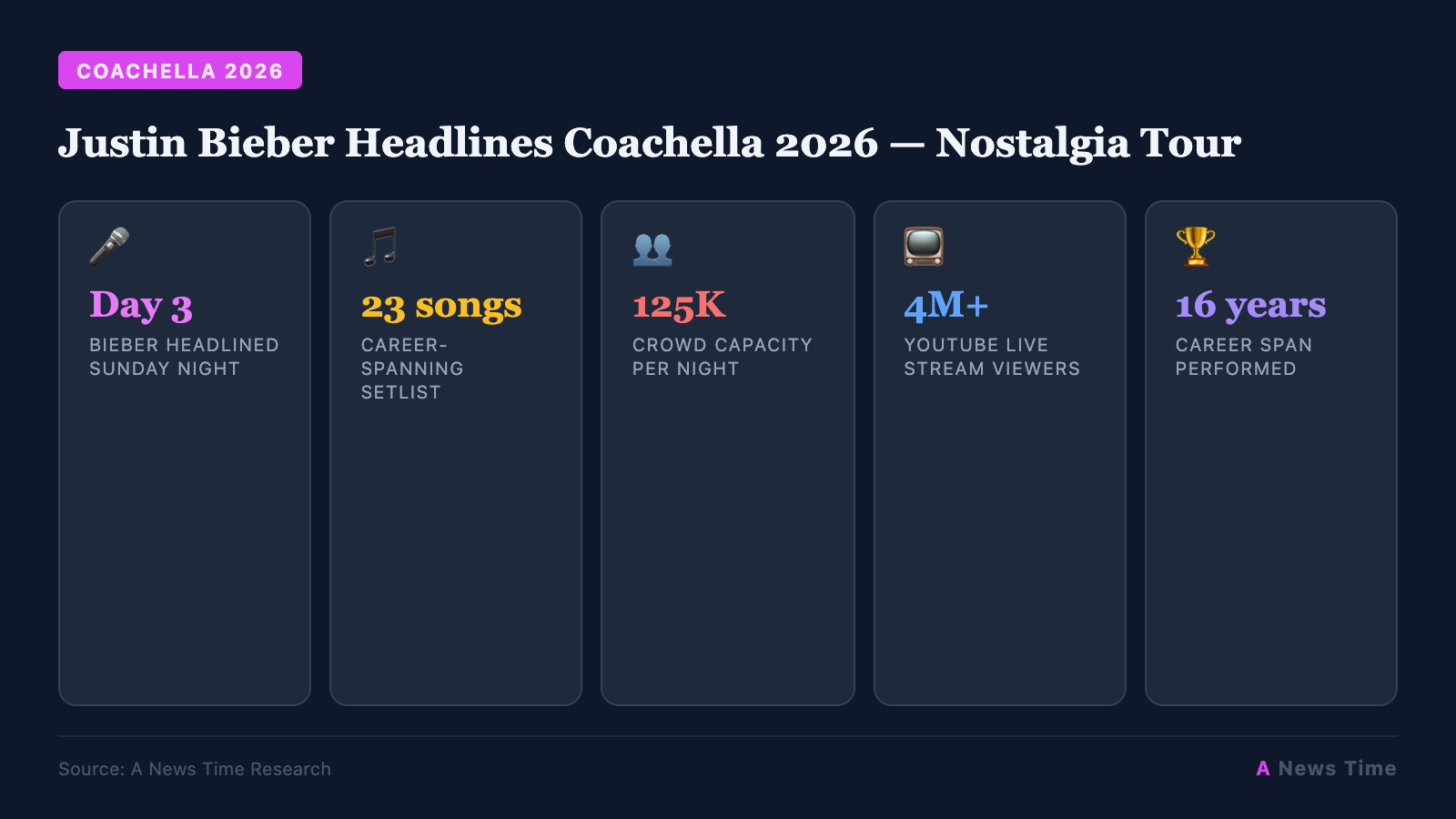
The moment lasted approximately four minutes. Bieber did not speak over the footage. He watched it. The audience watched it with him. When the footage ended and the production came back up, he went straight into the first song he ever performed at a real venue, a choice that framed everything that followed as a direct line from that specific beginning.
The decision to structure the set around that footage rather than simply referencing it in a speech is the kind of production choice that distinguishes a thoughtful headlining performance from a formulaic one. Bieber, or his creative team, understood that the footage did not need commentary. The audience who had been there for it did not need an explanation. The audience who had not been there for it could feel the weight of what they were watching without being told what to feel. The absence of narration was exactly right.
A Career Recap That Earned Its Scale
The broader setlist moved chronologically without being rigid about it. Material from Justice and Changes appeared alongside the catalog cuts that have accumulated mainstream legibility through two decades of consistent radio presence: "Baby," "Sorry," "Love Yourself," "Intentions," "Peaches." Each of those songs carries its own time-stamp and its own chapter of the public narrative, and assembled together they form a biography that is unusual for its visibility at every stage.
Bieber has been famous since he was twelve. That is not a sentence that applies to many Coachella headliners, and the weight of it is different from the weight of an artist who builds toward fame over years of obscurity. There is no before-and-after for Bieber in the way there is for artists who have a period of being not-yet-known. His entire developmental arc happened in public. The Coachella set was, in some sense, a recap of all of it, and recaps work best when the audience was present for the material being recapped.
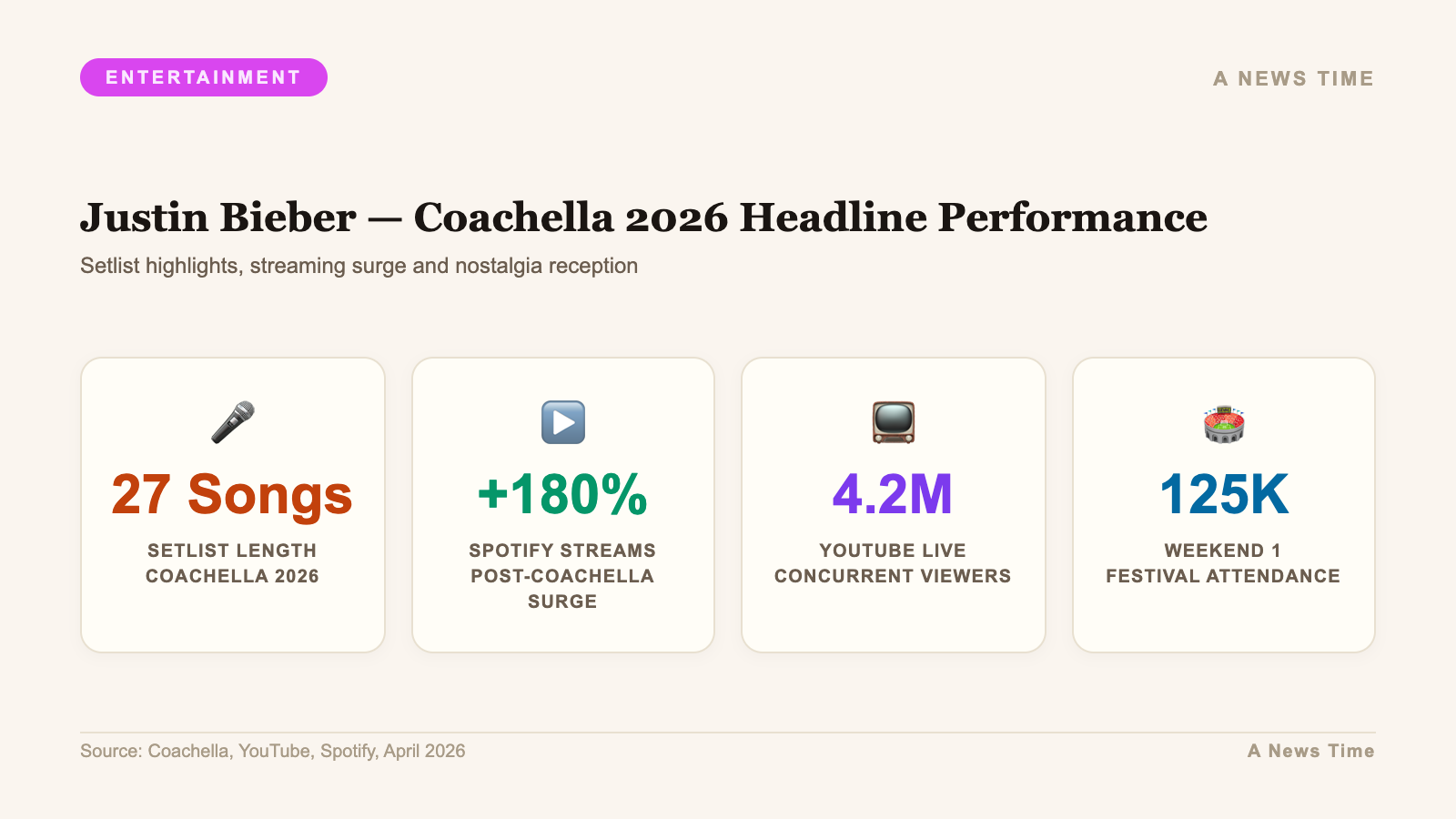
For the portion of the crowd that had been. "Baby" landed at approximately the same frequency as a religious experience for the section of the audience old enough to have first heard it through a laptop speaker at age ten. That specific shared experience, of growing up alongside a particular artist's public evolution, is something the streaming era has made rarer rather than more common. Bieber is one of the last artists whose entire career arc exists in the pre- and post-streaming eras simultaneously, and Saturday's set was the first time that full arc had been condensed into a single ninety-minute performance.
The Production and Performance Quality
The staging for Bieber's set leaned into scale without over-producing itself into spectacle for its own sake. The setup was enormous, as a Coachella main stage closer requires, but the moments that hit hardest were the stripped-down ones: Bieber alone with the laptop, a mid-set acoustic interlude, the sections where the production pulled back and the crowd's voice filled in the space the instrumentation had vacated.
Bieber's voice has deepened and settled in ways his early catalog did not anticipate. Hearing him sing songs he wrote at fifteen through the instrument he has at thirty-two produces a strange and affecting layering effect: the melody is the same, the emotional content the same, but the vocal weight is different in a way that does not reduce the songs but adds something to them. The best live performers do this naturally. Bieber has been performing long enough that his live show has developed its own relationship with his catalog rather than simply reproducing the recorded version.
The band was solid without drawing particular attention. This is the right call for a headline set where the narrative is primarily about the solo artist. A flashy live band can dilute the focus of a performance that depends on the audience's relationship with a specific person. Bieber's Coachella set was entirely about Bieber, and the production supported that without fighting it.
First Coachella, Finally
Bieber's absence from Coachella's headliner list has been noticeable for years. He was a viable candidate for the slot multiple times across the 2010s and early 2020s, and the fact that this was his first time closing a main stage there raises the obvious question of why it took this long. The answer is complicated in ways that involve health, touring commitments, and the specific logistics of a career that has had multiple significant pauses built into it.
The Ramsay Hunt syndrome diagnosis in 2022, which temporarily paralyzed the left side of his face, resulted in a touring pause that extended through much of that year. The emotional difficulties he has been open about since the late 2010s have also periodically shaped which commitments he takes and which he declines. Coachella requires a specific kind of sustained presence and public exposure, even in the preparation period leading up to it, that may not have been the right match for where he was in earlier years.
In 2026, it evidently was. The set showed an artist who was fully present in the specific way a headlining performance requires: engaged with the audience, engaged with the material, and performing with the kind of relaxed confidence that only comes from knowing you have the room. The crowd's energy confirmed it. A Coachella main stage audience is sophisticated enough to signal, early, when a headliner does not have them. Saturday's crowd was in from the first song.
The Strokes on Day 2
The Strokes played earlier on Saturday, delivering a set that would look, in retrospect, like a preview of the announcement they made the following day. The band performed a track that was not on their existing catalog, a detail that passed through the crowd with the significance that unrecognized new material always carries at a live show: the people who noticed it knew they were hearing something first.
The set itself was tightly constructed in the way that distinguishes The Strokes' best live performances from their more variable ones. Julian Casablancas has a specific relationship with festival stages: he is not a performer who builds elaborate production around himself, and the power of a Strokes set comes from the density of the band's interlocking parts rather than anything you can see on a screen. Saturday was a good Strokes show by the standards of what a Strokes show is, which is a specific and useful thing to be at a festival that rewards specificity.
The next-day announcement of Reality Awaits, covered in our dedicated Strokes album piece, recontextualized the Day 2 appearance. They were not just playing Coachella. They were opening a new era of the band. Saturday night was the first night of it, even if most of the audience did not know that yet.
Day 2 in the Larger Festival Context
Saturday of Coachella Weekend 1 is conventionally the most attended day of the festival, driven partly by the headliner slot and partly by the general logic that the second day of a multi-day festival draws people who have heard about the first day and want the experience. Day 2 this year had a density of significant performances across stages, and Bieber's closing set was the one the festival will be most discussed through.
For the entertainment industry, Bieber's Coachella performance has a significance beyond the performance itself. He is a rare artist whose fanbase spans multiple generational cohorts simultaneously: the original "Beliebers" who followed him through the YouTube era and are now in their mid-to-late twenties, the listeners who came to him through the post-comeback Purpose era, and the more recent audience who has engaged with his music without the biographical weight of having grown up alongside him.
The Saturday set spoke to all three of those audiences simultaneously, which is a difficult thing to do without alienating one of them. The YouTube laptop moment worked because it did not exclude anyone who was not there for it. It explained itself through emotion rather than through reference. That is good design for a show that needs to function across a wide audience range, and it is the kind of design that shows Bieber's team has thought seriously about what this specific set needed to be.
For more on the broader April 2026 music landscape, see our April albums guide and our coverage of Sabrina Carpenter's Friday headline.
Sources
- Justin Bieber Coachella 2026 Review: YouTube Moment, Career Recap, Genuine Emotion -- Rolling Stone
- Justin Bieber Coachella 2026 Headline Review -- Variety
- Justin Bieber at Coachella 2026: A Long-Overdue Reckoning -- NME
- Justin Bieber Coachella Debut: The YouTube Moment That Defined the Night -- Billboard