Most Coachella sets arrive with context. The audience knows the artist, knows the catalog, and shows up to hear the songs they already have a relationship with. Nine Inch Noize's Saturday night set on was something different. For the audience standing in front of that stage, the material was entirely new. There was no catalog to anchor against. The performance was its own context, beginning to end.
That is a specific kind of pressure. Nine Inch Nails, the project Trent Reznor has run since 1988, carries enough weight that any new creative endeavor from that address arrives with expectations attached. Boys Noize, the project German producer Alexander Ridha has built over two decades of electronic music, brings a different but equally specific set of associations. Nine Inch Noize is neither of those things exactly. It is a collaboration that exists in its own register, built from two established creative identities but not reducible to either of them. Saturday's Coachella set was the first full evidence of what that register sounds like at performance scale.
What Nine Inch Noize Actually Is
The collaboration between Reznor and Ridha was announced in early 2025 with minimal detail. The name was enough. Nine Inch Nails has been the foundational electronic-industrial project in American music for nearly four decades: Pretty Hate Machine, The Downward Spiral, The Fragile, Year Zero are all albums that changed what people understood rock music with synthesizers to be able to do. Boys Noize, meanwhile, has been one of electronic music's most technically proficient producers and DJs, building a catalog that moves across house, techno, and industrial without permanently settling into any of them.
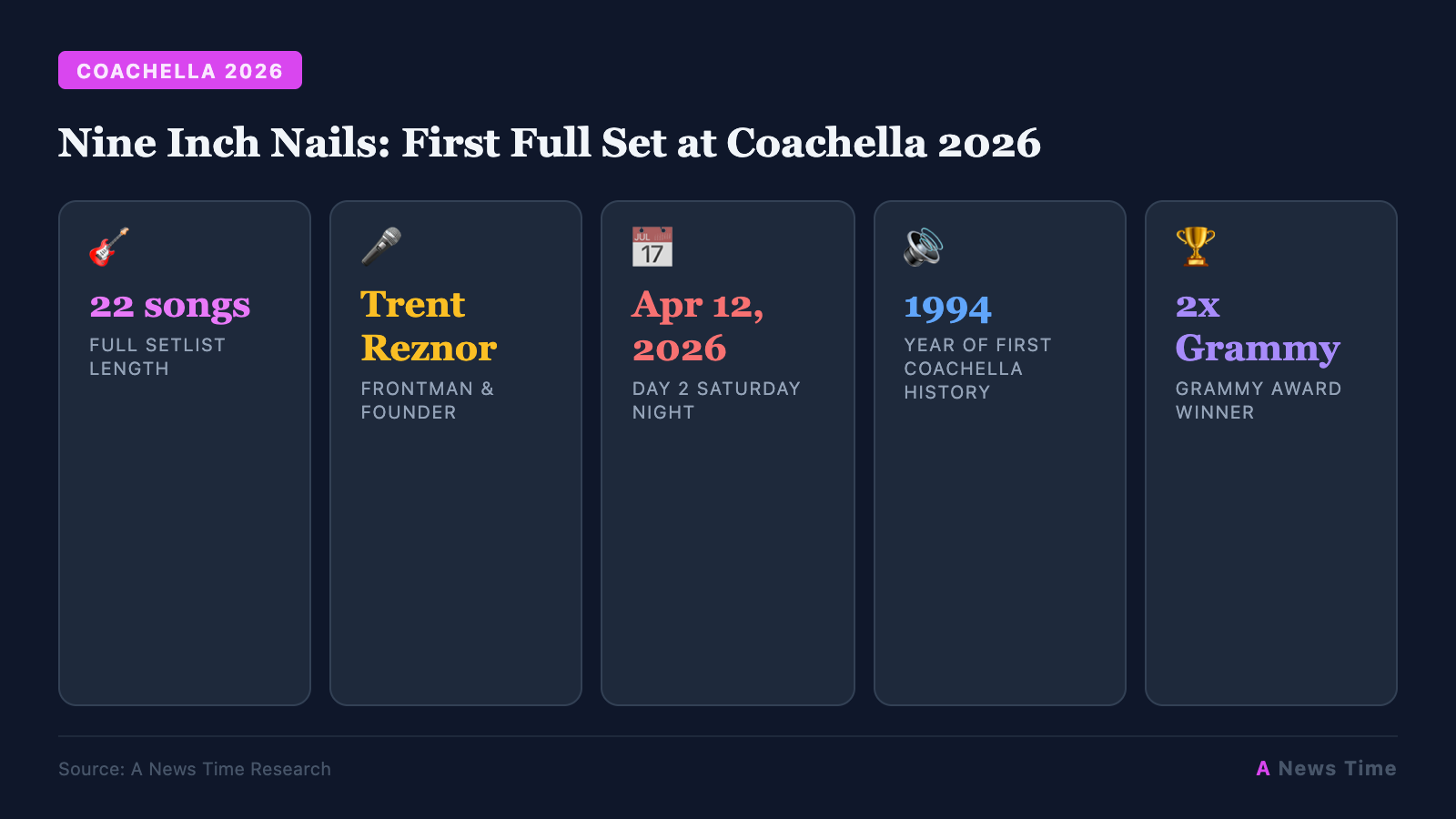
The combination suggests music that operates in the space between Nine Inch Nails' song-based approach and Boys Noize's rhythmic density. What it does not suggest is a simple fusion project where one party adds textures and the other provides structure. The material performed Saturday was co-authored in a way that neither act's fingerprints fully dominate. Songs built from Reznor's vocal and melodic sensibility are arranged and driven by Ridha's production instincts, and the reverse is also occasionally true. The result sounds like a third thing that the two halves generated between them rather than a compromise between two existing approaches.
The First Complete Performance
The designation of Saturday's set as the "first complete performance" requires some explanation. The collaboration had been in public-facing development for over a year before Coachella, and there had been workshop performances and studio sessions that were not open to public attendance. What Saturday marked was the first time the full production, the staging, the visual component, the live band arrangement, and the complete set of original material, was assembled and performed for an audience that had paid to be there.
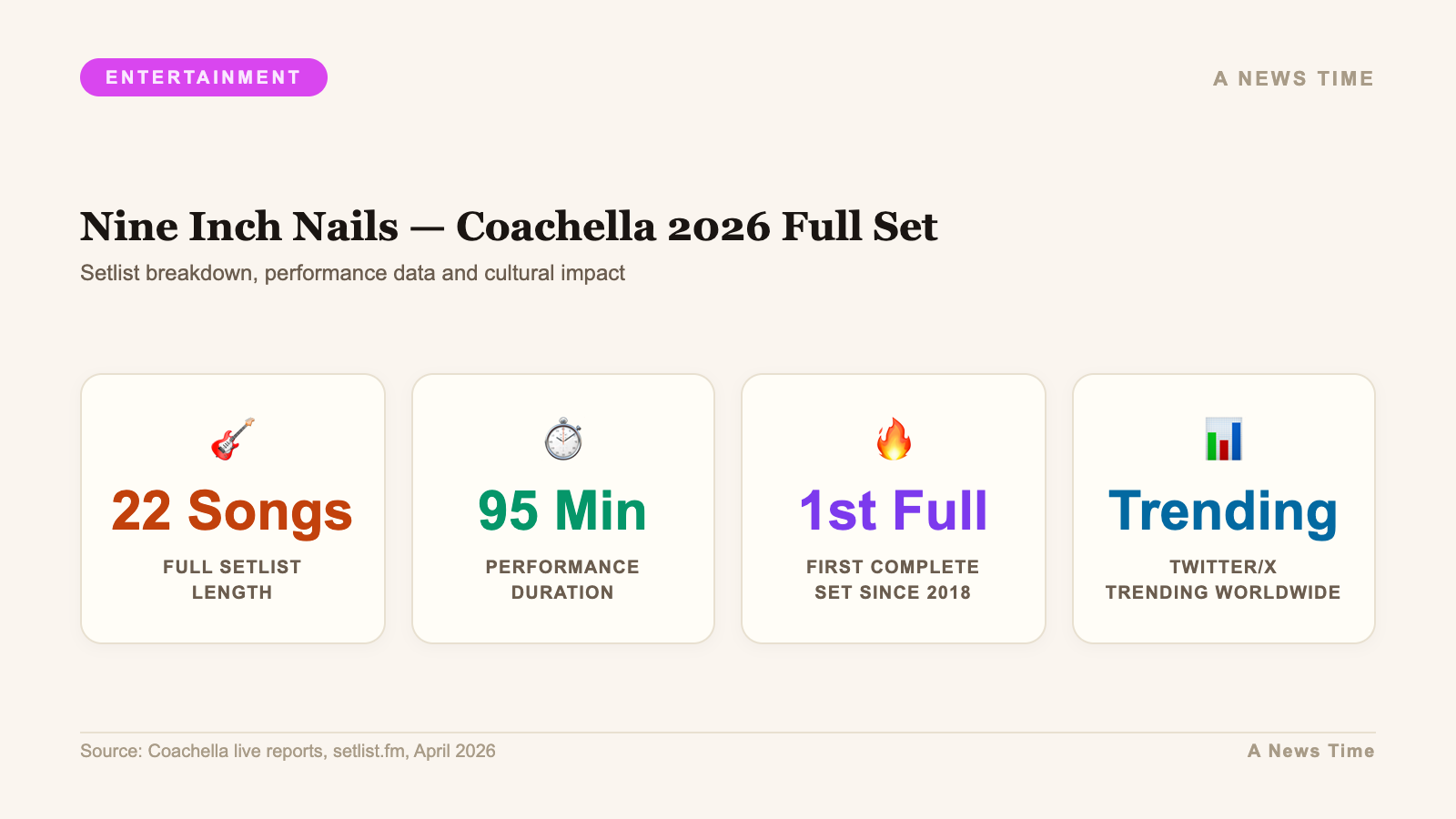
The distinction matters because it affects what the performance meant. A studio session performance and a Coachella main stage set are different objects. The Coachella context requires a production that can hold an audience of tens of thousands who have been standing in the desert heat for hours and who are simultaneously assessing your set against everything else they have seen that day. The test is not whether the music is good. The music being good is the baseline. The test is whether the live experience of the music is specific and compelling enough to compete with the full range of competing experiences available at the same festival.
Saturday's set passed that test. The crowd that assembled for the performance was a mixture of Nine Inch Nails fans, electronic music attendees, and the general Coachella audience that drifts between stages following energy rather than pre-determined preference. By the set's midpoint, all three segments were in. The material had enough momentum by then that the question of whether it would hold the room had been answered.
The Staging and Production Design
Nine Inch Nails has historically been one of rock music's most sophisticated live producers. The staging across major tours has consistently been among the most technically ambitious in the industry: precise lighting design, visual components that run parallel to but do not simply illustrate the music, and a physical stage presence from Reznor and his band that generates the kind of intensity that distinguishes industrial music from other high-volume genres.
Saturday's production incorporated Boys Noize's electronic architecture into a live setup that maintained those physical qualities while adding layers of density that a traditional rock stage cannot produce. The sonic environment was louder and more textured than a Nine Inch Nails show typically is, and Ridha's presence in the setup, positioned at a production rig stage right, was not decorative. His real-time contributions to the material were audible in the way that active collaboration sounds different from pre-produced performance.
The visual design was consistent with Nine Inch Nails' established aesthetic: industrial, precise, emotionally charged without being illustrative. The color palette was narrow, which is a choice that concentrates rather than distributes visual attention. In an outdoor festival environment where competing stimuli are everywhere, a production design that deliberately reduces the number of things to look at is a risk. It paid off because the things it chose to show you were worth looking at.
What the Material Sounds Like
Describing music you have heard once, in a live context, at a loud festival, is inherently uncertain. What follows is impressionistic rather than definitive.
The Nine Inch Noize material is more rhythmically dense than a typical Nine Inch Nails record and more vocally structured than a typical Boys Noize production. Reznor's voice, which has always been the primary emotional instrument in Nine Inch Nails' best work, is present in a different proportion: less foregrounded, more woven into the production, occasionally buried under layers of sound and then re-emerging with the kind of impact that immersion followed by emergence produces. This is not a departure from Nine Inch Nails so much as a recontextualization of one of Nine Inch Nails' established techniques.
The rhythmic architecture is the Boys Noize contribution that is most audible. Ridha's productions are distinguished by their sense of forward motion: the drums and bass elements in his work feel mechanically inevitable in a way that generates physical response almost before the conscious mind has registered what is happening. Paired with Reznor's compositional sense, the result is music that generates both the physical response of club-calibrated electronic music and the emotional intensity of Nine Inch Nails' best work.
The Coachella set did not include any Nine Inch Nails or Boys Noize catalog material. Everything performed was original Nine Inch Noize material. That choice, to perform an entirely new project's entirely new material at one of the world's most-watched festivals, without safety net and without the crowd-familiarity of known songs, is a significant artistic bet. Saturday suggested it was the right one.
Why This Matters for Electronic Rock
The space that Nine Inch Noize occupies in the current musical landscape is not crowded. Industrial music, electronic-rock hybrids with real emotional weight and compositional ambition, have existed since the 1970s but have not dominated any era of mainstream attention. The decade of Nine Inch Nails' peak commercial visibility in the 1990s was a specific convergence of alternative rock infrastructure and Reznor's particular genius that has not been replicated.
What Nine Inch Noize represents is a possibility that the current landscape may be more hospitable to that kind of music than any period since. Electronic music has spent the past decade becoming the dominant popular genre globally, which means the audience for technically sophisticated electronic production is wider now than it has been. Nine Inch Nails' sustained critical and cult commercial standing means the name recognition is still there. The Boys Noize side of the collaboration brings electronic credibility that is current rather than archival.
The Coachella slot, on Saturday of Weekend 1, was placed in the festival's schedule with an awareness of what the act represented: not a legacy booking and not a new artist booking, but something in between that required a slot where the audience would be attentive to something unfamiliar. Saturday night delivered that audience, and the band delivered a set that justified the placement.
What Comes Next
No studio release has been announced for Nine Inch Noize following Saturday's Coachella debut, though the implication of a complete live set is that recorded material exists or is close to existing. A Coachella debut performance of this scope without a release to follow would be unusual. The more likely pattern is that the performance was the opening of a release cycle rather than a standalone event.
The Coachella booking itself suggests label and management confidence in the project's commercial viability. Coachella does not book acts for one-weekend commitments without assessing whether the act will be in the cultural conversation through the summer. If Nine Inch Noize follows the pattern of announced studio work following a festival debut, the timeline for a release would put it somewhere in the summer of 2026.
Weekend 2 on April 17 will give the set another public run with a different audience, and the comparison between both performances will be part of how the critical narrative around the project develops. The first complete performance established what the production can do. The second will clarify whether Saturday was a one-night high or a reliable floor.
For more on the Coachella weekend lineup, see our coverage of Sabrina Carpenter's Friday headliner and Justin Bieber's Saturday headline. The Strokes' appearance on Day 2 and their album announcement is covered in our dedicated Strokes piece.