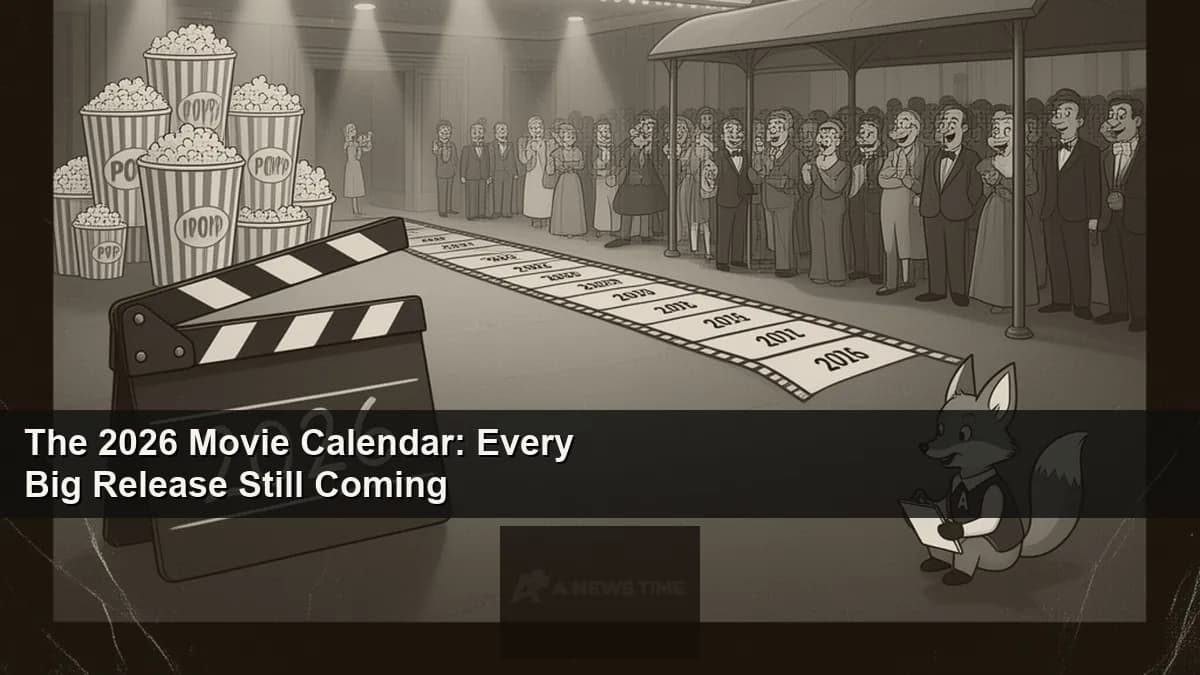
The theatrical year of 2026 officially found its footing in the first quarter, and the second half is where studios are placing their biggest chips. Super Mario Galaxy's record $372 million global opening over the first weekend of April announced, loudly, that animation-adjacent franchise properties can still move audiences at scale. Meanwhile, Project Hail Mary opened at $80 million domestically, a modest number for a big studio release but a credible one for a science fiction drama that doesn't come with a built-in action franchise. What's ahead, stretching from late spring through December, is a calendar that covers most of the major genres and a handful of legacy franchises that haven't appeared in theaters in years.
Studios restructured release schedules throughout 2024 and 2025 following the strike-related delays and the recalibration of streaming versus theatrical windows. The result is 2026's back half being unusually concentrated with titles that would, in a normal year, have been spread across two years. What audiences, exhibitors, and industry analysts are watching closely is whether that concentration creates cannibalization or whether the market can absorb multiple tentpoles in close succession.
Spring: From a Sequel Nobody Thought They Needed to Galaxy Far Away
The Devil Wears Prada 2 arrives on , nearly two decades after the original, with Meryl Streep returning as Miranda Priestly in a project that defied expectations when it was announced and has continued to defy them through production. The original film earned $326 million worldwide in 2006 on a $35 million budget, which is the kind of math that eventually produces a sequel regardless of how artistically unnecessary one seems. The question for May 1 is whether the audience that made the original a cultural touchstone is still showing up to theaters, and whether it has been joined by younger viewers who discovered the film through streaming.
Three weeks later, on , The Mandalorian and Grogu opens as Disney's formal declaration that the SW franchise's best path to theatrical profitability runs through the television characters rather than the film-first entries that underperformed after 2019. The series has a built-in global audience from its Disney+ run, and the theatrical presentation includes footage and production value that the streaming show couldn't deliver. Whether Star Wars works in theaters again, after Solo, The Rise of Skywalker, and several years of distance, is a genuine question. Grogu is the insurance policy.
"The audience for The Mandalorian is enormous and deeply loyal. What Disney is testing is whether theatrical feels like an event to them or just a more expensive way to watch something they'd see at home anyway. The answer will tell them a lot about where Star Wars lives as a franchise property."
Entertainment industry analyst, via Entertainment Weekly
Toy Story 5 closes out June on . Pixar's relationship with theatrical has been complicated since the pandemic-era direct-to-streaming releases eroded the studio's premium positioning. Toy Story 5 is positioned as a theatrical event with the production scale to justify the price of admission, though after the narrative closure of Toy Story 4, the thematic justification for a fifth entry is less clear. Box office analysts are projecting somewhere between the range of Lightyear (which underperformed) and the legacy Toy Story numbers, a wide range that reflects genuine uncertainty about where the franchise sits with audiences in 2026.
Summer: Nolan's Odyssey and Spider-Man's New Chapter
The single most anticipated film of the summer, and arguably the year, is Christopher Nolan's The Odyssey, opening with Matt Damon in the lead and a reported $350 million production budget that would make it one of the most expensive films ever made. Nolan's theatrical track record is the closest thing the industry has to a reliable benchmark: his last six films have each opened above $100 million domestically. The Odyssey represents a departure from his original intellectual property work toward literary adaptation, which introduces variables his recent work did not carry.
Two weeks after Nolan, on , Marvel's Spider-Man: Brand New Day brings the web-slinger back to theaters with a new Peter Parker following the multiversal conclusion of No Way Home. The Brand New Day storyline from the comics involves a significant reset of the character's circumstances, which gives the film narrative room to establish a new baseline rather than continuing to manage the continuity complexity that accumulated over three Sony/Marvel films. The casting announcement generated significant online response, and the first full trailer exceeded 200 million views in its first 48 hours.
| Film | Release Date | Studio | Category |
|---|---|---|---|
| Devil Wears Prada 2 | May 1, 2026 | Fox/Disney | Comedy Drama |
| The Mandalorian and Grogu | May 22, 2026 | Disney/Lucasfilm | Sci-Fi Adventure |
| Toy Story 5 | June 19, 2026 | Disney/Pixar | Animated |
| The Odyssey | July 17, 2026 | Universal | Literary Epic |
| Spider-Man: Brand New Day | July 31, 2026 | Sony/Marvel | Superhero |
| Hunger Games: Sunrise on the Reaping | Nov 20, 2026 | Lionsgate | YA Action |
| Avengers: Doomsday | Dec 18, 2026 | Disney/Marvel | Superhero Event |
| Dune: Part Three | Dec 18, 2026 | Warner Bros. | Science Fiction |
What Already Opened: The First-Quarter Performance
Before getting to what's coming, context from what's already happened in 2026 is worth establishing. The year opened with Wuthering Heights on , the Margot Robbie and Jacob Elordi adaptation directed by Emerald Fennell, which performed above industry expectations and positioned the classical literary adaptation as a viable theatrical category in a way the genre hasn't been in roughly a decade.
Project Hail Mary, adapted from Andy Weir's novel, opened in March at $80 million domestic, a number the trades read as a modest disappointment given its marketing spend but which represents a genuine audience for serious science fiction. The film's word-of-mouth has been strong, and its cumulative run will likely exceed the opening weekend story. The Andy Weir adaptation track record (The Martian was a global phenomenon) argues for patience with the number.
Then came Super Mario Galaxy, which reset what an animated film opening looks like. $372 million globally in its opening weekend is the second-largest animated opening in history. It converts Nintendo's gaming IP to theatrical proof in a way that the original Mario movie already partially established but which Illumination's Galaxy entry has confirmed at a new ceiling.
- Wuthering Heights (Feb 13): Above-expectations debut for literary adaptation
- Project Hail Mary (March): $80M domestic opening, strong word-of-mouth
- Super Mario Galaxy (April): $372M global opening weekend, second-largest animated record
Fall and Holiday: Hunger Games Returns, Marvel Rolls the Dice
The fall calendar opens with standard prestige season positioning, then delivers Hunger Games: Sunrise on the Reaping on . The fourth Hunger Games film is a prequel set during the 10th Hunger Games, adapting Suzanne Collins's 2020 novel. Lionsgate has been methodical about spacing the franchise entries to avoid oversaturation, and the five-year gap since The Ballad of Songbirds and Snakes has given the property time to reset its cultural position. The book performed strongly, and early tracking suggests a $100M-plus domestic opening.
Then December 18 arrives, and the calendar does something that industry observers have been watching with genuine suspense since both release dates were confirmed: Avengers: Doomsday and Dune: Part Three open on the same date.
Avengers: Doomsday is the first true Avengers-scale MCU event film since Endgame in 2019, with Robert Downey Jr. returning as Doctor Doom rather than Iron Man, a casting reveal that generated more industry conversation than any single piece of film news in the past two years. Dune: Part Three brings Denis Villeneuve's adaptation of Dune Messiah to conclusion, with the same cast, cinematographer, and production team that made Part Two one of the most celebrated science fiction films of the 2020s.
The two films are targeting different audience profiles, which is the studios' argument for why the December 18 date can work for both. But the overlap in demographics between epic science fiction fans and MCU fans is real, and a cinema-going audience making choices about which film to see opening weekend will split in ways that affect both final grosses. Some analysts are projecting the collision will cost both films $30-50 million in opening weekend domestic box office compared to unopposed openings.
The Bigger Picture
The 2026 theatrical calendar reflects a version of the post-streaming adjustment that studios arrived at through years of data and audience behavior analysis: theatrical is where the event films live, streaming is where the library lives, and the two can coexist if the theatrical product justifies the premium experience. The calendar from May through December is mostly evidence that studios have internalized this lesson. Most of what's on the list would not work as a streaming drop. It requires an audience assembled together, in the dark, for two or three hours.
What the calendar cannot tell you yet is whether audiences have fully returned to the habit of going to theaters for those experiences. Attendance data from the first quarter of 2026 shows improvement over 2025 but not a full recovery to pre-pandemic levels. Super Mario Galaxy's $372 million opening is a data point. So is the quieter weekday business at most multiplexes during the first week of April. The theatrical year's real story is still being written, one opening weekend at a time.
Sources
- Entertainment Weekly — 2026 theatrical calendar analysis and release date tracker
- Box Office Mojo — Super Mario Galaxy opening weekend global gross
- Deadline — Avengers: Doomsday and Dune: Part Three December 18 date conflict analysis
- Variety — Project Hail Mary opening weekend and theatrical market analysis