Every month, the streaming calendar produces a few releases worth reorganizing your evening for, a handful of things you will get to eventually, and a long tail of content that exists to fill the interface between the things you actually want to watch. April 2026 is unusual in how front-loaded the good stuff is. The month opened with multiple shows that are not just good but are actively competing for the same critical and cultural attention, which means the conversation about what to watch has actual stakes rather than the usual background noise.
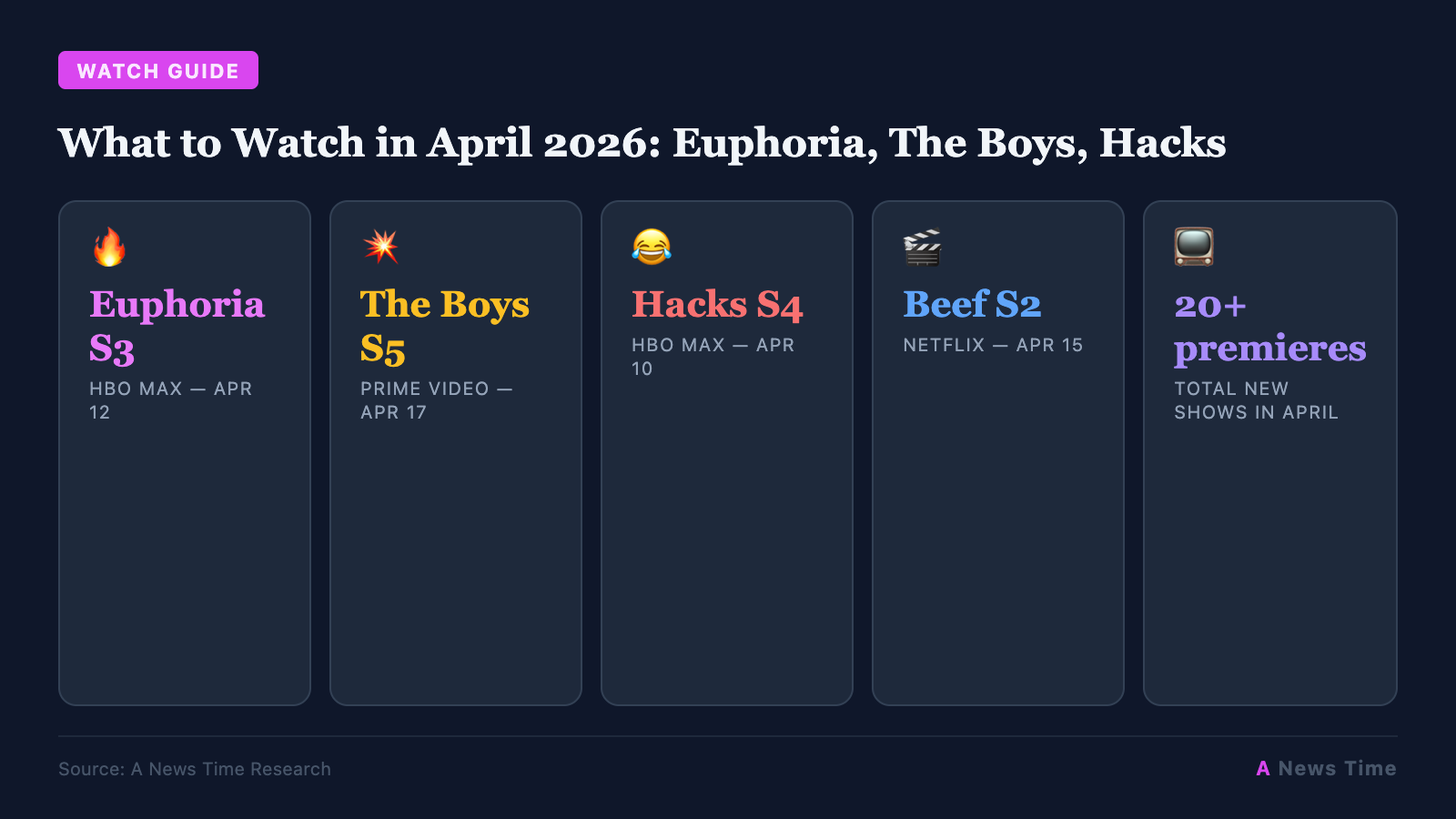
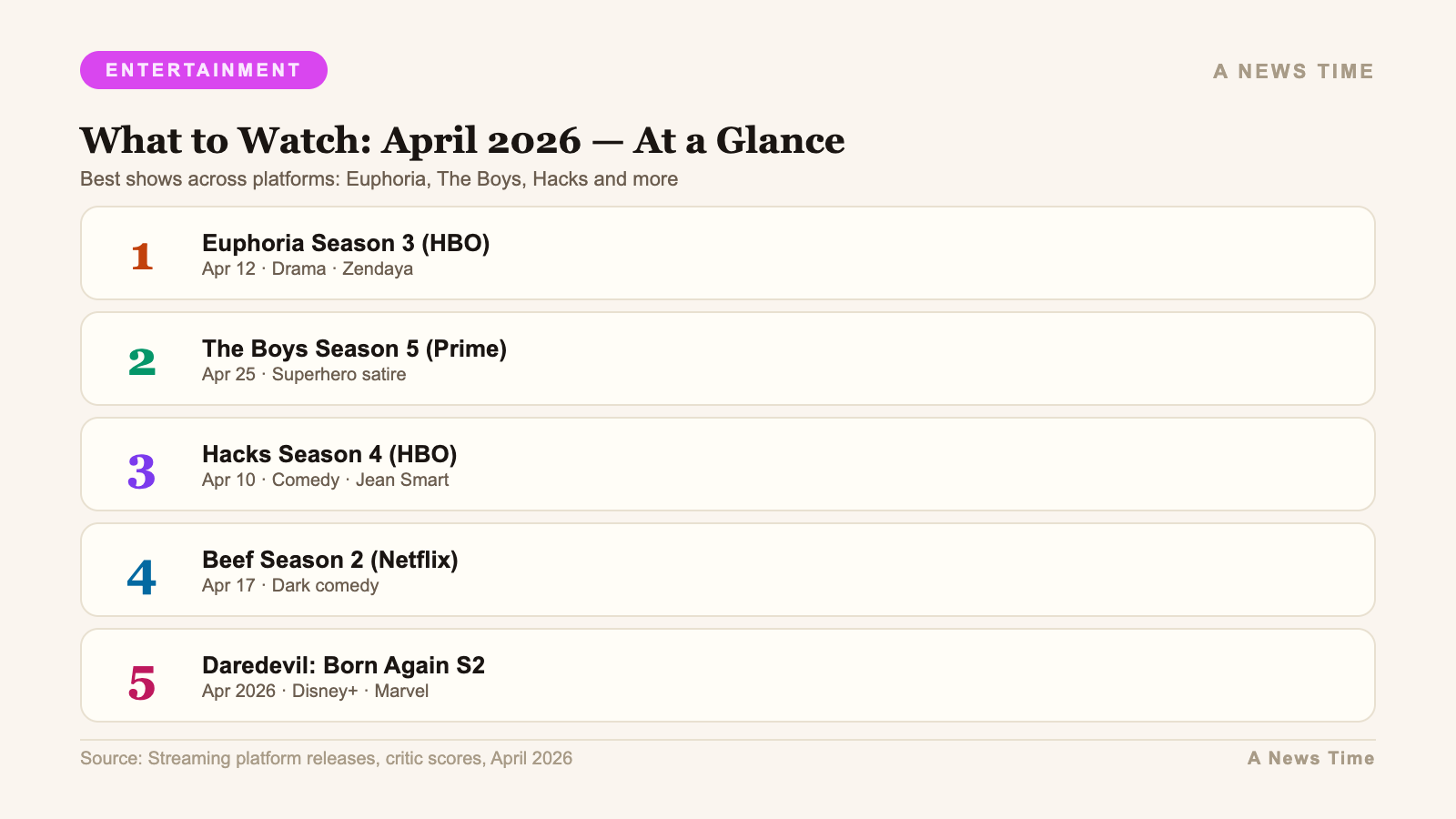
Euphoria Season 3 premiered April 12 on HBO with a time jump that resets the entire premise of the show. The Boys is in the final stretch of its last season on Prime Video. Hacks Season 5 is on Max and is being described by people who have seen advance copies as the show's best season. That is three premium cable-equivalent series all in motion simultaneously, on three different platforms, in the same four-week window. If you are trying to keep up with the cultural conversation about television in April 2026, you will need all of them. This guide tells you which ones to prioritize and what else is worth adding to the list.
Euphoria Season 3 (HBO) -- Mandatory Viewing
Euphoria Season 3 is the most discussed television event of the spring. The five-year time jump that showrunner Sam Levinson announced early in the production cycle was always the most interesting structural decision he could have made, and the first two episodes demonstrate why. Zendaya's Rue Bennett is now 23, five years past the rock bottom of Season 2. She is different. The show is different. The high school framework that gave the original series its specific social ecosystem, where every interaction carries the compressed intensity of an environment you cannot leave, has been replaced by something more open and more uncertain.
What the jump does not do is soften the show. Euphoria's signature quality, the willingness to take its characters' interiority seriously enough to let it be ugly and contradictory, is intact. Zendaya and Sydney Sweeney are both working at a level that suggests they have been waiting for the material these adult versions of the characters allow. Sweeney's Cassie Howard, now married to Jacob Elordi's Nate Jacobs, occupies a social position she wanted and is clearly not equipped for, which is exactly the kind of dramatic situation that Levinson is best at elongating past comfort.
Sharon Stone and Rosalía joined the cast for this season. Sharon Stone, in particular, has a specific screen presence that Levinson has used well in the first two episodes: she is not playing a supporting role in the conventional sense but occupies the season's narrative margins in a way that keeps pulling focus. Rosalía's presence is more contained and more formally interesting, serving a function closer to the show's use of music than to a traditional acting role. Both additions suggest a season interested in texture as much as plot.
Episodes have been releasing weekly, which is the right choice for a show this culturally productive. Weekly releases allow the conversation to develop between episodes in a way that binge-release structures foreclose. If you are not watching Euphoria Season 3 as it airs, you are having a different experience of the show than the one the release schedule was designed to create.
The Boys Season 5 (Prime Video) -- Essential, on a Timer
The Boys is in the final season of a run that began in 2019 as the most politically sharp superhero satire in television history and has occasionally lost the thread of its own argument in subsequent seasons. Season 5 is the last chance to resolve what Eric Kripke's show has been building toward: the question of whether Homelander can be stopped and what the stopping costs.
Karl Urban and Antony Starr are both performing at a level that justifies the original casting decisions across five seasons. Starr's Homelander has evolved from a terrifying but legible villain into something more unstable and therefore more dangerous: a character who has stopped being afraid of consequences in a way that makes him harder to write dramatically but more interesting to watch. Urban's Butcher, dealing with the physical consequences of previous seasons' choices, is operating with a desperation that gives the final season a ticking clock the show needed.
The new additions deserve attention. Jensen Ackles returns with Soldier Boy, whose arc from Season 3 left significant unresolved business that the final season needs to pay off. Jeffrey Dean Morgan joins as a character whose presence in the show's final season suggests Kripke has reserved a specific narrative function for him rather than simply adding star power. Daveed Diggs brings a quality to his scenes that is different from what the rest of the ensemble offers: he is funnier and more ambiguous simultaneously, which is a difficult combination to sustain in a show operating primarily in the register of dark political satire.
The final season is releasing in two batches, which is Prime Video's consistent approach to high-profile properties and which splits the cultural conversation in ways that can work for or against audience engagement depending on how satisfying the mid-season material is. The first batch is strong. Whether the second half sticks the landing is the question that defines how the show is remembered.
Hacks Season 5 (Max) -- The Best Drama on Television, Quietly
People who have been watching Hacks since Season 1 have spent four years advocating for it to friends who kept saying they would get to it eventually. Season 5, which premiered April 9 and is the confirmed final season, is the moment where that advocacy stops being optional. If you have not watched Hacks, the finale of one of the best comedy-dramas streaming has produced is the correct forcing function to start.
Jean Smart's Deborah Vance, a veteran stand-up comedian navigating the entertainment industry's complicated relationship with aging women, began the series as a sharp character in a situation that could have been a conventional mentor-student dramedy. Over four seasons, the show built Deborah into something more precise and more uncomfortable: a person who is right about most things and wrong about the same specific things repeatedly, who generates collateral damage proportional to her ambition, and who remains compelling despite being intermittently monstrous because Smart plays the complexity without ever abandoning the character's fundamental humanity.
Hannah Einbinder's Ava Daniels has completed the arc from dependent to professional peer, and Season 5 is built around what the relationship between these two characters looks like when the power differential that defined it has equalized. That is more dramatically interesting than the original setup and requires more from both performers. Early episodes suggest both are equal to it.
This is the final season. Hacks has been confirmed ending. Watch it while you still can form opinions about what ending it chose.
Beef Season 2 (Netflix) -- Worth the Price of Admission Alone
Lee Sung Jin's Beef won every award the television industry had to offer when Season 1 aired in 2023, and spent two years being the show people recommended with an urgency that tipped into evangelical territory. The original series starred Steven Yeun and Ali Wong as two strangers whose brief road rage incident cascades into mutual destruction. Season 2 keeps the title and the concept, a single explosive conflict between two people and its radiating consequences, while replacing the cast entirely.
Oscar Isaac and Carey Mulligan lead Season 2. That casting announcement was sufficient to generate considerable pre-release interest, and the first two episodes justify it. Isaac and Mulligan are performing at the level that makes their work together feel like the kind of pairing you want to see again as soon as you have seen it once. The story is different from Season 1 in setting and circumstance while maintaining the same formal interest in how rage operates as a force that bypasses rational decision-making and reorganizes behavior around pure drive.
If you did not watch Season 1, you do not need to. The two seasons are anthological. If you did watch Season 1, Season 2 is built around different enough choices that comparison feels like a category error: they are related projects in spirit rather than sequence.
Malcolm in the Middle Revival (Hulu) -- Nostalgic and Actually Good
The original Malcolm in the Middle ran from 2000 to 2006 and is one of the better American family sitcoms the format has produced. The revival on Hulu reunites Bryan Cranston, Jane Kaczmarek, Frankie Muniz, Justin Berfield, Christopher Kennedy Masterson, and Erik Per Sullivan in a continuation rather than a reimagining. Malcolm is an adult. His parents have aged. The family dynamic that made the original series work, the chaotic but fundamentally loving household where everyone is slightly too smart and slightly too emotional, is intact.
Hulu revivals have a mixed track record. The Malcolm in the Middle revival benefits from a creative team that has been transparent about not wanting to simply cash in on nostalgia and from a cast that has maintained enough goodwill across the intervening twenty years that their reunion does not feel like a financial arrangement. Whether it sustains across a full season is a question the first few episodes cannot answer, but the opening episodes justify giving it four more.
Star Wars: Maul (Disney+) -- For the Fans, by the Fans
Star Wars: Maul is the limited series that the Star Wars fan community has been asking Disney to make since Darth Maul's survival beyond The Phantom Menace became a canonical fact through The Clone Wars and Solo. The series covers the period of Maul's leadership of the Crimson Dawn crime syndicate, which was established in Solo: A Star Wars Story and has existed as narrative connective tissue in the expanded universe without ever receiving a full dramatization.
Disney+ Star Wars series have covered a wide quality range since The Mandalorian established the format. Andor is probably the best dramatic television in the franchise's history. Obi-Wan Kenobi had good intentions and inconsistent execution. Maul is positioned as a fan service delivery mechanism with enough craft behind it to function as television rather than simply as extended promotional material. The first three episodes suggest it falls in the better half of the Disney+ Star Wars range: not Andor, but competent and occasionally genuinely engaging.
If you watched The Clone Wars and have strong opinions about Maul's character arc, this is mandatory. If you are a casual Star Wars viewer who has not tracked the extended canon, the series includes enough contextual scaffolding that you can follow it without prior homework, though you will miss specific resonances that reward the longtime audience.
Keanu Reeves in Outcome (Apple TV+) -- The Sleeper Pick
Apple TV+ has built a consistent library of prestige originals that tend to perform better in critical conversation than in casual recommendation cycles. Slow Horses, Severance, Bad Monkey, Shrinking: these are shows that have excellent reputations among people who watch television seriously and that are persistently under-watched relative to their quality. Outcome, with Keanu Reeves in a dramatic role that is explicitly not an action film, is likely to follow that pattern.
Reeves plays a former intelligence operative navigating a moral reckoning in a geopolitical thriller that is more interested in character interiority than in set pieces. This is not John Wick. It is not The Matrix. It is Keanu Reeves doing the thing that a generation of action roles has made it easy to overlook: he is a specific kind of still, deliberate performer who is very good at conveying intelligence and restraint on screen. Outcome is built around exactly those qualities, and the first four episodes suggest a series that has figured out what its star can do and is using it well.
Apple TV+ is $12.99 per month with a free trial. Given the platform's catalog density in April, it is the month to try if you have been putting it off.
Thrash (Netflix) -- The Shark Thriller That Earns It
Shark thrillers are a genre that the post-Jaws decades have not treated with particular distinction. Most shark content exists on a spectrum from earnest imitation to self-aware camp, and the earnest imitation end tends to produce films and series that aspire to Jaws's tension while missing the specific qualities that make Jaws actually tense: the absence of the shark, the human characters worth caring about, the suggestion that something ancient and indifferent has entered an environment built on the assumption that it would not.
Netflix's Thrash earns a more respectful assessment. The thriller follows a competitive surfing community on the Northern California coast where a series of attacks upends a tournament season and forces several characters to make decisions that are credibly difficult rather than simply plot-necessary. The shark is handled with restraint, appearing less than you expect and landing harder because of it. The performances support the material in a way that keeps Thrash from tipping into parody even when the premise grazes absurdity.
This is not a prestige television event. It is a well-made genre thriller that knows what it is and delivers on its premises without embarrassing itself. On a platform that can overpromise on genre material, that modesty is worth something.
How to Manage the Platform Fragmentation
The eight significant April releases across seven streaming platforms represent a financial reality as much as a content one. Catching all of them requires subscriptions to HBO Max, Prime Video, Netflix, Hulu, Disney+, Apple TV+, and either the new Max subscription or a bundled tier that includes both HBO and Max. That is not a sustainable ongoing commitment for most households. The practical answer is rotation: subscribe to two or three platforms at a time, watch what you came for, and switch when the next cycle of releases justifies it.
April's strongest individual platform argument is for HBO Max, which has both Euphoria and Hacks simultaneously and has the additional depth in its library to justify the cost between major release windows. Prime Video is justified by The Boys' final season for subscribers who have been with the show since the beginning. Netflix has Beef Season 2 and Thrash in the same month, which is enough for a month's subscription. Hulu and Apple TV+ both have specific reasons to subscribe this month without being month-defining on their own. Disney+ is for the Star Wars audience specifically.
For a full breakdown of what each platform charges in April 2026, see our streaming prices comparison guide. For more on the Euphoria Season 3 cast and time jump in depth, see our dedicated Euphoria Season 3 guide. For the full The Boys Season 5 preview, see our dedicated Boys piece.