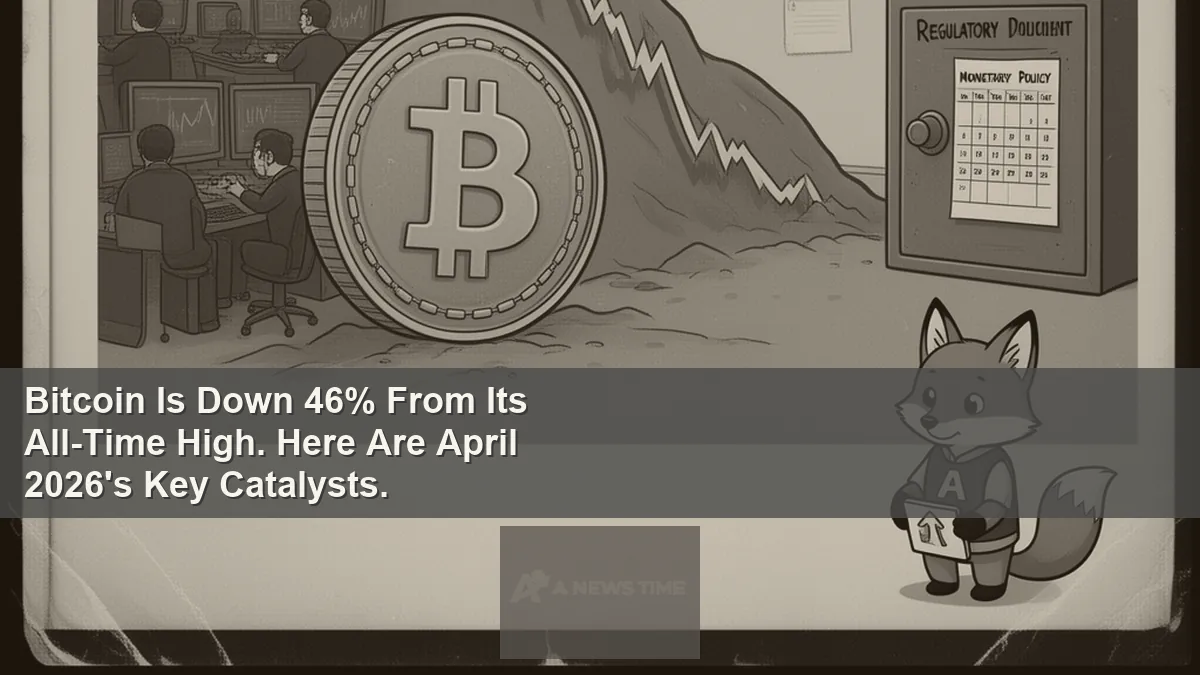
Bitcoin closed at $67,821, capping a first quarter that erased 46% of the asset's value from its all-time high and 30% from its January peak. The Fear and Greed index spent 46 consecutive days in the extreme fear zone through the end of March, a streak that exceeds anything recorded in the 2022 bear market. Ethereum closed at $2,043, down roughly 50% from its own cycle high. The cryptocurrency market, which began 2026 riding a wave of institutional adoption narratives and regulatory momentum, finished the first quarter looking more like a macro hedge fund liquidation than a maturing asset class.
The numbers frame a market that is neither in freefall nor recovery. Bitcoin has held a well-defined trading range of $65,000 to $72,000 throughout March, with sellers consistently defending the upper bound and buyers stepping in near the lower. That range compression, after months of elevated volatility, is either the formation of a base or the quiet before a bigger breakdown. April's calendar will do much to answer that question.
Where Bitcoin Stands: The Technical Picture
Bitcoin's technical structure as of April 1 is a study in unresolved tension. The $65,000 to $67,000 zone has absorbed three separate sell-offs in March, each time attracting enough buying interest to prevent a sustained breakdown below the psychologically significant $65,000 level. That buying support is meaningful, but it has not translated into price discovery to the upside.
The ceiling is equally clear. The $72,000 level has been tested twice since mid-March, and sellers have defended it on both occasions with enough force to produce swift reversals of $3,000 to $4,000 within 48-hour windows. For a weekly close above $72,000 to occur, which most technical analysts identify as the minimum condition for a renewed bullish trend, Bitcoin would need to either absorb the selling pressure at that level on significantly higher volume or benefit from an external macro or regulatory catalyst that forces short sellers to cover.
The options market reflects the same uncertainty. Implied volatility for near-term Bitcoin options has fallen to multi-month lows, suggesting that options traders are not currently pricing in a significant directional move in either direction. That low-volatility regime typically precedes either a resolution of the trading range (often explosive) or a continued drift lower as the macro environment erodes sentiment. The positioning data suggests institutional traders are neither significantly net long nor net short at current levels.
One metric offers a degree of structural comfort. US spot Bitcoin and Ethereum ETFs closed the trailing 30-day period with net positive inflows, a meaningful divergence from the broader picture of risk asset outflows. The institutional infrastructure around Bitcoin, built through the ETF approval cycle of 2024 and 2025, has not cracked. Capital is not fleeing the vehicle, even as price has declined. That is a different dynamic from the 2022 bear market, when institutional infrastructure was thin and retail panic drove the price mechanics.
The April Catalyst Calendar
Three events on the April calendar have the potential to shift the current narrative, either confirming the range breakdown thesis or providing the macro and regulatory clarity that bulls need to break $72,000.
The first is the CLARITY Act markup, expected to reach the Senate Banking Committee by mid-April 2026. The act would provide statutory regulatory clarity for digital assets, establishing jurisdictional lines between the SEC and the CFTC and creating a framework for token classification that has been litigated on a case-by-case basis for the better part of five years. Regulatory clarity is a genuine structural catalyst for the asset class, not merely a sentiment signal. It would reduce the legal risk premium embedded in institutional Bitcoin and Ethereum positions, potentially unlocking capital from large asset managers that have delayed meaningful allocations pending a clear legal framework.
The second is the FOMC meeting on April 28-29. The Fed has held rates at elevated levels throughout the first quarter, responding to persistent core inflation readings above 3% and the oil price shock associated with the U.S.-Iran military conflict. If the April meeting produces any language suggesting a dovish pivot (or even a softening of the hawkish guidance), crypto historically responds with outsized moves. Bitcoin's inverse correlation with real interest rates has been the dominant price driver of 2025 and 2026. A credible signal that rates are heading lower would change that calculus instantly.
The third catalyst is structural rather than event-driven: the continued development of Ethereum's Glamsterdam upgrade, which is targeted for . Glamsterdam represents the final stage of Ethereum's current upgrade roadmap and will increase the gas limit from 60 million to 200 million, enabling 10,000 transactions per second compared to approximately 30 currently. The historical pattern around major Ethereum upgrades is consistent: the Merge upgrade in September 2022 triggered a 35% rally in the two months preceding the event; the Shanghai staking withdrawal unlock in April 2023 drew a 40% gain; the Dencun upgrade in March 2024 helped ETH surge 20%. Pre-upgrade positioning typically begins 60 to 90 days before the event, which places the accumulation window squarely in April and May.
AI Tokens: The Quarter's Standout Performers
While Bitcoin and Ethereum absorbed macro selling pressure, the AI token sector delivered the strongest performance in the cryptocurrency market during March. The combined market cap of AI-focused tokens grew from $14.13 billion to $19 billion, a gain of approximately 30% in a single month during which the broader crypto market was declining.
| Asset | Current Price (March 31) | % From ATH | 30-Day Performance |
|---|---|---|---|
| Bitcoin (BTC) | $67,821 | -46% | -8.2% |
| Ethereum (ETH) | $2,043 | -50% | -11.4% |
| Solana (SOL) | ~$128 | -52% | -6.1% |
| XRP | ~$1.40 | -64% | -5.3% |
| AI Sector Average | N/A | Varies | +30% |
The outperformance is not uniform within the sector. Bittensor (TAO), the decentralized AI computing network, gained 67.5% over the 30-day period, driven by growing developer adoption and a series of subnet launches that expanded its use cases beyond the original language model training focus. FET (Fetch.ai) gained 44.13% on the back of its AI agent marketplace achieving measurable transaction volumes. SIREN, a smaller AI infrastructure token, posted a staggering 540% monthly gain on a specific protocol announcement that catalyzed speculative positioning. Render, the decentralized GPU rendering network that has attracted genuine enterprise customers, gained 21%.
The AI token sector's divergence from the broader market reflects a thematic rotation that has been building since late 2025. As investors grow skeptical of Bitcoin's near-term price catalysts and concerned about Ethereum's competitive position, capital has been flowing toward tokens with narratives tied to the AI infrastructure buildout. Whether that rotation represents genuine fundamental value discovery or thematic momentum chasing will become clearer as the broader macro environment resolves.
"The AI token sector is behaving like early-stage venture bets on infrastructure plays within crypto. The question is whether the underlying protocols have product-market fit or whether this is narrative momentum. The companies deploying real GPU compute for real AI workloads will separate from the ones that are just riding the theme." — Mustafa Mulla, Analyst, Coinpedia
Solana and the DEX Volume Story
Solana's decentralized exchange (DEX) ecosystem delivered one of the most significant growth stories in crypto during the period, even as the SOL token itself remained under price pressure. Solana DEX volume grew from $40.5 billion in August 2025 to $87.8 billion in late March 2026, a gain of 117% over seven months. That volume growth has occurred across a period of significant macro headwinds, suggesting that Solana's DEX ecosystem is capturing genuine market share rather than simply riding a bull market tailwind.
The volume figures have implications beyond the Solana ecosystem. High DEX volumes are a leading indicator of network health, developer activity, and user retention. Solana's ability to sustain and grow transaction volumes during a bear market for the underlying token is an unusual divergence from historical patterns, in which network activity and token prices have moved together. It suggests that the platform has developed a user base that is engaged with the network's applications regardless of the speculative price environment.
The contrast with Ethereum's DEX ecosystem is worth noting. While Ethereum's Layer 2 networks (Arbitrum, Optimism, Base) have captured significant DEX volume, the activity has not translated into ETH price outperformance. Solana's closer coupling between network activity and token price, through mechanisms like validator rewards and transaction fee burns, may give it a more direct feedback loop between usage and value accrual. That dynamic will become increasingly important as the Glamsterdam upgrade approaches and Ethereum's own transaction throughput limitations become less of a competitive disadvantage.
Web3 Infrastructure: The Protocols Building Through the Downturn
Three Web3 infrastructure protocols reported meaningful fundamental developments during the first quarter, even as their token prices remained subdued. Each represents a different vector of institutional integration.
Chainlink (LINK) reported 62% quarter-over-quarter growth in the value of cross-chain transactions it facilitated, reaching $18 billion in monthly cross-chain transaction volume. The more significant development is the institutional validation: JPMorgan and UBS are running blockchain settlements on Chainlink's infrastructure, a first for major Wall Street institutions at that scale. The Bitwise Chainlink ETF (ticker: CLINK) was listed on NYSE Arca during the quarter, providing traditional investors with equity-like exposure to Chainlink's growth. LINK is trading at $8.69 as of March 31, significantly below its all-time high, but the fundamental trajectory of the protocol is moving in the opposite direction from the price.
Polkadot (DOT) implemented a hard-capped supply ceiling of 2.1 billion DOT during the quarter, transitioning from an inflationary to a deflationary tokenomics structure. The SEC and CFTC jointly classified DOT as a "Digital Economy" asset, a classification similar to those applied to Bitcoin and Ethereum that provides regulatory clarity for institutional holders. An upcoming staking upgrade in April will reduce unbonding time from 28 days to 24-48 hours, a practical improvement that has historically been cited by institutional stakers as a friction point in managing liquidity around positions.
- Chainlink: 62% QoQ growth, $18B monthly cross-chain volume, JPMorgan and UBS live on infrastructure
- Polkadot: Hard-capped supply at 2.1B DOT, joint SEC/CFTC "Digital Economy" classification, April staking upgrade
- Uniswap: V4 launch enabling customizable fee pools, on-chain limit orders, and custom price curves
- AI sector: Market cap grew from $14.13B to $19B in one month (+30%), led by Bittensor, FET, and Render
Uniswap's V4 launch introduced pool-level customizability that was not possible in previous versions: operators can now modify fees dynamically, implement on-chain limit orders, and build custom price curves within the Uniswap framework. An active governance vote is underway for distributing protocol fees to UNI stakers, a proposal that, if passed, would create a yield mechanism for token holders and fundamentally change the investment thesis for holding UNI versus simply using the protocol.
Analysts: Where the Downside Risk Lives
The bull case for Bitcoin in April rests on a combination of technical support, ETF inflow resilience, and the potential for regulatory or macro catalysts to break the $72,000 ceiling. The bear case is more straightforward: if the FOMC meeting on April 28-29 delivers no dovish signal, if the CLARITY Act markup stalls in committee, and if the broader equity market continues to price in rising recession risk and elevated oil prices from the Iran conflict, the $65,000 support level may not hold.
A breakdown below $65,000 on significant volume would represent a structural deterioration of the current range, potentially opening a move toward $58,000 to $60,000, a zone that corresponds to the pre-January-2026 breakout level and where large institutional buyers accumulated positions during the 2025 accumulation phase. That scenario would not invalidate the long-term Bitcoin investment thesis, but it would likely extend the timeline for any return toward all-time highs well into 2027.
"April is genuinely binary for Bitcoin. The CLARITY Act and the FOMC meeting could provide the dual catalyst this market needs to break the range. Or they could confirm that the macro headwinds are not going away, and the $65,000 support finally breaks under the weight of continued risk-off positioning." — Mustafa Mulla, Analyst, Coinpedia
The more nuanced read from Mulla and other analysts watching the on-chain data is that the current environment, however uncomfortable for holders, is not the chaotic liquidation of 2022. Exchange balances are declining as holders move Bitcoin to self-custody. The ratio of short-term to long-term holders is more favorable than at equivalent price points in previous cycles. The ETF infrastructure is absorbing volatility without the kind of structural breaks that characterized the collapse of GBTC's premium discount in 2022 or the Three Arrows Capital liquidation cascade.
The Bigger Picture: Q2 and Beyond
The arc of crypto market cycles since the 2024 halving suggests that the current bear market phase, painful as it is, fits a recognizable historical pattern. The halving events of 2016 and 2020 were each followed by roughly 12 to 18 months of price discovery before the market found a sustained trend. The 2024 halving, combined with the institutional infrastructure of spot ETFs, may compress that timeline, but it is unlikely to eliminate it entirely.
What is different about the current period is the external macro environment. The U.S.-Iran conflict has introduced an energy price shock that is simultaneously increasing inflation (pushing the Fed toward continued hawkishness) and increasing recession risk (pushing growth assets lower). That combination is the worst possible backdrop for a high-beta risk asset like Bitcoin, because it removes the two scenarios that historically support crypto rallies: either low rates and abundant liquidity, or a flight-to-safety trade where Bitcoin benefits from dollar weakness. Neither condition is present in April 2026.
What could change the picture: a ceasefire or de-escalation in the Iran conflict that brings oil prices down, reducing inflationary pressure and giving the Fed room to signal rate cuts; a stronger-than-expected CLARITY Act markup that unlocks significant institutional capital; or an Ethereum pre-upgrade rally that pulls the broader market higher on the same pre-event dynamics that characterized the Merge, Shanghai, and Dencun cycles. Any one of those developments would likely be sufficient to break the $72,000 ceiling. Two of them together would almost certainly produce the weekly close above $72,000 that technical analysts identify as the first real signal of a trend reversal. The question for April is which way the data breaks, and the macro context has not yet delivered anything to resolve that uncertainty.
For institutional investors and active traders watching the April calendar, the setup is unusually clear. The catalysts are known. The price levels are well-defined. The range is tight. The resolution, when it comes, is likely to be fast.