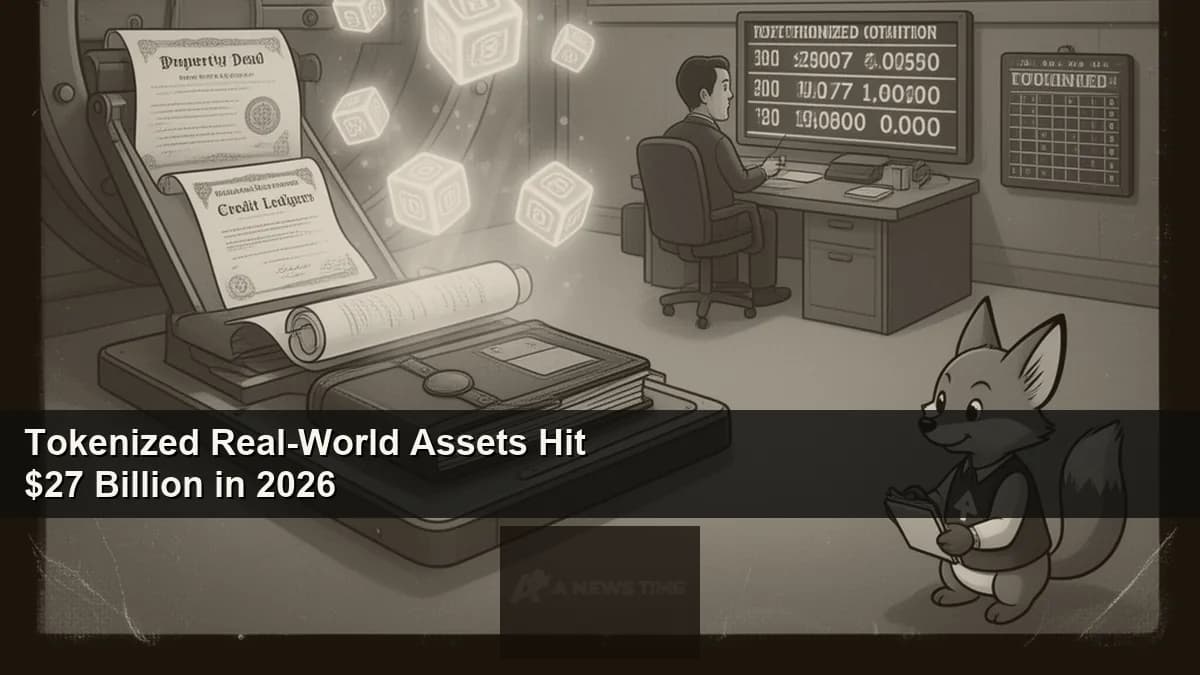
The market for tokenized real-world assets reached $27.65 billion in April 2026, a milestone that demonstrates the segment's resilience against the broader cryptocurrency market's recent volatility. While Bitcoin and Ethereum have experienced pressure from macroeconomic uncertainty driven by tariff policy and shifting monetary expectations, the RWA tokenization market has continued its growth trajectory, posting 4.07% month-over-month growth in March. The divergence reflects a structural difference in the investor base: tokenized RWAs attract institutional money that is more interested in yield and liquidity optimization than in speculative price appreciation.
The concept of asset tokenization is straightforward in principle even when the implementation is complex: traditional financial assets, including US Treasuries, corporate bonds, private credit instruments, and real estate, are represented as digital tokens on a blockchain. Those tokens can then be traded, transferred, or used as collateral in decentralized financial protocols with the settlement speed and programmability that blockchain infrastructure provides, while maintaining a legal link to the underlying asset. The result is a market that bridges traditional finance's asset quality with DeFi's technical infrastructure.
What $27.65 Billion Is Made Of
The composition of the tokenized RWA market reveals which use cases have found genuine institutional traction and which remain more theoretical:
| Asset Class | Tokenized Value (April 2026) | Primary Platforms |
|---|---|---|
| US Treasuries and government bonds | $12.78B | BlackRock BUIDL, Ondo Finance, Franklin Templeton |
| Private credit | $8.2B | Maple Finance, Goldfinch, Centrifuge |
| Commodities (gold, silver) | $3.4B | Paxos Gold, Tether Gold |
| Real estate | $1.9B | RealT, Tangible, Lofty |
| Corporate bonds and equity | $1.37B | Multiple platforms |
US Treasuries dominate the category for reasons that are straightforward from an institutional perspective. Treasury instruments are the most liquid, most credit-worthy, and most standardized assets in the global financial system. Tokenizing them adds programmability and 24/7 settlement capability without introducing credit risk or complexity. For institutions that want to hold short-duration government securities in a blockchain-native format that can be used as collateral in DeFi protocols or transferred instantly without going through traditional settlement infrastructure, tokenized Treasuries solve a real operational problem.
BlackRock's BUIDL fund, which holds short-term US Treasuries and distributes yield to token holders on a daily basis, has become the largest single tokenized fund product in the market, with reported assets under management exceeding $2.5 billion. The fund's success signals something important: when the world's largest asset manager builds a tokenized product and sees institutional demand at that scale, the use case has achieved mainstream institutional validation. That validation changes the risk calculus for other large institutions evaluating whether to participate in the RWA ecosystem.
Why Institutional Investors Are Buying In
The appeal of tokenized RWAs to institutional investors goes beyond novelty or technological preference. Several specific operational and financial advantages are driving adoption:
Settlement efficiency. Traditional bond settlement typically operates on a T+2 timeline, meaning two business days pass between trade execution and the transfer of assets and cash. Tokenized bond settlement can occur in seconds or minutes. For institutions managing large, complex portfolios with collateral requirements that need to be met precisely, faster settlement reduces the cash buffers that must be held to manage settlement timing mismatches. Over a large portfolio, the freed cash has real economic value.
24/7 liquidity. Traditional bond markets operate during business hours in their primary trading jurisdiction. Tokenized bonds trade continuously. For institutions managing global portfolios across time zones, the ability to execute transfers and collateral movements outside of traditional market hours provides operational flexibility that has genuine value in stress scenarios.
Fractional ownership. Minimum investment denominations for institutional bond products can be $100,000 or higher. Tokenization allows division into smaller units, expanding the effective market for assets that were previously accessible only to the largest investors. For private credit in particular, where deal sizes have historically excluded smaller institutional investors entirely, tokenization creates access to an asset class that offers yield premiums unavailable in public markets.
"Tokenized Treasuries solve a real institutional problem. I can hold T-bill exposure that generates daily yield, post it as collateral in the same protocol where I'm running other positions, and move it in a single transaction at 2 AM. That's operationally different from the traditional structure in ways that matter for treasury management at scale."
Portfolio manager at a major crypto-native asset management firm, industry comment, April 2026
The Geopolitical Hedge Dimension
One driver of RWA tokenization growth that has become more prominent in the Liberation Day tariff context is the search for assets that provide yield and stability while maintaining liquidity across different geopolitical and regulatory environments. Institutional investors in jurisdictions with significant exposure to US-China trade tensions have found tokenized Treasuries and private credit instruments useful precisely because they can be held and transferred in blockchain-native format without the geographic and institutional dependencies of traditional custodian-based asset holding.
This is not a mainstream institutional use case at scale, but it is a real factor in the marginal growth of RWA adoption in non-US institutional markets. The combination of US Treasury credit quality with blockchain-native transferability creates a profile that is useful as a reserve asset for institutions that want both yield and the flexibility of decentralized custody.
The growth of the private credit tokenization segment, the $8.2 billion category growing fastest within the RWA total, reflects a related but different driver. Private credit has become one of the most attractive yield sources in the current rate environment for institutional investors who can accept the illiquidity that direct lending involves. Tokenization provides a partial solution to that illiquidity problem: while the underlying loans are still illiquid, the tokens representing claims on those loans can be traded on secondary markets, creating a liquidity option that traditional private credit structures do not provide.
Regulatory Progress and Remaining Risks
The growth of the tokenized RWA market to $27.65 billion has occurred in a regulatory environment that is still evolving. In the United States, the SEC's guidance on when tokenized assets qualify as securities, and the corresponding registration and disclosure requirements, has been developing through a combination of guidance documents and enforcement actions. The 2026 regulatory environment is considerably clearer than 2023, but the remaining ambiguities are sufficient to keep some institutional investors on the sidelines pending clearer frameworks.
The European Union's MiCA regulation, which came into full effect in 2025, provides the most comprehensive existing framework for tokenized assets in a major jurisdiction. European-domiciled platforms operating under MiCA have clearer operating parameters than their US counterparts, and the EU has seen a disproportionate share of regulatory-compliant RWA platform development as a result. The competitive dynamics of regulatory arbitrage may shift as the US regulatory picture clarifies, but for now, MiCA compliance is a genuine platform advantage in European institutional markets.
The credit quality risk in private credit tokenization deserves specific attention as the market grows. Tokenization improves the liquidity and transferability of private credit instruments, but it does not improve the credit quality of the underlying loans. In a credit cycle where private credit default rates rise, the tokenized private credit market will face the same stress that traditional private credit markets face, potentially amplified by the secondary market dynamics of token trading creating pressure that traditional illiquid structures would not generate. As we covered in our earlier analysis of cryptocurrency investment considerations, yield-bearing tokenized products require the same credit analysis discipline as any yield instrument.
The $100 Billion Horizon
Industry analysts tracking the RWA tokenization market have consistently projected that the sector will reach $100 billion within the next 24 to 36 months if current growth rates continue. At $27.65 billion with 4% monthly growth, the arithmetic supports that projection, though growth rates in emerging financial markets rarely extrapolate in straight lines. The next phase of growth requires broader regulatory clarity, more institutional infrastructure for tokenized asset custody and trading, and continued development of the DeFi protocols that make tokenized assets useful in composable financial applications.
The market that exists today at $27.65 billion is still dominated by US Treasuries and private credit, which are the lowest-complexity entry points for institutional adoption. The higher-complexity categories, including tokenized real estate, infrastructure assets, and private equity, represent the larger long-term market but require more legal and operational infrastructure to implement at scale. The trajectory from $27.65 billion to $100 billion will be shaped substantially by how quickly those higher-complexity categories develop the institutional frameworks that make large-scale adoption possible.