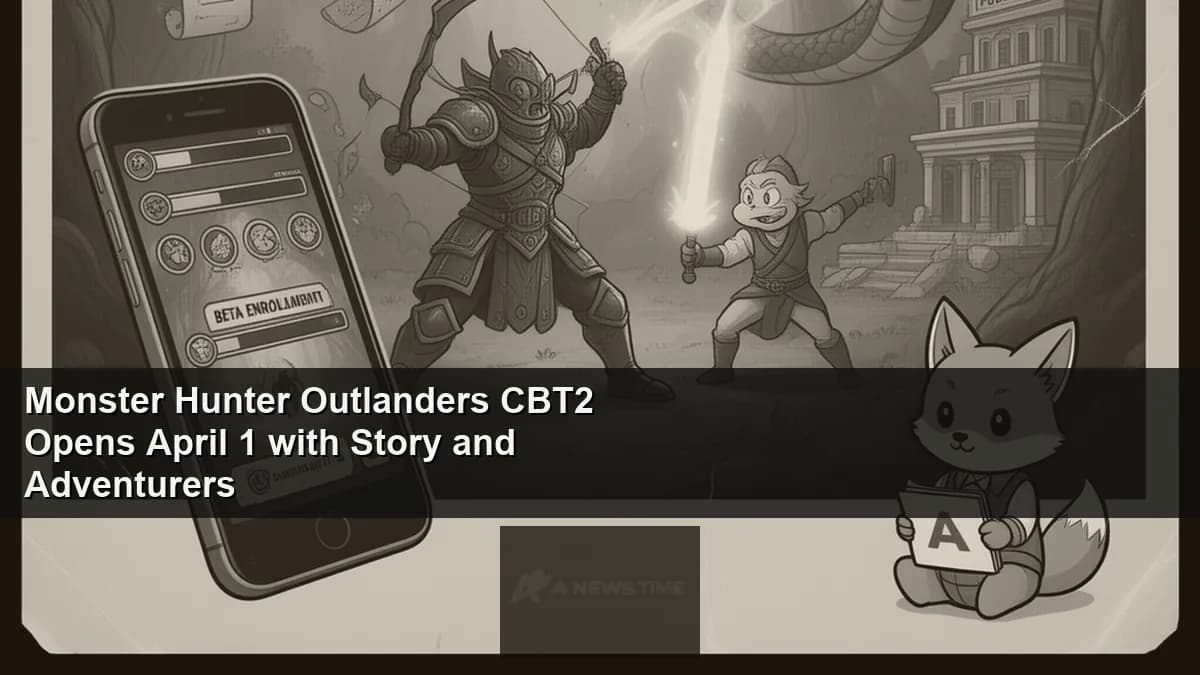
Capcom and TiMi Studio Group opened applications for the second closed beta test of Monster Hunter Outlanders on , with the test period running through . Available on iOS and Android, the second CBT2 represents a substantially expanded build compared to the first beta that ran in , adding story content, a reworked progression system, the Adventurer companion mechanic, and several monster additions that were not available for testing in the initial build. For the hunting game franchise's enormous console and PC fanbase, CBT2 is the first real evaluation of whether the mobile entry can stand alongside the mainline series rather than merely borrowing its name.
Monster Hunter Outlanders is developed by TiMi Studio Group, the Tencent subsidiary responsible for Honor of Kings and PUBG Mobile among other large-scale mobile titles, in collaboration with Capcom, which holds the Monster Hunter intellectual property and is providing creative oversight, lore approval, and monster design assets. The collaboration model is similar to what Capcom has used for other mobile entries, though TiMi's scale and mobile-specific expertise is a different development profile than the internal Capcom teams that built the mainline series.
What CBT2 Adds That the First Beta Lacked
The first closed beta in November 2025 was primarily a combat validation test, focused on whether the core hunting loop, tracking, engaging, and defeating large monsters with weapon arts adapted from the mainline series, translated to touchscreen controls with sufficient fidelity to satisfy Monster Hunter veterans. Feedback from that test was mixed on the control responsiveness for weapon types that require precise input timing, particularly the Charge Blade and Long Sword, and TiMi's team identified touchscreen haptic feedback calibration as a priority improvement area.
CBT2 addresses those concerns with a redesigned virtual control scheme and expanded hardware controller support. Players with Bluetooth game controllers can now use full analog stick input for all weapon types, which reviewers who received early access described as substantially improving the feel of weapon arts that depend on positional precision. The touchscreen improvements include a new aim-assist toggle and a more generous timing window for weapon combos that reviewers said made the experience less demanding for players unfamiliar with mobile gaming's accuracy constraints.
"CBT2 is a different game from CBT1. The story gives you a reason to care about what you're hunting, the Adventurer adds a tactical layer that the first test was missing, and the controls are finally good enough that long-time Monster Hunter players won't spend the first hour frustrated."
A gaming reviewer in early access, in a preview published to their YouTube channel prior to CBT2 opening
The story mode addition is the most significant content expansion. Monster Hunter Outlanders is set in a new world that Capcom has positioned as part of the series' established lore, with new environmental biomes, a civilization backstory that connects to the series' ecological themes, and a protagonist whose narrative arc is told through cutscenes and NPC interactions rather than silent environmental storytelling. Capcom has been secretive about where in the Monster Hunter timeline the story is positioned, but the use of existing monster species in the trailer footage confirms that it shares the same ecological world as the mainline games.
The Adventurer System Explained
The Adventurer mechanic, absent from CBT1 and central to CBT2, introduces companion characters who accompany the player on hunts and contribute passive abilities, combo assists, and mounted attacks that modify the combat dynamic. In the mainline Monster Hunter series, the closest analog is the Palico companion, a small cat-like creature that provides support functions. The Adventurer system is more complex, featuring human-scale characters with individual skill trees, personality-driven dialogue, and relationship progression systems that affect their behavior in combat.
The system appears designed to serve both solo players, who benefit from the Adventurer's AI-controlled combat contribution on difficult hunts, and social players, who can replace the AI Adventurer with a real co-op partner in multiplayer sessions. That dual function is a design choice that reflects the audience split in mobile gaming between players who engage alone and those who organize with guilds and friend groups.
Three Adventurer characters are available in CBT2, with more confirmed for the full launch. Each has a distinct combat role: one functions as a tank-type who draws monster attention and creates openings, one focuses on area damage during moments when the monster is stunned or trapped, and one supports the player character with healing and buff application. The Adventurer's abilities use a cooldown-based system rather than the resource management of weapon arts, creating a rhythm of combat decisions around both the hunter's own timing and the Adventurer's ability availability.
New Monsters in CBT2
Monster roster is the most important single variable in any Monster Hunter title, and Capcom has introduced three new monsters to the CBT2 build that were not available in the first beta. The additions represent the biome diversity that the game's marketing has emphasized: an ice-element dragon for the frozen tundra biome, a poison-based insectoid that burrows through the forest floor biome, and a returning classic from the mainline series, confirmed as Rathalos, whose appearance in CBT2 functions as both a familiar reference point for franchise veterans and as a benchmark for evaluating the game's rendering quality.
Rathalos's inclusion is significant because it is the monster the franchise's long-term community uses as a quality bar. Every Monster Hunter game is informally evaluated by how its Rathalos fight feels, and including it in the beta allows the most opinionated segment of the fanbase to form opinions about the mobile entry against a shared reference point rather than against only new designs they have no prior experience with.
| Monster | Biome | Element | Status (CBT2) |
|---|---|---|---|
| Rathalos | Ancient Forest | Fire | Available (fan benchmark) |
| Unnamed ice dragon | Frozen Tundra | Ice | New in CBT2 |
| Unnamed insectoid | Verdant Forest | Poison | New in CBT2 |
| Returning monster (CBT1) | Desert Wastes | Earth | Carried over from CBT1 |
The Monetization Preview: What Has Been Shown
Mobile Monster Hunter games have historically attracted scrutiny for their monetization structures, and CBT2 has provided enough of a preview to form initial impressions without full clarity on the final model. The beta includes a gatcha-adjacent system for acquiring Adventurer characters and certain equipment appearances, a crafting system for weapon and armor progression that mirrors the mainline series' resource-gathering loop, and a battle pass structure with seasonal rewards.
The critical question for the fanbase is whether the weapon and armor crafting system, which is the mechanical heart of every Monster Hunter game, is achievable through normal gameplay or is gated by premium currency. Based on beta content, weapon and armor progression appears to follow a craftable route using materials obtained from hunts, consistent with the mainline series model. The premium currency tracks appear to be concentrated on cosmetic options and Adventurer character access, which is a structurally healthier model than gating power progression behind spending.
Final judgment on monetization cannot be rendered from a beta, as developers routinely adjust the economy between test and launch. What CBT2 has established is that the fundamental gameplay loop, the part that makes Monster Hunter games compelling, is present and functional without payment, and that the premium content appears to be additive rather than a restriction on the core experience. That assessment can change, but it is an encouraging starting point for a franchise whose console and PC identity is built entirely around earned progression through skilled play.
What the Full Launch Timeline Looks Like
Capcom has not confirmed a full global launch date for Monster Hunter Outlanders. The CBT2 application window and test period running through mid-April suggests that TiMi and Capcom are still processing feedback that will inform final adjustments before launch, which makes a global release before mid-2026 unlikely. Industry observers tracking the mobile Monster Hunter space have speculated on a launch in the window, possibly timed to align with a marketing moment in the Monster Hunter calendar.
The game's place in the expanding mobile gaming market is strategically important for Capcom, which has built an exceptionally strong console and PC franchise but has not yet fully captured the mobile audience that plays hunting-style games in large numbers through titles like Genshin Impact and Bandai Namco's Tales of series entries. A successful Outlanders launch would be Capcom's most significant mobile presence in a genre the company pioneered but has not yet dominated on mobile.
TiMi's involvement brings production scale and mobile distribution expertise that Capcom does not have in-house. The collaboration is structured with Capcom maintaining creative control over lore, monster design accuracy, and franchise consistency, while TiMi handles the engine optimization, matchmaking infrastructure, and live service operational model that make or break mobile games at scale. Whether that collaboration produces something that satisfies both casual mobile gamers and franchise veterans is the question that CBT2 is designed to help answer, and the feedback from the test period through April 12 will shape what version of the game eventually reaches global launch.