Byline: Kieran Wolfe, Senior Gaming Reporter
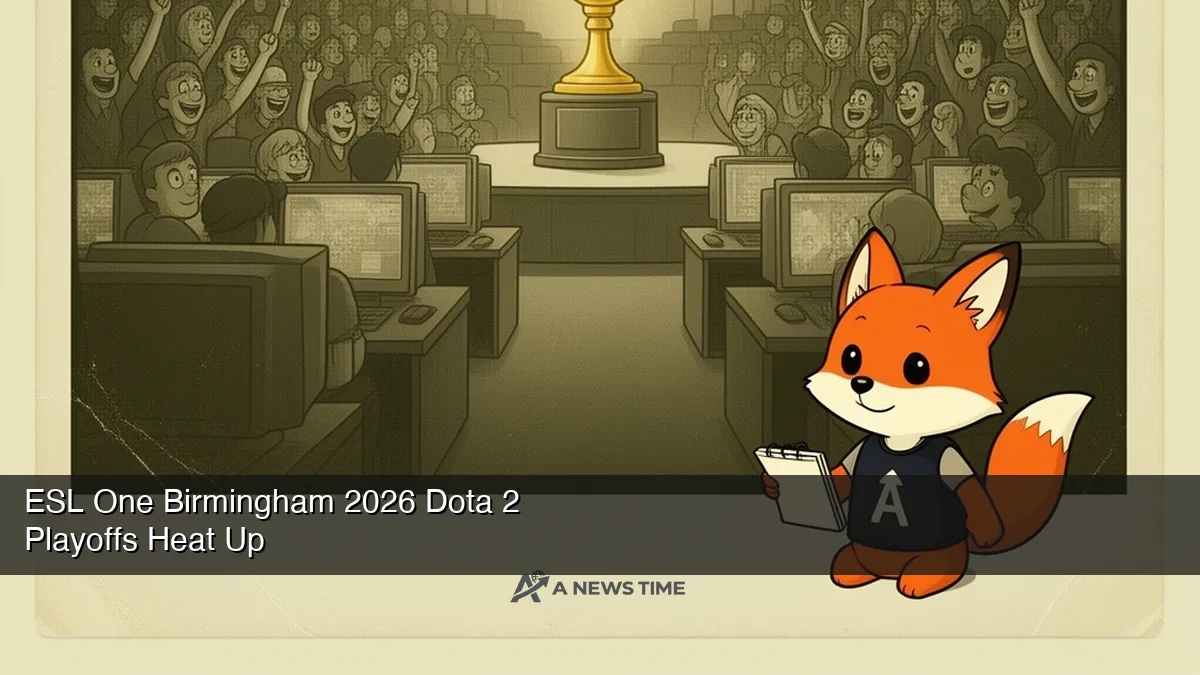
The ESL One Birmingham 2026 Dota 2 tournament has reached the playoff stage with a collection of results that nobody in the community fully predicted, and the bracket is set up for a grand final that could settle several unresolved questions about the current meta and the regional power balance heading into the second half of the competitive year. Held at DreamHack Birmingham from to , the event carries a $1 million prize pool and features 16 of the world's top teams competing across a full double-elimination playoff bracket. What the group stage delivered was a reminder that Dota 2 at the top level remains one of the most unpredictable competitive games in esports, where even small meta adjustments can invert expected power rankings overnight.
Group Stage Results: Who Came Through and Who Went Home
Group A produced the cleaner narrative of the two groups. Team Yandex topped the standings with a 5-2-0 record, demonstrating the kind of consistent execution that has made them one of the most reliable sides in Western European Dota 2 since their roster finalized late last year. Tundra Esports finished second at 4-3-0, a record that does not fully capture how dominant they looked in their best performances during the group. MOUZ qualified in third at 4-0-3, a series record that highlights their draw-heavy style: disciplined, methodical, and deeply resistant to the high-variance play that higher-seeded opponents often try to impose. PARIVISION rounded out the Group A qualifiers at 2-2-3, earning their playoff spot on the strength of a late-group surge that eliminated teams with better overall records.
Group B was considerably more volatile. Aurora Gaming ran through the group at 6-1-0, a dominant performance that placed them as one of the pre-playoff favorites and suggested their off-season changes had produced a more cohesive and tactically flexible unit than the one that underperformed at several events earlier in the season. Team Spirit qualified second at 5-1-1, though they showed signs of the inconsistency that has plagued them intermittently since their roster transitions. Team Falcons earned third place at 3-3-1, and Xtreme Gaming scraped through at 1-4-2, a result that few analysts predicted and that would set up one of the more compelling storylines of the playoff bracket.
The teams eliminated in the group stage form a list that reflects just how deep the current field is. GamerLegion, BetBoom, Yakult Brothers, REKONIX, Virtus.pro, paiN Gaming, OG, and Nigma Galaxy all departed without reaching the playoffs. The elimination of OG is particularly noteworthy: the organization carries enormous historical weight in Dota 2, having won The International twice with lineups built around individual brilliance rather than systematic coordination, and their continued struggles to recapture that level of performance are a visible signal that talent alone is no longer sufficient at the top tier.
The End of Team Liquid's Eight-Year ESL Streak
Before the tournament began, one of the most discussed storylines was Team Liquid's absence from the main event. Liquid had maintained an unbroken streak of ESL One appearances stretching back eight years, a consistency record that represented one of the most durable organizational achievements in competitive Dota 2. That streak ended in the WEU qualifier, where they were eliminated by MOUZ in a match that was closer than the result suggests but decisive in its outcome.
Jeremiah Sevilla, covering the event for Dot Esports, described the loss as "a watershed moment for WEU Dota 2," noting that the qualifier result reflects a genuine shift in regional dynamics rather than simply a bad tournament for Liquid. MOUZ, who have been ascending steadily through the competitive hierarchy over the past 18 months, appear to have crossed the threshold from "difficult opponents" to "legitimate top-tier threats," and their Group A performance confirmed that assessment.
For Liquid's leadership and roster, the streak's end carries genuine weight. Long-running records of this kind become part of an organization's identity, a proof point for recruitment, sponsorship negotiations, and fan loyalty. Rebuilding that kind of institutional momentum takes time, and the team will need to examine whether their current roster configuration and strategic approach are capable of returning them to the level of consistent qualification they maintained for nearly a decade.
Playoff Results: Tundra's Dominant Upper Bracket Run
The playoff bracket has been defined, so far, by Tundra Esports. Their performance in the upper bracket has been one of the most clinical displays of controlled Dota 2 seen at an ESL One event in recent memory. They dismantled Aurora Gaming 2-0 in their first upper bracket match, eliminating the team that had looked most dominant during the group stage, and then defeated Team Yandex 2-0 to advance directly to the upper bracket final. Those results mean Tundra has played four playoff games and won all four, without dropping a single map.
The Tundra performance deserves analysis beyond the win-loss record. Their draft selection has been exceptionally well-calibrated to the current patch, prioritizing the kinds of high-tempo, objective-focused compositions that punish slower teams before they can execute their ideal mid-game. Against Aurora, they identified the specific draft tendencies that Aurora had leaned on throughout the group stage and disrupted them systematically, not through individual mechanical superiority but through preparation and adaptability. Against Yandex, they showed a different face: patient in the early game, precise in the mid-game, and suffocating in the late stages.
The lower bracket has delivered its own compelling storyline through Xtreme Gaming. After barely qualifying from Group B with a 1-4-2 record, they have won two consecutive series: eliminating Team Spirit 2-1 in a match that included what observers on Hawk.live called one of the highest-quality individual performances of the tournament, and then defeating PARIVISION 2-1 in a tightly contested series that went to a third game decided in under 35 minutes.
The Grand Final Setup: Tundra vs. the Lower Bracket Gauntlet
The grand final will feature Tundra Esports against the winner of the Team Yandex versus Xtreme Gaming lower bracket match. This structure creates an interesting set of scenarios. If Yandex defeats Xtreme Gaming and advances to face Tundra, the final becomes a Western European regional clash between two teams with deep familiarity with each other's tendencies and a shared draft pool. Tundra will hold the upper bracket advantage, meaning they only need to win one series while Yandex would need to win two, but the competitive edge between the sides in a fresh series is not obvious.
If Xtreme Gaming wins their lower bracket match, the grand final narrative becomes significantly more compelling. A team that barely qualified from the group stage defeating two opponents in the lower bracket and then taking on the dominant upper bracket finisher would represent one of the more dramatic tournament arcs in recent Dota 2 history. Xtreme Gaming's style, volatile and individually brilliant in ways that systematic preparation struggles to fully counter, creates genuine uncertainty about how Tundra would approach the matchup.
The prize stakes reinforce the competitive tension. The champion takes home $250,000, with second place earning $100,000 and third $80,000. The full prize distribution from the Liquipedia event page shows that every team from 5th-8th earns $25,000, with the group stage eliminees splitting smaller amounts at the bottom. For teams like Xtreme Gaming, a deep run is not just a competitive achievement; it is financially meaningful for organizations operating in a market where prize pool volatility is a real operational concern.
Meta Observations: What ESL Birmingham Is Teaching Us
From a design and competitive integrity standpoint, ESL One Birmingham 2026 has been a useful stress test for the current patch. The meta has stabilized enough to produce consistent strategic approaches but retains enough flexibility that teams with strong individual players can create variance through unconventional picks. That balance is not always easy to achieve in a game as complex as Dota 2, and when it works, it produces the kind of competitive ecosystem where preparation and execution both matter.
The most successful teams at this event have shared a common approach: prioritizing vision control and resource denial over raw damage output in the early and mid-game, and transitioning to high-efficiency teamfight compositions once a small gold and experience lead has been established. Teams that deviated significantly from this template, attempting to force faster game states or execute high-risk late-game strategies, paid the price in consistency even when they occasionally produced spectacular individual performances.
For fans of competitive Dota 2, the format itself warrants acknowledgment. The double-elimination structure, combined with a group stage that provides meaningful context for seeding, is among the fairest formats in esports. It allows teams that stumble in the group stage to recover, as Xtreme Gaming has demonstrated, while rewarding consistency with genuine structural advantages. Compared to some of the single-elimination or round-robin formats used at smaller events, the ESL One approach produces more meaningful individual series and cleaner competitive narratives.
The broader context for this event sits within a packed 2026 esports calendar. As we detailed in our overview of 2026 shaping up as a record year for esports prize pools, the competition for top Dota 2 talent is intensifying across multiple event organizers, and results here will carry real weight in team seeding and qualification for later tournaments including The International 2026.
Industry Implications: ESL One and the Dota 2 Ecosystem
The ESL One series occupies a specific and important position in the Dota 2 competitive ecosystem. Operating outside the Valve-run DPC circuit while maintaining sufficient prize pools and production quality to attract top teams, ESL One events serve as both standalone competitive achievements and preparation opportunities for the official circuit. For teams building toward The International, the performance data and draft tendencies exposed at events like Birmingham are genuine strategic intelligence that opponents will analyze and prepare against.
The attendance of 16 teams, including representation from Western Europe, Eastern Europe, Southeast Asia, and China, makes ESL One Birmingham one of the more geographically diverse Dota 2 events outside of The International itself. That diversity matters for the quality of competitive insight the event provides: a team that performs well against opponents from multiple regions has demonstrated adaptability across different playstyle traditions, which is a more meaningful proof of quality than dominance within a single regional circuit.
According to data from ESL's official event coverage, viewer numbers for the ESL One series have remained stable year-over-year, a positive sign in a broader esports viewership landscape that has faced pressure from content fragmentation and audience fatigue with over-scheduled event calendars. The Birmingham event's timing, positioned within a period of high competitive activity across multiple titles, has not appeared to hurt its viewership numbers, suggesting that the core Dota 2 audience remains engaged with ESL's production quality and competitive format.
The hardware pressures affecting competitive gaming more broadly are also worth noting. As we covered in our analysis of MSI's GPU price increases and the challenging hardware market in 2026, the infrastructure costs for both organizing competitive events and for players accessing high-quality hardware continue to rise. Professional teams are somewhat insulated from these pressures by organizational support, but the talent pipeline that feeds professional rosters begins with players who need accessible hardware to develop skills in the first place.
Community Reaction and What Comes Next
The competitive Dota 2 community has responded to the ESL One Birmingham playoff results with the kind of engaged analysis that distinguishes the game's audience from more casual esports viewership. Discussion across Reddit's r/DotA2 subreddit, the official ESL forums, and the Liquidpedia talk pages has focused on three primary themes: Tundra's draft preparation quality, the meaning of Team Spirit's lower bracket elimination for their competitive trajectory, and whether Xtreme Gaming's playoff run reflects genuine improvement or fortuitous matchmaking.
The Spirit conversation is the most consequential from a long-term perspective. Spirit have been one of the most structurally sound teams in Dota 2 for the past several years, and their 5-1-1 group stage record initially suggested they were ready to compete for the title. Their 2-1 loss to Xtreme Gaming in the lower bracket, in a series where they held leads in multiple games but failed to close, has reignited questions about their consistency under pressure that have surfaced periodically throughout their recent history.
For Tundra, the question heading into the grand final is whether their upper bracket dominance reflects a genuine performance ceiling or whether a well-prepared opponent can exploit patterns that have not been tested across five consecutive playoff wins. Tundra's coaching staff will be aware of this uncertainty and will have prepared contingency drafts for a grand final opponent that has seen their entire playoff map pool. The next 48 hours will determine whether Tundra completes one of the more commanding tournament performances of the early 2026 competitive season, or whether the lower bracket produces the upset that has been building since Xtreme Gaming's surprising playoff entry.