A newly discovered 17th-century map has solved one of the most enduring mysteries in English literary history: the precise location of the only home William Shakespeare ever bought in London. Shakespeare scholar Lucy Munro of King's College London announced the discovery on , revealing that the playwright's property was a substantial L-shaped dwelling carved from a former medieval Dominican monastery near the Blackfriars Theatre, a venue Shakespeare himself partly owned.
An Accidental Discovery in the London Archives
Like many of the best historical discoveries, this one happened by accident. Munro, a professor of Shakespeare and early modern literature at King's College London, stumbled upon the document while searching the London Archives for entirely unrelated material.
"I came across it in the London Archives when I was looking for other things," Munro said, describing the moment with the understated composure of an academic who knows the magnitude of her find. The plan of the Blackfriars precinct, dating from the 17th century, shows in detail the layout of Shakespeare's house, including its gatehouse, within the broader context of the neighborhood.
Historians have known since at least the 19th century that Shakespeare purchased property in near the Blackfriars Theatre, but the exact location was never established. A plaque mounted on a 19th-century building in the area records only that the playwright had lodgings "near this site," an acknowledgment that the precise spot had been lost to time, fire, and the relentless redevelopment of London's financial district.
"It supplies extra bits of the jigsaw puzzle of Shakespeare's life."Lucy Munro, Professor of Shakespeare and Early Modern Literature, King's College London
A Substantial Home in a Shifting Neighborhood
The map reveals that Shakespeare's property was not a modest lodging but a substantial dwelling. The L-shaped layout was carved from a former 13th-century Dominican friary that had been repurposed for secular use after King Henry VIII's dissolution of the monasteries in the mid-16th century. The Blackfriars precinct, named for the black-robed Dominican monks who once lived there, had been converted into a mixed neighborhood of residences, workshops, and cultural venues.
By the time Shakespeare bought his property, the area was what Munro describes as "desirable" but "moving slightly down-market," partly because of people like Shakespeare himself. The playwright was affluent by the standards of his era, having earned substantial profits from his theatrical career, but he was associated with the slightly disreputable world of the stage. Theater people brought money but not the social cachet of the nobility and high-ranking courtiers who had previously dominated the precinct.
"After the dissolution of the monasteries, a lot of the nobility, quite high-ranking courtiers, court officials are living in the Blackfriars," Munro explained. "By the time Shakespeare bought his property, there are still a lot of important people living there, people who make protests against the playhouses at various points, because they see the playhouses as a bit of a public nuisance."
The irony is rich: the neighbors who complained about the theater next door were living alongside a man whose work would define English literature for the next four centuries.
Where Shakespeare May Have Written His Final Plays
The discovery raises a fascinating question about Shakespeare's later creative life. The property's size and its location, a five-minute walk from the Blackfriars Theatre, suggest that Shakespeare may have spent considerably more time in London toward the end of his life than scholars have traditionally assumed.
The conventional narrative places Shakespeare in semi-retirement in Stratford-upon-Avon, roughly 100 miles northwest of London, during his final years. He died there on , at the age of 52. But Munro's discovery suggests the London property may have been more than an investment: it may have been a working residence where Shakespeare completed his last plays.
If that is the case, the house could be where Shakespeare worked on Henry VIII and The Two Noble Kinsmen, both co-written with his collaborator and eventual successor John Fletcher. These final works represent a phase of Shakespeare's career that scholars have long debated, partly because the extent of his involvement has been unclear. A working London residence near his theater would explain how the collaboration with Fletcher, who was based in London, functioned on a practical level.
"A dazzling new sense of Shakespeare the London writer. She's helped us to understand how much the city meant to our greatest ever dramatist, as a professional and personal home."Will Tosh, Director of Education, Shakespeare's Globe
From Shakespeare's Daughter to the Great Fire
Munro's archival research did not stop at the map. She also discovered two documents detailing the property's sale by Shakespeare's granddaughter, Elizabeth Hall Nash Barnard, in . Shakespeare had left the property to his daughter Susanna in his will, and it remained in the family for roughly half a century after his death.
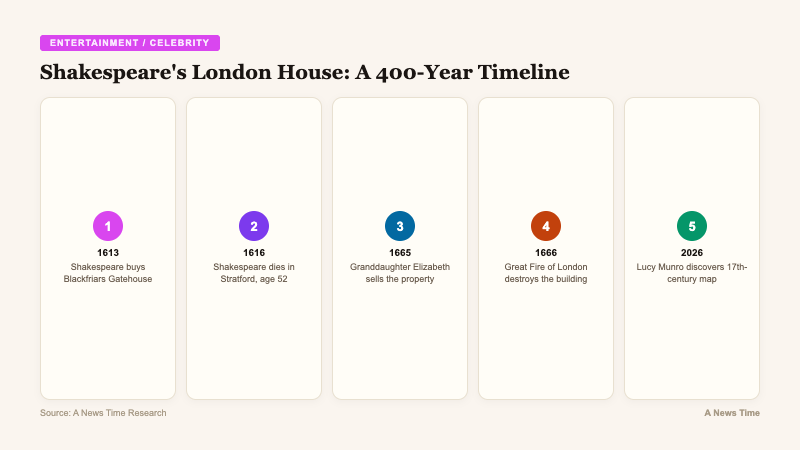
| Date | Event |
|---|---|
| Shakespeare purchases the Blackfriars Gatehouse property | |
| Shakespeare dies in Stratford; property passes to daughter Susanna | |
| Granddaughter Elizabeth sells the property | |
| Building destroyed in the Great Fire of London | |
| Lucy Munro discovers 17th-century map pinpointing the exact location |
The sale in 1665 came just one year before the building was destroyed in the Great Fire of London, which swept through much of the medieval city in . The timing was almost literary in its cruelty: had the building survived even a few more decades, it might have been preserved or at least documented more thoroughly before its destruction.

What Remains of Shakespeare's London
Very little of Shakespeare's London survives in the modern city. The area around Blackfriars is now part of London's financial district, dominated by glass and steel office towers that bear no resemblance to the timber-framed buildings of the early 17th century. A fragment of wall from the original medieval friary still stands nearby, and the street name Playhouse Yard serves as a quiet reminder that a theater once stood where bankers now commute.
Perhaps the most evocative surviving connection is the Cockpit pub, which sits across the street from the site of Shakespeare's house. The 17th-century map shows the building as the "Sign of the Cock," likely a tavern. The image of Shakespeare and his theatrical colleagues drinking at the pub across the road from his home is irresistible, and Munro's research lends it more than just romantic speculation.
"There are certainly complaints in the period about the playhouses leading to the opening of more and more drinking houses, 'houses for tippling,' as they call them in one of the documents I was looking at," Munro said.
Visitors to London can now, for the first time, stand on the precise spot where Shakespeare lived and look across at the pub where he very likely drank. For the millions of tourists who visit Stratford-upon-Avon each year to see Shakespeare's childhood home and the site of his death, the discovery adds a London pilgrimage stop that connects the playwright's professional life to a specific, visitable location.
A Discovery That Reframes Shakespeare's Final Chapter
The scholarly impact of Munro's find extends beyond geography. If Shakespeare maintained a substantial London residence during his final years, the traditional biography, in which he retired to Stratford as a wealthy gentleman who left the theater behind, needs revision. The picture that emerges instead is of a playwright who remained deeply embedded in London's theatrical world until close to the end of his life, collaborating with younger writers, investing in the industry, and living steps from the stage.
That reframing matters because Shakespeare's late plays, including The Tempest, The Winter's Tale, and the Fletcher collaborations, are often read through the lens of retirement and reflection. If Shakespeare was actively working in London rather than writing from rural distance, the creative context changes. The late romances become the work of a man still immersed in the theatrical scene rather than looking back on it from afar.
Munro's discovery, announced 410 years after Shakespeare's death, is a reminder that archival research can still transform our understanding of even the most studied figures in literary history. A single map, found while looking for something else entirely, has given Shakespeare scholars their most significant new evidence in years, and given the rest of us a reason to visit a pub across from a demolished house and raise a glass to the playwright who may have done the same four centuries ago.