
EY launched a new suite of AI accelerators on , aimed at helping enterprises bridge the gap between AI experimentation and full organizational transformation. The offering, called EY.ai Value Blueprints, targets what the firm identifies as the central failure mode in enterprise AI adoption: companies that bolt AI tools onto existing structures rather than redesigning their operations around the technology from the foundation up.
The 87% Problem: Why Most AI Implementations Stall
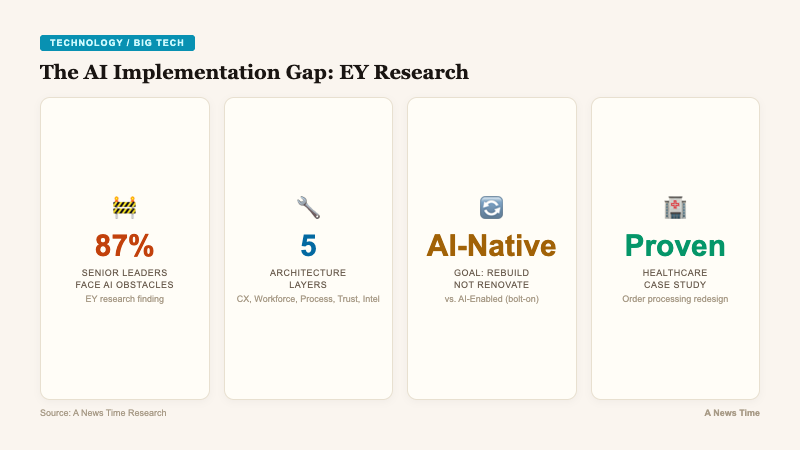
EY's own research provides the business case for the new offering. According to the firm's data, 87% of senior leaders encounter major obstacles when trying to implement AI technologies within their organizations. The obstacles are not primarily technical. They stem from organizational structures, workflows, and decision-making processes that were designed for a pre-AI era and resist the kind of fundamental changes that AI-native operations require.
Menno Bonninga, a partner at EY who leads the Value Blueprints initiative, framed the problem in terms that will resonate with executives who have been through multiple rounds of AI pilots without seeing transformative results.
"Every enterprise leader knows AI will reshape their industry. Most are pursuing the safer path of incremental adoption. But the window for competitive advantage is closing. Organizations that continue to incrementally layer AI onto legacy structures will find themselves outmanoeuvred by competitors who rebuild from the foundation."Menno Bonninga, Partner, EY
The distinction between "AI-enabled" and "AI-native" is central to EY's pitch. An AI-enabled organization uses AI tools to improve existing processes. An AI-native organization designs its processes, workflows, and decision-making structures around AI capabilities from the start. The difference, according to EY, is the difference between renovation and rebuilding.
How the EY.ai Value Blueprints Work
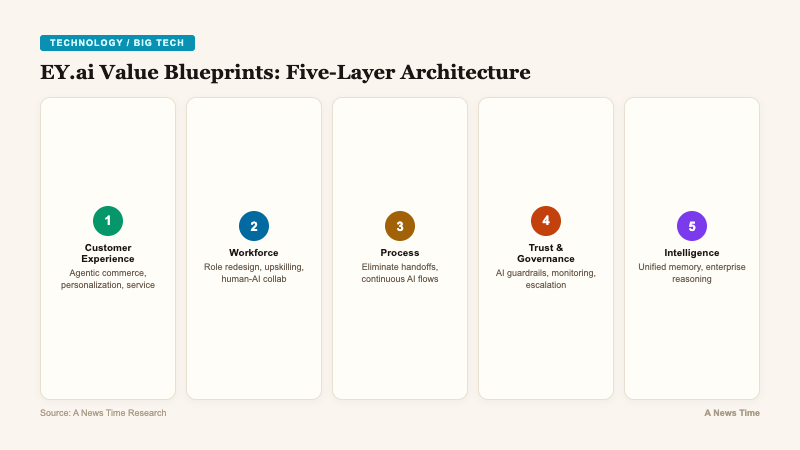
The Blueprints framework organizes an AI transformation across multiple layers that together create what EY describes as a complete architecture for intelligent operations:
| Layer | Focus | Key Activities |
|---|---|---|
| Customer Experience | External-facing AI interactions | Agentic commerce, personalization, autonomous service |
| Workforce | Human-AI collaboration | Role redesign, upskilling, strategic decision focus |
| Process | Operational redesign | Eliminate manual handoffs, continuous AI-powered flows |
| Trust & Governance | Security and ethics | AI guardrails, real-time monitoring, escalation protocols |
| Intelligence | Organizational knowledge | Unified memory, reasoning in enterprise context |
Each layer addresses a different dimension of organizational change. The customer experience layer focuses on how AI interacts with external stakeholders. The workforce layer redefines what humans do versus what AI handles. The process layer eliminates the manual handoffs and sequential workflows that slow organizations down. The trust layer ensures governance keeps pace with autonomy. And the intelligence layer builds the organizational "brain" that enables contextual reasoning across the enterprise.
Redesigning Work, Not Just Automating Tasks
The workforce layer is perhaps the most consequential for organizations considering the Blueprints framework. Bonninga emphasized that building an AI-native organization requires rethinking how human expertise is deployed, not merely adding AI tools to existing job descriptions.
"Redefining roles and responsibilities of human experts requires upskilling initiatives to enable more effective collaboration with AI agents. Human experts focus on interpreting complex outputs and handling strategic decisions that require the judgment, creativity, and contextual understanding that only people can provide."Menno Bonninga, Partner, EY
The process redesign component aims to eliminate what EY identifies as one of the biggest sources of inefficiency in current AI implementations: manual handoffs between AI-powered steps. In many organizations, AI automates individual tasks but the outputs still flow through human-managed workflows for review, approval, and forwarding. The Blueprints approach designs processes as continuous flows that leverage AI's ability to operate around the clock, with human intervention reserved for strategic decisions and exception handling.
Trust Architecture: Governance at the Speed of AI
The trust and governance layer addresses a concern that has become increasingly urgent as AI systems take on more autonomous decision-making. EY's framework calls for governance that is built directly into the AI architecture rather than applied as an oversight layer after deployment.
The practical requirements include:
- Clear decision boundaries: Frameworks that establish what levels of decisions AI can make autonomously versus which require human approval
- Real-time monitoring: Systems that track AI performance patterns and flag anomalies before they become problems
- Escalation protocols: Defined pathways for bringing humans into the loop for strategic decisions
- Embedded security: Ethical guardrails and security controls integrated directly into the code rather than applied externally
- Accountability frameworks: Clear ownership of outcomes regardless of whether a decision was made by a human or an AI agent
This approach aligns with the broader industry conversation about agentic AI governance, where the challenge is maintaining appropriate oversight without eliminating the speed and efficiency gains that AI provides. The recent wave of AI security concerns has made this a board-level priority for enterprises across sectors.
Healthcare Client Case Study Shows Early Results
EY points to a global healthcare client as an early validation of the Blueprints approach. The client used the framework to redesign its order processing system, replacing fragmented manual workflows with a single, streamlined interface powered by automation and intelligent orchestration.
The results, according to EY:
- Reduced manual work in order processing
- Improved customer engagement and satisfaction scores
- Stronger revenue protection through fewer order errors
- More available working capital from faster processing cycles
- Employee time freed from routine tasks for higher-value work
The case study illustrates the difference between automation (making existing order processing faster) and transformation (redesigning the entire order flow around AI capabilities). The former yields incremental improvements. The latter, according to EY's data, produces compounding gains as each layer of the architecture reinforces the others.
Where EY Fits in the Enterprise AI Landscape
EY's Value Blueprints launch positions the firm alongside the other Big Four consultancies, all of which have been aggressively expanding their AI service offerings. Deloitte, McKinsey, Accenture, and others have each staked out territory in the enterprise AI transformation market, creating a competitive landscape where the consulting firms serve as intermediaries between AI technology providers and the enterprises attempting to adopt their products.
The timing of the launch is notable. Enterprise AI spending has continued to accelerate in despite the global economic uncertainty caused by the Iran war, suggesting that companies view AI transformation as a strategic necessity rather than a discretionary investment. EY's framework is designed to capture a share of that spending by offering a structured approach to a process that many organizations have been pursuing ad hoc.
The core question for prospective clients is whether the Blueprints framework delivers enough specificity and customization to justify the consulting engagement, or whether it represents a repackaging of principles that organizations could apply independently. Bonninga's framing suggests that the value lies not in the framework itself but in EY's ability to apply it across the five layers simultaneously, a coordination challenge that few organizations can manage internally while also running their existing operations.
The winners in the AI transformation race, as Bonninga put it, "are doing different things, not just doing things differently." Whether EY's Value Blueprints can consistently produce that distinction at enterprise scale will determine how the offering is received in a market that is increasingly skeptical of AI hype and hungry for measurable results.