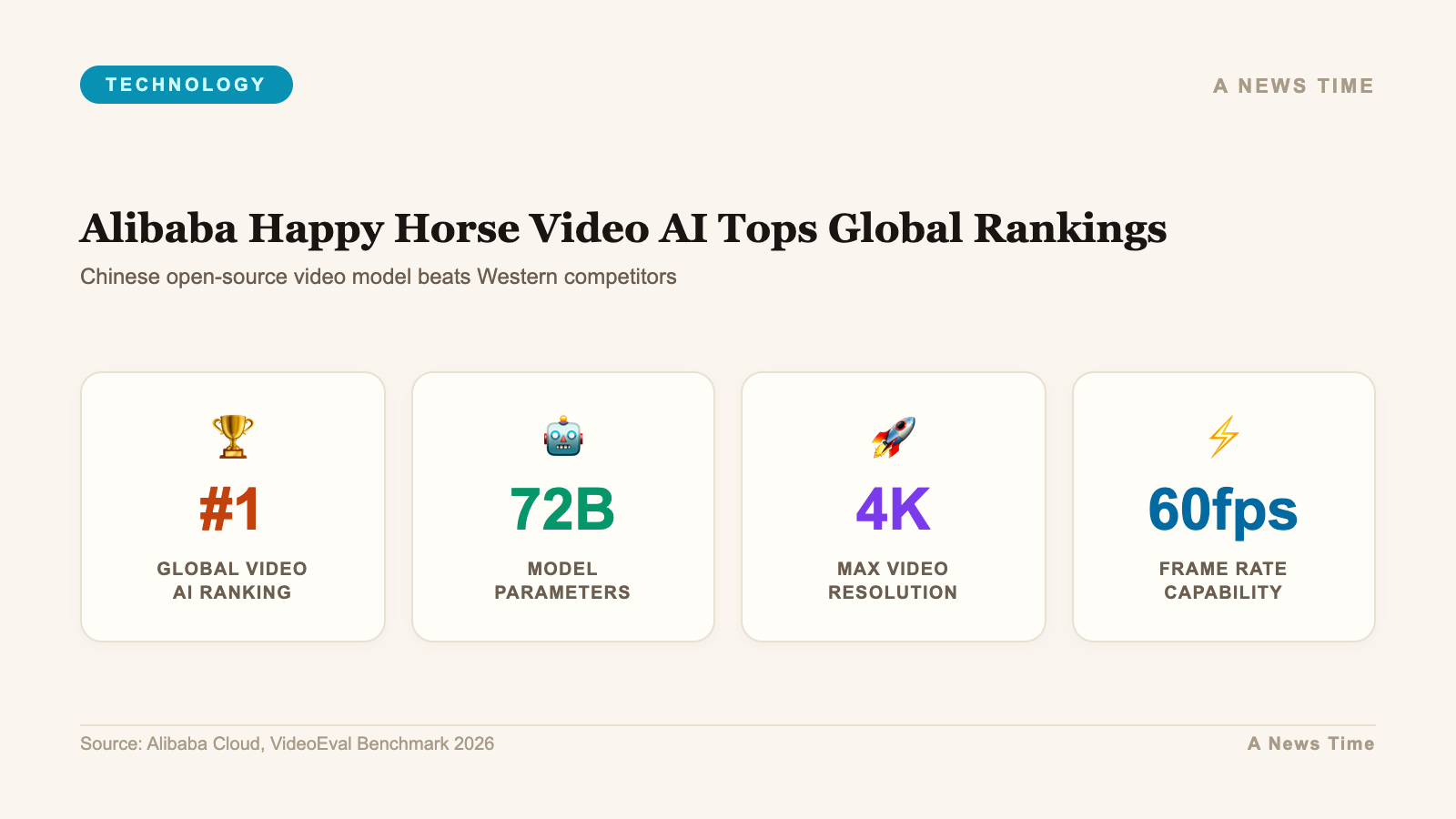
On , Alibaba broke cover on a secret. A video AI model called Happy Horse 1.0 had been topping the Artificial Analysis text-to-video leaderboard for several days before anyone knew who built it. When the platform's anonymous testing period ended, Alibaba claimed it. The revelation rippled through China's tech industry, not just because the model was good, but because of how it won: quietly, without a launch event, a press release, or a single tweet from the company.
The stealth-launch approach is deliberate. Alibaba wanted the performance results to stand on their own before attaching a brand name that would invite competitive scrutiny. It is a strategy that reflects how heated the Chinese AI race has become: when you lead the leaderboard, you let the numbers speak first.
What Happy Horse 1.0 Accomplished
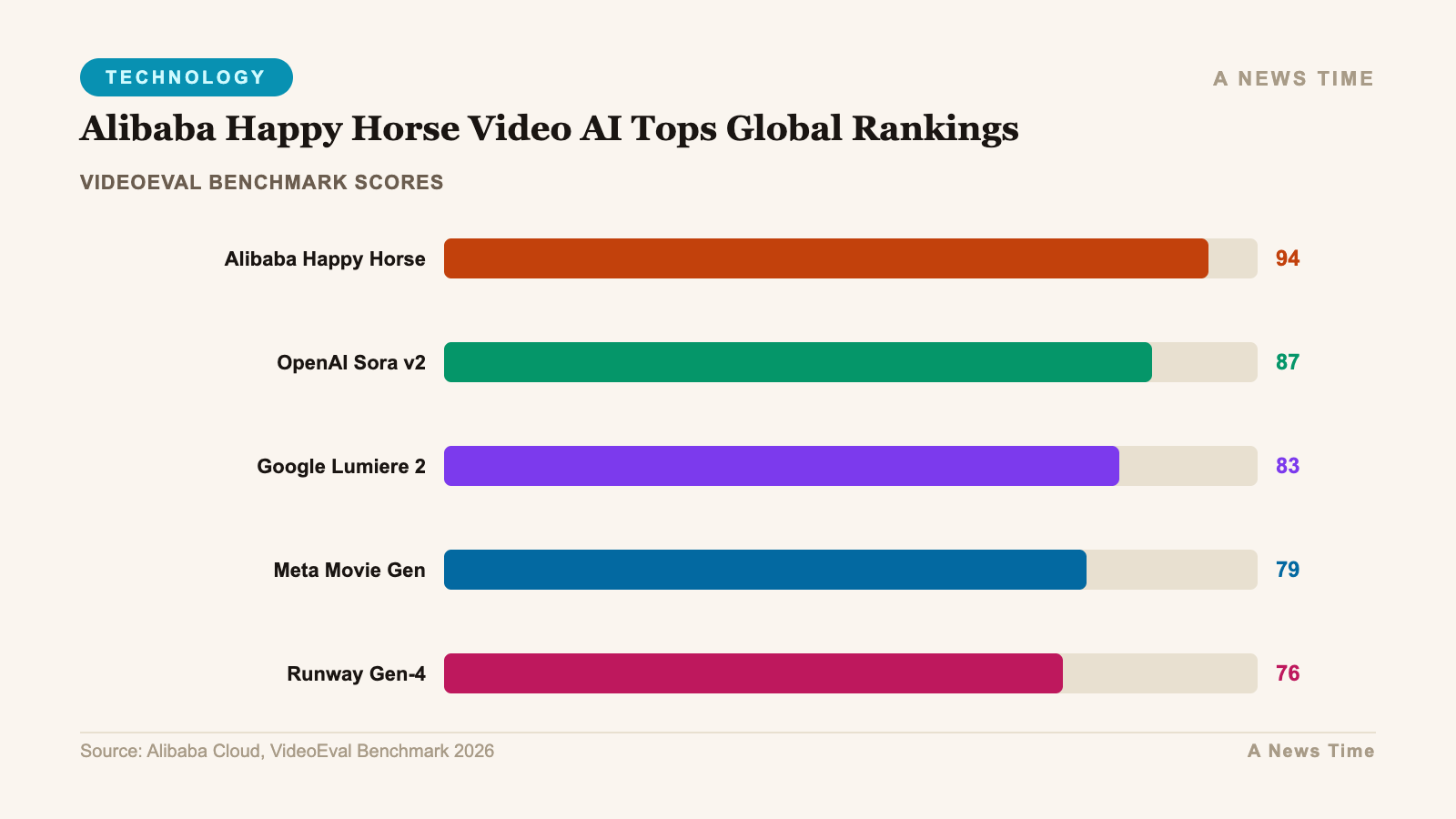
Artificial Analysis is one of the most watched independent benchmarking platforms in AI. Its video leaderboard evaluates text-to-video models on a range of criteria: temporal consistency across frames, physical plausibility of motion, prompt adherence, visual quality, and overall coherence. These are the dimensions that matter most for real production use.
Happy Horse 1.0 reached the top spot in the text-to-video category, displacing ByteDance's SeeDance, which had previously held that position. Beating ByteDance is meaningful in this context. SeeDance was built by a company with 100 million daily active users for its Doubao AI chatbot, extensive consumer feedback loops, and deep investment in video content through its media and short-form video operations. That Alibaba dethroned it with a model most people had never heard of says something about the pace of development inside the Alibaba Token Hub unit.
The model is still in beta testing. An Alibaba spokesperson confirmed it was under development within the Token Hub's innovation business unit, and that the leaderboard performance came during that testing phase. The version that eventually goes to production may look different from what achieved the top ranking, but the benchmark result is real and independently verified.
Alibaba Token Hub: The Reorganization Behind the Model
Understanding Happy Horse requires understanding what Alibaba Token Hub is. In early , Alibaba completed a sweeping reorganization of its AI operations, consolidating five previously separate divisions into a single unit called the Alibaba Token Hub (ATH) under CEO Eddie Wu's direct oversight.
The five units merged into ATH were Tongyi Laboratory (Alibaba's foundational model research division), Qwen (the open-source model family that has become one of the most widely adopted models globally), Wukong (an enterprise AI division), a cloud AI services operation, and the newer consumer-facing AI products team. Previously, these operated with separate leadership, separate roadmaps, and separate product strategies. The consolidation puts all of them under a single organizing mission.
ATH is built around a single organising mission: create tokens, deliver tokens and apply tokens.
Eddie Wu, CEO, Alibaba, in letter announcing Token Hub reorganization
Happy Horse came out of the Token Hub's innovation business unit, which sits inside this new structure. The reorganization is relevant because it explains why this model exists at all. Prior to ATH, video generation would have been one initiative among many competing for resources and attention across five separate teams. Under the consolidated structure, it becomes part of a focused mandate to push across every application of token-based AI, including video.
China's Video AI Race: ByteDance, Alibaba, and the Field
The rivalry between Alibaba and ByteDance in video AI is one of the most technically consequential in the industry globally, not just within China. Both companies have structural advantages that most AI labs do not: ByteDance through its TikTok and Douyin short-form video platforms, which provide billions of user-generated video examples and real-time feedback on what content people engage with; Alibaba through its e-commerce infrastructure, cloud services, and the Qwen model family that has become a platform for third-party developers worldwide.
SeeDance, the ByteDance model that Happy Horse displaced, had itself been advancing rapidly. ByteDance has 100 million daily active users on Doubao as of early and uses that consumer base as a continuous feedback mechanism for its AI products. The fact that Alibaba surpassed it, at least temporarily on an independent benchmark, reflects how compressed the innovation cycles have become.
| Model | Company | Status as of April 10, 2026 |
|---|---|---|
| Happy Horse 1.0 | Alibaba (Token Hub) | No. 1, Artificial Analysis text-to-video leaderboard |
| SeeDance | ByteDance | Previously No. 1; displaced by Happy Horse 1.0 |
| Doubao (chatbot) | ByteDance | 100 million daily active users, China's most-used AI app |
| Qwen (open-source) | Alibaba | Widely adopted globally; base for Meta Muse Spark training |
Other players are also active. Tencent launched ClawBot in March, integrating OpenClaw access directly into WeChat for its one billion monthly active users. Xiaomi and Meituan have both released their own large models. The competitive dynamic inside China is one where every major tech company feels existential pressure to have a frontier AI product, and the video generation category has become one of the primary battlegrounds.
How Chinese Models Are Winning Global Benchmarks
The broader context for Happy Horse's leaderboard result is that Chinese models have been outperforming U.S. models on OpenRouter, a popular marketplace for AI models, and increasingly competing for top positions on independent benchmarks across multiple categories.
Alibaba's Qwen family has been a particular success story in this regard. The models are open-source, which dramatically lowers the barrier to adoption for developers who cannot or will not pay for proprietary models from OpenAI and Anthropic. That accessibility has driven Qwen's spread to Southeast Asia, the Middle East, and Western markets. Meta's most recent model, Muse Spark, was reportedly trained partly on Qwen outputs, a detail that received significant attention when it became public in early April.
For video generation specifically, the Chinese competitive advantage comes partly from the scale of domestic video production and consumption. China's short drama industry generated roughly 470 new dramas every day in January 2026, with AI-assisted production now accounting for a substantial fraction of that output. A short drama that once cost 1 million yuan to produce can now be made for around 100,000 yuan using AI tools, with production windows shrinking from weeks to days. That industrial demand creates training data, user feedback, and commercial incentives for video AI development that few markets outside China can match.
What Makes Happy Horse Technically Different
Alibaba has not published a detailed technical paper on Happy Horse 1.0, and because it is still in beta, the full architecture is not public. What is known from the Artificial Analysis benchmark results is that it outperforms current alternatives on the evaluation criteria the platform uses, which center on the quality and consistency of generated video from text prompts.
Given Alibaba's prior work on video AI and the Qwen model family, it is reasonable to infer that Happy Horse builds on multimodal training techniques that combine language understanding with video generation. The leaderboard performance suggests particular strength in temporal consistency, meaning the generated video does not exhibit the visual artifacts and scene discontinuities that affect weaker models across longer sequences.
What the benchmark cannot fully capture is how the model performs on the production use cases that matter most: complex prompts, edge cases, non-standard aspect ratios, and the kinds of domain-specific requests that industrial users make. The beta testing phase that Happy Horse is currently in will likely surface those performance characteristics before any public launch.
Export Controls and What They Can and Cannot Stop
The U.S. government's export controls on advanced AI chips were designed to keep Chinese AI companies from closing the gap on frontier model capabilities. The Happy Horse result, and the broader picture of Chinese model performance in early 2026, raises legitimate questions about how well that strategy is working in video AI specifically.
The chip controls are real and have genuine effect. Chinese companies cannot legally access Nvidia's most advanced H100 and H200 chips at scale through official channels. They rely on Huawei's Ascend chips for domestic training, overseas data centers that operate in regulatory gray areas, and hardware sourced through grey markets at significant premium. Alibaba's April 8 announcement that it had built a data center running entirely on its own home-designed Zhenwu chips suggests active investment in chip sovereignty, but even Alibaba acknowledges that performance and production yield still lag the U.S. supply chain.
What the controls cannot stop is algorithmic innovation. The advances in Chinese video AI models reflect genuine research contributions in model architecture, training methodology, and data curation, not simply a function of having more compute. When Alibaba's researchers develop a model that tops a global benchmark, the achievement is not just about raw processing power. It is about making better use of the compute that is available, which is itself a form of advantage that export controls do not address.
Mohit Kumar, Jefferies' global macro strategist, told Fortune in mid-March that China holds a real edge in the AI race due to a combination of model valuation, wider AI adoption rates, and power generation capacity. Goldman Sachs estimates China will have approximately 400 gigawatts of spare power capacity by 2030, roughly three times projected global data center demand. Energy is increasingly a binding constraint on AI infrastructure. That constraint affects American companies too.
What the Stealth Launch Strategy Signals
The manner of Happy Horse's reveal deserves attention as a strategic signal. Chinese tech companies have historically announced AI milestones with significant fanfare: press conferences, official statements, detailed capability announcements designed to generate press coverage and developer interest. The stealth approach Alibaba used here inverts that pattern.
By submitting the model to an independent benchmark without disclosing its origin, Alibaba allowed the results to accumulate credibility before the competitive response could mobilize. ByteDance, Tencent, and other rivals learned about the model's performance at the same time as everyone else: when Alibaba claimed it on a Friday. The element of surprise is genuine, and in a competitive environment where every leaderboard position is public and scrutinized, that matters.
It also signals a maturing approach to product strategy. Rather than announcing a roadmap and building hype before the product is ready, Alibaba built the product quietly, validated it externally, and revealed it only when the numbers were already in. For a company that spent 123 billion yuan on capital expenditure in 2025 and saw net income fall 66% as a result, demonstrating that the spending is producing world-class results has obvious shareholder value.
What Comes Next for Happy Horse
Happy Horse 1.0 is in beta, which means it is not yet available to general users or enterprise customers. What Alibaba does with it from here is an open question. The Token Hub structure suggests it will be integrated into Alibaba's broader commercial AI offering rather than remaining a standalone research demonstration. That could mean embedding it in cloud services, powering the short drama production workflows that have become a major use case in China, or making it available through the Qwen developer ecosystem that has already achieved global adoption.
The international dimension is worth watching. Qwen's spread to developers outside China shows that model quality can overcome geopolitical friction when the technology is genuinely better and the licensing is sufficiently permissive. Whether Happy Horse follows a similar path, whether as an open-source release or a commercial API, will say a great deal about how Alibaba views the global video AI market and where it sees its competitive position.
For anyone building in the video AI space, the immediate takeaway is that the benchmark landscape shifted on , and it shifted without warning. The next shift could come from any direction, including from competitors that have not yet disclosed what they are working on.
Related reading: Google Gemma 4 brings open-weight AI to Apache 2.0 licensing, OpenAI GPT-5.4 targets enterprise agentic workflows.