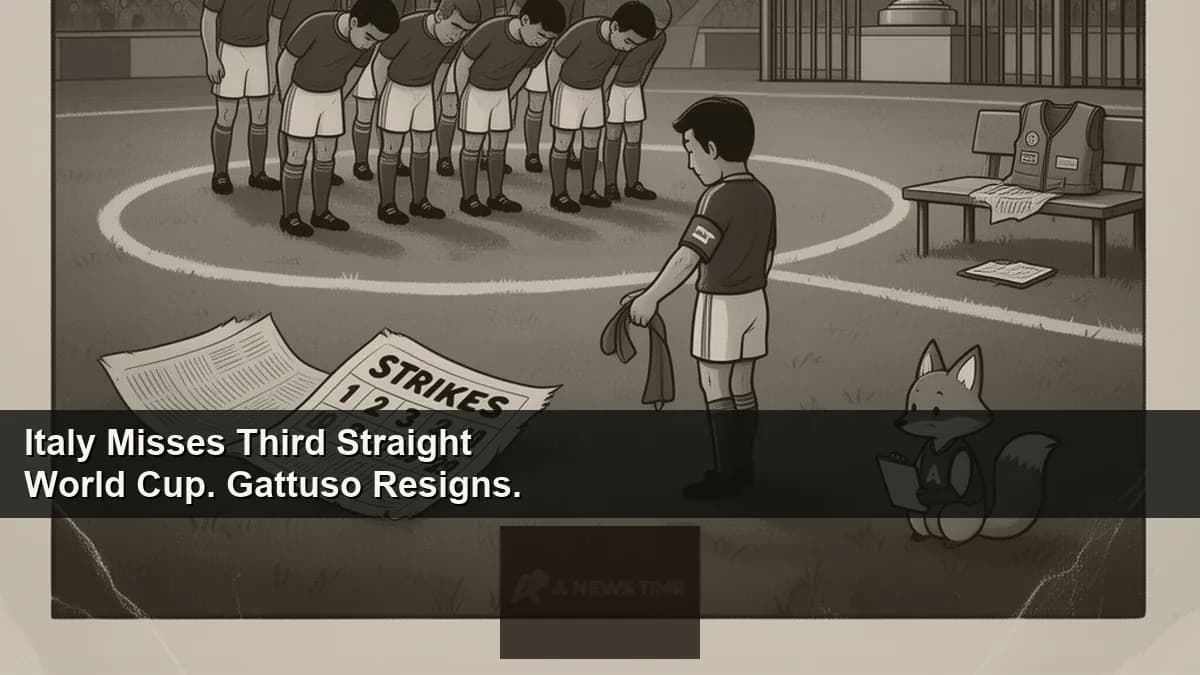
For the third consecutive FIFA World Cup, Italy will not be there. On , the Azzurri lost on penalties to Bosnia and Herzegovina in Zenica, the defeat confirmed by a 4-1 shootout scoreline that sent one of world football's most decorated programs home from qualifying for the third time running. The tournament, co-hosted by the United States, Canada, and Mexico, was supposed to be the one where Italy's rebuilding project delivered its first tangible result. Instead, Gennaro Gattuso walked away from the coaching position minutes after the final penalty missed, and the Federazione Italiana Giuoco Calcio is facing a crisis that is simultaneously sporting, financial, and institutional.
The sequence of failures now spans from 2018, when Italy missed the World Cup in Russia, through 2022, when Qatar proceeded without the four-time world champions, to this third absence in 2026. No other major European football nation has matched that run of consecutive non-qualifications in the modern era. Italy's total financial loss from missing three consecutive World Cups, in broadcast rights, commercial partnerships, national team merchandise, and UEFA coefficient erosion, is significant enough that FIGC has already convened an emergency session to assess the balance sheet implications.
How the Qualification Failed
The March 31 match in Zenica encapsulated everything that has gone wrong with this cycle. Italy took the lead but had center-back Alessandro Bastoni sent off before half-time, a red card that forced the team to defend for the majority of the match with ten men. Bosnia and Herzegovina equalized before full time. Extra time produced no further goals. The penalty shootout ended 4-1 to the hosts. Italy's route to the playoff had already been a signal that something was wrong before that night settled the matter: the Azzurri had been inconsistent through their qualifying group, dropping points in matches where their individual talent should have been sufficient, and reached the playoff as the lower-seeded team in their bracket.
The squad that played through qualification is not without talent. Several Italian players competing at the highest level of club football in Serie A and the major European leagues were available and participated. The issue is not an absence of quality at the individual level. It is a systemic problem in Italian football development that has been documented since at least 2018: a youth system that produces technically proficient players but not enough physical athletes capable of competing with the tactical and physical profile of the current European elite, combined with a Serie A domestic league that has become less competitive against the Premier League and La Liga and therefore provides fewer players with regular high-intensity competitive experience.
"The problem is not the players we have. The problem is the structure that creates them. Until Serie A is competitive at the level that pushes players every week, the national team will keep arriving at tournaments with technically capable squads that are not tournament-ready."
Antonio Cassano, former Italy international, via beIN Sports
Gattuso's Departure
Gennaro Gattuso resigned as Italy head coach immediately following the penalty shootout defeat, before the formal post-match press conference. The resignation was not unexpected. Gattuso had taken the position with a clear understanding that qualification for the 2026 World Cup was the minimum acceptable outcome, and the failure to deliver it made his continuation essentially untenable regardless of the shootout's randomness.
Gattuso's tenure as national team coach was a compressed period defined almost entirely by the qualification campaign. His club coaching record, built across stops at Napoli, Valencia, and subsequently in England and Serie A, showed a manager capable of producing defensively organized, high-energy football at club level. The translation of that approach to international football, where preparation time is minimal and squad cohesion is built across gaps of months rather than weeks, is a challenge that has undone more accomplished managers than Gattuso.
Italy's coaching position now opens under difficult circumstances. The incoming manager inherits a squad with an uncertain cycle position, a federation dealing with financial consequences of three straight absences, and a European Championship in 2027 that represents the next major competitive opportunity. The manager who takes the job knows that the margin for further failure is essentially zero.
The Conte Question
Antonio Conte has emerged as the primary candidate for the Italy position, according to reporting from multiple Italian football outlets and corroborated by World Soccer Talk. Conte's history with the national team is part of his appeal. He managed Italy from 2014 to 2016, unbeaten in 15 matches before leaving for club football. His coaching record since then includes league titles with Juventus, Chelsea, Inter Milan, and Tottenham. He is the highest-profile Italian manager available.
The complication with Conte is that his demands on the federazione are significant. He typically requires operational control over the squad structure, significant investment in support staff, and assurances about calendar management with club teams that the FIGC does not always have leverage to provide. His return would signal a genuine commitment from the federation to do what is necessary to rebuild. His refusal would confirm that the available candidates list is constrained.
Pep Guardiola has also entered the conversation, in what would represent a genuinely historic development in Italian football. The reporting on Guardiola's interest is less firm than the Conte reporting, and the structural challenges of a non-Italian manager taking charge of the Azzurri for the first time in the program's history carry both symbolic and practical weight. Guardiola is available following his departure from Manchester City. Whether Italian football's institutional culture would accept a Spanish manager, even one at Guardiola's level, remains an open question.
| Candidate | Italy History | Most Recent Club | Likelihood (Reports) |
|---|---|---|---|
| Antonio Conte | Italy manager 2014-16, unbeaten | Napoli (Serie A) | Frontrunner |
| Pep Guardiola | None as manager | Manchester City | Pursued but uncertain |
| Luciano Spalletti | Current UEFA Nations League cycle | Italy (predecessor) | Not reported as candidate |
FIGC: Financial and Structural Consequences
Missing three consecutive World Cups creates financial damage that compounds. The World Cup broadcast rights fees, commercial partnership payments, and national team merchandise revenues that flow to federations during tournament years represent a significant share of most European federations' budgets. Italy's FIGC has faced this loss three cycles running.
Beyond direct revenue, there is the competitive coefficient consequence. UEFA's access and seeding systems for European competitions weight historical performance, and Italy's coefficient has declined over the three-cycle absence period. This affects Serie A clubs indirectly through Champions League seeding, which affects the quality of opponents those clubs prepare against at the elite level, which ultimately cycles back to the quality of the competitive environment from which the national team draws players.
The FIGC electoral cycle runs in June 2026, meaning the new coach selection will happen against a backdrop of institutional change at the federation level as well. The incoming leadership will be inheriting both the coaching vacancy and a balance sheet that reflects three cycles of World Cup revenue absence.
Where Italian Football Goes From Here
The 2027 UEFA European Championship is the immediate competitive horizon. Italy won Euro 2020 in the summer of 2021 (played in 2021 due to the pandemic), which means the federation's last major tournament success is recent enough to remember what that looks and feels like. The talent for a competitive European Championship campaign exists in the current squad cycle. Whether the structural problems that produced three consecutive World Cup absences are addressed in the nine months between now and the start of Euro 2027 qualifying is the more important question than who coaches the next match.
The structural fixes require longer time horizons: investment in youth development, changes to the Serie A calendar and competitive structure, and a cultural shift in how Italian clubs develop and deploy domestic talent rather than importing from abroad. None of those changes happen before June. Some of them take a decade. Italy's football crisis is not going to be resolved by a coaching appointment, however high-profile. It is going to be resolved, if it is resolved, by a generation of changes that are already overdue.