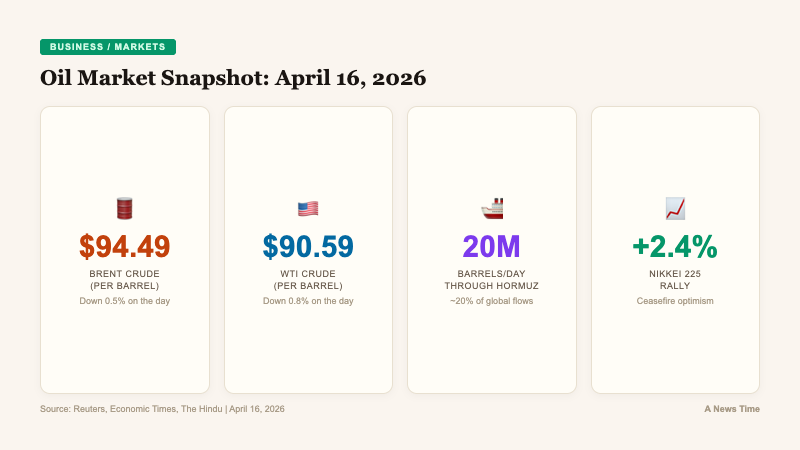
Crude oil prices edged lower in early trading as diplomatic signals from both Washington and Tehran raised cautious hopes for an end to the seven-week Iran war. Brent crude futures fell 44 cents, or 0.5%, to $94.49 per barrel, while U.S. West Texas Intermediate declined 70 cents, or 0.8%, to $90.59 per barrel. The moves reflected growing market confidence that the two-week ceasefire between the United States and Iran could be extended, potentially easing the largest disruption to global oil and gas supplies in modern history.
Strait of Hormuz Transit Reports Lift Market Sentiment
The key development driving price action was a report, cited by Reuters, that Iran may permit ships to move freely along the Omani side of the Strait of Hormuz if a deal is struck to avoid further escalation. The strait is the world's most critical oil chokepoint, handling approximately 20 million barrels per day, roughly 20% of global oil and LNG flows.
Since the war began on , Iran has restricted traffic through the strait, triggering the single largest disruption to global energy supply chains on record. The restrictions have caused cooking fuel shortages in Southeast Asia, forced at least one refinery to shut down, and prompted emergency closures across multiple countries dependent on Middle Eastern energy imports.
The White House said on that it was hopeful of reaching an agreement to end the conflict with Iran but warned that economic pressure on Tehran would intensify if it does not cooperate. U.S. Treasury Secretary Scott Bessent also warned that Washington was preparing to apply secondary sanctions on those doing business with Iran.
Pakistan Mediation Efforts Continue in Tehran
U.S. and Iranian officials are considering returning to Pakistan for another round of talks as early as this weekend, after discussions ended without progress on . Pakistan's army chief, acting as mediator, arrived in Tehran on in an effort to prevent further escalation and maintain the fragile ceasefire framework.
The diplomatic activity represents the most sustained engagement between the two sides since the conflict began. Previous rounds of talks in Islamabad produced the current ceasefire but failed to resolve the underlying territorial and nuclear disputes that triggered the conflict. Market participants are watching for any concrete agreement on Hormuz transit rights, which would immediately relieve the most acute supply pressure.
Analyst Forecasts Span a $70 Range
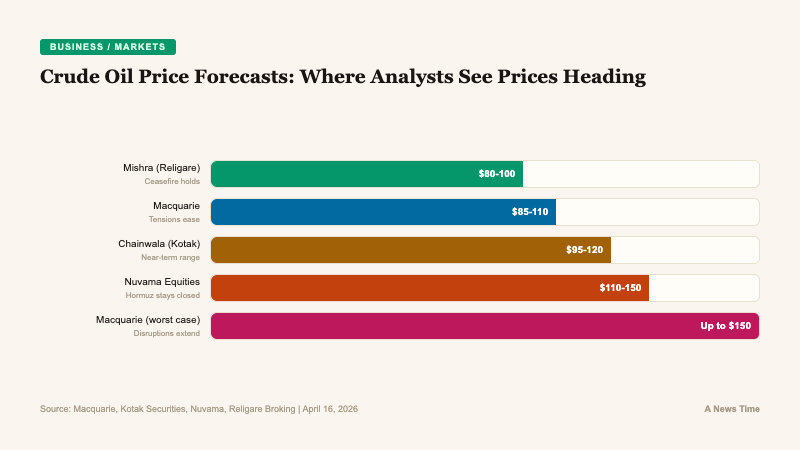
The range of analyst price forecasts underscores the extraordinary uncertainty hanging over energy markets. The gap between bull and bear cases reflects fundamentally different assumptions about the war's duration and the speed at which normal shipping can resume.
| Analyst / Firm | Scenario | Price Forecast |
|---|---|---|
| Macquarie | Tensions ease, gradual normalization | $85-$90 floor, $110 target |
| Macquarie | Disruptions extend through April | Brent could reach $150 |
| Kayanat Chainwala, Kotak Securities | Near-term range | $120, up to $150 if conflict continues |
| Nuvama Institutional Equities | Continued Hormuz closure | $110-$150 range |
| Ajit Mishra, Religare Broking | Current ceasefire holds | $80-$85 downside, $95-$100 upside |
| Ajit Mishra, Religare Broking | Return to pre-war levels ($70-$75) | Several months away |
"The current ceasefire is temporary and a return to pre-war levels of $70 to $75 could take several months. In the near term, crude is likely to remain within a range of $80 to $85 on the downside and $95 to $100 on the upside."Ajit Mishra, Senior Vice President, Religare Broking
Asian Markets Rally on Ceasefire Extension Hopes
The cautious optimism in oil markets extended to equities across Asia. Tokyo's Nikkei 225 jumped 2.4% to 59,549.59, while South Korea's Kospi climbed 2.0% to 6,215.38. The gains followed a record session on Wall Street, where major indices surged on the same ceasefire-related optimism.
The correlation between oil price stability and equity market performance has been unusually tight since the war began. When oil spikes, equity markets sell off on growth fears. When diplomatic progress lowers oil, risk appetite returns. That dynamic means the next round of talks in Pakistan could move trillions of dollars in global market capitalization depending on the outcome.
The broader macro picture remains complicated. Goldman Sachs has raised recession odds for multiple Western economies, and the IMF's spring meeting this week has been dominated by discussions about the war's economic toll. Even optimistic scenarios assume crude prices will remain well above pre-war levels for months, which means the inflation impulse is already baked into the global economy regardless of diplomatic outcomes.
Supply Chain Damage Already Extends Beyond Oil
The Hormuz disruption has affected far more than crude oil. LNG cargoes that transit the strait supply a significant portion of Asia's natural gas needs, and the weeks-long freeze has caused cascading effects across energy-dependent industries:
- Southeast Asian cooking fuel shortages: Countries dependent on LNG imports have experienced rationing and emergency measures
- Refinery shutdowns: At least one major refinery has been forced to close due to feedstock unavailability
- Jet fuel concerns: Both civil and military aviation face supply constraints, with European officials flagging jet fuel as a particular concern
- Fertilizer production: Natural gas-based fertilizer plants in multiple countries have reduced output, threatening agricultural supply chains
- Petrochemical feedstocks: The disruption to naphtha and ethane flows has affected plastics and chemicals production globally
Even a partial reopening of the strait, such as the reported Omani-side transit option, would not immediately resolve all supply chain bottlenecks. Shipping companies would need time to rebuild confidence in route safety, insurance markets would need to reassess risk premiums, and physical inventories drawn down during the disruption would need to be rebuilt.
US Blockade Adds Complexity to the Diplomacy
Complicating the diplomatic picture is the U.S. decision to enforce a naval blockade against the few ships Iran had allowed to navigate the strait. The blockade, announced last week, has drawn criticism from allies and trading partners who had negotiated independent transit arrangements with Tehran.
Saudi Arabia has reportedly pressed Washington to abandon the blockade out of concern that Iran could retaliate by targeting the Bab el-Mandeb strait at the entrance to the Red Sea, a chokepoint critical for Saudi crude exports. The blockade has also strained relations with Asian allies, particularly Japan, South Korea, and India, which depend heavily on Middle Eastern energy imports.
The market reaction to the blockade announcement last week drove the Dow into correction territory, highlighting how sensitive global markets remain to any escalation in the conflict. The partial retreat in oil prices this week reflects optimism that diplomacy may be gaining ground over confrontation.
"Even if tensions ease, oil prices are likely to stay supported in the $85 to $90 range, with a gradual move toward $110 as flows through the Strait of Hormuz normalise."Macquarie Research, Commodities Strategy Note
What to Watch in the Days Ahead
The oil market's direction over the next week hinges on three specific developments:
- Pakistan talks: Whether US and Iranian officials return to Islamabad this weekend and the substance of any resulting agreement
- Hormuz transit: Any concrete steps toward reopening the strait, even partially, would immediately lower supply risk premiums
- US secondary sanctions: Treasury Secretary Bessent's threat of secondary sanctions on Iran's trading partners could offset diplomatic gains by further restricting global supply flows
The $95 level has become a psychological threshold. Crude has oscillated around it for the past week, unable to break decisively higher as ceasefire hopes cap upside or fall significantly as supply risks remain real. A sustained move below $90 would signal that markets believe a diplomatic resolution is likely. A push above $100 would indicate the conflict is escalating. Until one of those thresholds breaks, oil markets remain in a holding pattern dictated by headlines from Pakistan and Tehran.