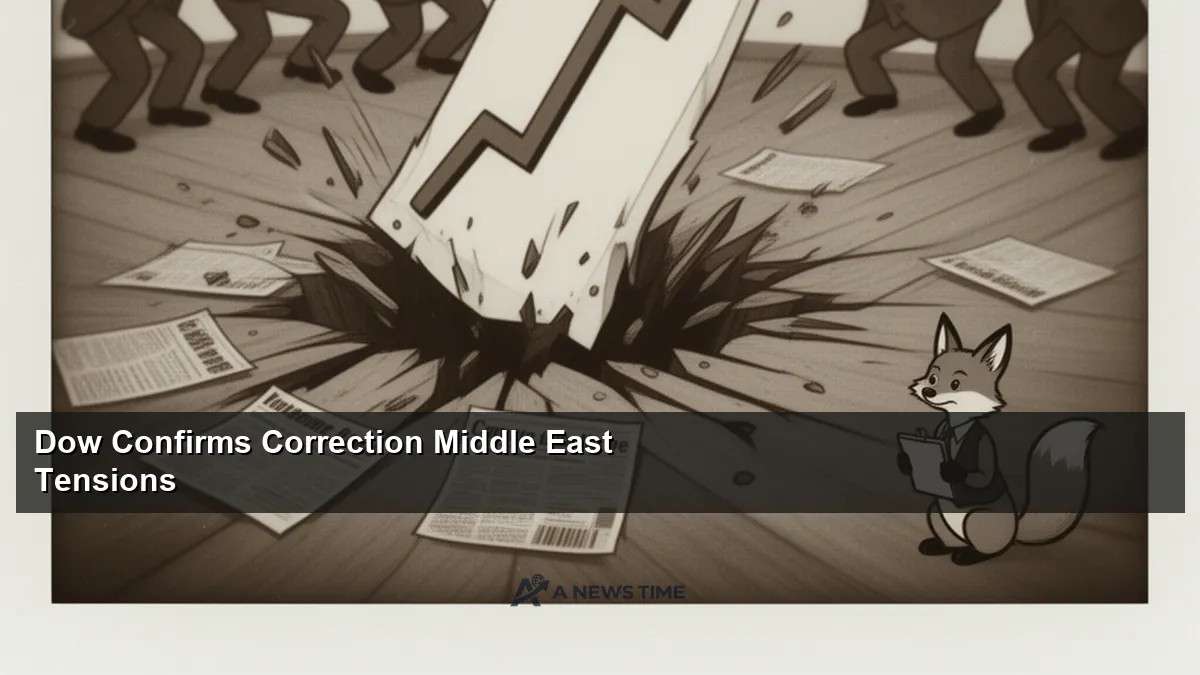
The Dow Jones Industrial Average officially entered correction territory on Friday, closing at 37,890, a decline of 10.4% from its December 2025 high of 42,297. It was not alone. The S&P 500 settled at 4,687, down 11.3% from its January peak, while the Nasdaq Composite finished at 14,412, a 14.1% decline that puts it within striking distance of a bear market. All three major U.S. indexes closed at their lowest levels in more than seven months, a collective retreat that reflects not a single bad earnings report or one disappointing data point, but a slow, grinding reassessment of what the U.S.-Iran military conflict means for the American economy.
The word "correction" has a clinical sound to it, as if the market were simply adjusting a minor miscalculation. In practice, a correction of this magnitude represents a transfer of wealth, from the investors who bought stocks at higher prices to the investors who sold before the decline, and from the retirement accounts of ordinary Americans to the abstract column of unrealized losses. The S&P 500 has shed approximately $4.2 trillion in market capitalization over five weeks. That is not an adjustment. That is a repricing of risk on a national scale.
How the Dow Got Here
The Dow's path into correction territory was not a sudden plunge but a series of steps, each driven by a specific catalyst that compounded the one before it. The first significant leg down occurred in late February, when U.S. naval forces engaged Iranian fast-attack craft near the Strait of Hormuz. That incident, which resulted in the sinking of three Iranian vessels and damage to one U.S. destroyer, transformed the conflict from an air campaign against nuclear facilities into a potential naval confrontation in the world's most important oil shipping lane. The Dow fell 680 points that day.
The second leg came in early March, when the OPEC emergency meeting in Vienna failed to produce an agreement on increasing production to offset supply disruptions. Saudi Arabia, the cartel's swing producer, indicated it would maintain current output levels rather than flooding the market with additional barrels. The decision was widely interpreted as Riyadh's unwillingness to subsidize American strategic objectives by depressing the oil price that funds its own government budget. Brent crude jumped to $108 per barrel the following day, and the Dow lost another 520 points.
The third and most recent leg, which pushed the index into correction territory this week, was driven by the collapse of diplomatic back-channels between Washington and Tehran. Reuters reported that Swiss-mediated communications, which had generated optimism in the first half of March, were suspended after Iran rejected what it described as unacceptable preconditions. The Dow fell more than 1,100 points over Thursday and Friday combined.
What Correction Territory Actually Means
A market correction is defined as a decline of 10% or more from a recent peak. The definition is somewhat arbitrary (there is nothing magical about the number 10), but it serves as a widely recognized threshold that triggers specific behaviors among institutional investors. Many pension funds, endowments, and insurance companies have risk management frameworks that require portfolio adjustments when major indexes enter correction territory. Some reduce equity allocations automatically. Others convene investment committee meetings to reassess their strategic positioning.
The practical consequence is that corrections can become self-reinforcing, at least in the short term. When large institutional investors are compelled to sell by their own risk management rules, the selling creates additional downward pressure, which can push the market further into correction territory, which triggers additional selling from other institutions with slightly different threshold levels. This mechanical dynamic explains why market declines often accelerate once key technical levels are breached.
Historical data provides some context for what typically follows. Since 1950, the S&P 500 has experienced 38 corrections of 10% or more, according to data compiled by Yardeni Research. Of those 38, approximately one-third evolved into bear markets (declines of 20% or more). The remaining two-thirds reversed before reaching bear market territory, with the average recovery period from correction trough to new high being approximately four months. The critical variable that determines which outcome prevails is whether the correction was caused by a temporary shock or by a fundamental deterioration in economic conditions.
The War-Gripped Market
What distinguishes this correction from the garden-variety pullbacks that the market experiences every 18 months or so is the nature of the catalyst. Corrections driven by valuation concerns or monetary policy shifts (the Fed raising rates more aggressively than expected, for example) tend to be orderly, with selling concentrated in the most overvalued sectors. This correction is being driven by a military conflict whose duration, escalation risk, and economic consequences are genuinely unknowable.
The uncertainty premium is visible across multiple asset classes, not just equities. Gold has risen to $2,340 per ounce, up 12% since the conflict began, as investors seek haven assets. The U.S. dollar index has strengthened modestly, reflecting both safe-haven demand and expectations that higher oil prices will keep the Federal Reserve from cutting interest rates anytime soon. Treasury volatility, measured by the MOVE index, has risen to levels not seen since the Silicon Valley Bank collapse in March 2023.
Credit markets have also begun to show stress. The spread between investment-grade corporate bonds and Treasuries has widened by 35 basis points since February, while high-yield (sometimes called "junk") bond spreads have widened by 80 basis points. Those numbers may sound small in absolute terms, but they represent meaningful increases in borrowing costs for companies that need to refinance debt or fund operations. Airlines, shipping companies, and chemical manufacturers, all of which are directly exposed to energy costs, have seen the most pronounced spread widening.
Jobs Data Looms as the Next Catalyst
The market's attention now shifts to the March employment report, due next Friday from the BLS. The jobs report has always been one of the most market-moving data releases on the economic calendar, but in the current environment it carries additional weight because it will provide the first significant evidence of whether the conflict-driven uncertainty is translating into actual hiring decisions.
Consensus estimates call for 180,000 new nonfarm payroll additions, down from 235,000 in February and below the trailing 12-month average of 210,000. The unemployment rate is expected to hold at 3.9%, and average hourly earnings growth is forecast at 4.1% year over year. Any of those numbers could surprise in either direction, and the market's reaction will depend not just on the headline figure but on the composition of job gains (which sectors are hiring, which are not) and the labor force participation rate (whether discouraged workers are dropping out of the labor market).
"The labor market has been the last pillar of strength in the bull case for the U.S. economy. If that pillar starts to crack, the market will need to price in a much more negative scenario."
Ellen Zentner, Chief U.S. Economist, Morgan Stanley
A weak jobs number would validate the recession concerns that have been building since Goldman Sachs raised its recession probability estimate to 30% two weeks ago. A strong number would provide a counternarrative, suggesting that the real economy has not yet absorbed the full impact of the conflict. But even a strong number carries a risk: if the labor market remains tight, the Fed has less reason to cut rates, which means the monetary policy cavalry that equity investors have been hoping for is unlikely to arrive.
Sector Rotation Under Stress
One of the more instructive aspects of the current selloff is the pattern of sector rotation it has produced. In a healthy, growing market, investors typically favor cyclical sectors (technology, consumer discretionary, industrials) over defensive ones (utilities, healthcare, consumer staples). When the market enters a stress regime, that preference inverts.
The data from the past five weeks confirms the inversion is well underway. The utilities sector has outperformed the S&P 500 by 8.3 percentage points over the period, its best relative performance since the fourth quarter of 2022. Healthcare has outperformed by 5.1 percentage points, boosted by the perception that pharmaceutical and insurance companies generate steady revenue regardless of geopolitical conditions. Consumer staples (companies like Procter & Gamble, Coca-Cola, and Walmart) have outperformed by 4.7 percentage points.
On the losing side, technology has underperformed by 2.9 percentage points, consumer discretionary by 4.5 percentage points, and industrials by 3.8 percentage points. The energy sector is an outlier: it has outperformed by 14.2 percentage points, its widest margin since the first quarter of 2022, when Russia's invasion of Ukraine sent oil prices soaring. Energy stocks are effectively a hedge against the very risk that is causing the rest of the market to decline.
Small-cap stocks, represented by the Russell 2000 index, have performed even worse than large caps, falling 15.8% from their recent high. Small companies tend to be more domestically focused, more leveraged, and more sensitive to economic slowdowns than their large-cap peers. The Russell 2000 is now in bear market territory by most definitions, a warning signal that the economic impact of the conflict may be hitting Main Street harder than Wall Street's headline indexes suggest.
International Markets Are Not Immune
The selloff has not been confined to U.S. markets. European equities, as measured by the Euro Stoxx 50, have fallen 9.2% since the conflict began, with German industrials and French luxury goods makers bearing the brunt. The FTSE 100 in London has performed relatively better (down 6.8%) because of its heavy weighting toward energy and mining companies, which benefit from higher commodity prices. Asian markets have been mixed: Japan's Nikkei 225 has fallen 8.4%, while China's CSI 300 has been roughly flat, reflecting China's status as a net importer of discounted Iranian crude oil under sanctions-busting arrangements that the U.S. has been unable to fully enforce.
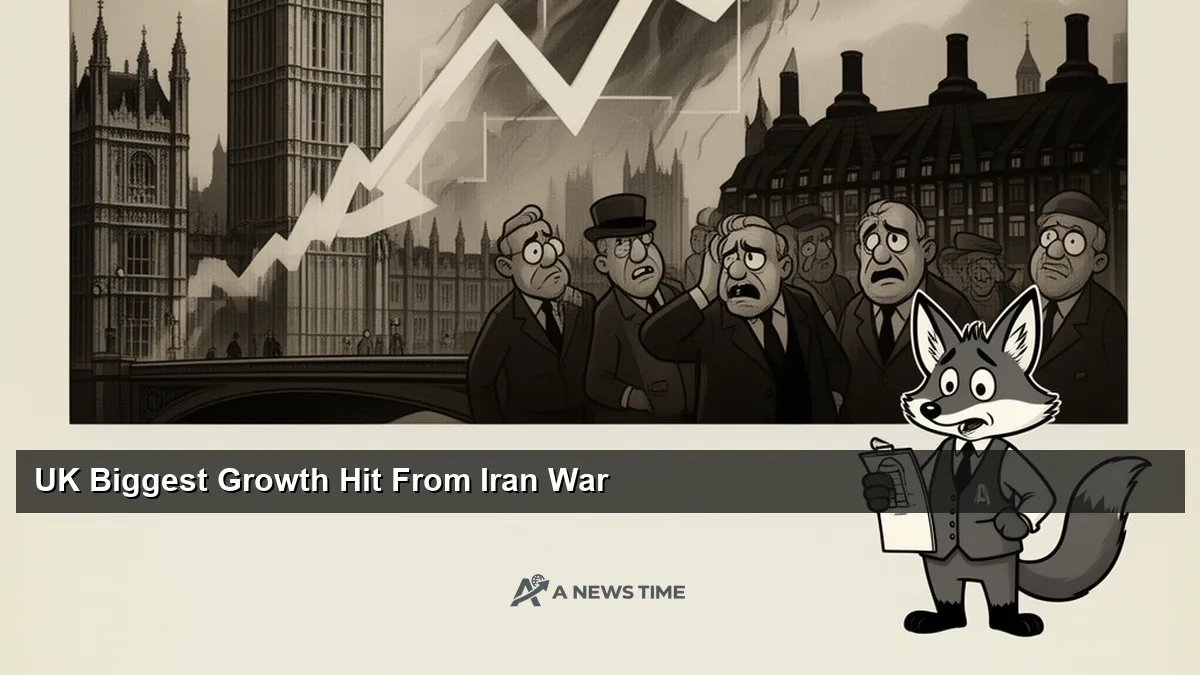
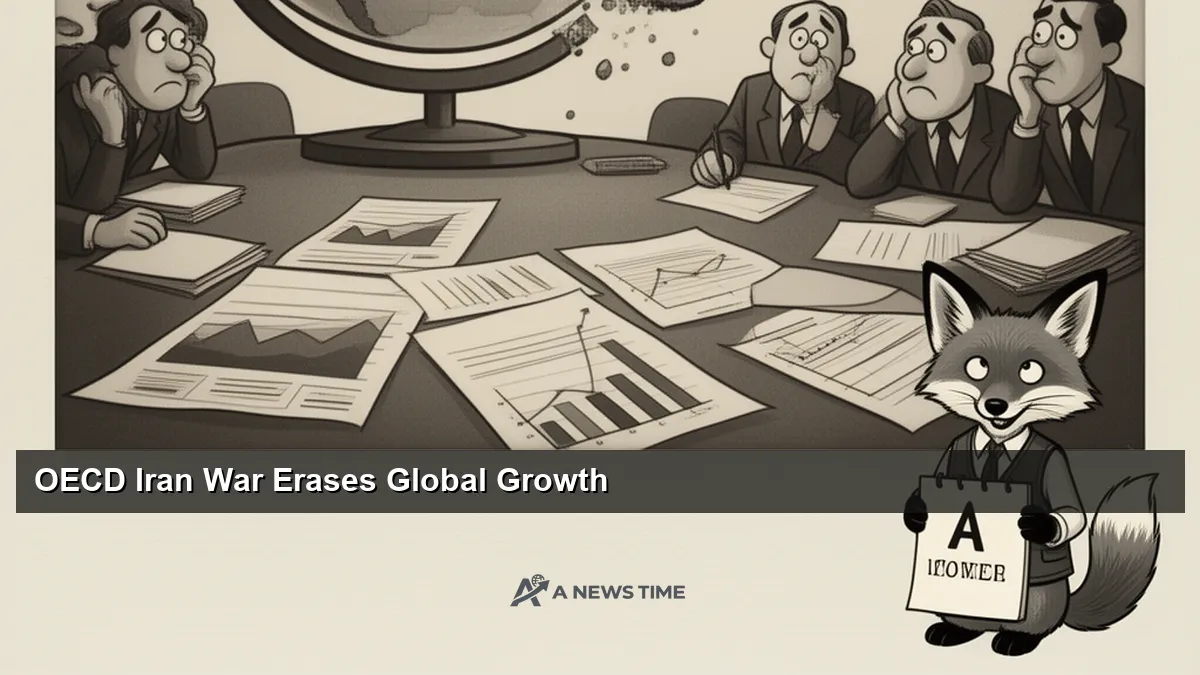
The OECD downgraded its global growth forecast this week, citing the Iran conflict as the primary reason. The organization said the war had erased the growth upgrade it issued in January, with the United Kingdom forecast to suffer the largest impact among major economies due to its dependence on imported energy and its relatively weak fiscal position.
What Smart Money Is Doing
Hedge fund positioning data, reported with a lag through the CFTC Commitments of Traders report, shows that leveraged funds have reduced their net long exposure to S&P 500 futures by 42% since mid-February. That is a significant de-risking move, consistent with the hedge fund industry's traditional approach to geopolitical uncertainty: reduce exposure, preserve capital, and wait for clarity before re-engaging.
Meanwhile, corporate insiders (executives and directors who buy and sell shares of their own companies) have been net buyers over the past two weeks, according to data from the Washington Service. The buy-to-sell ratio among corporate insiders reached 1.8 in the most recent reporting period, its highest level since October 2023. Insider buying during market corrections has historically been a modestly positive signal for future returns, on the theory that the people who know a company's business best are more likely to buy when they believe the stock price understates the company's intrinsic value.
Retail investors, tracked through order flow data from brokerages, have been net sellers of individual stocks but net buyers of broad market ETFs, particularly the SPDR S&P 500 ETF (ticker: SPY) and the Invesco QQQ Trust. This pattern suggests that individual investors are trimming their single-stock positions (perhaps selling the names that have fallen most) while maintaining or adding to their diversified index exposure. It is a reasonably disciplined response to a difficult environment, and it contrasts with the panic selling that characterized the COVID crash of March 2020.
The Path Forward
Predicting the near-term direction of a war-gripped market is an exercise in humility. The range of plausible outcomes, from a diplomatic breakthrough that sends stocks soaring to a military escalation that pushes them into a bear market, is exceptionally wide. What can be said with more confidence is that the factors that caused the correction are not going to resolve themselves quickly. The Iran conflict shows no signs of imminent resolution. Oil prices remain elevated and vulnerable to further supply disruptions. The Federal Reserve is constrained by competing mandates. And corporate earnings season, which begins in two weeks, will force companies to quantify, for the first time, the financial impact of operating in a wartime economic environment.
For long-term investors, the historical record offers a measure of reassurance. Corrections, even those caused by geopolitical crises, have been buying opportunities more often than they have been precursors to deeper declines. But that record comes with an important caveat: the entry point matters. Buying after a 10% decline offers a better risk-reward profile than buying at the peak, but it does not guarantee a profit over any specific time horizon. The market can always fall further before it recovers.
The Dow's descent into correction territory is a statement from the collective intelligence of millions of investors. That statement is not complicated: the risks have increased, the outlook has darkened, and the price of owning American equities needs to be lower to compensate. Whether the market has already priced in the worst, or whether it has only begun to, depends on events that no analyst, no algorithm, and no amount of historical data can reliably predict. The next data point that matters arrives on Friday, when the jobs report will reveal whether the war's economic shadow has reached the American worker.